
Best shading solutions 2026: top picks for UK homes
- Andrew Crookes
- 7 hours ago
- 8 min read
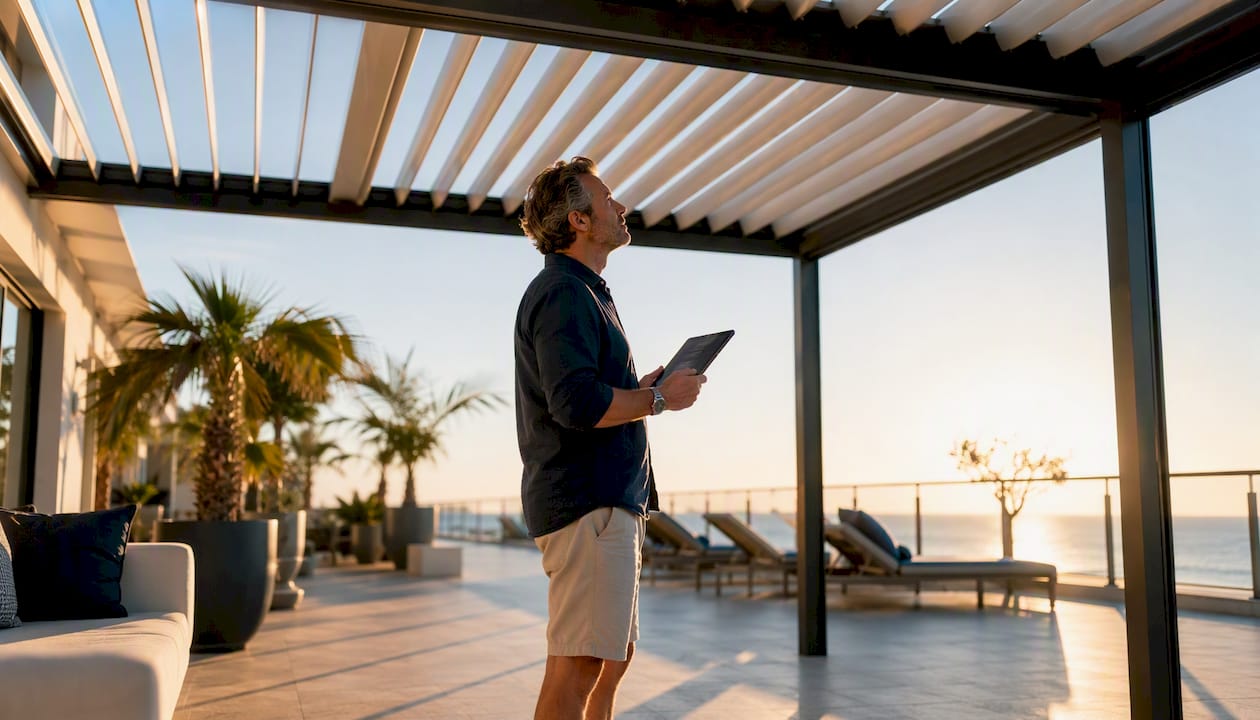
For most UK homeowners and businesses, a bioclimatic pergola with motorised aluminium louvres is the standout choice in 2026. It handles rain, wind, and sun without requiring you to dismantle anything or drag out a cover. Two strong alternatives exist for different budgets and needs:
Top pick: Bioclimatic louvred pergola (motorised aluminium, year-round use, smart controls)
Best flexible option: Retractable fabric awning (lower cost, suits patios and café frontages)
Best temporary/budget option: Shade sail or freestanding parasol system (minimal installation, easy to move)
Infinityawnings has been designing, supplying, and installing outdoor shading across Yorkshire and the surrounding counties for over 15 years. If you want a recommendation tailored to your property, a free site survey is the fastest way to get there.
Table of Contents
What are the main shading solutions available in the UK?
Understanding the categories makes the decision much easier. Each type suits a different combination of budget, use case, and exposure.
Bioclimatic louvred pergola: Motorised aluminium blades that rotate to control light, airflow, and rain run-off. Best for: year-round residential and commercial use, premium budgets.
Retractable fabric awning: A fabric canopy that extends and retracts, manually or electrically. Best for: patios, restaurant terraces, residential gardens, mid-range budgets.
Hard-top pergola or veranda: Fixed polycarbonate or aluminium roof, maximum weather protection. Best for: year-round use, commercial settings, those wanting a near-permanent structure.
Shade sails and parasols: Tensioned fabric panels or freestanding umbrellas. Best for: budget buyers, temporary or seasonal shading, flexible layouts.
Side screens and canopies: Vertical fabric or glass panels that add wind and privacy protection to any of the above.
Exploring the full range of shading types helps you match the right structure to your space before you speak to an installer.
Solution type | Best for | Year-round / waterproof | Solar control | Motorisation | Price band | Customisability | Durability / warranty |
Bioclimatic louvred pergola | Residential & commercial, year-round | Yes, with drainage | Louvres (precise) | Standard | Premium | High (LEDs, heaters, screens) | Excellent / manufacturer-backed |
Retractable fabric awning | Residential patios, café terraces | Partial (retract in heavy rain) | Fabric (moderate) | Optional | Budget–mid | Good (fabric, colour) | Good / brand warranty |
Hard-top pergola / veranda | Year-round, commercial | Yes | Fixed (low) | Optional | Mid–premium | Moderate | Excellent / manufacturer-backed |
Shade sail / parasol | Seasonal, temporary | No | Fabric (moderate) | No | Budget | Low | Moderate / limited |
Side screens / canopies | Add-on wind/privacy protection | Partial | Low | Optional | Budget–mid | Moderate | Good |
Why bioclimatic pergolas lead the UK market in 2026
The shift is straightforward: UK weather does not cooperate with passive structures. A fixed canopy blocks sun but traps heat; a fabric awning must retract the moment it rains. Motorised aluminium louvres solve both problems by rotating to any angle, letting you dial in exactly how much light and airflow you want, then closing flat to shed rain.
The engineering behind them matters. Blades typically overlap when closed, channelling water into perimeter gutters and away from the structure. Most systems also integrate power outlets, LED strips, and smart-home automation, so the pergola becomes a functional outdoor room rather than just a roof.
Adjustable shading reduces solar gain on hot days and supports passive cooling, which cuts the load on internal air conditioning. In winter, closing the louvres traps warmth from patio heaters underneath. That year-round flexibility is what separates bioclimatic systems from every other option on the market.
For UK weather resilience, look for systems with integrated drainage, optional perimeter glazing, and side screens rated for wind loads. Powder-coated aluminium frames will not rust, warp, or rot, which matters in a climate that delivers rain in every month of the year.
Pro Tip: Add wind, rain, and sun sensors to your bioclimatic pergola. They close the louvres automatically in a sudden downpour and reopen them once conditions improve, protecting the motor and the structure without any manual input.
How to choose the right shading solution for your property
Work through these criteria before you call an installer. The answers narrow the field quickly.
Decision checklist:
Primary use: Is this for year-round entertaining, a semi-permanent outdoor room, or seasonal shade only?
Footprint and headroom: Measure the area and check clearance heights, especially for wall-mounted awnings.
Site exposure: A wind-exposed roof terrace needs a different spec than a sheltered garden corner.
Planning and permitted development: Most domestic shading structures fall within permitted development, but larger or taller structures, listed buildings, and properties in conservation areas may need consent. Check with your local authority or ask your installer.
Integration: Do you need electrical supply for motors, LEDs, or heaters? Is drainage already in place?
Materials and sustainability: Aluminium is the low-maintenance choice for UK conditions. For garden rooms and ancillary structures, insulation and material choices affect both comfort and environmental impact.
Warranty and service: Manufacturer-backed warranties and a local installer who offers ongoing maintenance are worth paying for.
Questions to ask your installer:
Will you carry out a full site survey before quoting?
How will the structure be fixed, and what are the load-bearing implications?
Where does drainage go, and how is it integrated?
What electrical work is included, and who certifies it?
What warranty covers the frame, the motor, and the fabric or blades separately?
What is the lead time from order to installation?
Can I see material samples and a written specification before I sign?
Typical cost bands (installed, UK):
Budget: Shade sails, manual fabric awnings, freestanding parasols
Mid-range: Motorised retractable awnings, hard-top pergolas, polycarbonate verandas
Premium: Motorised bioclimatic louvred pergolas with LEDs, heaters, and side screens
Installation timeline: site survey (1–2 days to receive quote) → design and specification (1–2 weeks) → order and manufacture (4–8 weeks depending on customisation) → installation (1–3 days on site) → commissioning and handover (same day).
Red flags: any supplier who quotes without visiting the site, offers vague warranty terms, pushes upgrades without a written spec, or cannot produce a signed contract before work begins.
For a structured approach, the outdoor shading checklist for UK patios covers the key decision points in detail.
What does installation and maintenance actually involve?
Installation overview
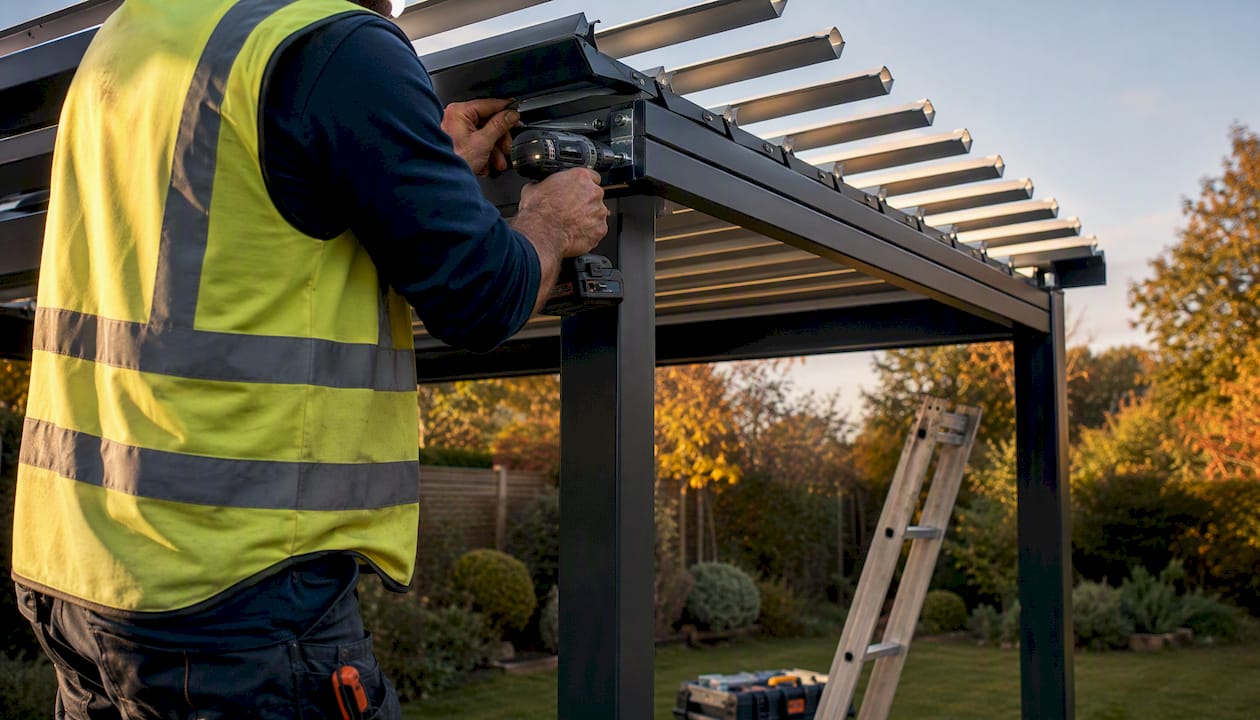
A professional installer begins with a site survey: measuring the space, assessing fixing points, checking drainage routes, and confirming electrical supply. For wall-mounted structures, the fixing method depends on the wall construction, so this step is not optional. Ground-mounted pergolas require base plates or concrete footings sized for the expected wind load.
On installation day, the frame goes up first, followed by the roof system, then electrical connections for motors, LEDs, and sensors. A reputable installer will commission every motorised component before leaving and walk you through the controls.
Professional installation preserves manufacturer warranties and ensures the structure is anchored correctly for local wind conditions. Many warranties are void if the structure is self-installed.
Maintenance schedule
Annual maintenance keeps a shading structure performing for 15–20 years. Check fabric or blade surfaces each spring for debris and surface staining; most manufacturers recommend a mild soap solution and a soft brush. Lubricate moving parts, including louvre pivot points and awning arms, once a year. Clear perimeter gutters after autumn leaf fall. Have the motor and control system checked every two to three years by a qualified engineer.
For retrofit installations on older properties, the step-by-step retrofit guide covers compatibility considerations in detail.
Planning and permitted development
Most domestic awnings and pergolas fall within permitted development rights in England, meaning no planning application is needed. Exceptions include listed buildings, conservation areas, and structures that exceed height limits or cover more than half the original garden. Scotland, Wales, and Northern Ireland have their own rules. This is general guidance only: confirm your specific situation with your local planning authority or a certified installer before ordering.
Pro Tip: Ask your installer for proof of public liability insurance, a written maintenance plan, and confirmation that the manufacturer’s warranty is registered in your name. These three documents protect you if anything goes wrong after handover.
How Infinityawnings delivers on the 2026 brief
A typical Infinityawnings project starts with a free site survey at the property. The surveyor measures the space, checks fixing points and drainage, discusses fabric or blade options with material samples in hand, and produces a tailored quote with a projected timeline and full warranty details. For a café owner in Yorkshire, that recently meant a motorised bioclimatic pergola with integrated LEDs and side screens, turning a previously unusable rear terrace into a year-round dining space. For a homeowner in Lincolnshire, it was a Weinor retractable awning over a south-facing patio, with a sun sensor that retracts automatically at high UV levels.
Infinityawnings supplies and installs products from Weinor, Llaza, Selt, Tarasola, and Morvelle, all of which carry manufacturer-backed warranties. With over 15 years of experience across residential and commercial projects, the team covers Yorkshire, Derbyshire, Nottinghamshire, and Lincolnshire.
Key takeaways
Bioclimatic louvred pergolas are the leading outdoor shading choice for UK homeowners and businesses in 2026, offering year-round comfort, smart control, and durability that fabric-only systems cannot match.
Point | Details |
Top solution for most UK properties | Motorised bioclimatic pergolas offer year-round use, precise solar control, and smart-home integration. |
Best alternative for tighter budgets | Motorised retractable awnings suit patios and commercial terraces at a lower installed cost. |
Key questions to ask any installer | Confirm site survey scope, drainage plan, electrical certification, and separate warranties for frame, motor, and fabric. |
Warranties and insurance matter | Ask for manufacturer warranty registration in your name and proof of the installer’s public liability insurance. |
Infinityawnings covers Yorkshire and surrounding counties | Free site surveys available; brands supplied include Weinor, Llaza, Selt, Tarasola, and Morvelle. |
Why the cheapest option usually costs more in the long run
The budget case for a shade sail or a basic fabric awning is real: lower upfront cost, no planning considerations, easy to move. But the trade-off shows up within two or three seasons. Fabric degrades faster in UV-heavy summers and wet winters. Motors on unbranded awnings often fail outside warranty. A structure that needs replacing every five years costs more over a decade than a powder-coated aluminium pergola that runs for twenty.
The smarter question is not “what is the cheapest shading option?” but “what is the lowest cost per year of usable outdoor space?” On that measure, a well-specified bioclimatic pergola from a brand like Weinor or Tarasola, installed by a local team who will still be around for maintenance, wins consistently. The premium is real. So is the return.
Infinityawnings: design, supply, and installation across Yorkshire
Fifteen years of shading projects across Yorkshire, Derbyshire, Nottinghamshire, and Lincolnshire means Infinityawnings has seen every combination of exposure, wall construction, and planning constraint the region produces. The service covers the full project: design, supply, installation, repair, and maintenance of retractable awnings, bioclimatic pergolas, verandas, and canopies, with customisation options including motorisation, LED lighting, patio heaters, and side screens.
Every installation is covered by manufacturer-backed warranties from brands including Weinor, Llaza, Selt, Tarasola, and Morvelle, and carried out by insured, experienced fitters. The free site survey is the starting point: no obligation, no guesswork, just a clear quote with a timeline and a written specification. Request your free pergola survey and find out which solution fits your property and budget.
Useful sources and further reading
The best insulation types for UK garden buildings — material and sustainability guidance for garden structures
Benefits of outdoor shading: comfort and energy savings — energy efficiency and solar gain reduction for UK homes
Top tips for choosing outdoor shading for UK spaces — practical buyer guidance from Infinityawnings
Recommended