
Specify 316 stainless and EN 13561 for Coastal awnings UK
- Andrew Crookes

- 1 day ago
- 9 min read
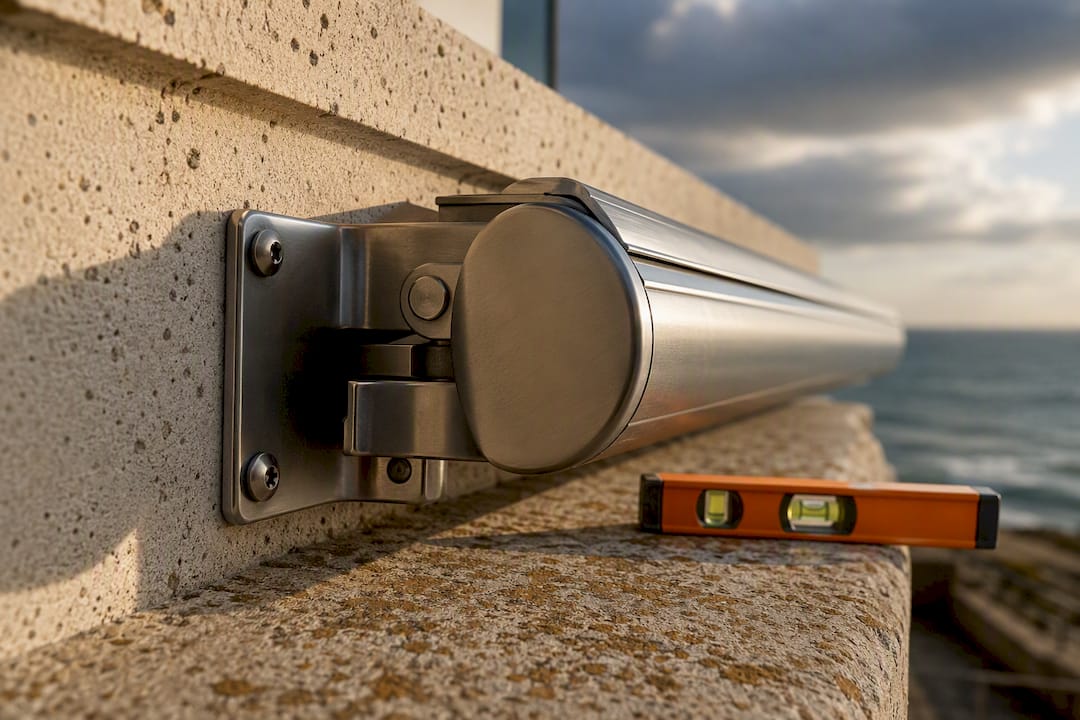
A genuine coastal-grade awning combines a solution-dyed or PVC-coated fabric, 316 stainless or powder-coated fixings, and a wind-rated frame with automatic stowage, delivering the distinctive coastal look your shore house deserves Coastal look for your shore house. Anything less will corrode, sag, or fail within a few seasons on an exposed UK coastline. The right move is straightforward: get a specialist site survey before you commit to a specification, since it’s the only way to match the product to your actual wind exposure and save money over the product’s working life.
TL;DR:
Coastal-grade awnings need solution-dyed fabric, marine-grade stainless fixings, and a wind-rated frame to withstand salt, UV, and wind exposure.
Proper site surveys are essential to match awning wind ratings with local gusts, avoiding over- or under-specification that risks damage or failure.
Installation by qualified specialists is strongly advised to ensure correct fixing, calibration, warranty coverage, and safety, especially on exposed sites.
Regular maintenance, including rinsing salt deposits and checking fixings, prolongs lifespan and preserves warranty validity in coastal conditions.
Warranty coverage often excludes corrosion and wind damage if maintenance is neglected, making professional installation and proper calibration crucial.
Table of Contents
What makes an awning coastal-grade for UK properties?
Three things attack an awning near the sea: salt, UV, and wind. Salt spray corrodes untreated metal fixings within a couple of winters, UV bleaches ordinary fabric and weakens its fibres, and gusty coastal wind loads stress joints and motors that were never designed for it. Damp completes the job by encouraging mould in fabric folds that never fully dry out.
A coastal-grade specification answers each hazard directly. A sealed cassette keeps the fabric enclosed and dry when not in use, which alone prevents most of the mould and fold-line staining seen on cheaper units within a year or two. A robust frame with corrosion-resistant joints holds its geometry under repeated wind loading instead of racking out of true. The fabric itself needs to resist both salt and UV without fading or delaminating.
Paying more upfront for the right combination almost always beats replacing a bargain awning twice in a decade. The trade-offs worth understanding:
Fabric grade: solution-dyed acrylic resists fading; budget printed polyester does not.
Frame material: powder-coated aluminium outlasts untreated steel by years in salt air.
Cassette design: fully enclosed cassettes protect fabric far better than open-arm designs.
Fixings: marine-grade stainless outperforms standard zinc-plated hardware within a single winter.
Materials and hardware: fabrics, frames and coastal-proof components
For domestic coastal properties, solution-dyed acrylic fabric is usually the right call. The colour runs through the fibre rather than sitting on the surface, so salt abrasion and UV exposure don’t strip the finish the way they do with printed fabrics. For heavy commercial use, restaurant terraces and hotel courtyards taking constant footfall and weather, PVC-coated polyester tends to hold up better under abuse, even if it’s a heavier, less refined look. Trade suppliers such as Dickson Orchestra are commonly specified precisely because the acrylic weave is built for exactly this kind of exposure.
Hardware matters just as much as fabric. Specify 316 stainless fasteners, not the cheaper 304 grade, since 316 contains molybdenum that resists chloride pitting far better in salt air. Pair that with powder-coated aluminium framework and sealed bearings in the roller mechanism, and you remove most of the failure points that ruin budget installations.
Fabric lifespan in severe coastal exposure runs roughly 7 to 12 years for solution-dyed acrylic with regular cleaning, and 5 to 10 years for PVC canopies depending on how much salt and sun the site actually gets.
Accessories close the remaining gaps:
Fully enclosed cassettes to shield fabric between uses
Sealed end caps to stop moisture creeping into the roller tube
Zip-guided edges that keep the fabric tensioned in gusts, cutting flapping damage
How do you pick the right wind rating for an exposed site?
Every awning sold in the UK should carry a tested wind class under EN 13561, and matching that rating to your actual site exposure is the single most important technical decision in the whole specification. A design wind speed quoted on a datasheet doesn’t mean much until you translate it into something you can picture. Beaufort scale guidance helps bridge that gap: a Force 6 “strong breeze” (25 to 31 mph) is a normal Tuesday on many exposed coasts, while a Force 8 gale (39 to 46 mph) is the kind of gust an unrated awning simply won’t survive.
Work through it in this order:
Establish the site’s design wind speed from local exposure, not a national average. A clifftop terrace and a sheltered courtyard 200 metres inland face entirely different loads.
Choose a product wind class rated above that figure, with margin. Never specify to the exact figure and no higher.
Set motor and sensor limits below the frame’s rated threshold, so the awning retracts well before structural stress builds.
Confirm fixing substrate strength before installation, not after the bracket is drilled.
Motorised cassette awnings with wind sensors are the sensible default for most coastal terraces because they retract automatically the moment gusts exceed the set threshold, removing the need for anyone to run outside mid-storm.
Fixings deserve equal attention. Through-bolts with backing plates spread load across a wider area of masonry or render, which matters enormously on older coastal properties where the substrate may already be weathered. If there’s any doubt about wall or fascia strength, get a structural engineer to sign off the fixing method before installation, not after.
Pro Tip: Don’t accept a generic factory wind-sensor setting. Gust profiles vary wildly between a seafront terrace and a garden three streets back, so ask your installer to calibrate the sensor threshold to your specific site, not a default value pulled from the manual.
Installation, commissioning and maintenance for coastal awnings
A proper site survey should produce more than a verbal quote. Expect an exposure classification for the site, proposed mounting heights, photographs of the substrate you’re fixing into, and a written fixing proposal. Typical programme timelines run roughly one to two weeks for survey, two to six weeks for specification and approvals, four to eight weeks for manufacture, and one to three days on site for installation, so build that into your planning if you want an awning ready for spring.
Commissioning should include:
Motor limit settings tested and recorded, not just left on factory defaults
Wind-sensor calibration to the site’s actual gust profile
Photographic records of the finished fixings and cassette seal
An operation and maintenance manual handed over, not promised later
Maintenance in coastal exposure needs to happen more often than inland. Rinse salt deposits off the fabric and frame every few weeks in exposed locations, check fixing bolts for early corrosion annually, and have the mechanism serviced on a proper schedule rather than waiting for something to grind. Our step-by-step maintenance guide for UK homes covers the cleaning routine in more depth.
What questions should you ask before choosing an installer?
Before signing anything, ask for the paperwork that actually proves the specification matches your site rather than a generic brochure. A tender pack worth trusting includes:
Full product datasheets naming the tested EN 13561 wind class, not just a marketing description.
A written fixing specification referencing your substrate, not a generic bracket list.
A clear warranty document stating what’s covered on frame, motor, and fabric separately.
A servicing plan with intervals, not a vague “we’ll be in touch.”
At quote stage, ask directly what wind-sensor threshold they’ll set, whether an engineer needs to sign off the fixings given your wall type, and what their policy is if fabric needs replacing under warranty, do they hold stock, or is it a lengthy reorder. A vague answer to any of these is a red flag. A confident installer will have exact numbers ready, not reassurance.
Checking a supplier’s Trustpilot reviews is worth doing too, but treat it as one input among several. Verify specific claims about lead times and warranty response directly with the installer rather than taking a star rating at face value. Our own guide to choosing awnings for UK outdoor shade walks through the fuller buyer checklist.
Why choose a specialist for coastal installations?
Infinityawnings has spent over 15 years supplying and fitting retractable awnings, pergolas and verandas across Yorkshire, Derbyshire, Nottinghamshire and Lincolnshire, working with brands including Weinor, Llaza, Selt, Tarasola and Morvelle. Every proposal includes a proper site survey, bespoke manufacture to the site’s wind exposure, motorisation with calibrated wind sensors, and a maintenance plan. A professional proposal should hand you drawings, datasheets and a warranty document before any deposit changes hands, not after.
What do warranties actually cover on a coastal installation?
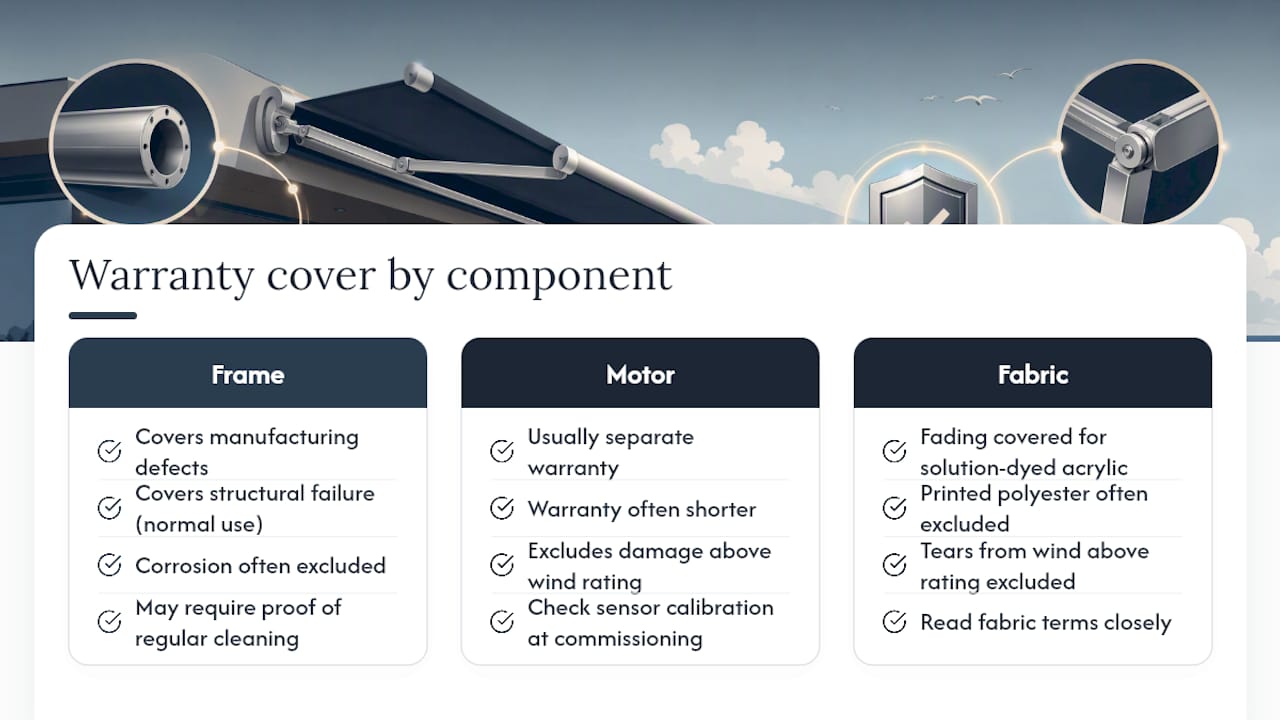
Warranty terms on coastal awnings vary far more than most buyers expect, and the gap between what’s promised and what’s excluded usually sits in the small print around corrosion. Frame warranties typically cover manufacturing defects and structural failure under normal use, but many exclude corrosion caused by inadequate maintenance, meaning a warranty claim can be refused if you never rinsed salt off the fixings.
Motor warranties are usually separate from frame warranties, often shorter, and rarely cover damage caused by operating the awning in wind above the rated threshold, which is exactly why sensor calibration matters so much at commissioning stage.
Fabric warranties deserve the closest read. Fading and colour loss are often covered for a set period against solution-dyed acrylic specifically, since manufacturers stand behind the fibre’s UV stability, but this cover rarely extends to printed polyester fabrics in full sun near the coast. Tears from wind damage above the rated wind class are almost always excluded, which loops back to why correct wind-class specification matters more than any warranty document.
Ask specifically whether salt-induced corrosion on fixings is covered or excluded, whether the warranty requires proof of regular cleaning, and whether motor and sensor components carry the same warranty period as the frame. A reputable installer will answer all three clearly and put the answer in writing rather than gesturing at “standard terms.” If a warranty document doesn’t separate frame, motor, and fabric cover, ask why not, because that ambiguity usually favours the installer, not you.
Should you install a coastal awning yourself?
Professional installation is the sensible route for anything beyond the smallest, most sheltered domestic awning, and the reasoning holds up under scrutiny rather than just serving the trade. Coastal fixing work involves substrate assessment that most homeowners genuinely cannot do accurately from a ladder with a masonry drill. Getting it wrong doesn’t just mean a wobbly awning, it means a fixing that fails in a Force 7 and takes render or brickwork with it.
DIY installation also tends to void manufacturer warranties outright, since most coastal-grade product warranties specifically require installation by an approved or qualified fitter. That’s not a technicality designed to sell services, it reflects genuine liability: a poorly torqued fixing or an uncalibrated wind sensor is a safety issue, not just a cosmetic one.
Where DIY genuinely makes sense is at the lightest end of the market: a small, manually operated fabric canopy on a sheltered inland-facing wall with minimal wind exposure, where failure risk is low and the warranty terms are less stringent. Even then, checking the substrate and using proper stainless fixings rather than whatever’s in the shed is worth the extra half hour.
For anything wall-mounted, motorised, or facing open coastal wind, get a quote from a specialist. The cost difference between a DIY attempt and a professional installation is usually smaller than people assume, and it’s the only route that keeps the warranty intact if something does go wrong. Our piece on all-weather awnings and their year-round benefits covers how the right installation extends usable outdoor time well beyond a typical British summer.
What I’ve learned from watching coastal installs go wrong
The pattern that repeats most often isn’t bad fabric or a weak frame. It’s a wind sensor left on factory defaults on a site that gets far gustier than the manual assumed. When you’re comparing quotes, ask exactly how the installer plans to calibrate that threshold to your actual site. If they can’t answer specifically, that’s your answer about the rest of the proposal too.
— Andrew
How Infinity Awnings can help with your coastal project
Infinityawnings is the local alternative to a generic online awning order, if you’re on an exposed Yorkshire, Derbyshire, Nottinghamshire or Lincolnshire coastline, you get a proper site survey rather than a fabric swatch and a guess. That matters more here than almost anywhere else in the country: an awning specified for a sheltered inland patio will not survive a season facing open water.
Our free site survey covers exposure classification, substrate checks, and a written fixing proposal before you commit to anything, removing the guesswork that causes most warranty disputes down the line. We supply and install retractable awnings, pergolas and verandas from Weinor, Llaza, Selt, Tarasola and Morvelle, with motorisation, wind-sensor commissioning and planned servicing built into every proposal. If you’re weighing up a pergola for year-round shelter alongside an awning, our pergola range is worth a look too. Get in touch for a free, no-obligation survey and quotation, and find out exactly what your site needs before you spend a penny.
Sources
Recommended
Comments