
East Facing Patio Shade: What Works and Where to Put It


An east facing patio needs shade for a different reason than a south or west facing one. The sun arrives early, low and bright, then moves off the patio as the day goes on. The best shade is therefore usually adjustable: a retractable awning with a front drop screen, a tilting or wall-fixed parasol, or a pergola with a movable roof. These let you block the low morning glare when you need to and open the patio to the light when you don’t.
This guide covers how the sun behaves on an east facing patio, how to work out what you need, which shade types suit it, and what to check before you buy.
TL;DR
East facing patios get sun in the morning and are in shade for much of the afternoon, so the problem is usually low, direct morning light rather than all-day heat.
Adjustable shade, such as a retractable awning, a tilting parasol or a louvred pergola, suits this aspect better than a fixed roof that blocks the sun you want.
A drop screen or side panel handles low sun far better than an overhead canopy alone, because the sun comes in at a shallow angle.
Plan for wind, fixings and drainage first, then check whether planning rules or your deeds affect a pergola or veranda.
A site visit settles the details: projection, height, fabric and operation all depend on your wall and your habits.
Table of Contents
How the sun moves across an east facing patio
The sun rises in the east, travels round to the south and sets in the west. BBC Gardeners’ World Magazine points out that this means east and west facing gardens get stronger sun at particular times of day, rather than an even spread. Midday is the hottest period for everyone, but an east facing patio has already had its main direct sun before then.
In practice, a typical UK east facing garden gets roughly four to six hours of gentle morning light, with shade for much of the afternoon. That is why east facing patios are popular for breakfast and morning coffee, and why they feel comfortable on a hot July afternoon when a west facing neighbour is struggling.
Three things change that general picture:
Time of year. In summer the sun rises well to the north of east, so it can reach the back of the house and the patio early, at a very shallow angle. In winter it rises in the south east and is low all day.
What surrounds you. A neighbouring extension, a high fence or a mature tree can take the morning sun away entirely. A small, slightly raised or enclosed garden may only catch sun for a short spell.
The house itself. A patio hard against the rear wall is shaded by the house from the afternoon onwards. A patio at the far end of a long garden can catch the morning sun and then, depending on the layout, a little late sun as it swings round.
When east facing patios actually need shade
There are usually three situations:
Early sun in your eyes and on the table. Low sun between about 7am and 10am from late spring to early autumn is bright, direct and hard to avoid by moving a chair.
Heat building in the house. If patio doors or a conservatory face east, the glass takes the morning sun and the room warms up before you have even left for work. External shade stops the heat entering rather than dealing with it afterwards.
Sun on the patio all through the middle of the day. If the garden is open and the sun swings round to the south, the patio can still be exposed around midday, which is when heat is at its most intense according to the BBC’s gardening guidance.
If your problem is the opposite, strong evening sun, our guide to an awning and drop screen for west facing patios covers it. For the other extreme, there is a separate guide on north facing patio shade.
Work out what you actually need before choosing
BBC Gardeners’ World Magazine advises plotting where you need shade and how much, thinking about whether it is needed in the morning, at midday or in the afternoon, and sizing it for the way you use the space. A hammock needs a smaller shaded area than a table and chairs.
A simple way to do this:
Check the aspect. Stand with your back to the rear wall of the house and use a compass app. If you face roughly east, you have an east facing garden. North east and south east patios behave similarly but with more or less midday sun.
Watch it for a few mornings. Note the times the sun reaches the patio, which part of the seating area it hits and when it leaves. Do it in the season you use the patio most.
Decide the use. Breakfast table, play area, hot tub, a place to work from home, or a run of patio doors that overheat the house?
Measure. Width of the area you want covered, how far it should project from the wall, and the height of the fixing point above the patio.
Note the fixing surface. Brick, render, insulated render, timber cladding and a soffit all need different fixing methods, and this affects what is possible.
This gives you the shape of the shade you need before you look at products.
Where to position shade without losing the morning sun
The most common mistake on an east facing patio is covering it as if it were south facing. A full solid roof overhead keeps out the sun that is the main attraction of this aspect, and it does little about low sun that comes in sideways.
A more balanced approach:
Shade the seating, not the whole patio. Cover the table area and leave the rest open so you still get light on plants, washing lines and the part of the patio where you stand with a coffee.
Use vertical shade for low sun. The morning sun hits at a shallow angle, so an overhead canopy can leave you squinting. A front drop screen, a side screen or a valance on an awning cuts the glare where it comes from.
Choose shade you can pull back. Retractable shade stays out of the way on dull mornings and in winter, when you want every scrap of daylight in the house.
Think about the house, too. If the aim is to keep rooms cooler, cover the glazing on the east wall. Shade fixed above doors and windows is more effective than shade sitting out on the lawn.
One practical point: a fixed solid structure on the east side of the house will also reduce winter light into the rooms behind it. Movable and open-slat options avoid that.
The main types of east facing patio shade
BBC Gardeners’ World Magazine lists parasols, awnings, sails and pergolas or plant-clad structures as the main routes. Here is how they compare on an east facing patio.
Shade type | Best for | Strengths on an east facing patio | Points to weigh |
Retractable awning | Patio doors, dining areas, house heat | Wall mounted, saves ground space, retracts in dull weather, adds a drop screen for low sun | Needs a suitable wall and projection; wind sensor advisable |
Tilting or cantilever parasol | Small patios, flexible seating | Tilts to follow the sun; some can be wall fixed where ground space is limited | Smaller coverage, needs a heavy base or fixing |
Shade sail | Larger or irregular spaces | Light, inexpensive structure, can be angled | Needs strong posts or fixing points; not a rain shelter |
Pergola | Defined outdoor room, year-round use | Structure for planting or lighting; louvred roofs adjust to the sun | Fixings and footings matter; planning rules may apply |
Veranda or canopy | Rain cover as well as shade | Usable in more weather | Fixed, so reduces light to the house behind it |
The BBC’s guidance also notes that retractable awnings are space saving, but that the shade they give cannot be shifted around the way a tilting parasol’s can. On an east facing patio that is usually fine, because the sun only comes from one general direction and the patio is used at predictable times.
Retractable awnings
For most east facing patios attached to a house, a retractable awning is the most practical answer. It mounts to the wall above the patio doors, extends when you want it and winds back in when you don’t. Fit it with a front drop screen or valance and it handles the low morning sun, which a simple flat canopy does not.
Choices that matter on an east facing patio:
Projection and width. Wide enough to cover the table and the glazing, with enough projection to keep the sun off the seats at the time you sit down.
Pitch. A steeper angle lets more low sun in under the front edge. A flatter pitch with a drop screen gives more control.
Electric or manual. Electric operation with a remote makes it far more likely you will actually use it before work. A wind sensor will retract it for you if a gust arrives.
Extras. LED lighting and a heater can extend use into cooler mornings and evenings.
See our patio awnings and retractable awnings pages for the range.
Parasols and sails
A tilting parasol gives you more control over where shade falls, and cantilever parasols can be fixed to a wall or overhang a space where there is no room for a central pole. They are a sensible choice for a small east facing patio or as a supplement to other shade. The limit is coverage: one parasol covers one table.

Sails suit larger or oddly shaped gardens, but they need solid fixing points, and they are a poor match for a high wind.
Pergolas
A pergola turns a patio into a defined outdoor room. On an east facing patio, a pergola with an adjustable or louvred roof lets you shade the morning glare and open it up the rest of the time. The BBC also notes that plant-clad structures work as shade, and climbers on a pergola are a traditional way of softening the sun while keeping a garden feel.

Before you commit, it helps to understand cost and lifespan. Our guides on what UK homeowners pay for a pergola and pergola lifespan go through both. Our pergolas page shows the options we supply.
Fabric, materials and sun exposure
The BBC advises that durable outdoor shade materials should withstand ultraviolet exposure, and that temporary structures can last longer because they get less sun. The same logic applies to awnings: a fabric that is retracted when not in use spends less time in the sun.
For an east facing patio, look at:
Colour and weave. Lighter colours reflect more heat, darker colours block more light and glare. A tighter weave blocks more sun and gives more privacy.
UV and water resistance. Awning fabric is designed for outdoor use and is treated for UV and moisture, but quality differs between products.
Frame finish. A powder-coated aluminium frame is built to cope with UK damp.
Our guides on the role of fabric in awnings and how to select awning fabric go into weaves and finishes in more detail.
Wind, fixings and drainage
East facing patios are not generally more exposed than others, but the same safety basics apply to every shade structure.
Wind. UltraDecking UK’s guide to building a pergola over decking says pergola roofs can create wind uplift, and recommends securing beams to posts with high-wind ties and setting posts in concrete footings. For wall mounted awnings, the equivalent is a secure fixing into sound masonry and a wind sensor that retracts the awning automatically. Never leave an extended awning out in strong wind or unattended in a forecast gale.

Fixings. A structure is only as strong as what it is fixed to. Brickwork in good condition is normally fine. Hollow, rendered, insulated or cladded walls need the right brackets and sometimes a support frame. This is the main reason a survey beats an online order.
Drainage. The same guide advises keeping timber posts out of wet ground and sloping concrete away from them so rainwater drains away. Check where water will run from any new roof or canopy, and where a gutter or downpipe sits, before the design is fixed.
Maintenance. Brush off debris, rinse fabric with mild soapy water, and let it dry before retracting. A yearly check of fixings and motor keeps a retractable system working.
Do you need planning permission?
Most wall mounted retractable awnings are straightforward, but pergolas, verandas and other fixed structures are different. East Cambridgeshire District Council, for example, advises checking whether works such as pergolas need permission from the council, the landowner or a residents’ association before work starts. Rules vary by council, and listed buildings, conservation areas, flats and leasehold properties often have extra restrictions.
For a clearer picture, read our guides on pergola planning rules, veranda planning permission and permitted development versus planning permission. Your local planning authority has the final say, so contact it if there is any doubt.
Our perspective
On east facing patios we most often see two mistakes. One is buying a fixed roof that shuts out the lovely morning light. The other is buying an awning that is too shallow and leaves the low sun shining straight in at breakfast. Our advice is to start with how you use the patio and when. If you eat out early, we look at a retractable awning with a drop screen, usually electric, so it is quick to use and can retract itself in a gust. If you want an outdoor room that works for more of the year, a pergola may suit you better, and we will talk you through the options. We have more than 15 years’ experience, supply premium brands such as Weinor, Llaza, Selt, Tarasola and Morvelle, and work across Yorkshire, Derbyshire, Nottinghamshire and Lincolnshire. We take a consultative, no-pressure approach, because the right shade is the one that fits your wall, your garden and your mornings. Andrew
Getting shade designed for your patio
We design, supply and install residential awnings and canopies, pergolas and verandas for homes across Yorkshire, Derbyshire, Nottinghamshire and Lincolnshire. Every east facing patio is different, so we look at your wall, your sun path and the way you use the space, then recommend a layout, operation and fabric to suit. Quotes are free, and our range covers manual or electric operation, a choice of fabrics, LED lighting, heaters, weather sensors and side screens.
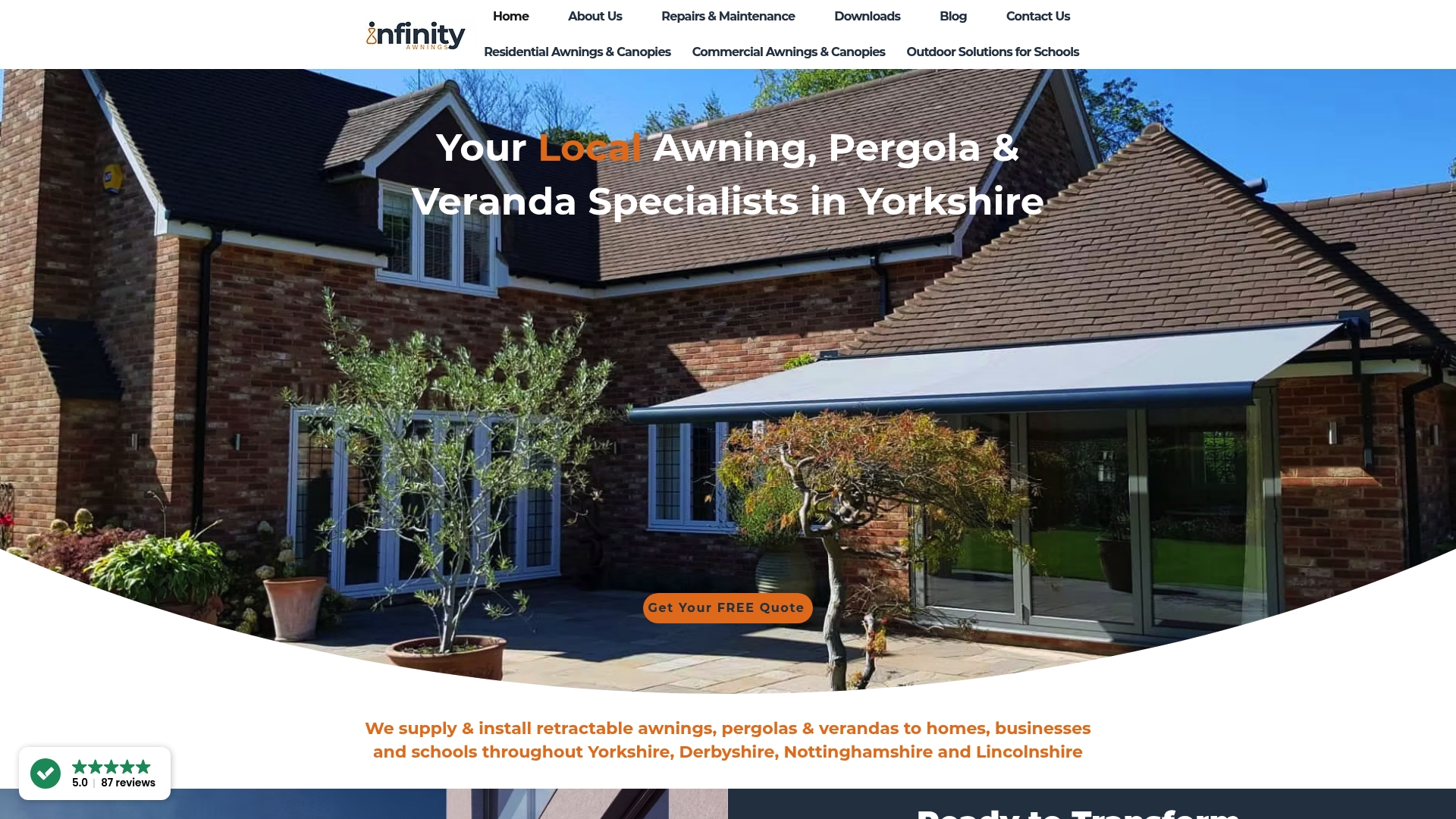
If you are ready to talk, request a free quote from Infinity Awnings and tell us which way your patio faces.
Shade is not only for homes. If you run a café, pub, restaurant or hotel with an east facing terrace, our commercial awnings and canopies make the morning trade more comfortable. For shaded dining areas at home, see our practical guide.
A simple decision guide
Breakfast patio against the house, glazing getting hot: retractable awning with a drop screen and electric operation.
Small patio, flexible seating: tilting or wall fixed cantilever parasol.
Larger garden, want an outdoor room: pergola with an adjustable roof, ideally with a plan for lighting and heating.
Wet weather use as well as sun: veranda or a pergola with a waterproof roof.
Sun mainly at midday as the garden is open: awning projecting further, or a pergola over the dining area.
Whichever you choose, get the measurements, the fixing surface and the planning position settled first. They decide what is possible, and they are much cheaper to sort out before you order than afterwards.
FAQ
Does an east facing patio need shade at all?
Often yes, though for less of the day. Morning sun is low and bright, which is uncomfortable at a breakfast table and warms east facing glazing. Most of the afternoon is shaded, so you need shade that you can use when you want it rather than a permanent roof.
What is the best shade for an east facing patio?
For a patio against the house, a retractable awning with a drop screen suits most people, because it blocks low morning sun and retracts when you want light. Tilting parasols suit small patios, and pergolas with adjustable roofs suit people who want a defined outdoor room.
Will shade make my house darker?
A fixed solid structure over east facing windows or doors can reduce daylight indoors. Retractable awnings and open or louvred pergolas avoid this, because you can open them up on dull days and in winter.
Do I need planning permission for patio shade?
It depends on the structure and the property. Pergolas, verandas and other fixed structures may need permission, and listed buildings, conservation areas, flats and leasehold homes often have extra rules. Check with your local council before work begins, and read our planning guides above.
Sources
Recommended
Comments