
Manual vs electric awnings: How to choose the best

TL;DR:
Manual awnings are cheaper with simpler mechanics, while electric ones offer automated convenience.
Over 15 years, manual awnings tend to have lower total costs despite less frequent use.
Electric models enhance outdoor use and safety with sensors and remote operation, suitable for busy or large spaces.
Choosing between a manual and electric awning sounds straightforward until you’re actually standing in your garden weighing up price tags, neighbour recommendations, and a dozen spec sheets. Many homeowners and commercial property managers across Yorkshire, Derbyshire, Nottinghamshire, and Lincolnshire tell us the same thing: they wish someone had cut through the noise earlier. The decision isn’t simply about budget. It’s about how you actually live, how often you’ll use the awning, who will operate it, and what the Yorkshire weather will throw at it. This guide gives you the clear, honest comparison you need.
Table of Contents
Key Takeaways
Point | Details |
Manual saves upfront | Manual awnings cost 40-50% less initially and are ideal for low-use scenarios. |
Electric increases use | Electric awnings double usage frequency and offer the most convenience for frequent outdoor living. |
Maintenance matters | Manual awnings need less maintenance, but electric versions are safest in storms if fitted with sensors. |
Match to your needs | Choose based on your space size, user ability, and how often you want to use the outdoor area. |
Lifespan varies | Electric awning motors last 10-20 years; manual mechanisms usually last longer overall. |
What are manual and electric awnings?
Having set the stage, let’s break down what manual and electric awnings actually are and how they work.
Manual awnings use a crank or pulley system with no electrical components, making them mechanically simple. You turn a handle or pull a cord, and the awning extends or retracts. That’s the whole system. No wiring, no motor, no app. For many homeowners, that simplicity is exactly the point. You can learn about the practical manual awning operation benefits to understand why this matters for long-term ownership.
Electric awnings employ tubular motors, remotes, apps, and sensors for automated operation. At the touch of a button or a tap on your phone, the awning moves. Many electric models also include wind and rain sensors, meaning they can retract automatically when the weather turns. Exploring the full range of electric awning features reveals just how sophisticated these systems have become.
Here’s a quick summary of what each type offers:
Manual awning advantages:
Lower upfront cost
No power supply needed
Mechanically simple and easy to understand
Works during power outages
Lighter maintenance demands
Electric awning advantages:
One-touch or automated operation
Wind and rain sensors for protection
Smart home and app integration
Ideal for larger spans or commercial settings
Encourages more frequent use of outdoor space
Both awning types can be fitted with quality fabrics, LED lighting, and heaters. The drive mechanism is the main difference, but that one difference has significant knock-on effects for cost, convenience, and suitability.
Cost comparison: Initial price, running costs and value
With a basic understanding clear, the next hurdle for most buyers is price and long-term value.
Manual awnings cost 40 to 50% less upfront, typically in the range of £1,200 to £2,000, compared with £2,000 to £5,000 or more for a quality electric awning with sensors and smart controls. That’s a meaningful gap, particularly for homeowners on tighter budgets or those fitting a single small terrace.
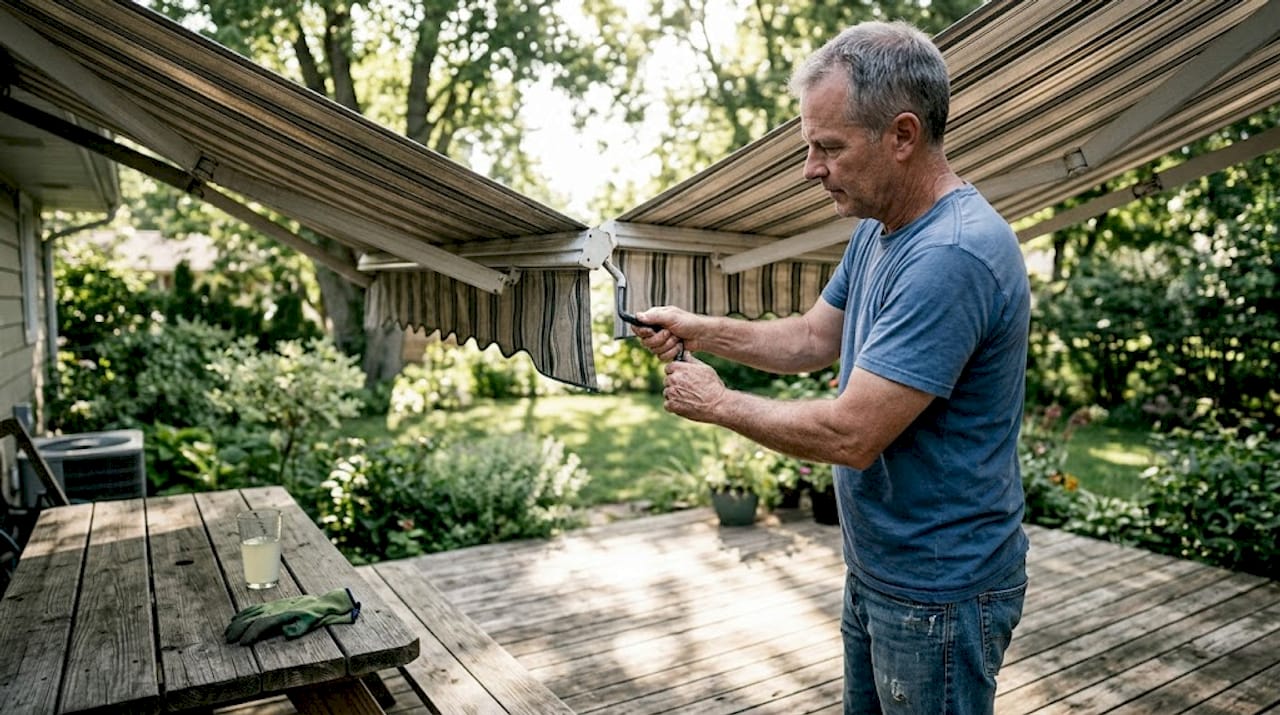
But upfront price rarely tells the full story. Over 15 years, manual total costs run lower overall, yet electric awnings are used two to three times more frequently, which changes the value equation considerably.
Cost factor | Manual awning | Electric awning |
Upfront price | Lower (approx. £1,200 to £2,000) | Higher (approx. £2,000 to £5,000+) |
Installation | Simpler, often cheaper | Requires electrical work |
15-year running cost | Approx. £2,000 to £3,200 | Approx. £3,250 to £6,600 |
Usage frequency | Lower (manual effort) | 2 to 3x more frequent |
Maintenance cost | Minimal | Motor checks, wiring |
Unexpected costs to keep in mind:
Electric awnings may need a qualified electrician for installation
Sensor replacements or motor servicing if problems arise
Manual cranks or pulleys can wear over time and need replacing
Pro Tip: Don’t just compare purchase prices. Calculate your manual operation cost benefits over five to ten years, factoring in how often you’ll actually use it. An electric awning used daily delivers far more value per pound than a manual one opened twice a week.
Functionality, maintenance, and everyday use
Beyond cost, daily living with an awning comes down to its ease of use and the reality of upkeep.
Manual awnings have fewer parts, lower maintenance requirements, need no power supply, and function during power outages. Electric awnings require periodic motor checks and wiring inspections. That said, a well-maintained electric awning rarely causes problems, and motor failures in modern units are relatively uncommon.
Electric awnings boost outdoor usage by 2x, delivering up to 40% more outdoor space use, with sensors preventing damage during wind or rain. This is a striking real-world difference. When deployment requires zero effort, people simply use the space more.
Here’s how everyday operation compares:
Feature | Manual | Electric |
Speed of operation | Moderate (30 to 60 seconds) | Fast (10 to 15 seconds) |
Weather response | Manual retraction required | Automatic with sensors |
Power dependency | None | Mains electricity needed |
App or remote control | No | Yes |
Ease for elderly users | Can be difficult | Very easy |
Maintenance priorities for each type:
Clean the fabric regularly regardless of type, particularly after autumn leaves and Yorkshire rain
Lubricate manual crank mechanisms annually to prevent stiffness
Test electric sensors and motor function at the start and end of each season
Inspect fabric for mould or UV fading each spring
For a detailed routine, the retractable awning maintenance guide covers everything, and the awnings maintenance checklist is particularly useful for seasonal care.
Pro Tip: The single biggest cause of costly repairs in electric awnings is leaving the awning extended during sudden storms. A wind sensor fitted at installation pays for itself the first time bad weather rolls in unexpectedly.
Suitability for different spaces and users
Now, let’s get practical and connect each awning type to the real spaces and priorities they’re best for.
Manual awnings suit small or low-use areas, spaces without power access, tighter budgets, and users who prefer simplicity. Electric awnings are the better fit for high-traffic use, larger spans, commercial settings, and users with accessibility needs.
Think about these real-world scenarios:
Residential settings:
Small terrace or courtyard: A manual awning is perfectly adequate and cost-effective
Large rear garden patio: Electric operation makes regular use practical, especially with family
Households with elderly or mobility-limited residents: Electric is significantly easier to operate
Commercial settings:
Pub or restaurant terrace: Electric is strongly preferred for speed, branding, and ease during busy service periods
Hotel courtyard or event space: Commercial awnings often use electric systems for large spans, consistent branding, and durability in exposed areas
School or office building: Either type works depending on access, but electric reduces staff burden
The numbers support this: electric awnings boost space use by 40%, which for a bar or café translates directly into revenue. For a busy pub manager in Sheffield or Nottingham, that’s not a luxury, it’s a sound business case.
“The question isn’t which awning is better. It’s which awning fits how your space is actually used.”
For businesses weighing their options, the full commercial awning selection process is worth working through carefully before committing.
Longevity and durability: What lasts?
Every investment for your home or business should be built to last. Here’s what the numbers and experience say about longevity.
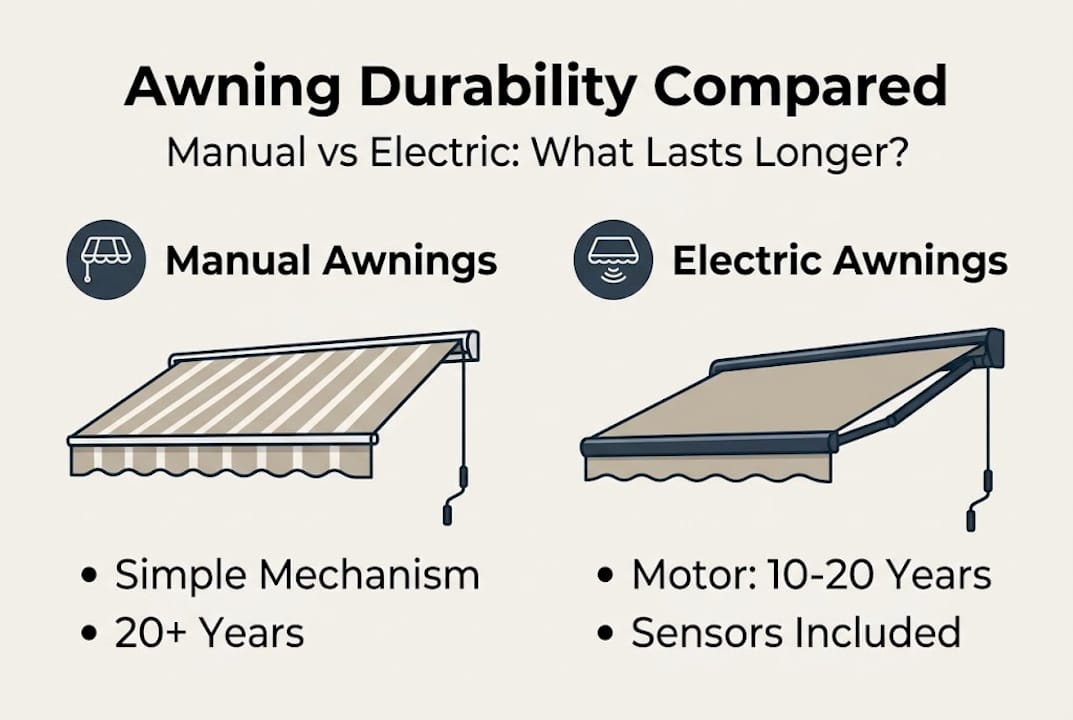
Electric awning motors last 10 to 20 years, while manual awnings tend to be mechanically more durable long-term. In practice, the fabric and frame often determine lifespan more than the drive mechanism. A quality manual awning with a robust aluminium frame and solution-dyed acrylic fabric can easily last 15 to 20 years in UK conditions.
What tends to wear out first:
Manual awnings:
Crank handles and gear mechanisms
Fabric at the fold points
Spring tension in the arms
Electric awnings:
Tubular motor (though quality motors are very long-lasting)
Sensor accuracy over time
Wiring connections in exposed locations
The Yorkshire and Lincolnshire climate is particularly demanding. Cold winters, wet autumns, and occasional strong winds all place stress on fabrics and mechanisms. Brands like Weinor and Selt, which we supply, are built with these conditions in mind. Proper storage (retracting during winter or prolonged wet periods) dramatically extends lifespan for both types.
For practical guidance, the awning durability tips page is an excellent starting point, and the awnings repair maintenance resource covers what to do when parts do eventually wear.
The real decision: What most buyers get wrong
Here’s the advice that rarely gets the emphasis it deserves.
Most buyers fixate on the upfront price difference and treat it as the deciding factor. But in our 15-plus years fitting awnings across Yorkshire, Derbyshire, and beyond, the buyers who report the highest satisfaction are those who chose based on lifestyle, not just the quote. A manual awning bought to save money that goes unused because it’s awkward to operate is a waste of every pound spent.
Think honestly about your household. Are there elderly relatives who struggle with cranking? Do you have young children who’ll run in and out all day? Do you run a commercial terrace where staff need to respond to weather in seconds? These realities matter far more than a spec sheet.
Power outages are occasionally cited as a reason to avoid electric awnings, but in practice, most modern electric awnings include a manual override. And the electric awning impact on indoor heat reduction is a genuine, underappreciated benefit that adds real comfort value through summer. Choose the awning that fits how you actually live outdoors, not how you imagine you might.
Ready for your ideal outdoor space?
With a clear idea of what fits your situation, why not see how the right awning or pergola could transform your outdoor space?
At Infinity Awnings, we’ve spent over 15 years helping homeowners and businesses across Yorkshire, Derbyshire, Nottinghamshire, and Lincolnshire find the right shading solution. Whether you’re drawn to the simplicity of a manual awning or the convenience of a fully automated electric model, we can match you with the right product from brands like Weinor, Selt, and Tarasola. Explore our garden pergolas for larger shading projects, or visit our main site to discover the full range of bespoke awning solutions. Request a free quote today and we’ll help you get it right from the start.
Frequently asked questions
Are manual awnings really more reliable than electric ones?
Manual awnings use a crank or pulley with no electrical components, so there are simply fewer things that can go wrong. For pure mechanical reliability, they do have a natural advantage.
Do electric awnings use much electricity?
Electric awnings use tubular motors that only draw power during operation, making running costs genuinely minimal. Most users see little to no noticeable impact on their electricity bills.
Which is safer for wind and rain: manual or electric?
Sensors in electric awnings can automatically retract the canopy when wind or rain is detected, offering a meaningful safety advantage over manual models that rely on someone being present to act.
How long do awnings usually last?
Electric motors last 10 to 20 years with proper maintenance, while manual awnings often outlast their motorised counterparts in overall mechanical durability. Fabric lifespan depends most on cleaning and storage habits.
Recommended
Comments