
Rain sensor technology for awnings: automatic protection explained

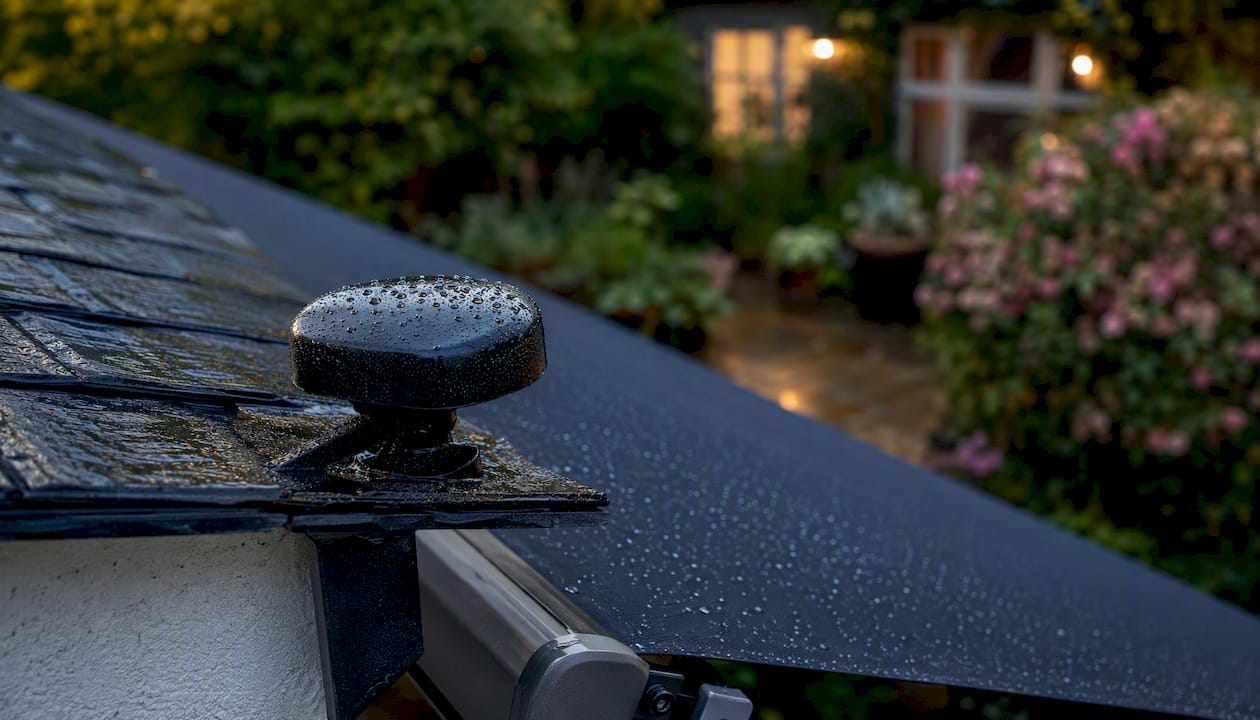
Rain sensor technology for awnings is a precipitation-detection device that sends a signal to your motor the instant it senses rain, telling the awning or pergola canopy to retract or close before water can pool on the fabric. It’s a modest addition to any motorised system, and for anyone running an outdoor terrace unattended, or simply out at work when a summer storm rolls in, it’s usually worth the outlay, as highlighted in Reasons to add outdoor plumbing to your UK home.
Is it right for you? If you own a retractable awning purely for shade on a patio you can watch from the kitchen window, a sensor is a nice-to-have. If you run a restaurant terrace, a hotel courtyard, or any pergola with a glass roof left extended overnight, it becomes a genuine safeguard rather than just a convenience against sagging fabric, stretched seams, and a soaked mechanism.
A few things worth knowing before you go further:
Sensors like the Somfy Soliris range automatically retract an awning the moment rain is detected, and can lock out manual commands until it stops.
Most units build in a short delay of several seconds to avoid repeated or false activations, so a passing splash doesn’t send your awning yo-yoing in and out.
Infinity Awnings has spent over 15 years fitting and servicing these systems across the region, working directly with manufacturers including Weinor, Llaza, Selt, Tarasola, and Morvelle.
Table of Contents
How rain sensor technology works on a motorised awning
The moment moisture hits the sensor’s detection surface, it fires a command to your control unit, which tells the motor to retract the fabric or close the roof slats. That’s the whole principle. What varies is how the sensor “feels” the rain and how that signal reaches the motor.
Four detection methods turn up most often on domestic and commercial awnings:
Conductive pads use two exposed contacts that complete an electrical circuit when water bridges them, a simple and cheap method that’s been standard for years.
Optical or capacitive sensors detect moisture through changes in light refraction or electrical capacitance on a small sensing surface, generally more resistant to debris than bare contacts.
Mechanical tipping cups, borrowed from weather-station design, collect water until a tiny cup tips and trips a switch.
Vibration-triggered units, often paired with wind detection, respond to the physical impact of rainfall or gusts on a mounted plate.
Once the sensor fires, the signal has to reach the motor somehow. On a wired dry-contact setup, the sensor connects directly into the control box, offering a reliable, interference-free path that suits new installations where cable runs are easy. On a wireless setup, the sensor pairs with an RF receiver near the motor, which is the more common retrofit route because there’s no cable to chase through brickwork.
Manufacturer instructions for combined wind, sun, and rain units describe adjustable sensitivity settings alongside that built-in delay, specifically to stop the system reacting to every stray drop rather than genuine rainfall. Somfy’s own Soliris documentation goes further, noting that once rain is confirmed, the control unit can override manual “extend” commands entirely until conditions clear.
Picture three boxes in a row: sensor, receiver, motor. The sensor spots the rain, the receiver translates that into a motor command, and the motor does the physical work of pulling the fabric in. Break any link in that chain, whether it’s a flat battery, a receiver too far from the sensor, or a motor on the wrong protocol, and the whole system stops earning its keep.
Which type of rain sensor suits your awning?
Not every sensor suits every setup, and the right pick depends less on brand loyalty and more on your motor’s control protocol, your power access, and how exposed the mounting spot actually is.
Conductive-pad sensors are the cheapest and easiest to retrofit but can misread dew or condensation as rain, especially on cooler mornings. Optical and capacitive units cost more but shrug off debris and false positives better, making them the sensible choice for anywhere unattended for long stretches. Tipping-cup mechanisms are robust and largely maintenance-free, though slower to respond because they need a measurable volume of water first. Combined multi-sensor units, which bundle rain detection with wind and sometimes sun sensing, dominate the commercial market because one receiver box handles every weather trigger.
Power and connection choices matter just as much as detection method:
Battery-powered wireless sensors suit retrofits where running mains cable isn’t practical, though batteries need checking annually.
Mains-wired dry-contact sensors offer the most dependable signal path but require an electrician or installer to run cable during fitting.
RF wireless pairing sits between the two, giving flexible placement without the interference issues that can plague older wired runs.
Sensor type | Power source | Connection method | Mounting location | Response time | Typical cost/install complexity | Weatherproofing |
Conductive pad | Battery or mains | Wired dry-contact or RF | Exposed edge of awning box | Fast (seconds) | Low, straightforward retrofit | Moderate IP rating |
Optical/capacitive | Battery | RF wireless | Exposed, debris-free surface | Fast (seconds) | Moderate | Higher IP rating |
Tipping cup | Battery | RF wireless | Fully open, unobstructed spot | Slower (needs volume) | Moderate | Good, mechanical seal |
Combined multi-sensor | Mains or battery | Wired or RF, brand-specific | Rooftop or mast mount | Fast, tuneable delay | Higher, often professionally fitted | High, commercial-grade |
For a small private patio, a straightforward conductive or optical sensor on RF wireless usually does the job. A restaurant terrace, especially one relying on unattended overnight extension, benefits from a combined wind and rain unit with mains power and professional calibration. A conservatory or pergola with an integrated glass roof needs the fastest-reacting sensor available, since closing slats after water has already found a gap defeats the purpose, a point Veraforza makes clearly in its own pergola sensor guidance.
Connecting a sensor to your motorised awning or pergola
Most sensors reach the motor one of two ways: a wired dry-contact input straight into the control box, or a wireless pairing with an RF receiver sitting near the motor. Which route works for you depends almost entirely on what motor and control protocol your awning already runs.
Before buying anything, run through this compatibility list with whoever’s quoting the job:
Is the motor AC or DC, and does it accept a dry-contact input directly, or does it need an intermediate receiver?
What control protocol is in use, RTS, io-homecontrol, or basic wired dry-contact, and does the sensor manufacturer support it?
How far is the receiver from the intended sensor position, and are there metal obstructions likely to disrupt an RF signal?
Does the sensor need its own power source, and is there a sensible route to it?
Retrofitting an existing manual or basic electric awning with sensing usually means adding a receiver box, sometimes a new power outlet near the mounting point, and occasionally a short cable run if you’re going wired rather than RF. None of that is drastic, but it does add labour hours beyond simply bolting a sensor to the frame, something worth factoring into any quote. Our guide to motorised awning control options covers these protocols in more depth if you want the full picture before a site visit.
Infinity Awnings supplies and fits systems from Weinor, Llaza, Selt, Tarasola, and Morvelle, and installers generally favour manufacturer-approved sensor modules over generic third-party units wherever one exists. A sensor built to talk directly to Weinor’s own control logic, for instance, tends to integrate more cleanly and keeps the manufacturer’s warranty intact, whereas mixing an unapproved sensor with a branded motor can occasionally void cover.
One safety wrinkle worth knowing: on combined systems, a wind sensor can override a rain command. If gusts are pushing the awning dangerously while rain is falling, the wind sensor input takes priority and retracts the fabric regardless of what the rain sensor is doing, because a torn awning in high wind is a worse outcome than a wet one.
Getting the placement right so the sensor actually works
Position the sensor somewhere it will reliably see rain and nothing else. That single rule causes more false triggers and missed detections than any hardware fault.
Mount the sensor in a genuinely exposed spot, away from any overhang, eave, or roofline that could shield it from direct rainfall.
Set mounting height so the sensing surface catches falling rain rather than splash-back off a nearby surface.
Keep a clear line to the receiver where RF is in use, since thick walls or metal cladding between the two can weaken the signal noticeably.
Route cable entry points downward, not upward, so water can’t track along the wire into the housing.
Leave the manufacturer’s stated minimum clearance around the unit for airflow and drainage.
Awning pitch matters more than most people expect. Base Direct’s own guidance notes that a flat awning lets water sit before the sensor even reacts, because the fabric simply pools rather than shedding rain off the edge quickly. An awning with adjustable pitch, angled correctly, sheds water fast enough that the sensor’s response actually matters. On a dead-flat setup, you can have a perfectly good sensor and still end up with standing water before retraction completes.
Common installation mistakes worth avoiding: mounting the sensor beneath the awning box itself where it never gets properly wet, positioning it near a gutter downpipe or sprinkler head that triggers false readings, and placing metallic trellis or cladding between sensor and receiver that scrambles the RF signal.
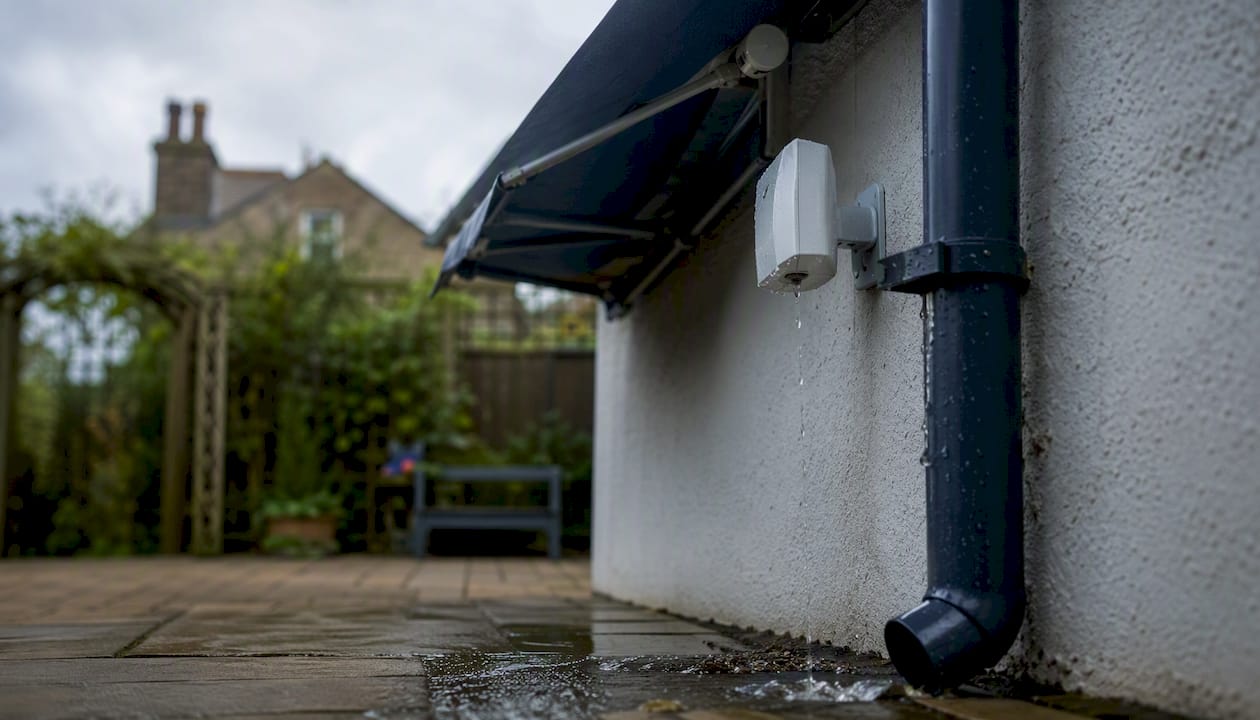
Pro Tip: Fit the sensor on the same roofline as the awning itself rather than a separate wall bracket, then run it through a full season before locking in the sensitivity setting. Rain patterns and wind exposure shift with the seasons, and a sensitivity level that felt right in a dry August can trigger constantly through a wet November.
What rain sensors actually protect against, and where they fall short
Rain sensors cut down on fabric pooling and repeated soaking, but they aren’t fail-safe, and they’re no substitute for common sense in genuinely severe weather. That distinction matters when you’re deciding how much to spend on one.
On the benefit side:
Automatic retraction the moment rain starts, whether anyone’s home or on shift to notice.
Less strain on the fabric and frame from repeated wet-dry cycles, which shortens the life of cheaper materials noticeably.
Hands-free operation for hospitality staff who have better things to do mid-service than watch the sky.
On the limitation side, light drizzle can sometimes trigger retraction unnecessarily, particularly on conductive-pad sensors, and condensation on a cool morning can occasionally read as rainfall on less discriminating units. Nearby sprinkler systems and roof run-off from an adjacent building are the two most common causes of genuinely false triggers, both worth checking during a site survey rather than after installation.
Manufacturer data on the Soliris control range shows that professional systems build in dynamic retraction delays specifically to filter out these nuisance triggers while still reacting fast enough to genuine downpours. That’s also why combined wind and rain units dominate commercial installations: a hotel terrace or restaurant canopy facing an open aspect needs both triggers working together, since wind damage and water damage rarely arrive on the same schedule but both need covering.
Keeping a rain sensor working reliably year-round
Regular visual checks and a seasonal function test catch most problems before they become expensive ones. Sensors are simple devices, but simple devices still accumulate grime, drain batteries, and occasionally lose their pairing.
A sensible maintenance rhythm looks like this:
Wipe down optical or capacitive pads every few months to clear pollen, dust, and cobwebs that can dull their response.
Check battery levels on wireless units at the start of each season, particularly before autumn’s wetter months arrive.
Book an annual professional calibration and function test alongside your usual awning maintenance checklist.
When something stops working, run through it in order:
Confirm the sensor has power, checking any LED indicator against the manufacturer’s manual.
Test with a jug of water poured directly over the sensing surface to see if it triggers at all.
Reset the RF pairing between sensor and receiver if the LED shows power but nothing happens downstream.
Check the receiver’s own wiring and connections for looseness or corrosion.
Call in a professional if the fault persists past these steps.
Symptoms like a motor that won’t respond to any input, not just the sensor, or scorched-looking connections in the control box, point to wiring or receiver faults rather than a dirty sensor pad, and that’s a job for an installer rather than a weekend fix. Our repairs and maintenance guide covers when it’s worth escalating beyond DIY troubleshooting.
What a rain sensor fit typically costs
Total cost swings considerably depending on sensor sophistication, the brand behind it, and how complicated the retrofit turns out to be. A simple conductive sensor added to an existing wireless-ready motor sits at the lower end of the market, while a combined wind, sun, and rain unit fitted with new mains wiring and a fresh receiver box sits well above it. Treat any figure you see quoted online as a rough steer rather than your actual price, since site conditions change the number fast.
The variables that move the price most:
Sensor sophistication, a basic single-function pad versus a combined multi-sensor unit.
Power supply needs, whether new mains wiring is required or a battery-powered unit will do.
Whether your existing motor already has a compatible receiver or needs a new controller.
Cable run length and access difficulty, particularly on older buildings or hard-to-reach mounting points.
VAT and site-specific labour rates, which vary by region and by how much scaffolding or access equipment the job needs.
Ask any installer for a written quote that itemises the sensor unit, installation labour, and any additional parts separately, rather than a single lump figure. That breakdown makes it far easier to compare two quotes fairly and to spot where one installer has priced in a part the other hasn’t. Always confirm what warranty covers the sensor itself versus the labour that fitted it before you sign anything.
Questions worth asking before you agree to a rain sensor fit
Bring this list to any site meeting and expect straight answers on the spot, not a follow-up email a week later.
Which sensor model are you proposing, and why does it suit my specific awning or pergola brand?
Is this sensor compatible with my existing motor and control protocol, or does it require a new receiver?
How is the sensor powered, and what cabling, if any, does the job involve?
Will you test the sensor on-site once fitted, and how?
What warranty covers the sensor itself, separately from the installation labour?
How much downtime should I expect during the fit?
Can I have an itemised price breakdown before I commit?
Will someone demonstrate the system to me or my staff once it’s installed?
An installer proposing a manufacturer-authorised module for your specific brand, offering an on-site test before they leave, and putting warranty terms in writing is generally the stronger proposal, even if it isn’t the cheapest one on the table.
Why the sensor is only half the job
Sensor choice and correct placement matter roughly equally, and treating the device as a plug-and-play gadget rather than part of an engineered system is where most disappointing installs go wrong. A premium sensor mounted in the wrong spot performs worse than a basic one placed correctly, which is a lesson that only really sinks in once you’ve seen it happen on a live site.
A proper site assessment looks at motor protocol, mounting exposure, receiver range, and how the awning’s pitch will actually shed water, not just where a sensor happens to fit neatly on the frame. Skipping that step is how you end up with a system that technically works in the showroom but misfires constantly once it’s exposed to a real garden or terrace with its own quirks of shade, wind funnelling, and nearby structures.
Manufacturer-approved sensor modules also protect something easy to overlook at the point of sale: your warranty. Fitting a generic sensor to a branded motor can, in some cases, void cover that a manufacturer-matched module wouldn’t touch. After 15 years supplying and fitting Weinor, Llaza, Selt, Tarasola, and Morvelle systems, our experience says the extra time spent on a proper site survey for commercial clients, restaurants and hotels especially, pays for itself the first time a storm rolls through unattended.
How Infinity Awnings fits and supports your rain sensor
Infinity Awnings supplies and fits compatible rain sensor solutions across every premium brand it works with, Weinor, Llaza, Selt, Tarasola, and Morvelle, matched correctly to your motor and control protocol rather than bolted on as an afterthought.

Our service covers the full job from start to finish: an on-site survey to assess exposure and mounting options, sensor selection matched to your specific awning or pergola, retrofit installation for existing motorised systems, and a handover demonstration so you or your staff know exactly how the system behaves once it’s live. For pergola owners considering an integrated glass roof with automatic weather response, our pergolas page shows what’s possible when sensors are designed into the structure from the outset rather than added later.
If you’re weighing up a rain sensor fit for a home patio or a full weather-response system for a commercial terrace, get in touch for a free site survey and a written quotation that itemises the sensor, the labour, and any extra parts your setup needs.
Key takeaways: is a rain sensor right for your awning?
A rain sensor works because it converts a physical trigger, be it moisture, vibration, or both, into an automatic motor command that protects fabric faster than any person watching the sky ever could.
Point | Details |
Who benefits most | Unattended patios, restaurant terraces, and pergolas with glass roofs gain the most from automatic protection. |
Core benefit | Automatic retraction reduces fabric pooling and cuts repeated wear from wet-dry cycles. |
Main limitation | Light drizzle, condensation, or nearby sprinklers can occasionally cause false triggers. |
Integration path | Sensors connect via wired dry-contact or RF pairing with a receiver, depending on your motor’s protocol. |
Suggested next step | Book a site survey with Infinity Awnings to confirm compatibility with your brand and get an itemised quote. |
Frequently asked questions
What is rain sensor technology for awnings, exactly? It’s a small precipitation-detection device wired or paired wirelessly to your awning’s motor, so the system retracts or closes automatically the moment it senses rain, without you needing to be present or reach for a remote.
Do rain sensors work with manual awnings? No. Rain sensors require a motorised system to act on, since the sensor’s whole function is to send a retraction command to a motor. If your awning is manually operated, you’d need to upgrade to electric operation first.
Can I retrofit a rain sensor onto an existing electric awning? In most cases, yes. It usually means adding an RF receiver near your motor or, for a wired setup, running a short cable, both straightforward for an installer familiar with your motor’s protocol.
Will a rain sensor stop every false trigger? No system is completely immune. Light drizzle or nearby sprinklers can occasionally cause an unnecessary retraction, though a built-in delay of 10 to 20 seconds and correctly calibrated sensitivity cut this down significantly.
How much does a rain sensor typically add to an awning installation? It varies with sensor type, power supply needs, and retrofit complexity, so get a written, itemised quote rather than relying on a general figure, since site conditions change the price considerably.
Sources
Recommended
Comments