
Commercial awning costs in the UK: a complete pricing guide

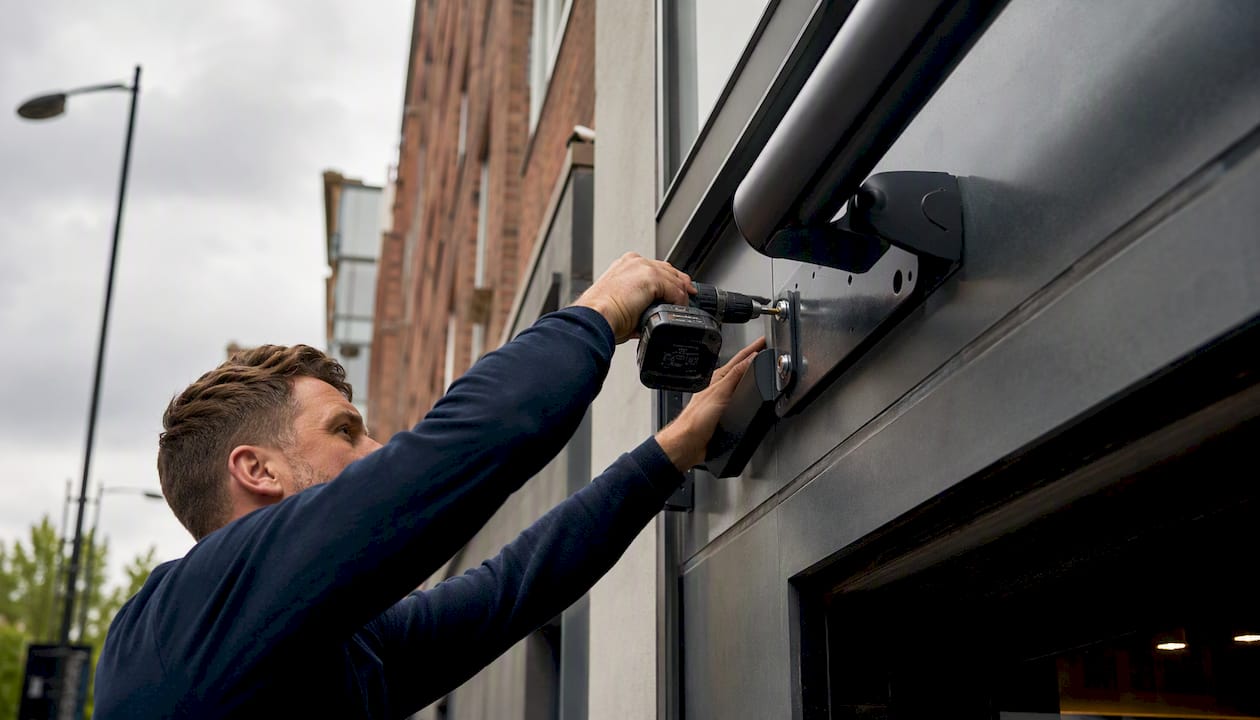
Most commercial awnings in the UK typically cost a few thousand pounds for supply and installation, with many café, restaurant and shopfront projects falling within a moderate cost range. This cost generally covers a standard fabric awning, a powder-coated aluminium frame, and a straightforward ground-floor installation. It does not include structural fixings to listed buildings, printed branding valances, scaffolding for upper-floor access, or dedicated electrical circuits for motorised systems.
According to the MyBuilder price guide, retractable awnings run from roughly £500 to £3,500 and fixed systems from £300 to £1,000, with installation typically adding £150–£500 on top. Those figures reflect domestic and light commercial work. For a fully specified commercial project with motorisation, wind sensors and a branded valance, budget from £3,000 upwards, and expect bespoke premium installs to exceed £6,000.
Entry-level commercial: £1,500–£3,000 (manual retractable or fixed canopy, plain fabric, ground floor)
Mid-range commercial: £3,000–£6,000 (motorised cassette, quality fabric, basic branding)
Premium/bespoke: £6,000–£12,000+ (large-span pergola or cassette system, full branding, sensors, LED lighting)
Infinityawnings works with manufacturers including Weinor, Llaza, Selt, Tarasola and Morvelle to cover all three tiers across Yorkshire, Derbyshire, Nottinghamshire and Lincolnshire.
Key takeaways
Most commercial awning projects in the UK typically cost several thousand pounds for supply and installation, with structural extras, branding and motorisation being common factors that can affect the budget.
Point | Details |
Typical cost range | Most commercial installs land between £2,500 and £8,000; bespoke or large-span systems exceed £10,000. |
Budget for extras | Scaffolding, electrical works and structural fixings can add £800–£1,500 to the headline price. |
Include a contingency | A 15% contingency on the total budget covers the unexpected items most quotes omit. |
Maintenance in OPEX | Annual servicing costs £100–£250; fabric recover every 7–12 years runs £400–£1,200. |
Infinityawnings next step | Book a free on-site survey with Infinityawnings to receive a full line-item commercial quote within 5 working days. |
Table of Contents
What does a commercial awning cost by type?
The spread between awning types is wider than most buyers expect. A plain fixed canopy over a shopfront entrance sits at a completely different price point from a motorised cassette system covering a restaurant terrace, even at the same width.
Manual retractable awnings are the entry point for most commercial buyers. A 4-metre manual arm awning in a commercial-grade fabric typically costs £1,200–£2,500 supply and install. They suit lower-traffic shopfronts and smaller café terraces where staff can operate the awning manually without inconvenience.
Motorised and cassette awnings are where most hospitality businesses end up. The cassette housing protects the fabric when retracted, which matters enormously on a busy high street exposed to wind and rain. Motorised systems commonly sit in the £3,000–£6,000 band, with larger or more complex installs going higher. Weinor and Selt both produce cassette systems in this range that Infinityawnings supplies and installs.
Fixed canopies and entrance awnings are structurally simpler and therefore cheaper per square metre, but they offer no retractability. A powder-coated steel or aluminium fixed canopy over a 3-metre shopfront entrance typically costs a few hundred to a few thousand pounds installed, varying with projection depth and cladding material.
Pergolas and covered walkways sit at the top of the range. A freestanding commercial pergola with a louvred or polycarbonate roof, suitable for a hotel terrace or school covered area, typically starts at £5,000 and can reach £15,000 or more for large-span bespoke structures. Tarasola and Morvelle systems, available through Infinityawnings, cover this category.
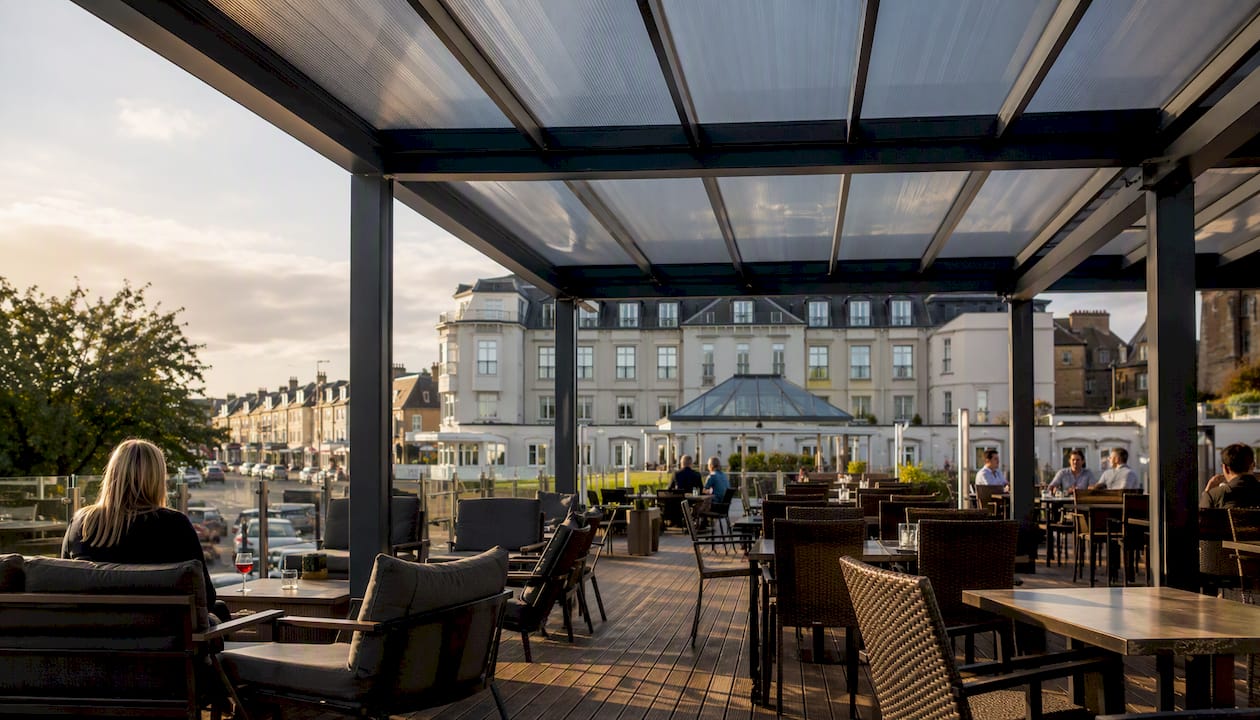
Branded shopfront awnings carry an additional cost layer. Custom shop awnings commonly cost between £1,000 and £10,000 depending on design, fabric, operating system and branding. A digitally printed valance with a business logo and colour-matched fabric can add £300–£800 to the base price of any system.
Pro Tip: If you are comparing manual versus motorised, factor in the operational reality. A busy restaurant terrace with 60 covers will use the awning dozens of times a day. A motorised system pays for itself in staff time and reduced fabric wear within a couple of seasons.
Typical sizes and indicative UK price bands
Size is the single biggest lever on price, but it does not scale linearly. A 6-metre awning costs less than twice a 3-metre one because the frame, motor and installation labour are largely fixed costs. Per-square-metre pricing tends to fall as the awning gets larger.
The MyBuilder guide cites a cost-per-square-metre estimate of £150–£450 for awnings generally. For commercial-grade systems with motorisation, the realistic range sits toward the upper end of that band.
Size (W × projection) | Type | Indicative supply + install |
3 m × 3 m | Manual retractable | £1,200–£2,500 |
4 m × 3 m | Motorised retractable | £3,000–£6,000 |
6 m × 3 m | Motorised cassette | £3,000–£6,000 |
8 m × 4 m | Motorised cassette, branded | £6,000–£12,000+ |
5 m × 4 m | Fixed canopy/pergola | £3,000–£6,000 |
These bands assume a straightforward ground-floor brick or masonry fixing, standard fabric grade, and a single-phase electrical supply already available nearby for motorised systems. Any deviation from those conditions adds cost.
A quick sanity check: divide the total quote by the covered area in square metres. For a commercial motorised system, anything below £150/m² is likely underspecified. Anything above £500/m² warrants a detailed breakdown to confirm what is included.
What extra costs should you budget for beyond the headline price?
The headline supply-and-install figure is rarely the final number on a commercial project. Several common extras catch buyers off guard, particularly on older buildings or first-floor installations.
Scaffolding and access: Ground-floor installations rarely need it. First-floor or fascia-mounted awnings on buildings above 4 metres typically require scaffolding, adding £300–£800 for a standard residential-scale rig. Larger commercial buildings can push this to £1,500 or more.
Electrical works: A motorised awning needs a fused spur or dedicated circuit. If one is not already in place, an electrician will charge £150–£400 to install one, depending on cable run length and consumer unit proximity.
Structural fixings and brick repairs: Older masonry, render or cladding may need specialist fixings or remedial work before the awning bracket can be safely loaded. Budget £200–£600 for this on buildings over 30 years old.
Removal of an existing awning: Stripping out an old frame and disposing of it typically adds £100–£300 to the job.
On-site survey: Most reputable suppliers, including Infinityawnings, offer a free on-site survey. If a supplier charges for this, it should be credited against the final invoice.
Transport and delivery: For large commercial systems, oversized frame sections may incur a delivery surcharge of £50–£150.
For projects combining awnings with outdoor heating or cooling, coordinating trades adds scheduling complexity. If you are also specifying commercial air conditioning for an adjacent indoor space, aligning both installations in a single site visit can reduce overall labour costs.
Pro Tip: Always ask for a written breakdown that separates supply, installation labour, electrical works and any structural items. A single lump-sum quote makes it impossible to compare suppliers fairly or to identify where costs can be trimmed.
What drives the price up or down the most?
Size, fabric specification and motorisation account for the majority of the variance between a £2,000 quote and a £7,000 one for nominally similar awnings.
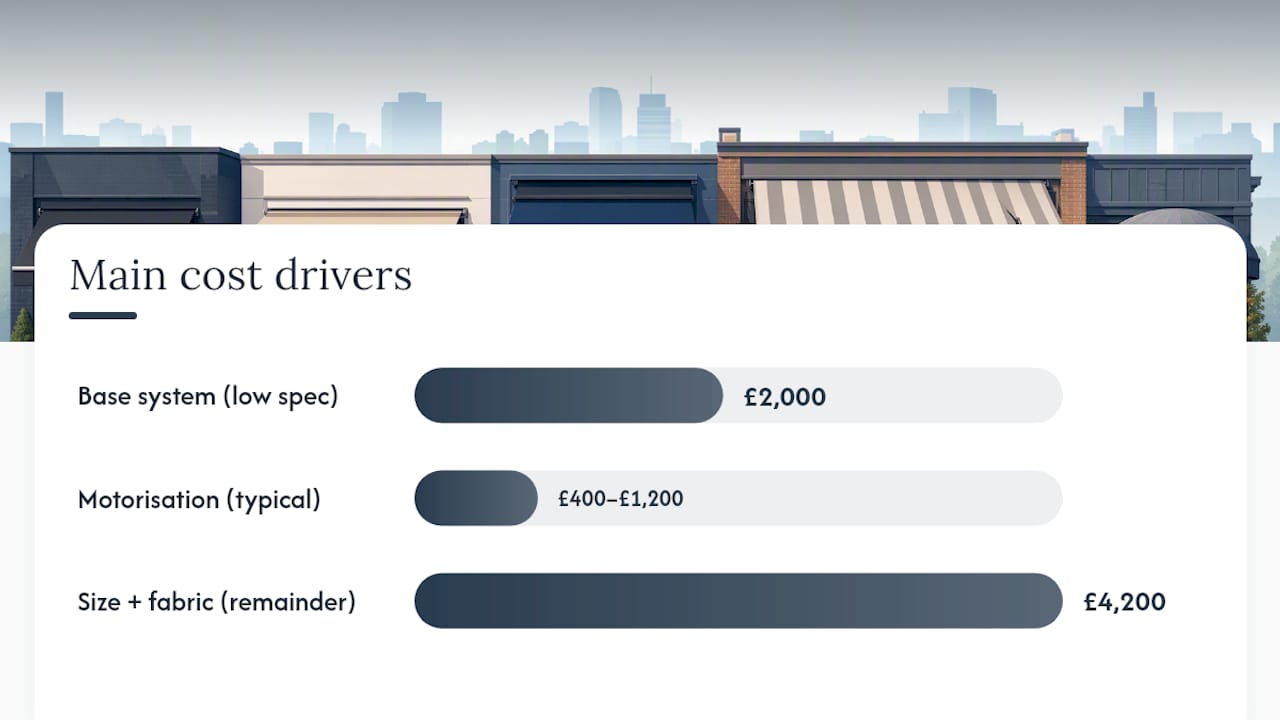
Size is the most obvious driver, but projection depth matters as much as width. A 3-metre projection requires longer arms, heavier fixings and a more robust frame than a 1.5-metre projection at the same width. Every extra metre of projection adds disproportionate structural load.
Fabric grade has a significant impact on both price and longevity. Entry-level acrylic fabrics are serviceable but fade faster under UV exposure. Solution-dyed acrylics from manufacturers like Sunbrella or Dickson, which Infinityawnings uses across its commercial range, carry a higher unit cost but resist fading and mildew far better over a 10–15 year service life.
Motorisation and controls add £400–£1,200 to the base system cost depending on motor brand and control type. A basic wall-switch motor sits at the lower end. A tubular motor with a rain sensor, wind anemometer and smartphone app integration sits at the top.
Secondary drivers, roughly in order of impact:
Wind-rating certification. A system rated to Beaufort 5 or 6 costs more than one rated to Beaufort 3, but it is often a planning or insurance requirement for exposed commercial sites.
Printed or branded valance. Digital printing on a replacement valance panel adds £300–£800 depending on complexity and fabric width.
LED lighting cassette. Integrated LED strips add £200–£500 and require the electrical supply already mentioned.
Infrared heaters. Bracket-mounted heaters add £300–£700 per unit, plus electrical works.
Side screens or wind barriers. Retractable side screens add £400–£900 per screen and extend the usable season considerably.
Warranty length. Systems backed by a 5-year manufacturer warranty (standard across Weinor and Llaza products supplied by Infinityawnings) typically cost more upfront than budget alternatives with 1–2 year cover.
Understanding the main cost drivers before you approach suppliers puts you in a much stronger position to challenge a quote or redirect spend toward the features that actually matter for your site.
Planning permission, listed buildings and health & safety obligations
Commercial awning installations are not always permitted development. Getting this wrong can mean enforcement action or an insurance void, so it is worth checking before you order.
When you likely need planning permission: Any awning projecting more than 1 metre over a public highway, any installation on a listed building, any structure that materially alters the external appearance of a building in a conservation area, and any freestanding pergola or canopy exceeding certain height thresholds. Contact your local planning authority before proceeding.
Listed buildings and conservation areas: Consent is almost always required. The specification may also be restricted to certain colours, materials or fixing methods. Factor in 8–12 weeks for consent and potential additional costs for heritage-compliant fixings.
Building control: Structural fixings for large commercial awnings may require a building notice or full plans application, particularly where the fixing loads are significant or the building is older. Your installer should advise on this; if they do not raise it, ask directly.
Wind-load certificates: For any commercial installation, request a wind-load calculation or manufacturer certificate confirming the system is rated for the site’s exposure category. This is a requirement for most commercial property insurers.
Public liability and PAT testing: Confirm that your installer holds public liability insurance of at least £2 million. For motorised systems, electrical components should be PAT tested and a commissioning certificate issued.
Signage regulations: A printed valance that carries a business name or logo may be treated as an advertisement under the Town and Country Planning (Control of Advertisements) (England) Regulations 2007. Express consent may be required in some locations.
Pro Tip: Ask your supplier to confirm in writing which of these obligations fall to them and which fall to you. A reputable installer will have navigated all of them before and will flag issues during the survey, not after the awning is up.
What does maintenance and repair cost over the awning’s lifetime?
A well-maintained commercial awning should last 10–15 years for the frame and 7–12 years for the fabric, depending on exposure and usage intensity. Maintenance is not optional on a commercial site; a failed awning over a public area is a liability issue.
Annual maintenance tasks and indicative costs:
Fabric clean (specialist treatment, mildew removal): £80–£200
Lubrication of arms, joints and gearbox: included in most service visits
Annual service visit from a certified fitter: £100–£250
Motor and sensor function check: included in service visit
Common repairs and typical price ranges:
Fabric awning repairs range from roughly £77 for minor patch work to £1,079 for extensive damage, with a typical mid-range repair around £462–£600.
Full fabric recover (replacing fabric on a sound frame): £400–£1,200 depending on size and fabric grade. Recovering an existing awning is often significantly cheaper than full replacement and can extend the structure’s life by another 7–10 years.
Motor replacement: £199–£450 for a standard tubular motor, plus labour.
Arm or bracket repair: £150–£400 depending on severity.
For a fuller breakdown of servicing tasks and schedules, the awnings repair and maintenance guide covers what to check and when.
Maintenance item | Frequency | Indicative cost |
Annual service visit | Yearly | £100–£250 |
Fabric clean | Yearly | £80–£200 |
Fabric recover | Every 7–12 years | £400–£1,200 |
Motor replacement | As needed | £199–£450 + labour |
Minor fabric repair | As needed | £77–£600 |
How to get accurate, comparable commercial awning quotes
Vague briefs produce vague quotes. The more precisely you specify the job before contacting suppliers, the easier it is to compare what you receive.
Before you contact anyone, prepare:
Measure the opening width and desired projection depth (see the awning measurement guide for the exact method).
Note the wall construction (brick, render, timber frame, cladding) and the floor level of the fixing point.
Confirm whether a power supply is available within 3 metres of the proposed motor position.
Decide whether you need branding on the valance and, if so, supply your brand guidelines.
Check whether your building is listed or in a conservation area.
Questions to ask every supplier:
What is the wind rating of the system, and do you provide a certificate?
Which manufacturer and model is the motor, and what is its warranty?
Does the quote include all fixings, electrical connection and commissioning?
Who holds public liability insurance for the installation, and to what value?
Is waste removal and disposal of any existing awning included?
What is the warranty on the fabric and the frame separately?
Does the price include an on-site survey, or is that charged separately?
Red flags in a quote:
No on-site survey offered before pricing (a remote quote for a commercial job is almost always incomplete).
A single lump-sum figure with no line-item breakdown.
No mention of wind-load rating or structural fixings.
Warranty under 2 years on a commercial system.
No reference to planning or building-control obligations.
The commercial awning installation guide explains what a thorough commercial quote should include at each stage.
Sample project costs from Infinityawnings
These illustrative examples reflect the kind of projects Infinityawnings handles across Yorkshire and the surrounding counties. Figures are indicative and based on typical project parameters.
Project A — Town-centre café, 4 m × 3 m motorised cassette awning, branded valance, ground floor: Supply and installation of a Weinor motorised cassette system in solution-dyed acrylic fabric with a digitally printed valance. Total: approximately £4,800–£5,500 including electrical connection and branded print. Lead time: 4–6 weeks from survey to installation.
Project B — Hotel terrace, 6 m × 3.5 m motorised cassette with wind sensor and LED lighting, first floor: Motorised Llaza cassette system, wind anemometer, integrated LED strip, scaffolding for first-floor fixing. Total: approximately £7,500–£9,500. Lead time: 6–8 weeks.
Project C — Retail shopfront, fabric recover on existing 5 m frame: Existing frame in sound condition; full fabric recover in new branded acrylic. Total: approximately £900–£1,400. Lead time: 2–3 weeks.
Lead times tend to lengthen between April and July as demand peaks. Booking a survey in February or March typically secures a May installation slot. Autumn bookings often carry shorter lead times and, occasionally, better availability on fabric stock.
What the industry gets wrong about commercial awning budgets
The standard advice is to get three quotes and pick the middle one. That is not wrong, but it misses the more expensive mistakes.
The biggest budget shortfall on commercial projects is almost never the awning itself. It is the structural and electrical works that nobody mentioned in the initial conversation. A supplier who quotes only the awning and says “we’ll sort the electrics on the day” is setting you up for a variation order. Structural fixings into older brick, render repairs after bracket installation, and a cable run from a distant consumer unit can collectively add £800–£1,500 to a job that looked straightforward on paper.
The second underestimated cost is branding. A printed valance sounds like a minor add-on. On a 6-metre awning with a full-colour logo and brand colours, it is a £500–£800 line item that often gets forgotten in the initial budget.
On the other side of the ledger, buyers sometimes over-invest in motorisation when manual operation would genuinely suffice. A small fixed canopy over an entrance that never moves does not need a £600 motor. Spend that money on a better fabric grade instead; it will last longer and look better throughout its life.
On a £5,000 project, that is £750 held back for the unexpected. In most cases it covers the electrical works or the scaffold hire that the initial quote did not include.
Infinityawnings’ commercial awning service
Infinityawnings brings over 15 years of commercial installation experience to projects across Yorkshire, Derbyshire, Nottinghamshire and Lincolnshire. Every commercial enquiry starts with a free on-site survey, where a certified fitter assesses the structure, confirms fixing points, checks electrical supply proximity and advises on planning obligations before a penny is committed.
Commercial quotes from Infinityawnings include a full line-item breakdown covering supply, installation, electrical connection (where applicable), and manufacturer warranty. Systems are sourced from Weinor, Llaza, Selt, Tarasola and Morvelle, with 5-year warranties standard across the range. Branding, LED lighting, wind sensors and side screens are all available as specified additions, priced transparently in the quote.
To book a free survey or discuss your project, visit the commercial pergolas and shading page or call the team directly. You will receive a written quote within 5 working days of the survey.
Sources
These are the primary sources used to assemble the price ranges and repair estimates in this guide. An on-site survey remains the only way to get a definitive commercial quote for your specific building.
Recommended
Comments