
Heatwave Patio Shade: Keeping a UK Patio Cool and Usable


The best heatwave patio shade is one that stops the sun before it reaches you and your windows, and that you can adjust as the sun moves. For most UK homes that means a retractable awning, a well-placed sail or a pergola with a fabric roof, used alongside the usual hot-weather habits. Below we compare the options, explain what to check before you buy, cover the planning basics and set out how to use a shaded patio safely when temperatures climb.
TL;DR
Shade outside the glass works best: the heat is stopped before it enters the house, and an awning does this for the patio and the rooms behind it.
Retractable awnings adjust to the sun’s angle and fold away. Sails need several anchor points. Pergolas give only partial shade unless you add fabric or another roof.
Before choosing, map where the sun falls through the day, how much rain cover you want and what you can fix the structure to.
Shade is one layer of protection. Keep drinking fluids, wear sunscreen and avoid the hours between 11am and 3pm outdoors.
A freestanding pergola may be covered by permitted development limits, but attached structures, listed buildings and conservation areas need checking with your local planning authority.
Table of Contents
Why shade matters when the heat arrives
A patio in full sun during a heatwave is not just uncomfortable, it is a health question. NHS heatwave advice says that if you have to go outside you should stay in the shade, especially between 11am and 3pm, wear sunscreen, a hat and light clothing, and avoid activity that makes you hotter. The same guidance, reproduced in a 2026 NHS hot weather toolkit, points to the hours when UV levels are highest and recommends SPF 30 or higher sunscreen with UVA protection, a wide-brimmed hat and sunglasses. It also says babies under six months should be kept out of direct sunlight.
Most people do not want to spend a heatwave shut indoors. A proper shaded outdoor area gives children, older relatives and the rest of the household somewhere to sit that is noticeably more comfortable than open lawn or bare paving.
There is a second benefit. The British Red Cross Overheating Adaptation Guide for Homes notes that shade sails or canopies over a patio can help keep both the inside and the outside of a home cooler. If your patio doors face south or west, the shade you put over the patio is also shade for the living room.
Why external shade beats shade inside the window
Curtains and internal blinds help, but the heat has already come through the glass by the time they act. The Red Cross guide describes external shading as blocking or reducing direct sunlight before it enters through windows or openings, and lists awnings, solar screens, louvres, shutters, brise soleil, trees and planters as examples.
The measured evidence points the same way. A Lund University solar-shading study found average solar-energy-transmittance values of 0.3 for external products, 0.5 for interpane products and 0.6 for internal products. Lower means less solar energy gets through. The same study reported that external shading was on average twice as effective as internal shading at reducing peak cooling loads, because heat absorbed outside is largely dissipated to the outdoor air. It was a Swedish study, so treat the figures as an indication of the principle rather than a promise for any particular UK home.

It is also worth seeing shade as part of a wider set of passive measures. If you are thinking about the whole house, a piece on roof treatment and cooling demand shows how roof and shading choices sit together in keeping a home cooler with less energy.
The main types of patio shade compared
The Red Cross guide lists natural tree shade, shade sails, retractable awnings, parasols, pergolas and gazebos as the usual options. They behave very differently in a heatwave.
Option | How it works | Best for | Watch out for |
Retractable awning | Fabric extends from the wall and retracts when not needed | Patios against the house; shade that follows the sun | Needs a sound wall or fixing point and correct projection |
Shade sail | Fabric fixed at several anchor points | Awkward shapes and freestanding areas | Needs strong anchor points and positioning for sun angle |
Pergola | Permanent open-roof frame | Defining an outdoor room | Often only partial shade unless fabric or a roof treatment is added |
Parasol | Movable canopy on a pole | Small tables and flexible use | Covers a small area; needs moving as the sun shifts |
Gazebo | Freestanding covered structure | Occasional use and gatherings | Less integrated with the house |
Trees and planters | Natural shade | Long-term, low-impact cooling | Takes years to grow and shade moves with the season |
Homebuilding’s UK comparison of garden sunshades says sails are relatively easy to install but their position must account for sun angle and the area you need to cover. It describes pergolas as permanent, assembled structures that usually give only partial shade unless fabric or another roof treatment is added.
Retractable awnings
For a patio attached to the house, a retractable awning is usually the most practical answer to a heatwave. You extend it when the sun is on the patio and fold it away on dull days or in high wind, so you keep light in the house for the rest of the year. Options such as electric operation, weather sensors, LED lighting and heaters can be added. You can read more about our retractable awnings and patio awnings.
Pergolas and verandas
A pergola gives the patio a permanent shape and a sense of being a room. On its own the open roof lets a good deal of sun through, so in a heatwave you want a fabric or louvred roof element. If you also want rain cover, a veranda is worth considering. See our pergolas and verandas.
Sails and parasols
Sails suit gardens where there is no wall to fix to, provided you have strong anchor points. Parasols are the cheapest way to get started and can be moved, but they only cover a small area and cannot protect the house behind the patio.
For a wider overview of the choices, our guide to types of outdoor shading solutions for UK homes goes through them in more detail.
How to choose shade that works in a heatwave
Start with the sun, not the product. Homebuilding advises considering the sun’s angle, the area that needs shade and the available anchor points, and also whether you want a permanent or adjustable option and whether you need rain shelter.
A simple way to do this:
Watch the patio for a day. Note when the sun reaches it, when it leaves and which side it comes from. A south-facing patio gets the high midday sun. West-facing patios get low, hot evening sun that a flat overhead cover may not block.
Decide the hours that matter. If you mostly use the patio for lunch and the afternoon, shade for 11am to 3pm is the priority, which matches the NHS advice on peak UV hours.
Measure the space you want covered. Include the table, seating and the route to the door, not just the table.
Check what you can fix to. Awnings need a suitable wall or support, sails need strong anchors, and pergolas need a solid base.
Choose fixed or adjustable. Adjustable options such as retractable awnings let you have shade in a heatwave and light on cooler days.
Think about rain and wind. Shade you cannot use in a British shower is shade you will use less often.
Our outdoor shading checklist for UK patios and the guide on how to choose outdoor awnings for UK patios cover the same decisions step by step.
UV protection, fabric and ventilation: what to look at
The fabric does the work, so it is worth understanding before you commit. Look at:
UV protection. Ask what level of UV protection the fabric offers and how it is specified. Our article on UV protection in awnings explains what to look for, and a second piece on safeguarding your outdoor space with UV protection goes further.
Fabric choice and colour. The material affects how long the awning lasts, how it looks and how it copes with weather. Our guides to retractable awning material options and how to select awning fabric compare the choices.
Airflow. A cover that traps hot air under it is less comfortable than one with open sides, so think about how air will move under it. Open-sided awnings and pergolas generally let air pass freely, and side screens can be added when you want to cut low sun.
Weather resistance. Operation by motor with a wind sensor means the awning can retract when conditions change, which protects the product when you are not there.
The point of all this is to match the specification to how you will use the patio, not to chase the most expensive option.
Planning and building rules for permanent shade
Movable shade rarely raises planning questions. Permanent structures can. For pergolas, Homebuilding’s planning guide says permitted-development limits may include a maximum height of 2.5 metres within 2 metres of a boundary, up to 4 metres for a dual-pitched roof or 3 metres for another roof type farther away, and coverage of no more than half the garden. It adds that attached pergolas, listed buildings, conservation areas, Article 4 areas and front gardens may need further checks.
The Planning Geek pergola guide adds that outbuilding limits include not being forward of the principal elevation and using the structure for an incidental domestic purpose such as outdoor dining, shade or relaxing. It also notes that flats and maisonettes do not have the same outbuilding rights as houses.
These are England-specific summaries and rules vary with your property. Before building anything fixed, ask your local planning authority, and if your home is listed or in a conservation area, do that first. We can talk you through what a design involves, but the final answer on planning always rests with the council.
Our view: shade you can control
We have spent over 15 years fitting shade across Yorkshire, Derbyshire, Nottinghamshire and Lincolnshire, and the same lesson keeps coming back: the patios people use most in a heatwave are the ones where the shade can be adjusted. A fixed roof is a commitment. A retractable awning with a motor and a sun or wind sensor gives you the heat protection when the sun is on the patio and gives you the light back when it is not. For a south or west-facing house, we think that is the best starting point, and we can add a pergola or veranda when you want a more permanent outdoor room. We work with premium brands including Weinor, Llaza, Selt, Tarasola and Morvelle, and we choose between them on what suits your property rather than pushing one range. Our approach is consultative and without pressure: we look at the sun, the walls, how you use the space and your budget, then recommend what fits. For businesses, the same thinking applies. A bar, restaurant or hotel terrace that stays comfortable on the hottest days is one customers keep using. For schools and nurseries, shade over play and gathering areas is a sensible part of looking after children outdoors. Andrew
Shade for homes, businesses and schools
The needs differ by setting, though the principles are the same.
Homes. Cover the patio and, ideally, the glazing behind it. Our residential awnings and canopies are designed around this.
Hospitality and shops. A terrace that is comfortable at lunchtime in July earns more covers. Commercial installations need to be robust, easy to operate for staff and sized for the seating plan. See our commercial awnings and canopies.
Schools, nurseries and colleges. A British Safety Council article from 2026, citing Climate Change Committee recommendations, describes shading and blinds as passive cooling measures and calls for cooling in critical settings including schools and care settings. For children, NHS-aligned advice is to keep them indoors or in the shade during peak hours. Our outdoor solutions for schools include canopies and playground shade.

Get shade planned before the next heatwave
We design, supply and install retractable awnings, pergolas and verandas for homes and businesses across Yorkshire, Derbyshire, Nottinghamshire and Lincolnshire, and we also repair and maintain existing installations. Options include manual or electric operation, a choice of fabrics, LED lighting, heaters, weather sensors and side screens.
Tell us about your patio and we will give you a free quote. See our retractable awnings, pergolas and verandas or go straight to patio awnings.
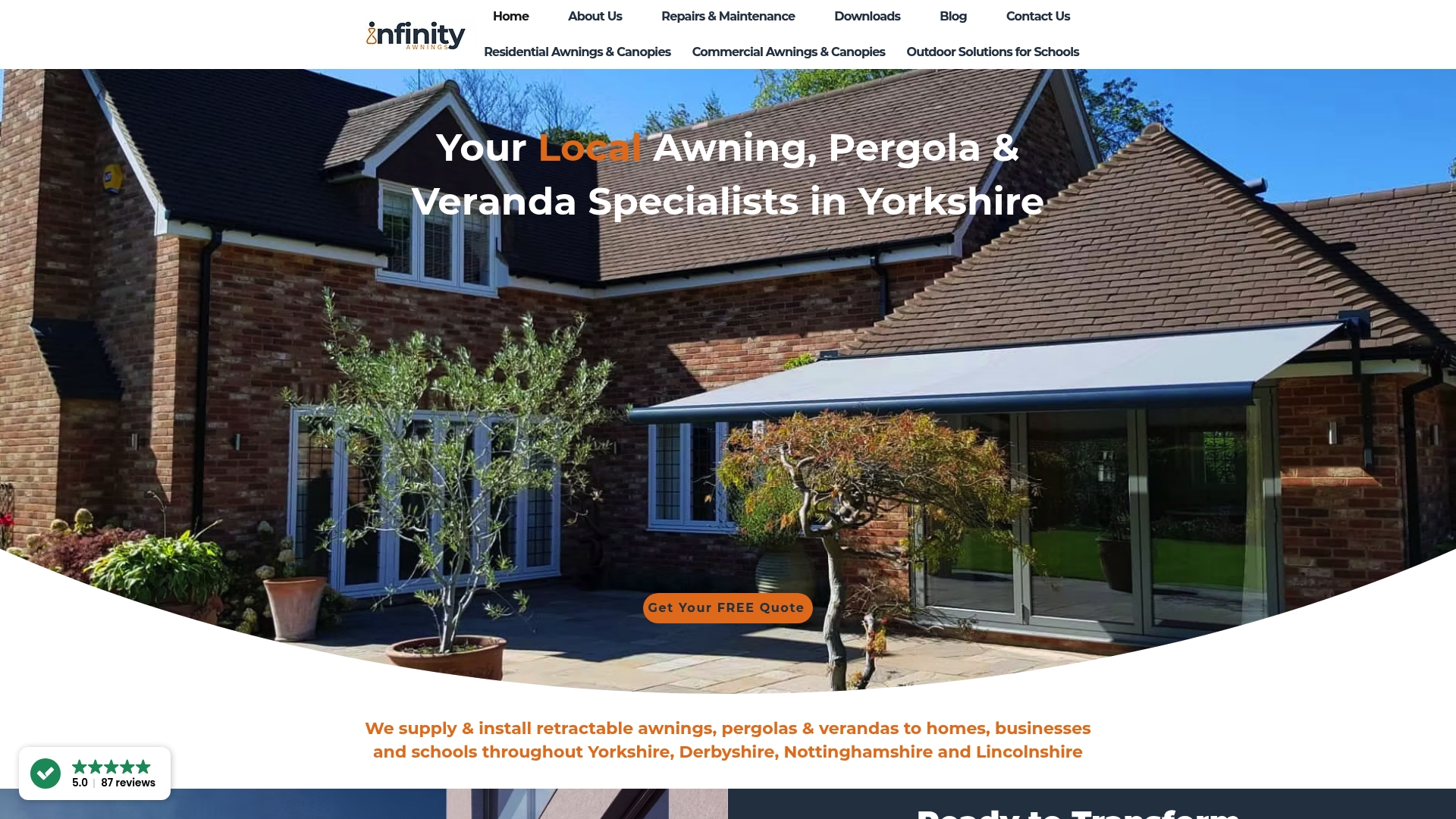
If you want to read more first, our article on the benefits of outdoor shading explains comfort and energy gains, and how to choose awnings for stylish outdoor shade walks through choosing one.
Using a shaded patio safely in hot weather
Shade lowers the risk but does not remove it. UKHSA and NHS advice treats shade as one layer of protection, to be combined with sunscreen, suitable clothing, hydration and timing activity away from peak heat and UV.
Drink more cold drinks, avoid too much alcohol and avoid extreme exercise. NHS guidance on heat exhaustion also says to move to shade or a cooler place if heat exhaustion develops.
Apply sunscreen even when sitting under an awning, and wear a hat, because shade does not block every bit of UV.
Keep babies under six months out of direct sunlight.
Know the emergency signs. The NHS says to call 999 for suspected heatstroke if a person remains unwell after 30 minutes of cooling, or has a very high temperature, hot skin without sweating, fast breathing or heartbeat, confusion, a seizure or loss of consciousness.
With an awning or sail, keep it in good condition, check fixings at the start of summer and retract it in strong wind. If you have a motorised system, a wind sensor does that automatically. Our maintenance and repair service can check an existing installation.
FAQ
What is the best shade for a patio in a UK heatwave?
For a patio against the house, a retractable awning is usually the most practical choice because it blocks sun before it reaches the glass and can be folded away. Pergolas with a fabric roof or a veranda suit people who want permanent cover. Parasols and sails work for smaller or freestanding areas.
Do I need planning permission for patio shade?
Movable parasols do not, and many freestanding pergolas fall within permitted development limits such as height and garden coverage. Attached structures, listed buildings, conservation areas and front gardens need extra checks. Ask your local planning authority before building anything permanent.
Is external shade better than blinds inside?
Yes, as a rule. A Lund University study found external shading roughly twice as effective as internal shading at reducing peak cooling loads, because heat is stopped and dissipated outside. Internal blinds still help as an extra layer.
Is it safe to sit under an awning all day in a heatwave?
Shade helps, but you still need sunscreen, a hat and plenty of cold drinks, and you should avoid strenuous activity at peak hours. If anyone shows signs of heat exhaustion, move them to a cool place, and call 999 for signs of heatstroke.
Sources
Recommended
Comments