
Hotel terrace awning workflow: 2026 business guide

TL;DR:
A hotel terrace awning workflow involves careful planning, professional installation, and ongoing maintenance to enhance outdoor comfort and prevent operational issues. Proper site assessment, phased installation, and regular servicing ensure the longevity and functionality of the shade structures. Treating awnings as critical assets rather than decorative features optimizes guest experience and maximizes revenue potential.
A hotel terrace awning workflow is the structured process of planning, installing, and maintaining commercial shade structures to maximise outdoor comfort and visual appeal for hospitality venues. Done well, it turns an underused terrace into a revenue-generating space that works in all seasons. Done poorly, it creates operational headaches, guest complaints, and costly repairs. This guide gives hotel and restaurant owners a clear, step-by-step framework covering site assessment, professional installation, daily operation, and ongoing maintenance, drawing on industry-standard practices from brands like Weinor, Tarasola, and Selt.
What does a hotel terrace awning workflow actually involve?
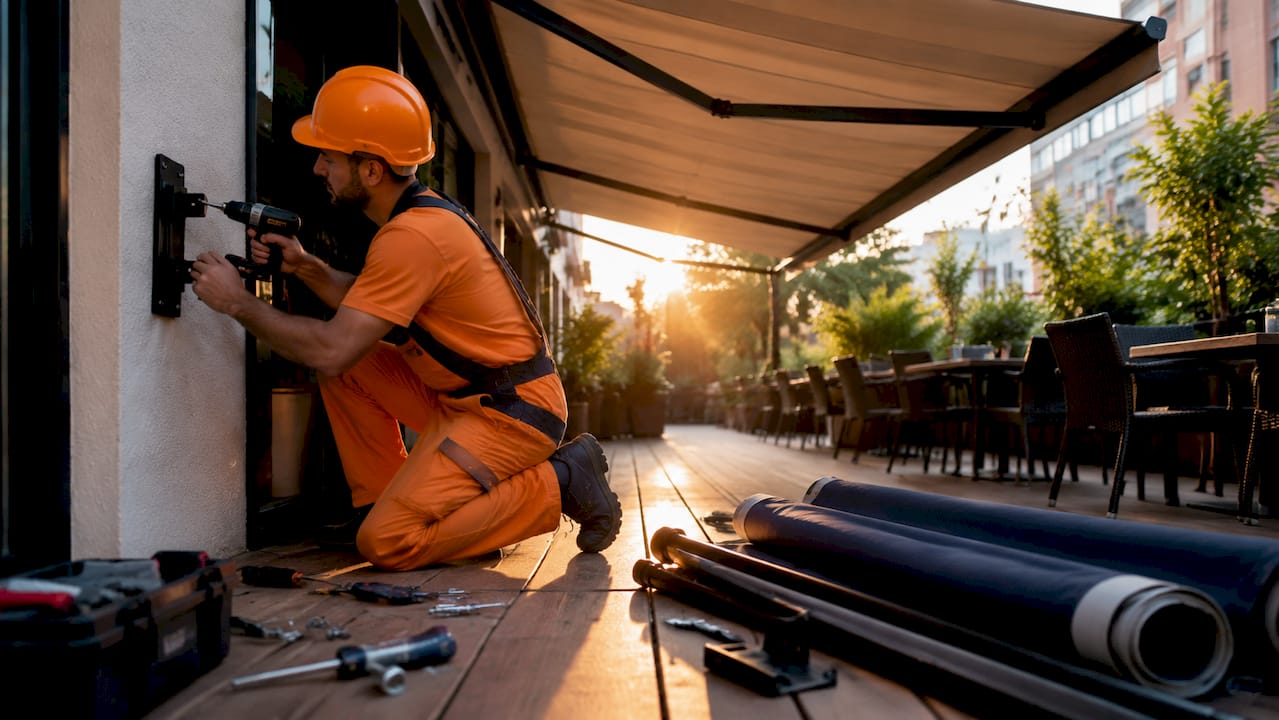
A commercial awning workflow covers three distinct phases: pre-installation planning, the installation itself, and ongoing operational management. Each phase has specific requirements that directly affect guest experience and the lifespan of your investment. Skipping steps in any phase is where most hospitality businesses lose money.
Awnings installed near glazed façades reduce solar heat gain and improve indoor comfort. That single benefit alone can increase your terrace’s operational capacity year-round. The broader point is this: a terrace shade structure is not a decorative extra. It is an operational asset that requires the same structured management as any other piece of commercial equipment.
The industry term for the full scope of this process is commercial shading project management. You will encounter this phrase when working with professional installers. Understanding it helps you ask the right questions and hold suppliers accountable at every stage.
What prerequisites must you check before awning installation?
Site assessment is the foundation of every successful outdoor awning installation. Rushing past it causes structural failures, drainage problems, and costly rework. Before any supplier visits your terrace, you need answers to four critical questions.
1. What is your mounting surface?Mounting on non-load-bearing surfaces such as insulation cladding causes structural failure. Fixings must anchor into concrete, steel, or masonry. If your terrace wall has composite cladding or render, custom bracket engineering is likely required. Always confirm this with your installer before ordering.
2. What pitch angle does your terrace allow? The minimum pitch angle is 10–14 degrees for effective rainwater runoff. Below this threshold, water pools on the fabric, accelerating deterioration and creating a safety hazard for guests below.
3. Do you have the right power supply? Motorised systems require a 210–250V power supply with a consumption of 230–300W. If your terrace lacks a dedicated outdoor circuit, factor electrical work into your project timeline and budget before installation day.
4. Do you need permissions or approvals? Listed buildings, leasehold properties, and venues within conservation areas often require landlord consent or planning permission for external structures. Confirm this early. A delayed approval can push your installation back by weeks during peak season.
Prerequisite Check | What to Confirm | Tool or Resource Needed |
Mounting surface type | Load-bearing substrate confirmed | Structural survey or installer assessment |
Pitch angle | Minimum 10–14 degrees achievable | Spirit level, site drawings |
Power supply | 210–250V outdoor circuit available | Electrician’s report |
Permissions | Landlord or planning consent obtained | Lease review, local authority check |
Scheduling | Installation timed to avoid peak service | Operational calendar review |
Pro Tip: Book your site assessment during a quiet trading period. Installers need unobstructed access to mounting walls and roof edges, and a busy service period makes accurate measurement difficult.
How to install a terrace awning: step-by-step commercial workflow
Professional consultation and customised design development is the correct starting point for any commercial awning installation. Generic off-the-shelf solutions rarely account for the specific drainage, lighting, and heating integration requirements of a working hotel terrace.
Follow this sequence for a well-managed installation:
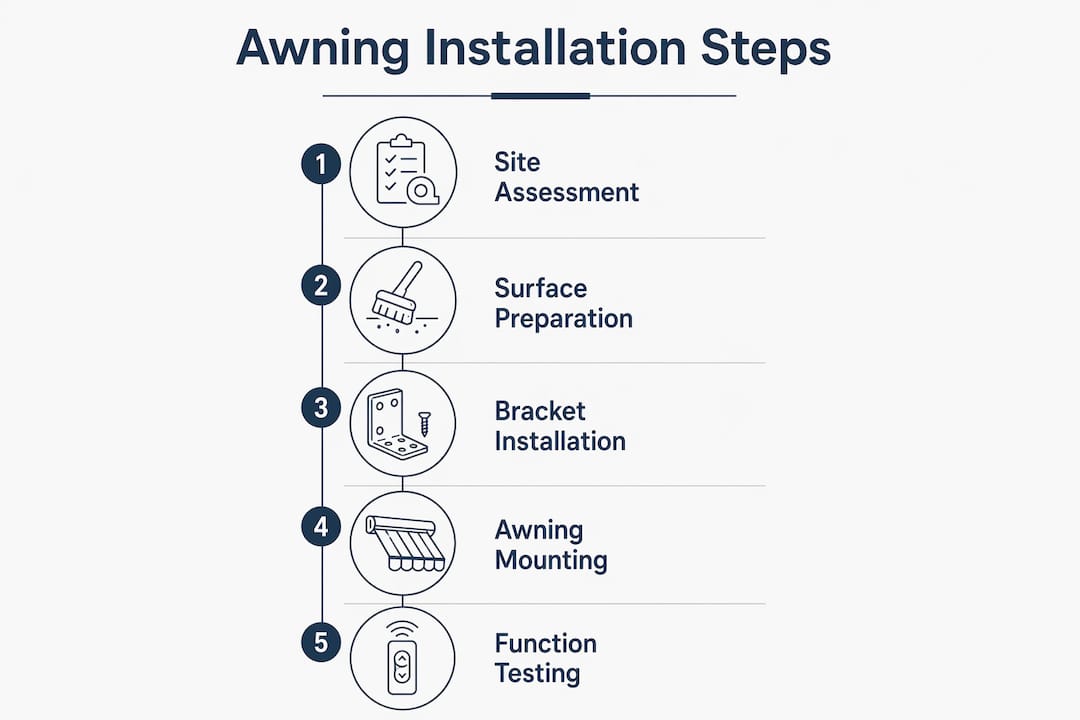
Engage a specialist installer for a full site survey. Confirm substrate type, pitch angle, power availability, and any structural engineering requirements. Suppliers like Infinityawnings provide this as part of their consultation process.
Develop a customised design brief. Specify fabric type, colour, operation method (manual or motorised), and any integrated features such as LED lighting or infrared heaters. This brief becomes the contract document.
Plan installation in phases. Phased scheduling keeps parts of the terrace open during installation, protecting your revenue and respecting service hours. A single-day full closure is rarely necessary for most hotel terrace projects.
Conduct a pre-installation walk-through. Define staging areas and circulation zones before any equipment arrives on site. Mark pathways clearly so guests and staff can move safely around the work area.
Prepare the mounting surface. Drill pilot holes and install anchor bolts into the confirmed structural substrate. Never allow fixings to terminate in surface cladding or insulation board.
Assemble and mount the awning frame. Assembly typically takes 45–60 minutes for a standard unit, though full installation including electrical integration may extend across a phased schedule. Confirm the pitch angle with a spirit level before final tightening.
Integrate electrical and automation systems. Connect motorised drives to the outdoor circuit. Install weather sensors if specified. Test retraction and extension cycles fully before signing off.
Brief your team on operation. Staff must know retraction wind speed thresholds, sensor override procedures, and who is responsible for daily checks.
Pro Tip: Never sign off an installation without a full wet-weather test. Run the awning extended during rainfall to confirm drainage direction and check for pooling before your first busy service.
How should you manage daily operation and maintenance?
Daily operation of a motorised hotel terrace awning is straightforward when staff protocols are clear. The system should retract automatically when wind speeds exceed 20–25 mph. If your installation includes a weather sensor, confirm it is calibrated correctly at the start of each season. Manual override must be understood by at least two members of staff per shift.
Consistent maintenance is what separates a ten-year awning from a three-year one. Follow these awning maintenance tips as a minimum standard:
Conduct a visual inspection monthly, checking fabric tension, seam integrity, and bracket fixings.
Clear debris from the fabric surface after every storm. Leaves and standing water accelerate mould growth.
Clean the fabric with a soft brush and mild soap solution every three months. Rinse thoroughly and allow to dry fully before retracting.
Lubricate moving parts using a silicone-based dry spray only after cleaning. Never use WD-40 or heavy grease. Both attract dirt and form a grinding paste in joints that accelerates wear.
Schedule a professional deep clean and mechanical inspection annually, or every six months for high-use terraces.
Task | DIY Approach | Professional Service |
Fabric cleaning | Soft brush and mild soap; effective for surface dirt | Deep clean removes embedded grime and treats mould |
Mechanical inspection | Visual check of brackets and fixings | Torque testing, motor diagnostics, and bearing replacement |
Lubrication | Silicone spray on accessible joints | Full mechanism service including internal drive components |
Frequency | Monthly visual; quarterly clean | Annual or bi-annual depending on usage level |
Pro Tip: Schedule your professional service in late february or early march, before the summer season begins. Availability is higher and you avoid the rush that hits most commercial installers from april onwards.
What are the most common awning problems and how do you fix them?
Fabric sagging is the most frequent complaint from hotel operators. It almost always traces back to incorrect pitch angle during installation or fabric tension that has loosened over time. Retension the fabric at the roller and recheck the pitch. If the angle is below 10 degrees, the mounting position needs adjustment.
Motor malfunctions typically fall into two categories: sensor faults and drive unit failures. Sensor faults are usually resolved by recalibration. Drive unit failures require a qualified engineer. Automation reduces staff workload compared to manual operation, but it does require periodic professional attention to keep the system reliable.
Drainage problems appear as water pooling at the front edge or running back towards the building. Both indicate a pitch angle problem or a fabric that has stretched beyond its designed tension. Address this before the fabric sustains permanent damage.
Issue | Manual Awning Workflow | Motorised Awning Workflow |
Weather response speed | Staff must act manually; delay risk during service | Sensor triggers automatic retraction within seconds |
Daily operation effort | High; requires trained staff each time | Low; automated cycles with manual override available |
Maintenance complexity | Simpler mechanics; fewer components | Requires motor and sensor servicing annually |
Guest experience impact | Dependent on staff availability | Consistent and reliable regardless of staffing levels |
Integrated features like heating and LED lighting extend terrace usability into shoulder seasons, directly increasing covers and revenue. This is the optimisation step most hotel operators overlook when planning their initial installation. A terrace that closes in october because it is too cold is a missed opportunity that a well-specified awning system can solve.
Key takeaways
A well-executed hotel terrace awning workflow requires confirmed structural fixings, correct pitch angle, phased installation, and a consistent maintenance programme to protect both the investment and guest experience.
Point | Details |
Confirm substrate before ordering | Fixings must anchor into concrete, steel, or masonry to prevent structural failure. |
Maintain 10–14 degree pitch | Correct angle prevents water pooling and fabric deterioration from the first day of use. |
Phase your installation | Staggered scheduling keeps the terrace trading and protects revenue during the project. |
Use silicone spray only | Never lubricate with WD-40 or heavy grease; both accelerate joint wear over time. |
Add heating and lighting | Integrated features extend seasonal usability and increase terrace profitability year-round. |
What i have learned after 15 years of commercial awning projects
The single biggest mistake I see hotel and restaurant owners make is treating an awning purchase like buying furniture. They focus entirely on colour and style, then hand the project to whoever quoted lowest. Six months later, the fabric is sagging, the motor is unreliable, and the terrace is half the asset it should be.
The operators who get this right treat their terrace shade structure the same way they treat their kitchen equipment. They ask about service intervals before they ask about price. They want to know who maintains it, how quickly parts are available, and whether the installer will still answer the phone in three years. That mindset produces better outcomes every time.
I have also seen the phased installation approach save businesses that initially resisted it. One hotel I worked with insisted on a single-day installation to minimise disruption. The result was a full terrace closure on a saturday in july. A phased approach across two early-morning sessions would have cost the same and kept the terrace earning. The commercial awning installation guide we follow at Infinityawnings builds phasing in as standard for exactly this reason.
My honest advice: choose your installer based on their maintenance offer, not just their installation price. The best awning in the world underperforms without a structured servicing programme behind it.
— Andrew
Upgrade your hotel terrace with Infinityawnings
Infinityawnings has delivered commercial awning solutions across Yorkshire, Derbyshire, Nottinghamshire, and Lincolnshire for over 15 years, working with hotels, restaurants, and bars to create outdoor spaces that earn their keep. Every project starts with a full site survey and a bespoke design brief, covering fabric selection, motorised operation, and integrated features like LED lighting and infrared heaters.
If your terrace needs a shade solution that works as hard as your team does, explore the Infinityawnings range of bespoke pergolas and awnings designed specifically for hospitality settings. Request a free quote and site assessment today to get your 2026 terrace season off to the right start.
FAQ
What is a hotel terrace awning workflow?
A hotel terrace awning workflow is the structured process of planning, installing, and maintaining commercial shade structures on a hotel or restaurant terrace. It covers site assessment, phased installation, daily operation, and scheduled servicing.
What pitch angle is required for a commercial terrace awning?
The minimum recommended pitch angle is 10–14 degrees. This angle ensures effective rainwater runoff and prevents water pooling on the fabric surface.
How often should a hotel terrace awning be serviced?
Monthly visual inspections and quarterly fabric cleaning are the minimum standard. A professional deep clean and mechanical check should be carried out annually, or every six months for high-use terraces.
Should i choose a motorised or manual awning for my hotel terrace?
Motorised awnings are the better choice for commercial settings. They respond automatically to weather sensors, reduce reliance on staff, and deliver a more consistent guest experience than manual systems.
What fixings are safe for commercial awning installation?
Fixings must anchor into a structural substrate such as concrete, steel, or masonry. Mounting into surface cladding or insulation board causes failure and is not safe for commercial use.
Recommended
Comments