
How to enhance outdoor comfort in your garden

TL;DR:
Proper shading significantly reduces outdoor heat and enhances comfort by blocking up to 80% of solar radiation.
Effective outdoor zones, weather-resistant furniture, layered lighting, and well-placed plants create inviting spaces tailored to your family’s needs.
Most gardens look great in photos but feel awkward in practice. Whether it’s the glare bouncing off your patio at midday, furniture pushed to the edges like a waiting room, or no shade to speak of, getting to grips with how to enhance outdoor comfort takes more than buying a new set of chairs. This guide covers the full picture: assessing your space, choosing shade, arranging furniture, building atmosphere, and keeping your family safe and hydrated throughout the season. Start here and you’ll spend more time outside.
Table of Contents
Key takeaways
Point | Details |
Shade is non-negotiable | Well-positioned awnings and pergolas can block up to 80% of solar radiation, dramatically lowering outdoor temperature. |
Zone your space deliberately | Plan separate areas for dining, lounging, and conversation rather than arranging furniture along the perimeter. |
Choose weather-resistant materials | UV-resistant fabrics and quick-dry foam cushions maintain comfort and durability through sun and rain. |
Layer your lighting | Combining ambient, pathway, and focal lights lets you adjust the atmosphere for different moods and occasions. |
Hydrate before you feel thirsty | Thirst is a late sign of dehydration; proactive drinking is the single easiest health habit for outdoor enjoyment. |
How to enhance outdoor comfort: start with an honest assessment
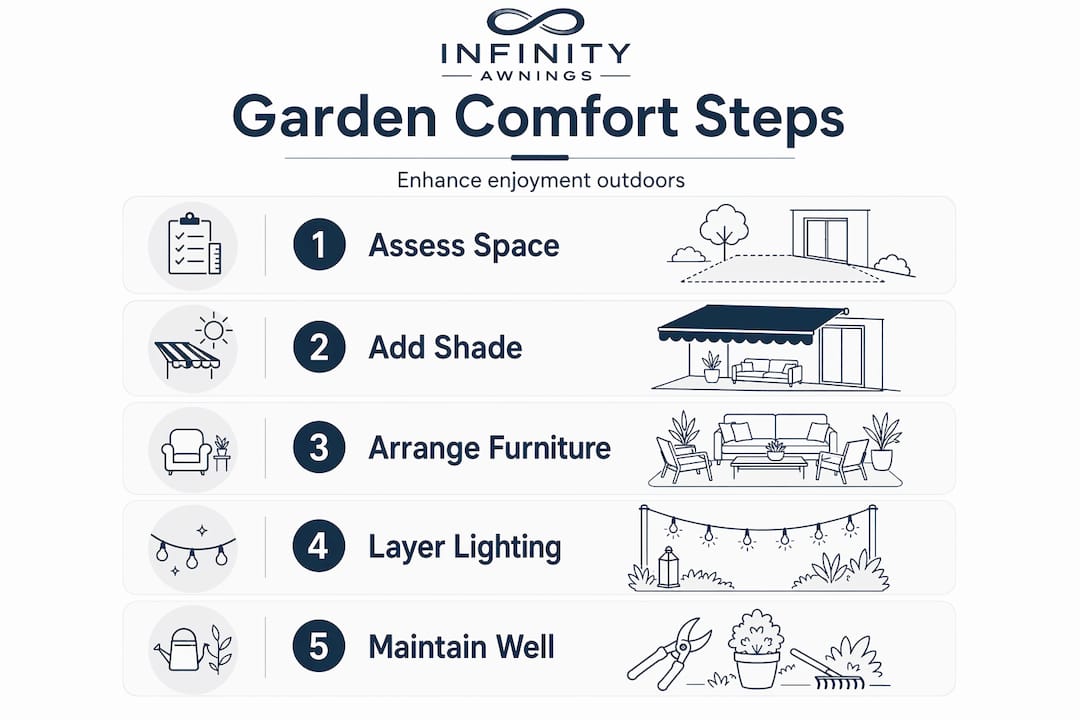
Before spending a penny, walk your outdoor space at different times of day. Where does the sun land at noon? Where is it shady by mid-afternoon? Engineered planning of outdoor zones is consistently more effective than arranging things on impulse and hoping they work.
Make a rough sketch of your garden or patio. Mark where the sun tracks, where draughts come from, and which areas currently have any natural cover. Then think about how you actually use the space, or how you want to. Most gardens benefit from at least three distinct zones: one for dining, one for relaxed lounging, and one for children to play or guests to gather informally.
Here is a quick reference for the key things to assess and what you will need:
What to assess | What to consider | Useful tools or materials |
Sun exposure | Which areas get direct sun, and when | Compass app, site visit at 10am and 2pm |
Wind direction | Prevailing winds that may reduce comfort | Local weather data, observation |
Existing features | Trees, walls, fences providing cover | Tape measure, garden plan sketch |
Activity zones | Dining, lounging, play areas | Graph paper or free garden planner app |
Budget range | Cost of furniture, shading, and lighting | Online quotes, Infinityawnings free quote service |
Once you know your space honestly, every decision that follows becomes clearer and cheaper. You stop solving problems you do not have and start fixing the ones that actually keep you from going outside.
Shading solutions that make a real difference
Shade is where most outdoor comfort improvements begin and end. Shading can reduce Mean Radiant Temperature by up to 10°C in hot conditions, which is the kind of change you feel immediately rather than measure on a thermometer. Pergolas, retractable awnings, shade sails, and large free-standing umbrellas all serve different purposes, so matching the solution to your space matters.
Here is how the main options compare in practical terms:
Pergolas offer a permanent, architectural feel with maximum coverage. They suit larger patios and gardens where a defined outdoor room is the goal. See Infinityawnings’ pergola installation guide for a detailed walkthrough on getting the most from this option.
Retractable awnings give you flexibility. You get full shade on hot days and open sky when you want it. They attach to the house wall and can be motorised, making them practical for families and older homeowners.
Shade sails are a lower-cost option for covering irregular spaces. They work well over sandpits or casual seating areas but offer less protection against heavy rain.
Market umbrellas are the most portable and affordable choice. They suit smaller spaces or areas where permanent structure is not possible.
Positioning matters as much as the type of shading you choose. Well-placed awnings and pergolas can prevent indoor temperatures from climbing 5 to 6°C during summer months by blocking solar radiation before it reaches glass doors and windows.
Pro Tip: If you have a south-facing patio in Yorkshire or the East Midlands, prioritise east-to-west coverage to intercept the sun at its highest point between 11am and 3pm. This is when UV intensity peaks and shade has the greatest impact on both comfort and safety.
Broad-spectrum SPF 30+ sunscreen remains important even when you have good shade, since reflected and diffused UV rays still reach you under a pergola or awning. Apply it 15 to 30 minutes before heading outside and reapply every two hours.
Choosing and arranging furniture for real relaxation
Good outdoor furniture is not just about looks. The materials need to survive British weather without rotting, fading, or rusting after one season. Powder-coated aluminium, treated hardwood like teak or acacia, and synthetic rattan are all solid options. UV-resistant fabrics and quick-dry foam cushions maintain their colour and shape through repeated exposure to sun and rain, so they are worth paying for.
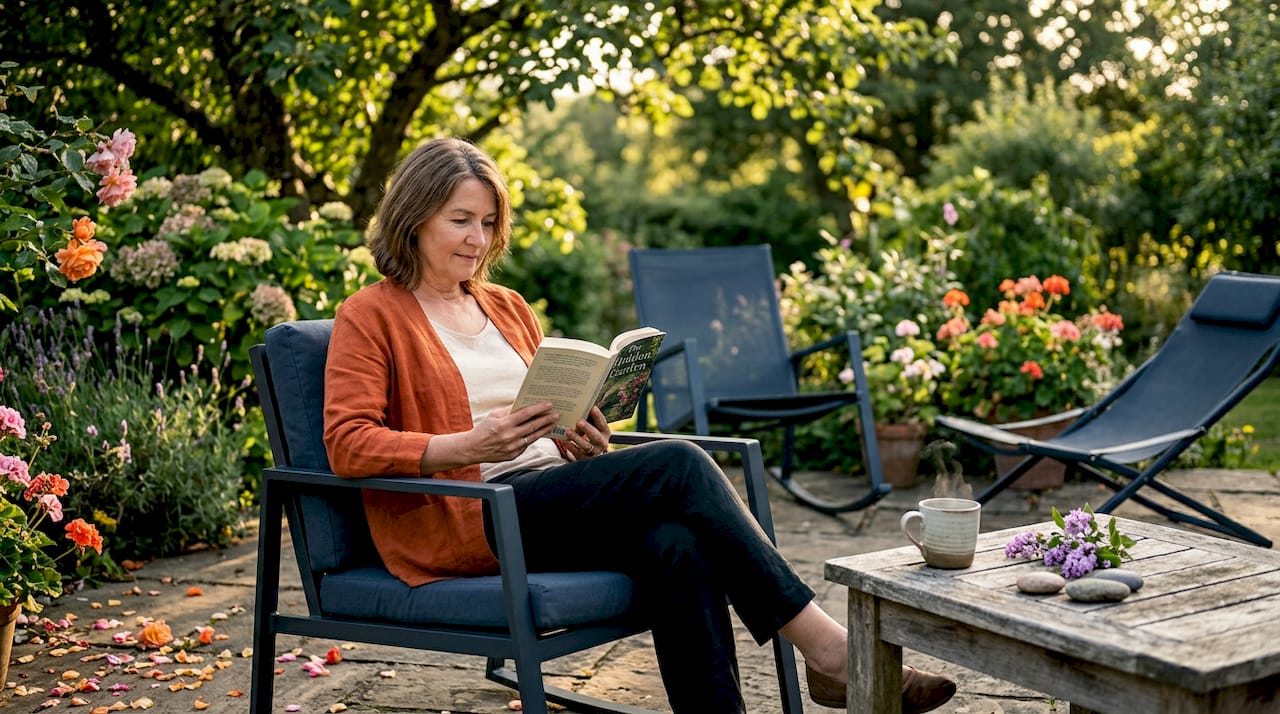
Where most people go wrong is the arrangement. Pushing all your furniture to the perimeter of a patio creates dead space in the middle and makes conversations feel like shouting across a room. Instead, pull pieces together and arrange seating in conversational groupings with roughly 2 to 3 feet of walkable space around each cluster. The result feels more like a living room than a car park.
Mixing seating types helps too. Combining a dining set with a lounge sofa and a pair of individual chairs gives different family members what they need without overcrowding the space. Look at smart furniture choices for smaller spaces if your garden is compact; modular pieces that stack or fold are far more adaptable than large fixed sets.
Consider these finishing touches for warmth and personality:
Outdoor rugs to define zones and add softness underfoot
Weatherproof throws or blankets for cool evenings
Scatter cushions in UV-stable fabrics to add colour without replacing the entire set
Side tables within arm’s reach of every seat so drinks and books have a home
Pro Tip: Buy at least one piece of furniture that moves easily, such as a lightweight rocker or folding lounger. Being able to follow the shade or the sun gives you flexibility that no fixed arrangement can match.
Lighting, plants, and water features for atmosphere
Once the structure and furniture are right, the atmosphere is what keeps people outside past 9pm. Layering lighting with string lights, pathway lights, and focal features creates genuinely different moods for a family dinner versus a quiet evening alone. Dimmable options let you shift from bright and practical to warm and relaxed without swapping bulbs.
Pathway lights serve both safety and aesthetics. They define the edges of your zones, guide guests safely after dark, and add a polished feel without any grand investment. Solar options have improved considerably and work well across most of the UK during spring, summer, and autumn.
Plants do three things that no product can replicate: they provide natural privacy screening, add fragrance that changes the sensory quality of the space, and create a visual backdrop that makes furniture look considered rather than dropped in. Tall grasses, lavender, and climbing roses along a trellis are all low-maintenance choices that reward you quickly.
“Spending even a few minutes in nature reduces stress. The value of any outdoor space comes down to whether it has a spot tailored to your comfort that genuinely draws you outside.” Source: Houzz
Water features deserve more credit than they typically get. A small tabletop fountain or wall-mounted water blade adds a sound layer that masks road noise and creates a feeling of seclusion, even in an urban garden. Keep safety in mind if young children use the space; covered or raised designs remove the drowning risk entirely.
Hydration, sun safety, and keeping the space well maintained
No amount of great design compensates for feeling rough on a hot afternoon. Heat-related illness, including heat exhaustion and heat stroke, is preventable, and the combination of shade, hydration, and sensible timing prevents almost all cases.
Follow these steps to keep your family comfortable and safe during warm spells:
Drink water before you go outside, not when you start to feel thirsty. Thirst is a late indicator of dehydration, and by that point your concentration and energy are already dipping.
Apply sunscreen 15 to 30 minutes before exposure and reapply every two hours. “Water resistant” does not mean waterproof. Products specify 40 or 80 minutes of resistance, after which reapplication is needed regardless.
Wear a hat and sunglasses in addition to relying on shade. Reflected UV from light-coloured paving still reaches the face and eyes.
Plan a quick retreat route. Know where you will go if a summer shower arrives or the temperature spikes unexpectedly. A covered veranda or retractable awning makes this effortless.
Store cushions and throws in a weatherproof box or garden storage unit between uses. Consistent care extends the life of fabrics by years, not months.
UV exposure accelerates fluid loss, which is why shade and hydration work together rather than independently. Treating them as separate concerns is a common mistake that leaves families feeling drained mid-afternoon without quite knowing why.
My honest take on what actually makes a garden work
I’ve seen hundreds of outdoor spaces across Yorkshire and the East Midlands over more than fifteen years, and the pattern is consistent. The gardens that genuinely get used are not the most expensive ones. They are the ones that were planned with real life in mind.
The most common mistake I come across is treating the garden as a single open space with furniture dropped in roughly. Zoning changes everything. When you create an area that is specifically for lounging, complete with shade overhead and a side table nearby, people gravitate towards it naturally. They stop standing around and start relaxing.
I’d also push back on the idea that comfort comes last, after you’ve sorted the aesthetics. In my experience, the opposite is true. Get the comfort right first: shade, seating, surface, light. The personality of the space, the plants, the colours, the decorative touches, all of that comes together more easily once the fundamentals are sorted.
The spaces I’ve watched fall flat are almost always missing one thing from that comfort list. A gorgeous patio with no shade above it sits empty from May to September. A well-shaded area with nowhere comfortable to sit becomes a thoroughfare rather than a destination. Small maintenance habits, keeping cushions dry, checking fixings annually, and replacing worn fabric before it looks tired, extend the enjoyment of a space by years.
Tailor the space to your family. If you have young children, open ground for play matters. If you entertain, a generous dining zone with good lighting earns its investment back within a season. There is no universal answer, only an honest assessment of how you actually live.
— Andrew
Transform your outdoor space with Infinityawnings
If shading is the missing piece in your outdoor space, Infinityawnings has been designing and installing pergolas, verandas, and retractable awnings across Yorkshire, Derbyshire, Nottinghamshire, and Lincolnshire for over 15 years. Their products, drawn from premium brands including Weinor and Tarasola, combine genuine durability with a design quality that genuinely improves the look and feel of a garden or patio.

Whether you want a stylish garden pergola that creates a defined outdoor room, or a year-round veranda that gives you cover whatever the weather brings, Infinityawnings offers fully customisable options with professional installation included. Features like integrated LED lighting and electric heating extend your outdoor season comfortably into autumn. Request a free quote directly on the Infinityawnings website and take the first practical step towards an outdoor space your family will actually use.
FAQ
How much can shading lower outdoor temperature?
Well-positioned shading structures can reduce Mean Radiant Temperature by up to 10°C and block up to 80% of solar radiation, according to recent thermal comfort research. This translates to a genuinely more usable space on hot summer days.
What is the best furniture material for UK outdoor spaces?
Powder-coated aluminium, treated hardwood such as teak or acacia, and synthetic rattan are all reliable choices for the UK’s mixed climate. Pair them with UV-resistant, quick-dry cushion fabrics for lasting comfort.
How should I arrange outdoor furniture for socialising?
Pull seating into conversational groupings rather than pushing chairs to the perimeter. Leave 2 to 3 feet of walkable space around each cluster and mix seating types to accommodate different preferences.
How often should I reapply sunscreen outdoors?
Reapply broad-spectrum SPF 30 or higher sunscreen every two hours, or sooner if you have been swimming or sweating. “Water resistant” products specify either 40 or 80 minutes of protection before reapplication is needed.
What outdoor lighting works best for ambiance in the evening?
Layering string lights for ambient warmth, pathway lights for safety and definition, and a focal point such as a lantern or wall-mounted light gives you the most flexibility. Dimmable fittings let you shift the mood without changing the setup.
Recommended
Comments