
Safety considerations for school awnings explained

TL;DR:
School awnings often fail due to improper mounting into non-structural surfaces, risking collapse in wind. Proper installation involves fixing brackets to wall studs or masonry using load-rated fasteners and maintaining operational wind thresholds with sensors. Regular inspections, fire safety compliance, and proactive retraction protocols are essential to ensure long-term safety and durability.
School awnings fail far more often than they should, and the cause is almost never the product itself. The safety considerations for school awnings that matter most — correct structural mounting, weather response protocols, material certification, and routine inspection — are regularly underestimated by facility managers who treat awnings as low-priority installations. In Yorkshire, Derbyshire, Nottinghamshire, and Lincolnshire, where wind and rain are reliable visitors, that underestimation carries real consequences. Students gather beneath these structures daily. Getting the details right is not optional.
Table of Contents
Safety considerations for school awnings: mounting and installation
The single biggest risk with any school awning is not the fabric, the frame, or the weather. It is where and how the brackets are fixed to the building. Mounting must secure into structural framing like wall studs using load-rated anchors at a 5 to 15 degree pitch for water runoff, avoiding non-structural materials entirely to prevent collapse risks.
This matters because buildings in older school estates across the region often feature substantial render, cladding, or composite siding on their exterior walls. Fixing brackets to that surface alone is not fixing to the building. It is fixing to a layer that was never designed to bear dynamic loads. When the wind catches an extended awning, the force transferred to those brackets is far greater than most people expect.
Here is what correct installation actually requires:
Structural substrate first: Identify wall studs, concrete, or masonry behind the surface finish before any bracket goes up. A fixing into stud framing holds under load. A fixing into render does not.
Load-rated fasteners: Use stainless steel bolts for timber-framed substrates and chemical anchors (resin-bonded fixings) for masonry. Standard wood screws are not appropriate for overhead structures near students.
Pitch angle between 5 and 15 degrees: This is the operational angle of the awning arm, not just aesthetics. Too flat and rainwater pools on the fabric, stretching the weave, stressing the frame, and accelerating deterioration.
Avoid flat mounting entirely: A zero-degree pitch looks clean on paper but creates a water reservoir. The weight alone can compromise brackets over a season.
For schools procuring awnings for the first time, the school awning installation guide on this site walks through each stage in plain language. It is worth reviewing before speaking to any contractor.
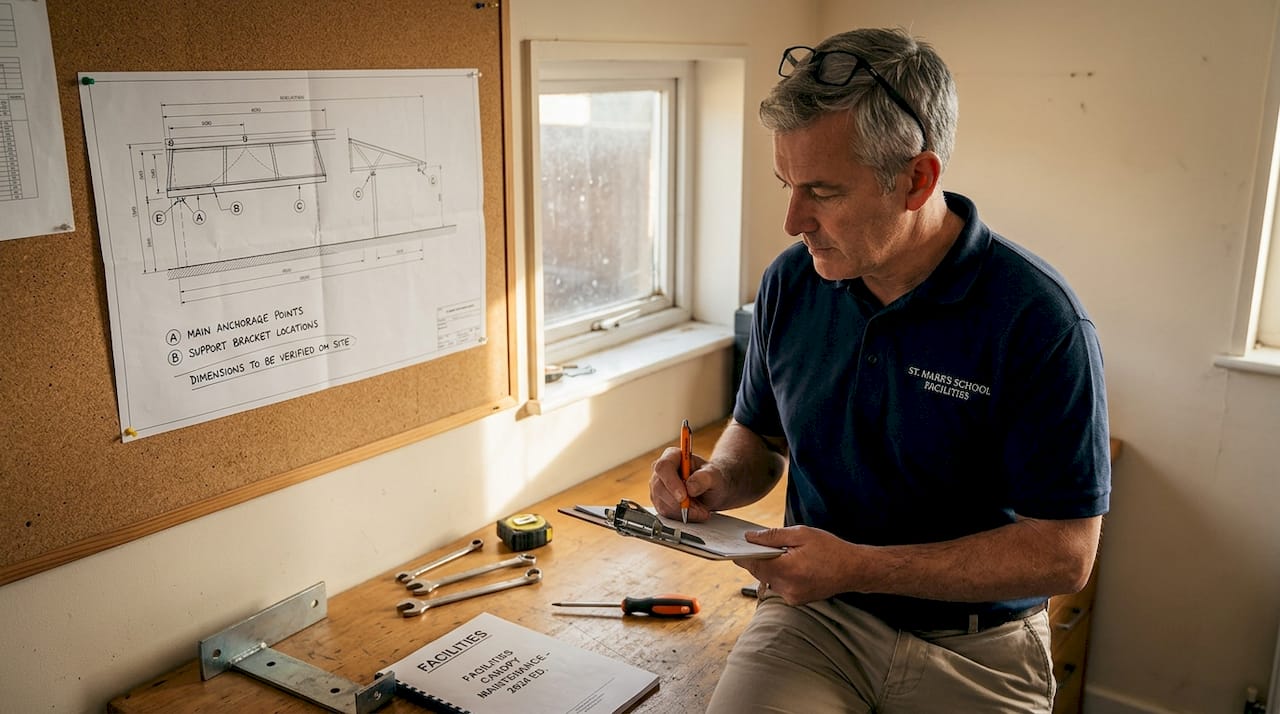
Pro Tip: Before installation day, ask your installer to identify every substrate fixing point on a marked-up elevation drawing. If they cannot produce one, that is a warning sign.
With installation fundamentals clear, next we explore weather-related risks and operational safety around school awnings.
Managing wind and storm conditions for school awnings
Wind is the most common cause of awning damage in the UK, and yet the retraction protocols in most schools are informal at best. Awning safety guidelines around wind resistance are built on the Beaufort scale, a standardised measure of wind speed that runs from 0 (calm) to 12 (hurricane force). Most commercial-grade retractable awnings carry a wind resistance rating, typically expressed as a Beaufort class.
Understanding what that rating means in practice is essential. Here is a comparison of relevant Beaufort levels and their implications for school awning operation:
Beaufort level | Wind speed (mph) | Description | School awning action |
3 | 8 to 12 | Gentle breeze | Safe to extend |
4 | 13 to 18 | Moderate breeze | Monitor and consider retracting |
5 | 19 to 24 | Fresh breeze | Retract immediately |
6 | 25 to 31 | Strong breeze | Never extend, risk of damage |
7+ | 32+ | Near gale and above | Structural risk regardless of rating |
Retractable school awnings should be retracted before storms when winds reach 20 to 25 mph (Beaufort 4 to 5), and should never be left extended in gusts exceeding their rated class to avoid damage or injury. This is not a conservative recommendation. It is the operational threshold most manufacturers set.
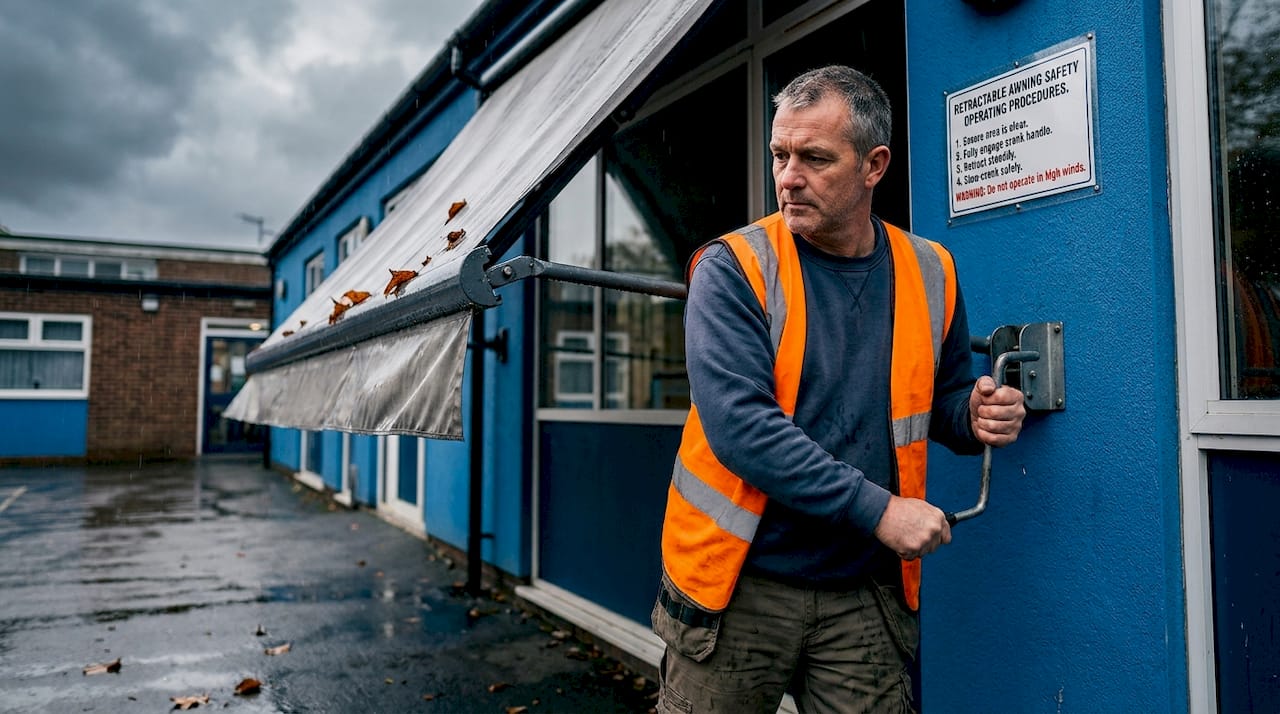
The moment winds exceed your product’s rated value, retract the awning immediately. This applies even briefly, because awning arms are designed for sustained loads, not sudden gusts.
A practical storm protocol for schools should follow this sequence:
Check the Met Office forecast each morning when wind is predicted to exceed 18 mph at any point during the school day.
Assign a named member of facilities staff as awning duty holder for each day.
Retract all awnings before Beaufort 5 conditions arrive, not when they arrive.
After heavy rain, snow, or hail, inspect fabric and frame before next extension.
Log all weather-related retractions in a facilities diary for maintenance reference.
“The moment the wind exceeds your product’s specific rated value, you should immediately retract the awning.” Waiting until you can see or hear the problem is always too late.
Where budget allows, automatic wind sensors remove human judgement from the equation entirely. They attach directly to the awning structure, detect vibration and pressure changes, and trigger motorised retraction without any staff input. For schools where outdoor areas may be in use without close adult supervision, this is a meaningful safety upgrade. Review the awning regulations in Yorkshire for local compliance detail relevant to your site.
Pro Tip: Even if your awning has a manual crank mechanism, fitting a separate anemometer (wind speed meter) with an audible alarm near the covered area gives staff a clear trigger point without guesswork.
Now that weather risks are understood, we turn to the materials and fire safety standards important for school awnings.
Fire safety standards and material considerations for school awnings
Outdoor awnings are not typically the first item on a school fire risk assessment, but they should not be the last either. When an awning is fixed above a doorway, beside a window, or over a walkway, its fire behaviour becomes relevant to safe evacuation and to the fire load of the building envelope.
The governing standard is BS EN 13501-1:2018, which provides the harmonised European method for classifying how materials behave when exposed to fire conditions, including ignitability and smoke production. For schools, the classifications to look for when specifying awning fabric are:
A2-s1,d0: Very limited combustibility, minimal smoke, no flaming droplets. This is the highest practical class for textile products and appropriate for awnings positioned near primary escape routes or building openings.
B-s2,d0: Nearly non-combustible, low smoke contribution, no droplets. Suitable for most school outdoor areas where the awning is not directly adjacent to glazing or doorways.
Avoid unclassified or C-rated fabrics: Standard decorative canopy materials without fire certification are not appropriate for educational buildings, regardless of cost savings.
Beyond the classification letter, check that the certification is current. Fire-rated coatings on fabric can degrade over time, particularly when fabric is regularly wet and dried through the British seasons. Fabric that was certified at installation may not meet the same standard five years later if it has not been maintained correctly.
Procuring fire-rated school awnings is not a significant cost premium over standard products when sourced correctly. The compliance benefit and the reduction in liability exposure make it straightforward to justify.
With safe materials chosen, the article next covers practical installation and maintenance steps to keep awnings secure and functional.
Ongoing maintenance and inspection for safety and longevity
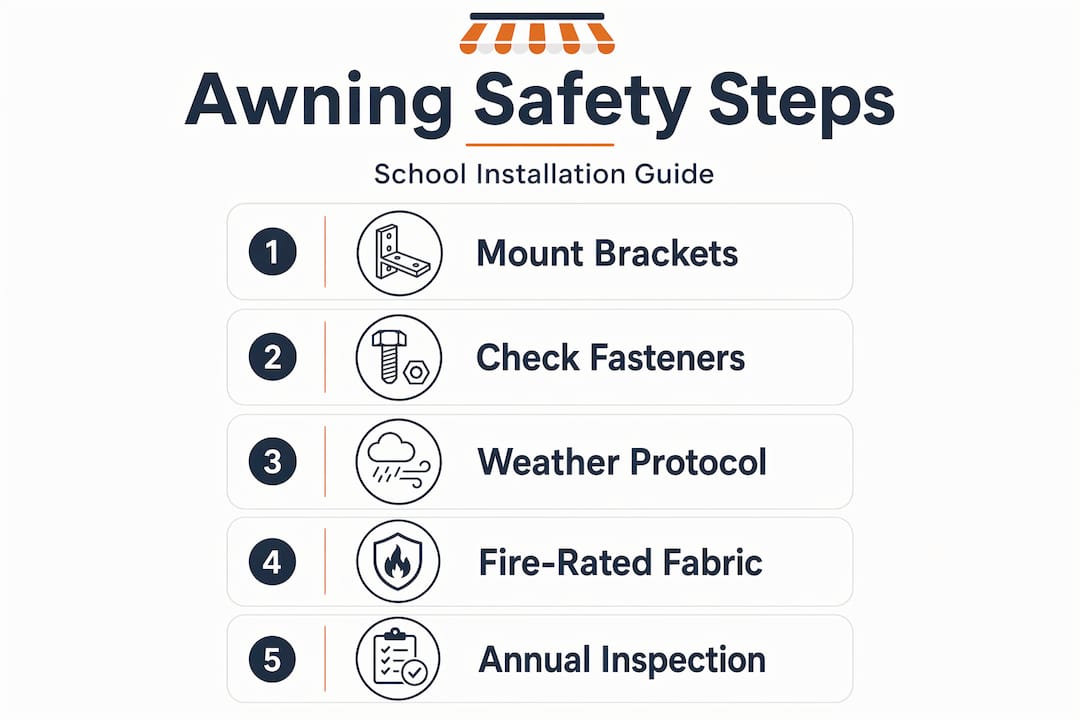
An awning that passes installation day safely can still become a hazard two or three years later if nobody has looked at it closely in the interim. Awnings and student safety are linked directly by what happens between installations, and post-installation maintenance is minimal but important for maximising awning lifespan, including annual bracket checks and biannual fabric cleaning.
The following sequence covers what a thorough maintenance programme looks like in practice:
Annual structural inspection: Check every mounting bracket and fastener for loosening, corrosion, or movement. Stainless steel fasteners resist corrosion well, but galvanic corrosion can still occur where dissimilar metals meet. Any movement in a bracket under manual pressure is a failure point.
Biannual fabric cleaning: Use a mild soap solution and a soft brush. Avoid pressure washers, which can drive water into seams and degrade waterproof coatings. Cleaning in spring and autumn aligns well with the school calendar.
Pivot joint and arm bearing check: Extend the awning fully and watch for uneven tension, jerky movement, or squealing from any arm. These are early signs of bearing wear. Addressing them early costs very little. Ignoring them costs the arm assembly.
Post-storm inspection: After any Beaufort 5 or above event, inspect fabric for stress marks, seam separation, or distortion before the awning is used again.
Staff training: Every member of facilities staff who might need to retract an awning in an emergency should be shown the process, including where the manual override is on motorised units.
Reviewing the school awning maintenance steps on this site provides a printable reference your team can keep in the facilities office.
Pro Tip: Photograph every bracket fixing point during annual inspection and date the images. This creates an evidence trail that is genuinely useful if a fault appears and you need to demonstrate it was not present at the last inspection.
Having covered upkeep, we now offer a unique perspective on why overlooking these safety steps risks severe consequences for schools.
Why most school awning safety failures are avoidable and how to prevent them
After years of working with schools across Yorkshire and the surrounding counties, the pattern is consistent. When an awning fails, the investigation almost always leads to one of two places: the bracket fixing or the retraction decision. Roughly 80 percent of premature awning failures trace back to improper anchoring or mounting techniques. That figure is not surprising to anyone who has seen what passes for an awning installation on a school building where cost was the dominant factor.
The uncomfortable truth is that many of these failures are not freak weather events. They are the result of an awning being mounted into siding because nobody checked what was behind it, or a member of staff waiting until the awning was visibly shaking before deciding to retract it. Both scenarios are entirely preventable.
Schools that treat awnings as furniture rather than fixed structures will consistently underinvest in installation quality and skip the inspections that catch problems early. Schools that treat them as building-mounted equipment with defined operational limits, clear staff responsibilities, and annual sign-offs have a fundamentally different safety record.
The investment case for doing this properly is strong. A quality awning professionally installed into structural framing, with a wind sensor and a maintenance log, will serve a school for fifteen years or more. One that is mounted incorrectly, left out through a storm, and never inspected will cause damage and possibly injury within three to five years. The difference in capital cost is modest. The difference in long-term liability is not.
Our position is this: every school awning should have a named responsible person, a written retraction protocol, and a maintenance schedule attached to it from day one. Treating proper school awning installation as a one-time event rather than the beginning of an ongoing commitment is where most problems start.
Discover durable pergolas and awnings tailored for schools
At Infinity Awnings, we design, supply, and install awnings and pergolas specifically suited to the demands of school environments across Yorkshire, Derbyshire, Nottinghamshire, and Lincolnshire. Every product we specify is matched to the structural conditions of your building, the operational needs of your site, and the weather patterns of the region.

Our school pergolas and awnings are sourced from reputable manufacturers including Weinor and Tarasola, with fire-rated fabric options, motorised operation, and compatible wind sensor integration available as standard choices. We provide professional installation by experienced engineers who fix into structural substrates, not surface finishes. We also offer scheduled maintenance visits to keep your awning performing safely year after year. Contact Infinity Awnings today for a free consultation and find out which solution fits your outdoor spaces best.
Frequently asked questions
What is the safest way to mount a school awning?
Secure the mounting brackets directly into structural framing such as wall studs or concrete, using load-rated fasteners appropriate for the substrate, and never attach to non-structural materials like render or siding to prevent collapse risk.
When should we retract retractable school awnings during bad weather?
Retract awnings before winds reach 20 to 25 mph (Beaufort 4 to 5), and also ahead of heavy rain, hail, or snow, to prevent structural damage and protect students beneath them.
Are fire-rated awning fabrics necessary for schools?
Yes. Fabrics certified under BS EN 13501-1:2018 with classifications such as A2-s1,d0 offer very limited combustibility and minimal smoke generation, which supports both fire safety and educational building compliance.
How often should school awnings be inspected and maintained?
Inspect mounting points and fasteners annually, clean fabric with mild soap twice yearly, and check arm bearings and pivot joints each time you conduct a visual inspection to catch wear before it becomes a safety issue.
Can smart wind sensors improve awning safety in schools?
Yes. Advanced sensors detect 3D vibration and automatically retract motorised awnings when conditions become unsafe, providing reliable protection even when no member of staff is present to make the call manually.
Recommended
Comments