
Exterior shading explained: optimise comfort and style

TL;DR:
Choosing the right exterior shading is crucial for managing solar heat gain, enhancing comfort, and reducing energy costs. Proper design involves assessing site orientation, weather exposure, and balancing sun control with daylight and glare management. Customized, site-specific solutions outperform generic products, ensuring year-round usability, aesthetic appeal, and effective climate adaptation.
Most people assume that any shade structure does the same job. Put something over a patio, block the sun, done. But the type of shading you install, where you position it, how it angles and adjusts, and whether it suits Yorkshire’s unpredictable weather all make an enormous difference to real-world comfort, usability, and even the running costs of your home or business. Understanding those differences before you invest is not just useful — it is essential.
Table of Contents
Key Takeaways
Point | Details |
Block sun before windows | External shading stops heat and glare before they enter your home, keeping interiors cooler and more comfortable. |
Match solution to climate | Choose fixed or louvred shades for windy regions; use retractables only where their limits suit your needs. |
Tailor design for sunlight | Effective shading is calculated using sun angles and building orientation for optimal performance all year. |
Balance daylight and protection | Aim for solutions that keep glare out but daylight in — smart design avoids dark interiors. |
Evaluate practical trade-offs | No system is perfect; weigh adjustability, automation, and maintenance against comfort and appearance. |
Why exterior shading matters for homes and businesses
Solar heat gain is one of the biggest contributors to overheating in buildings across Yorkshire, Derbyshire, Nottinghamshire, and Lincolnshire — and it is far more manageable than most property owners realise. When sunlight hits glass, it converts to radiant heat inside the room. Once that heat is in, it is genuinely difficult to move without mechanical cooling. External shading works best because it intercepts solar energy before it ever touches the glass, preventing heat from entering in the first place.
“Well-designed external shading doesn’t just make a patio more pleasant — it changes how the whole building breathes. Block summer sun before it reaches the glass and you remove the heat at source, not after the fact.”
This principle explains why two properties with identical interiors can feel completely different in summer: one has external shading positioned correctly, the other relies on curtains and fans. The results vary dramatically, and shade solutions that make patios usable also reduce the heat load on adjacent rooms, which lowers cooling costs over time.
For businesses such as restaurants, hotels, and bars across our region, the stakes are even higher. An unusable terrace in July is lost revenue. An overheated function room in August is a reputational issue. Investing in well-engineered shading is genuinely about the bottom line.
Here is what good exterior shading should deliver:
Reduced overheating in rooms adjacent to shaded glass
Usable outdoor spaces for most of the warmer months
Lower energy costs by cutting cooling demand before it even builds
Improved comfort for occupants indoors and out, year-round
Enhanced kerb appeal and property value
The connection between outdoor space and well-being is well established. Spending time outside reduces stress, improves mood, and increases productivity. None of that happens if your patio is an oven by 2pm. The UK benefits for homes from exterior shading go well beyond aesthetics.
Types of exterior shading solutions: strengths and trade-offs
Understanding the main categories of shading helps you match the solution to your actual priorities. There is no single best option — the right choice depends on what you value most and how exposed your property is. Here is a breakdown of the most common systems:
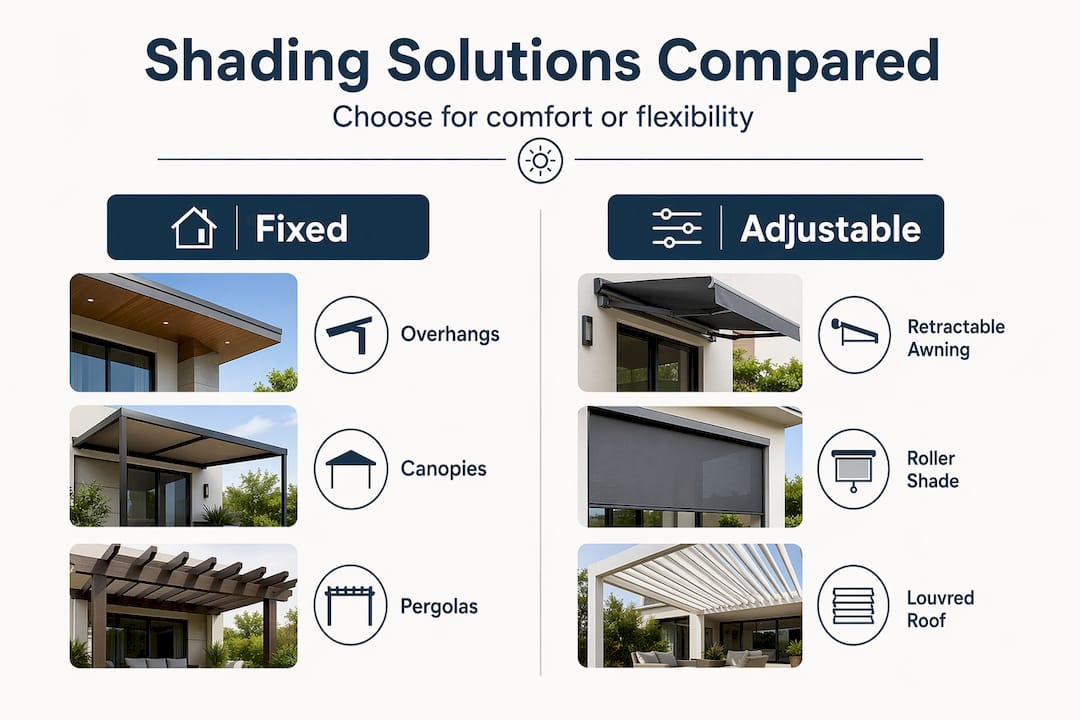
Fixed overhangs and canopies are built into or attached to the structure of a building. They provide permanent, passive protection but cannot be adjusted. Their effectiveness depends entirely on correct sizing for the sun angle at your latitude.
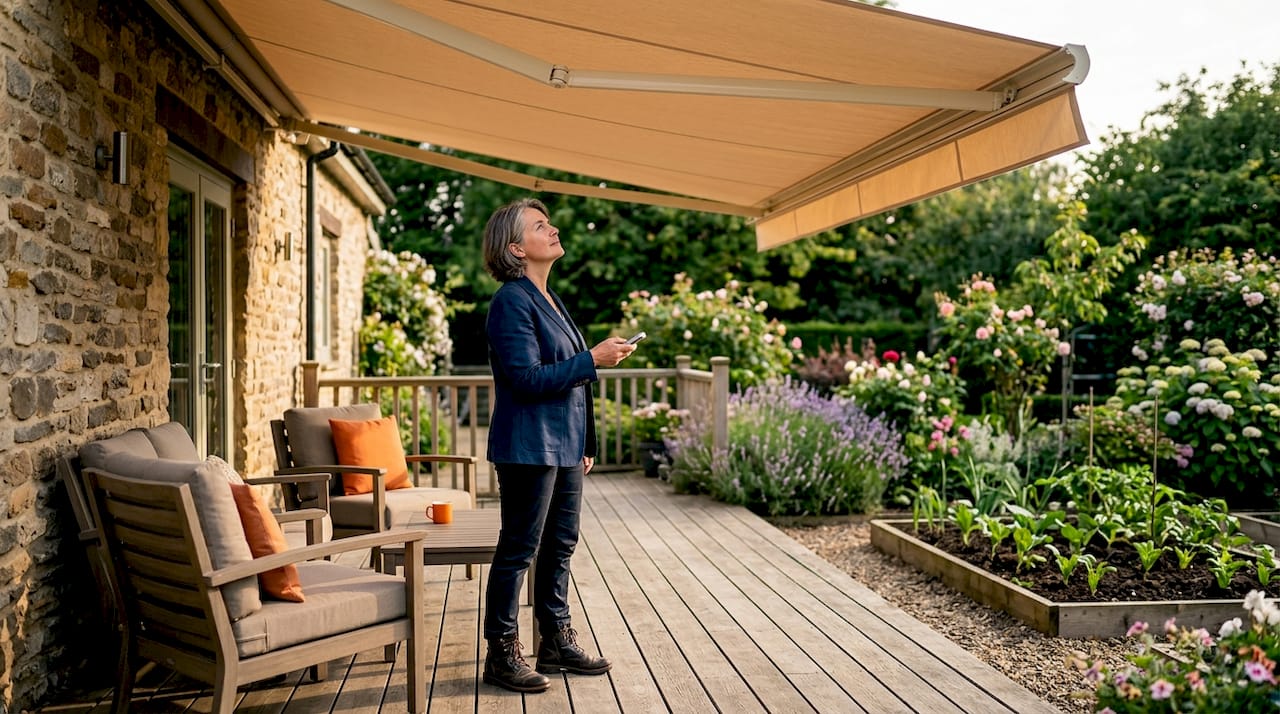
Retractable awnings extend and retract on demand, giving you flexibility to open the sky when you want it and shade when you need it. They are excellent for sun management but retractable awnings must retract during high winds and storms — which means rain protection disappears precisely when weather turns nasty.
Pergolas with fixed or louvred roofs offer a middle ground. A solid or slatted pergola provides year-round structure, while louvred systems with precision tilt allow you to control light angles and ventilation without full retraction. These are increasingly popular for year-round outdoor dining areas.
Roller shades and vertical screens give excellent glare control and can also provide wind and rain deflection when positioned on the sides of a space. They are particularly useful for enclosed patios and commercial terraces.
Solution | Sun control | Rain protection | Wind resilience | Automation | Year-round use |
Fixed overhang | Moderate | Good | Excellent | None | Yes |
Retractable awning | Excellent | Limited | Low | Yes | Seasonal |
Louvred pergola | Excellent | Good to excellent | Good | Yes | Yes |
Fixed pergola | Moderate | Moderate | Good | None | Yes |
Roller/vertical shade | Good | Moderate | Moderate | Yes | Year-round |
When choosing between these options, ask yourself:
Is rain protection or sun control my primary need?
How exposed is the site to wind?
Do I want the sky visible on good days, or is permanent coverage acceptable?
How important is automated operation versus a simple manual system?
What types of shading solutions best suit the architectural style of my property?
Pro Tip: Automation is a convenience, not a guarantee. Wind sensors can trigger automatic retraction to protect a fabric awning, but if the power fails or the sensor misses a gust, the product is at risk. In high-exposure Yorkshire gardens, a robust retractable roof system or a fixed louvred structure may give you far more peace of mind than a motorised awning alone. Visit shading examples and patio awning ideas to see how different solutions look in real UK settings before you decide.
Design science: how effective shading is calculated
This is where many projects go wrong. People buy a shade structure based on how it looks in a showroom, without any consideration of solar geometry. The result is either a space that is never truly cool or one that is permanently gloomy.
Overhang design must be calculated to block the high sun angles of summer while still allowing low-angle winter sun to warm and illuminate a space. At Yorkshire’s latitude (approximately 53 to 54 degrees north), the sun’s altitude at solar noon varies from around 13 degrees in December to around 60 degrees in June. That is a massive difference, and any fixed overhang must be sized with these numbers in mind.
Sustainable facade shading geometry — including fins, overhangs, and projections — should be optimised using sun path calculations for your specific orientation. A south-facing extension in Sheffield needs different geometry to an east-facing terrace in Nottingham. There is no off-the-shelf answer.
Research also demonstrates that parametric modelling of shading variables — depth, spacing, and tilt — produces measurable trade-offs between solar heat gain control and daylight performance. In plain terms: deeper shading blocks more heat but also more daylight.
Sun angle (Yorkshire) | Season | Ideal shading response |
58 to 60 degrees | June/July | Deep horizontal overhang or full retraction when cool |
35 to 45 degrees | April/September | Adjustable louvres at mid-angle |
13 to 20 degrees | November to February | No overhang; allow sun penetration |
To assess your own property, follow these steps:
Identify the primary window or door orientation (south, west, south-west — these are typically the problem areas in the UK).
Measure the height from ground to the top of the glazed area. This determines the minimum overhang projection needed at your latitude.
Use a free sun path tool online (input your postcode) to understand peak sun angles across the year.
Consider the interior use — a home office needs different glare control to a dining room or bedroom.
Consult a specialist about how improving kerb appeal with a well-proportioned shading structure can also be engineered correctly at the same time.
Refer to our detailed patio shading guide for a step-by-step walkthrough tailored to Yorkshire homes. The numbers matter, and getting them right from the start saves you from expensive adjustments later.
Pro Tip: Always ask a shading supplier for a projection-to-glass-height ratio calculation for your specific window before ordering a fixed canopy or overhang. If they cannot provide it, that tells you something important about the quality of their expertise.
Balancing solar control, daylight and glare: what most people overlook
Here is the uncomfortable reality that nobody talks about in a sales brochure: the same shading that cools your room also darkens it. Block 70% of incoming solar energy and you will also lose a significant portion of natural daylight. That matters enormously for home offices, kitchens, and any space where people spend long hours.
Shading choices must balance solar heat gain reduction with daylight availability and glare control. These are not the same thing. You can have a very bright room that is also uncomfortably warm. You can also have a cool room that is unpleasantly dark. The sweet spot requires careful design.
“Glare is often the silent villain. A space can be a comfortable temperature yet completely unusable because reflections from a low sun angle make screens unreadable and conversations uncomfortable. Blocking raw heat is only half the job.”
The trade-offs between solar control and daylight can be managed intelligently with adjustable systems. Here are practical strategies for enhancing comfort and saving energy without sacrificing the light you want:
Choose lighter fabric colours for awnings. Light grey or cream fabrics transmit more diffused natural light than dark tones while still blocking UV and direct heat.
Use adjustable louvres that can be positioned at different angles throughout the day, targeting glare without blocking ambient light from the sky.
Consider a light shelf on south-facing windows — a horizontal reflective surface that bounces natural light deeper into the room while the overhang above blocks direct summer sun.
Avoid oversizing. An overhang that projects further than necessary will darken the interior unnecessarily in spring and autumn.
Use our shading checklist for UK patios to cross-reference all these factors before making a final decision.
Selecting the right exterior shading for your property
By now you have the technical context. Here is how to translate it into a clear decision for your specific property.
Follow these five steps:
Define your priorities. Is this primarily about creating a usable outdoor space, reducing indoor temperatures, protecting furniture from UV, or improving the appearance of your property? Rank these before looking at products.
Assess your location and orientation. A west-facing terrace in an exposed rural part of Derbyshire has very different needs to a south-facing courtyard in a sheltered Sheffield suburb. Wind exposure, prevailing rain direction, and shading angles all vary.
Compare types honestly. Use the table above to match your priority ranking to the system that actually delivers it. Retractable awnings in storms must be wound in, so if wet weather cover is high on your list, they are not the best primary solution.
Evaluate your weather challenges. Yorkshire and Lincolnshire see some of the most variable weather in England. Any structure needs to handle not just July sunshine but March squalls and October gales. Ask about wind ratings, drainage details, and maintenance requirements. This is where dual protection guidance for the wider building envelope becomes relevant.
Consider aesthetics and automation together, not separately. A beautiful louvred pergola that clashes with your building style or a motorised awning with a sensor system you never learn to use will both underperform. Read more on outdoor shading explained for a full breakdown of how these choices interconnect.
Pro Tip: For year-round usability on exposed UK sites — particularly in more northerly parts of our region — fixed louvred systems with integrated drainage almost always outperform retractable awnings in the long run. The extra upfront cost is recovered quickly through year-round use and lower maintenance.
What homeowners usually get wrong about outdoor shading (and how to get it right)
After more than 15 years of designing and installing shading solutions across Yorkshire, Derbyshire, Nottinghamshire, and Lincolnshire, we have seen the same mistakes made repeatedly. The most common one is this: people fall in love with how a product looks and buy it without understanding how it will actually perform in their specific location.
A motorised retractable awning looks impressive in a glossy brochure. But in a garden that catches the south-westerly winds that roll across the Pennines, a wind sensor will trigger retraction on half the afternoons you want to use it. Suddenly, that expensive automation feels like an obstacle rather than a feature.
The second mistake is treating automation as a safety net. Adjustable shading systems in high winds must retract to protect the fabric and mechanism, and that moment — a sudden downpour on a warm August afternoon — is precisely when you wanted the cover most. For properties where near-permanent weather protection genuinely matters, a fixed or louvred structure with integrated drainage is almost always the better answer.
We also see clients purchase shading purely on visual trend — a style seen on a European terrace in an Instagram post — without considering that climates differ dramatically. What works beautifully in southern France does not necessarily suit a garden in Harrogate or a commercial terrace in Lincoln.
Our advice: demand performance data from any supplier before you commit. Ask for sun path calculations for your postcode, wind loading ratings, drainage specifications, and real examples from comparable UK installations. A supplier who can answer those questions confidently is a supplier worth trusting. Our step-by-step approach sets out exactly what to ask and why it matters.
The best shading project is not the most expensive one or the most automated one. It is the one where every design decision was made with your specific building, orientation, climate, and priorities in mind.
Ready to transform your outdoor space?
Everything covered in this article points to one conclusion: great exterior shading is a bespoke solution, not a product off a shelf.
At Infinity Awnings, we bring over 15 years of regional expertise to every project across Yorkshire, Derbyshire, Nottinghamshire, and Lincolnshire. From initial sun path assessments to final installation, we guide you through every decision with evidence, not sales pressure. Whether you are exploring pergolas for your garden or considering a fully enclosed verandas installation for year-round outdoor living, our team can help you find the system that genuinely fits your space, your budget, and your climate. Get in touch today for a free, no-obligation consultation and let us help you make the most of your outdoor areas.
Frequently asked questions
What’s the difference between external and internal shading?
External shading blocks solar heat before it reaches your window glass, preventing heat build-up entirely, while internal blinds only slow heat transfer once it has already entered the building.
Can external shading really lower my energy bills?
Yes. Optimised shading geometry reduces cooling demand by preventing heat from entering rooms in the first place, which is particularly effective during the long afternoon sun hours of British summers.
Are retractable awnings safe for the UK’s wind and rain?
They perform well in sunshine and light conditions, but retractable awnings in high winds must be wound in, which means you lose rain coverage at the worst possible moment. For exposed sites, a fixed or louvred structure offers more reliable protection.
Is it possible to get both good daylight and glare control?
Absolutely. By carefully selecting shading geometry, tilt, and fabric colour, solar heat and glare control can be achieved without significantly reducing the natural daylight entering your space.
How do I know which type of shading suits my property best?
Start by ranking your priorities — sun control, rain cover, aesthetics, automation — then assess your building orientation, wind exposure, and usage patterns before comparing specific systems against those criteria.
Recommended
Comments