
Top reasons to install awnings in schools for safer spaces

TL;DR:
Schools must invest in quality shading to protect pupils from UV radiation and extend outdoor usability throughout the year. Proper awnings reduce energy costs, support outdoor learning, and demonstrate a school’s commitment to safety, wellbeing, and sustainability. Strategic implementation of durable, flexible shading solutions offers long-term educational, financial, and environmental benefits.
School leaders face mounting pressure to deliver outdoor environments that are safe, usable, and cost-effective across every season. Yet awnings are frequently dismissed as a luxury purchase or pushed to the bottom of the capital expenditure list in favour of more visible improvements. That is a mistake worth reconsidering. This article sets out the strongest, evidence-led reasons for investing in quality shading at your school, from protecting pupils against UV radiation and heat illness to cutting energy bills and enabling genuine outdoor learning whatever the weather in Yorkshire, Derbyshire, Nottinghamshire, or Lincolnshire.
Table of Contents
Key Takeaways
Point | Details |
Maximise student safety | Awnings shield pupils and staff from sun, UV, and heat, keeping outdoor learning safe. |
Slash energy usage | Properly installed awnings can cut school cooling energy requirements by up to a quarter. |
Enable flexible outdoor spaces | Covered areas support teaching, play, dining, and events whatever the weather. |
Boost compliance and value | Awnings help schools meet health and safety duties while offering lasting cost savings. |
Enhancing student safety and comfort outdoors
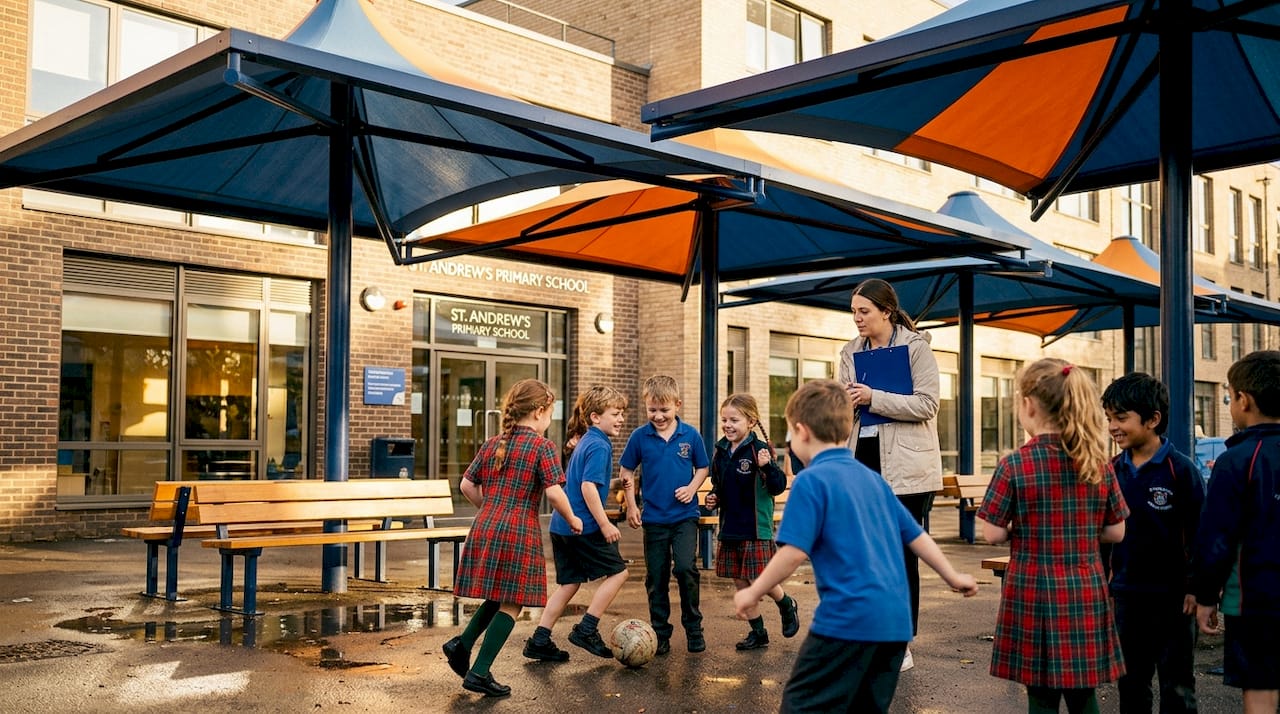
Safety is always the first question on a headteacher’s desk, and rightly so. Direct sun exposure during the school day carries real physiological risks, particularly for younger pupils whose skin is more sensitive than that of adults. Shade structures placed over play areas, entrance canopies, and outdoor classrooms reduce peak UV intensity at ground level, lowering the risk of sunburn and cumulative skin damage. They also keep paved and rubber-crumb surfaces cooler, which reduces the risk of contact burns and prevents the kind of radiant heat that makes outdoor play genuinely uncomfortable on warm days.
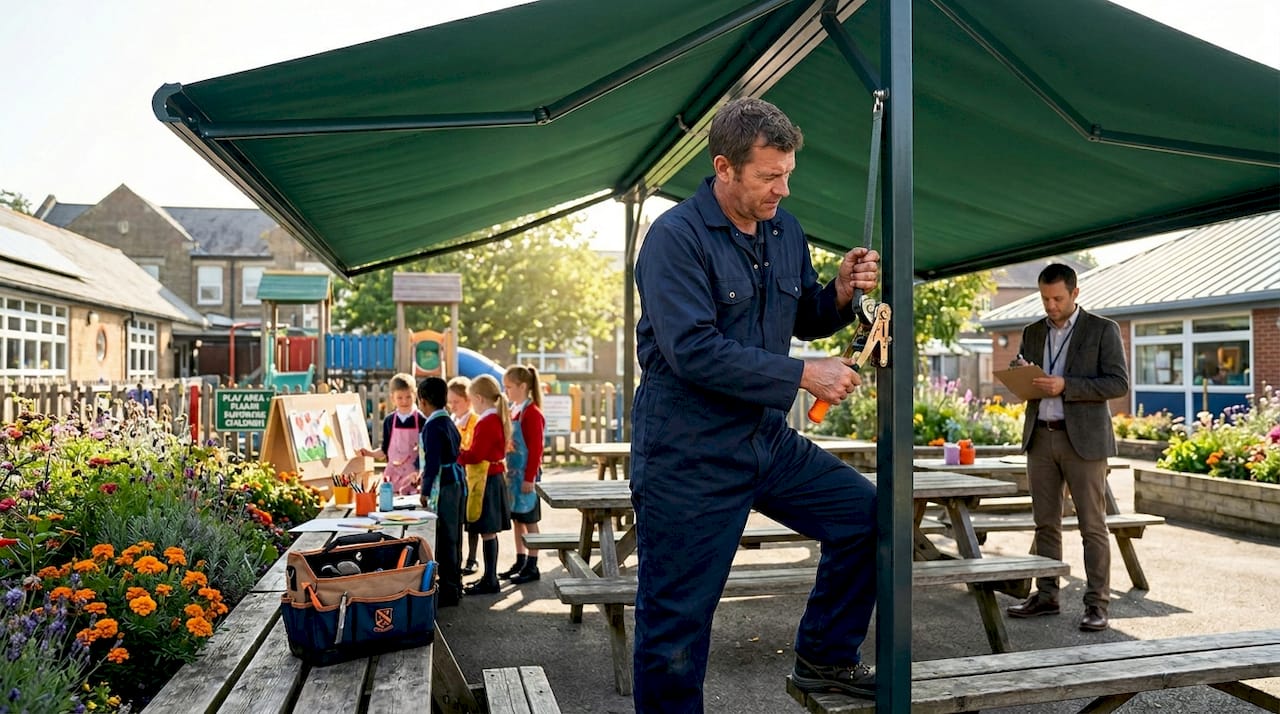
Beyond UV, awnings extend the usability of outdoor areas into weather conditions that would otherwise force everyone back inside. A covered lunch zone means wet weather does not bottleneck your dining hall. A shaded terrace attached to a science or art block becomes a functional teaching space rather than an unusable strip of tarmac. Rain, drizzle, and intermittent sunshine are features of British weather almost every month of the year, and a well-specified awning handles all three.
The scale of investment some schools commit to shade underlines just how seriously safety is taken. One American school district, the Gila Elementary School District, invested over $202,000 in shade structures across three campuses to protect pupils during extreme heat. Whilst the UK climate is considerably milder, the same logic applies: shade is a safeguarding measure, not a cosmetic upgrade.
Key safety and comfort benefits include:
Protection from UV radiation, reducing cumulative skin exposure during the school day
Lower surface temperatures on playgrounds, preventing contact burns on hot days
Glare reduction, making outdoor reading and screen-based learning far more comfortable
Shelter from light rain and wind, extending the seasons during which outdoor spaces are genuinely usable
Reduced risk of heat exhaustion during sports days, outdoor PE, and break times
For materials that stand up to institutional use, durable awning materials designed for schools are worth examining closely. You should also ensure any structure meets fire safety requirements; fire-rated school awnings are an important consideration when specifying for educational buildings. Adopting UV protection best practices at the property level complements the physical shade structure itself.
“Shade is not a comfort perk. On a sun-drenched playground, it is a frontline health intervention.”
Pro Tip: Specify awning fabrics with a minimum UPF 50+ rating when the structure covers areas used during peak UV hours between 11 am and 3 pm. This is the rating that genuinely blocks ultraviolet radiation at a meaningful level rather than simply providing visual shade.
Reducing energy costs and creating greener schools
Beyond the playground, awnings make a measurable difference to a school’s energy consumption, and that translates directly into budget savings that can be redirected towards teaching and resources. The mechanism is straightforward: external shading intercepts solar heat before it enters the building through glazing, reducing the load on mechanical cooling or simply keeping classrooms at a comfortable temperature without the need for expensive air conditioning units.
Research published in a peer-reviewed journal found that cooling loads can fall by 16 to 25% depending on the orientation of the shaded window. Overhangs work best on south-facing glazing, while vertical fins perform better on east and west-facing windows where the sun angle is lower. This is not a trivial saving. A school building with extensive glazing on its south façade can see a meaningful reduction in its energy bills simply by installing well-designed awnings or solar blinds externally.
The table below summarises how shading type and window orientation interact with energy performance:
Orientation | Best shading type | Estimated cooling load reduction |
South-facing | Horizontal overhang or retractable awning | Up to 25% |
East-facing | Vertical fin or side-arm awning | Up to 16% |
West-facing | Vertical fin or side-arm awning | Up to 16% |
North-facing | Minimal benefit from shading | Negligible |
A 20% reduction in cooling energy across a large secondary school building could represent thousands of pounds saved annually, funds that belong in the classroom rather than the energy supplier’s accounts. Many schools pursuing eco-school accreditations or carbon reduction pledges find that external shading is one of the most straightforward and cost-effective improvements they can make to their building fabric.
For a broader look at energy-saving shading benefits across educational and commercial settings, there is detailed guidance available. Additional energy efficiency tips relating to window treatments reinforce how much impact the right external solution can make.
Pro Tip: Prioritise retractable awnings on south-facing classroom windows first. These offer the best payback period because they tackle the strongest solar gain, and the retractable mechanism means you retain natural light on overcast days without sacrificing energy performance on sunny ones.
Supporting outdoor learning and flexible use of space
The argument for awnings in schools is not simply about blocking harmful radiation or trimming energy bills. It is about what becomes possible when outdoor space is genuinely weatherproofed. Schools that invest in covered outdoor areas unlock a range of educational and social benefits that simply are not available to schools that leave their external spaces exposed.
Consider the specific scenarios in which shaded, covered zones add direct educational value:
Open-air science and art lessons where natural light and fresh air improve focus without the discomfort of full sun or rain interrupting the session
Covered outdoor dining areas that reduce corridor congestion and allow pupils to eat outside regardless of the weather
Protected performance and assembly space for events, drama presentations, or whole-school gatherings that do not depend on fine weather
Sensory garden and reading zones where shade creates the calm, comfortable conditions that benefit pupils with sensory processing needs
Covered entrance canopies that reduce wet coats and muddy boots being brought into the building, with a knock-on effect on cleaning and facilities budgets
Research into daylighting and its effects on student wellbeing indicates that comfortable, well-lit environments are associated with improved engagement and mood, even where direct causal links to academic outcomes are difficult to isolate. The inference is reasonable: if pupils are comfortable, they are more likely to engage productively with the task in front of them.
The comparison below shows how awnings stack up against common alternative solutions for covering outdoor school spaces:
Solution | Cost | Permanence | Weather protection | Flexibility | Aesthetic |
Quality retractable awning | Medium | Semi-permanent | Good | High | Excellent |
Fixed pergola with canopy | Medium to high | Permanent | Very good | Low | Very good |
Temporary gazebo or tent | Low | Temporary | Poor | Medium | Poor |
No shade | None | Permanent | None | None | Neutral |
Timber sail shade | Low to medium | Semi-permanent | Limited | Low | Good |
Retractable awnings consistently offer the best balance of flexibility and weather protection. They can be deployed on demand and retracted when you want full natural light or when wind speeds exceed the system’s rated threshold.
Pro Tip: Design your outdoor shading scheme with modularity in mind. A combination of fixed canopy structures over dining zones and retractable awnings over teaching terraces gives you year-round adaptability without committing every space to a single, inflexible solution. For guidance on installation, installing durable awnings in educational settings covers the practical steps involved.
Meeting compliance, resilience, and long-term value goals
School governors and bursars think in terms of total cost of ownership, not just purchase price. A poorly chosen awning that needs replacing every three years is not a saving; it is a recurring headache. Specifying correctly from the outset means the initial investment pays for itself many times over across the structure’s lifespan.
Compliance is a non-negotiable dimension of any school installation. Relevant considerations include:
UV protection standards for fabrics used in pupil-facing shade structures, particularly where the area is used during high-UV periods
Wind and load ratings ensuring the structure does not become a hazard in adverse weather conditions typical of the East Midlands and Yorkshire
Slip resistance underfoot in covered areas where rain can still blow in from the sides
Safeguarding compliance for outdoor teaching zones, ensuring sightlines and supervision are not compromised by the structure’s design
Fire safety certification for any fabric or structural element attached to or close to the school building
Modern awnings from reputable manufacturers come with wind sensor compatibility and automatic retraction systems, meaning the structure protects itself during gusts. This is not just a product feature; it is a risk management tool. A structure that survives a decade of British weather with minimal intervention represents far better value than a cheaper option that requires constant attention from your facilities team.
Pro Tip: Establish a seasonal maintenance schedule from the moment of installation. Keeping records of inspections, cleaning, and any repairs not only prolongs the awning’s life but provides documented evidence of due diligence if the structure’s condition is ever questioned from a health and safety perspective. Further detail on awnings maintenance steps specific to school settings is worth bookmarking for your facilities manager.
The wellbeing research referenced earlier reinforces the broader point: environments that are well-lit and comfortable contribute to better outcomes, even when direct causation is hard to pin down. A school that maintains high-quality outdoor infrastructure signals to pupils, parents, and inspectors alike that it takes the physical environment seriously as a component of education.
Why every school should prioritise shaded spaces
Here is an opinion that tends to surprise administrators who have managed school buildings for years: awnings are not a feature you add once everything else is done. They belong in the category of foundational infrastructure, alongside adequate heating and decent lighting.
The conventional framing treats shade structures as something warm-climate schools need and British schools can probably skip. That thinking was questionable twenty years ago and is increasingly difficult to defend now. Summers are warmer, UV intensity is higher, and the expectation that schools will offer usable, high-quality outdoor environments has grown sharply. Ofsted’s emphasis on the wider curriculum, and the growing evidence base around outdoor learning and pupil wellbeing, means that schools with well-designed outdoor spaces carry a genuine competitive and reputational advantage.
There is also a leadership dimension here that gets overlooked. Administrators who invest proactively in shaded outdoor environments are communicating something important about their values: that pupil comfort matters, that sustainability is taken seriously, and that the school’s physical environment reflects its educational ambitions. That message resonates with parents, staff, and pupils in ways that are hard to quantify but easy to feel.
We have worked with enough commercial and institutional clients over fifteen-plus years to know that the schools most satisfied with their outdoor shading investments are those that approached it strategically. They mapped their spaces, considered orientation and usage patterns, specified materials for longevity, and thought about flexibility. The schools that struggled were those that bought on price alone or treated shade as an afterthought when a heat-related incident or an Ofsted visit focused attention on outdoor areas.
Climate change makes outdoor shading benefits more compelling with each passing year, not less. The investment you make in your school’s outdoor spaces today will pay dividends in safety, energy costs, and educational quality for a decade or more.
Ready to enhance your school’s outdoor spaces?
If this article has confirmed what you were already starting to suspect, the next step is straightforward: talk to a specialist who understands the specific demands of educational settings.

At Infinity Awnings, we have over fifteen years of experience designing and installing shading solutions for schools, businesses, and homeowners across Yorkshire, Derbyshire, Nottinghamshire, and Lincolnshire. Whether you are looking at pergola options to create a permanent covered learning zone or exploring veranda installation to weatherproof an existing terrace, we can help you find the right solution for your budget and your space. Get in touch for a free, no-obligation quote and let us help you make your school’s outdoor areas work harder for every pupil.
Frequently asked questions
How much does it cost to install awnings in a school?
Costs vary considerably depending on scale, materials, and the complexity of installation. One American district spent over $202,000 across three campuses, though UK pricing will differ based on product specification and site conditions.
Do awnings really reduce energy bills in schools?
Yes. Research demonstrates that external shading can cut cooling loads by 16 to 25% depending on window orientation, with south-facing installations delivering the strongest savings.
Do awnings require much maintenance?
Most modern school awnings are engineered for low maintenance, but routine seasonal inspection and cleaning are still recommended to protect the investment and satisfy health and safety documentation requirements.
Are there proven learning benefits to more shaded outdoor space?
Direct outcome studies specific to awnings are limited, but daylight and comfort research consistently links thermally comfortable, well-lit environments to improved pupil wellbeing and engagement.
Recommended
Comments