
Step-by-step awning maintenance for UK homes

TL;DR:
Regular, proper maintenance extends the lifespan of retractable awnings and prevents costly repairs.
Key steps include thorough cleaning, inspecting fabric and hardware, lubrication with dry silicone spray, and seasonal winterisation.
A neglected retractable awning rarely fails all at once. More often, it slowly deteriorates, mould creeps across the fabric, joints seize up, bolts work loose, and one morning the mechanism simply refuses to move. For homeowners and business owners across Yorkshire, Derbyshire, Nottinghamshire, and Lincolnshire, where persistent drizzle, high humidity, and sharp frosts are a regular feature of the calendar, these problems arrive faster than most people expect. The good news is that a consistent, straightforward maintenance routine keeps all of that at bay, extending the life of your awning by many years and protecting a significant investment in your outdoor space.
Table of Contents
Key Takeaways
Point | Details |
Routine care matters | Seasonal cleaning and inspection are vital to prolong awning life and prevent costly damage. |
Dry before retracting | Always allow awning fabric and parts to dry thoroughly before storage or retraction. |
Lubricate wisely | Apply dry silicone spray to clean, grit-free joints after cleaning, not before. |
Avoid common pitfalls | Neglecting drying, overusing lubricants, or skipping inspection can lead to corrosion and mechanical faults. |
Professional support available | Consider trusted local awning specialists for installation, upgrades and ongoing maintenance. |
Awning maintenance essentials: tools and materials
With the intent established, let’s begin by assembling what you’ll need for safe and effective maintenance.
Cleaning and lubricating awnings requires specific materials and proper procedure, and walking out to your awning unprepared usually means two trips instead of one. Getting everything together beforehand saves time and reduces the temptation to skip steps.
You can find a thorough maintenance checklist for UK homes to complement what’s listed here. Below is a quick-reference table for the core items you’ll need.
Category | Item | Purpose |
Cleaning | Soft-bristled brush | Removes loose debris without abrasion |
Cleaning | Mild soap (pH neutral) | Lifts dirt and organic matter gently |
Cleaning | Lukewarm water | Dissolves soap and rinses fabric safely |
Lubrication | Dry silicone spray | Lubricates moving joints without attracting grit |
Hardware | Screwdriver and spanner set | Tightens loose bolts and brackets |
Protection | Waterproof canvas cover | Shields fabric during storage |
Safety | Nitrile gloves | Protects hands from soap and lubricants |
Safety | Safety glasses | Prevents debris from entering eyes |
Safety | Stable step ladder | Provides safe access to high-mounted fixtures |
When it comes to fabric covers, waterproof canvas for outdoor furniture offers a useful reference for the kind of material that protects awning fabric during storage months.
Essential items checklist:
Soft brush (never wire or stiff bristles)
pH-neutral mild soap
Two buckets (one for soapy water, one for rinsing)
Clean, dry cloths or a microfibre towel
Dry silicone spray lubricant (not oil-based)
A screwdriver and an adjustable spanner
Stable ladder rated for your height requirements
Nitrile gloves and safety glasses
Pro Tip: Lay everything out before you start. Running indoors mid-job to hunt for a spanner is how maintenance sessions get abandoned halfway through, leaving joints exposed and lubrication incomplete.
Step-by-step awning cleaning and inspection routine
With your materials prepared, follow these stepwise instructions for awning care.
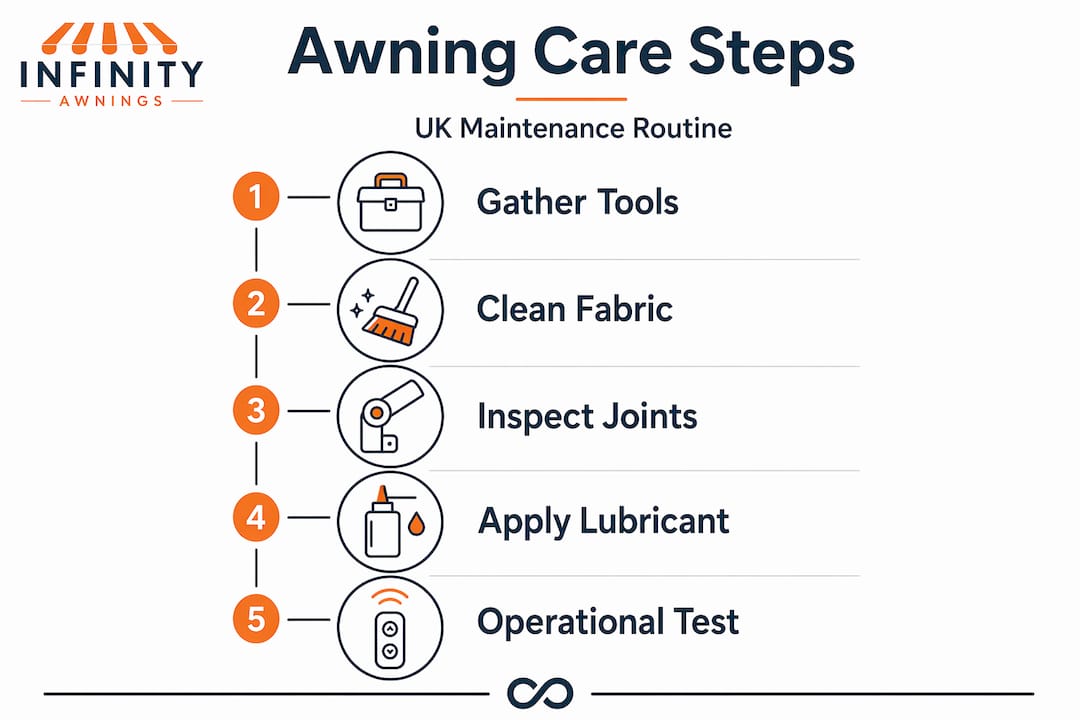
The process for maintaining retractable awnings is most effective when performed in a logical sequence. Rushing steps or working out of order, such as lubricating before clearing grit, can embed debris into the mechanism and cause more harm than doing nothing at all.
Follow this numbered routine each time you carry out a full service:
Extend the awning fully in dry, calm conditions so every component is accessible and visible.
Carry out a visual inspection from both sides, looking at the fabric, the frame, and all visible fixings before touching anything.
Clear loose debris from the tracks, arms, and roller tube using a dry soft brush. Work from the centre outward.
Check the fabric for mould spots (often appearing as dark speckling), tears, fraying edges, or any areas of sagging that could indicate stretched or broken internal tension springs.
Mix mild soap with lukewarm water and apply with the soft brush in gentle circular motions, working across the fabric from one side to the other.
Rinse thoroughly with clean water, ensuring no soap residue remains. Soap left in fabric fibres attracts dirt over time.
Allow the fabric to air-dry completely before moving on. This is non-negotiable, as retracting damp fabric is the single most common cause of mould growth.
Inspect all moving parts including the arms, brackets, roller mechanism, and any motorised components.
Tighten loose bolts using your spanner. Pay particular attention to wall brackets and mounting fixings, as vibration from wind gradually works these loose.
Apply dry silicone spray to all pivot points and moving joints, wiping away any excess immediately.
Test the full operation by extending and retracting the awning twice to confirm everything moves smoothly and evenly.
“Extend safely, visually inspect, clear debris from tracks, check fabric for mould, tears and sagging, clean with mild soap, lubricate, test operation, tighten loose bolts, and air-dry before retracting.” Spring awning maintenance captures the complete sequence that professionals follow.
For guidance on when to escalate to professional repair, visit awning repairs and maintenance for a clear overview of what can be handled at home and what requires specialist attention.
Spring vs. autumn routine priorities:
Task | Spring focus | Autumn focus |
Fabric inspection | Mould after damp winter | Leaf staining and debris |
Frame check | Frost damage and rust spots | Loose bolts from summer use |
Lubrication | Full re-application after storage | Light top-up before winter |
Fabric treatment | Reproofing after winter | Cleaning before storage |
Operational test | Full extension and retraction | Retraction mechanism only |
Weather sealing | Check for UV damage from summer | Confirm all seals are intact |
Pro Tip: Always remove every trace of grit from joints and pivot points before applying lubricant. Grit mixed with silicone spray creates a mild abrasive compound that wears down components over repeated cycles.
Winterisation and seasonal storage guidance
Once cleaned and inspected, address long-term protection and seasonal needs for your awning.
Yorkshire winters in particular can be brutal. Freezing temperatures, prolonged wet spells, and occasional heavy snowfall all create conditions that can warp aluminium frames, split fabric seams, and cause electronic components to fail. Weatherproofing awnings in Yorkshire is a subject we take seriously, and the winterisation process is where the bulk of long-term damage is either prevented or caused.
Winterisation includes cleaning, inspecting for rust, tears and loose bolts, lubricating, retracting, securing, and storing in a dry, ventilated space. Each step connects directly to the next, so cutting any one of them short creates a weak link in your protection strategy.
Essential winter preparation steps:
Complete the full cleaning and inspection routine described above
Allow the fabric to dry for at least 24 hours in reasonable conditions before storage, longer in humid weather
Apply a final light coat of dry silicone to all moving parts
If your awning is a portable or seasonal model, remove it from its brackets and store indoors
For fixed retractable models, retract fully, lock in position, and fit a purpose-made awning cover
Ensure any drainage channels or guttering nearby are clear to prevent water pooling against the wall mount
Disconnect and store motorised control units according to the manufacturer’s instructions
Inspect electrical connections for corrosion before reconnecting in spring
The principle behind achieving lasting outdoor comfort through winter is straightforward: keep moisture out, keep air circulating, and keep metal components coated against oxidation.
Seasonal storage timeline:
Month | Task |
September | Inspect and clean fabric thoroughly |
October | Final lubrication and operational test |
Late October / November | Retract or remove and store |
February | Check storage condition, look for condensation or pests |
March | Reconnect, clean, inspect, and test before first use |
One point that catches many people out: storing an awning in a sealed plastic bag or airtight container traps residual moisture and creates the perfect conditions for mildew and frame corrosion. Always opt for a breathable waterproof cover or a dry, ventilated outbuilding rather than airtight packaging.
Troubleshooting common awning maintenance mistakes
Despite your best efforts, mistakes happen. Here’s how to spot and correct the most frequent ones.
The most expensive awning repairs we see usually trace back to a handful of predictable mistakes, not freak weather events or defective materials. Understanding what goes wrong and why makes it straightforward to course-correct early.
What not to do and how to fix it:
Retracting a damp awning: This is the most common mistake of all. Never put the frame away damp because moisture leads directly to corrosion on metal components and mould growth on fabric. Fix: always allow full air-drying, even if that means leaving the awning extended overnight in dry weather.
Skipping the visual inspection: Mould, tears, and loose bolts caught early are minor issues. Left for another season, they become structural problems. Fix: make inspection the very first step each time, not an afterthought.
Using oil-based lubricants: Standard WD-40 and similar products attract dust and grit, which then work their way into pivot points. Fix: switch to a dedicated dry silicone spray, which leaves a clean, non-sticky film.
Over-lubricating joints: More is not better. Excess lubricant runs down fabric, staining and weakening the fibres, and collects grit at the joint. Fix: one short spray per pivot point, followed by wiping away the excess with a dry cloth.
Cleaning with harsh chemicals or pressure washers: Both damage the fabric coating and can strip waterproofing treatments. Fix: always use mild soap, soft brush, and gentle hand pressure.
Ignoring motor and sensor checks: Electric awnings have wind and sun sensors that need cleaning and testing. A dirty sensor can fail to retract the awning in strong winds, causing serious damage.
For a deeper look at maintaining your awning like a professional, visit expert awning maintenance tips for guidance that goes well beyond the basics.
Pro Tip: Always finish your maintenance session with a complete extension and retraction cycle. This confirms that every adjustment, tightened bolt, and lubricated joint is working together correctly under real operating conditions. If anything catches, squeaks, or moves unevenly, you’ll know about it before the next storm arrives.
A practical Yorkshire perspective on awning care
Over more than 15 years of supplying and installing awnings across Yorkshire, Derbyshire, Nottinghamshire, and Lincolnshire, we’ve noticed something consistent: the homeowners and business owners who get the longest life from their awnings are not necessarily the most diligent cleaners. They’re the ones who treat cleaning and lubrication as linked steps rather than separate tasks.
The conventional advice is to clean in spring and lubricate at some point after. What we’ve found is more nuanced. Cleaning dislodges particles from joints, and if you don’t follow immediately with lubrication, those joints run dry and can corrode or seize. The sequence matters enormously. Remove grit first, then apply light lubrication and finish with a full operational test cycle. That’s the loop that actually produces durable results.
There’s also a less-discussed problem at the other end of the scale: over-maintenance. We occasionally meet owners who clean their awning fabric every few weeks throughout summer, using a slightly stronger soap each time because they feel it needs it. What they’re actually doing is gradually stripping the waterproof coating from the fabric, creating a surface that absorbs rather than sheds water. Then they wonder why the awning is letting in damp. Mild cleaning, done correctly and at the right intervals, is significantly more effective than frequent harsh treatment.
The installing retractable awnings guide is worth reading alongside this tutorial, because understanding how the components fit together gives you a much clearer picture of what you’re actually inspecting and lubricating during maintenance. Knowledge of the mechanism translates directly into better care decisions.
Finally, never underestimate the value of the operational test. It sounds obvious, but after a session of tightening, cleaning, and lubricating, many people retract the awning and walk away satisfied without ever extending it again to check. One full cycle, watched carefully from start to finish, tells you more about your awning’s condition than any visual inspection alone.
Next steps: enhance your outdoor space with professional solutions
After carrying out your own maintenance routine, you may find that your awning needs more than a clean and a lubrication. Or perhaps the process has simply made you realise how much more your outdoor space could offer with the right structures in place.

At Infinity Awnings, we’ve spent over 15 years helping homeowners and businesses across Yorkshire, Derbyshire, Nottinghamshire, and Lincolnshire get far more from their outdoor areas. Whether you need a professional service visit, a replacement awning, or you’re ready to go further and explore pergolas for your garden or full verandas installation and maintenance, we’re here to help you every step of the way. We offer free quotes and genuine, experienced guidance from people who understand regional weather conditions and what your outdoor space actually needs to perform well year after year.
Frequently asked questions
How often should I clean my awning to prevent mould?
Ideally, clean your awning every season and after significant weather events, always ensuring the fabric is fully dry before retracting to stop mould from developing in stored fabric folds.
What is the best way to lubricate moving parts in UK conditions?
Always use dry silicone spray after cleaning, and make sure every joint is free from grit before application to avoid creating an abrasive mixture that accelerates wear.
Can I leave my awning out in winter, or does it need to be stored?
Retractable awnings should be cleaned, thoroughly dried, and stored in a dry, ventilated space for winter, or at minimum retracted fully and secured if the structure is fixed to the building.
What mistakes could damage my awning during maintenance?
The most damaging errors include retracting while damp, skipping hardware inspections, and applying too much lubricant. Always air-dry completely and inspect all bolts and brackets before storage.
Do I need any specialist cleaning products for awning fabric?
Mild soap and lukewarm water applied with a soft brush are all you need. Harsh chemicals and pressure washers strip the fabric’s waterproof coating and should be avoided entirely.
Recommended
Comments