
Will rain on a pergola drive you mad? Here's the honest answer
- Andrew Crookes

- 35 minutes ago
- 9 min read
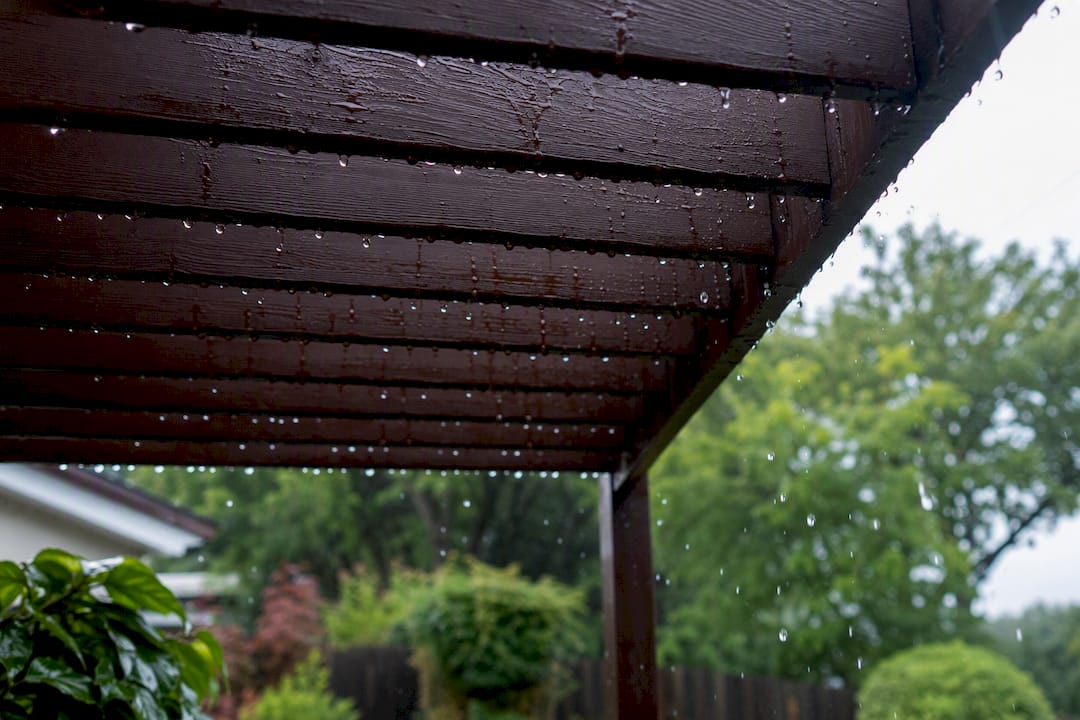
Most pergolas are noisier in rain than homeowners expect, but the noise is rarely inevitable. It comes down almost entirely to roof type and build quality, not the weather. A thin single-skin aluminium roof can turn a shower into a drumming session; a well-built double-skin louvre system with tight fixings barely registers above background garden noise.
If you’re buying, ask about double-skin construction before you ask about colour. If you already own one and it’s driving you outside during a storm, start by checking loose fixings and gaps before assuming you need a new roof.
Verdict: noise level depends on roof construction, not rainfall itself
First move: inspect fasteners, seals and panel contact points
Buying tip: double-skin or insulated roofs outperform single-skin every time
Deeper detail: decibel ranges, retrofit options and when to call a professional are all covered below
Key Takeaways
Rain noise on a pergola is driven almost entirely by roof construction and fixing quality, and double-skin louvre roofs with properly tightened fasteners solve the vast majority of complaints.
Point | Details |
Roof type decides the noise | Double-skin louvres dampen impact far better than single-skin blades or thin fabric roofs. |
Fix cheap fixes first | Tighten fasteners in a pattern and add rubber washers before considering professional treatment. |
Professional damping works | ISO-tested compounds plus insulation cut rainfall noise by up to around 20 decibels in tested systems. |
Size and shape matter | Larger, poorly supported spans amplify vibration; intermediate posts and pitched roofs reduce it. |
Choose quality from the start | Infinity Awnings fits double-skin, acoustic-aware pergola roofs designed to stay quiet in rain. |
Table of Contents
What causes pergola rain noise in the first place?
Rain noise starts with impact. Each drop striking a thin, unsupported panel makes it vibrate like a tiny drum skin, and a pergola roof is essentially a large, exposed drum stretched across a frame. The thinner and flatter the panel, the more efficiently it converts that impact into sound.
Frame and fixings do the rest of the damage. Long unsupported spans flex more, loose bolts let metal parts knock against each other, and any point of metal-on-metal contact acts like a tiny bell every time a droplet lands nearby. Loose fasteners, panel gaps and edge lift are among the most common causes of the tapping and rattling homeowners report, and tightening these in a controlled pattern resolves most cases without touching the roof material at all.
Louvre angle changes the character of the sound too. A steeper pitch makes rain slide off quickly with less direct impact noise; a flatter angle lets drops bounce and re-strike the same panel, multiplying the racket.
To work out where your noise is actually coming from:
Stand under the pergola during light rain and note which panels sound loudest.
Tap each panel gently by hand and listen for a hollow rattle versus a dull thud.
Check bolted joints and brackets for movement when you push on the frame.
Repeat the test in heavier rain, since some gaps only “sing” once water volume increases.
Pro Tip: Do the diagnostic walk-round in your socks. Vibration through the floor tells you more about which support post is loose than your ears will.
How loud does rain on a pergola actually get?
There’s no single number, because roof material changes everything. Light drizzle on a well-built aluminium roof might sit close to background garden noise, while heavy rain hammering a thin single-skin panel can push well past the point where conversation becomes difficult.
As a rough guide to how humans perceive the range:
Below roughly 35 decibels: barely noticeable, similar to a quiet room
Around 35 to 50 decibels: conversational level, noticeable but not disruptive
Above roughly 50 decibels: intrusive enough to interrupt talking or concentration
Supplier testing on modern aluminium pergolas suggests that thicker sections and hollow chamber construction can bring perceived noise down towards the conversational end of that range, even in fairly heavy rain. Treat any specific figure as an estimate. Rainfall intensity, wind, and how the roof was tested all shift the result, and no two storms sound quite the same.
Does roof type change how loud the rain sounds?
Yes, more than any other single factor. The construction of the roof panel decides whether rain sounds like a gentle patter or a snare drum, and the differences between roof types are stark enough to matter when you’re choosing what to install.
Double-skin (hollow) louvre blades are the quietest common option. The air gap between the two metal skins adds stiffness and damping, so instead of a sharp ping you get a duller, lower-amplitude thud. Industry comparisons of louvre construction consistently rank double-skin blades ahead of single-skin on both noise and heat performance, which is exactly why we recommend them wherever a pergola sits above a bedroom window or a seating area used year-round. You can read more detail on how these systems work in our louvre systems guide.
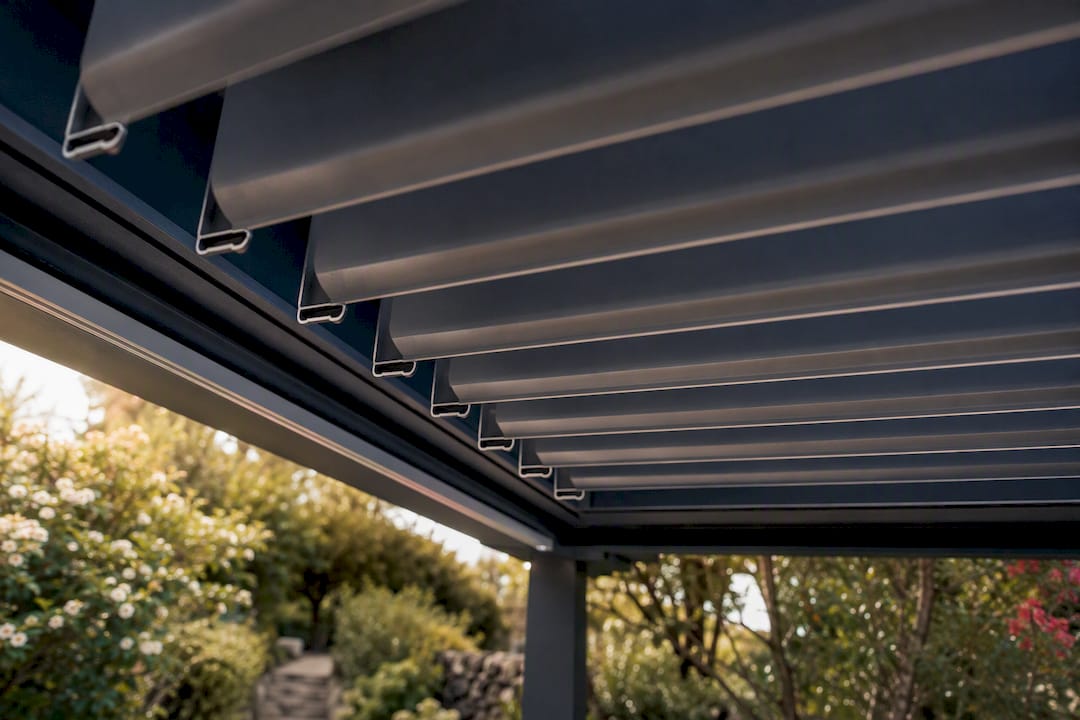
Single-skin blades and thin metal panels are the budget option, and they sound like it. Less stiffness means more flex under raindrop impact, and that flex is what produces the characteristic drumming.
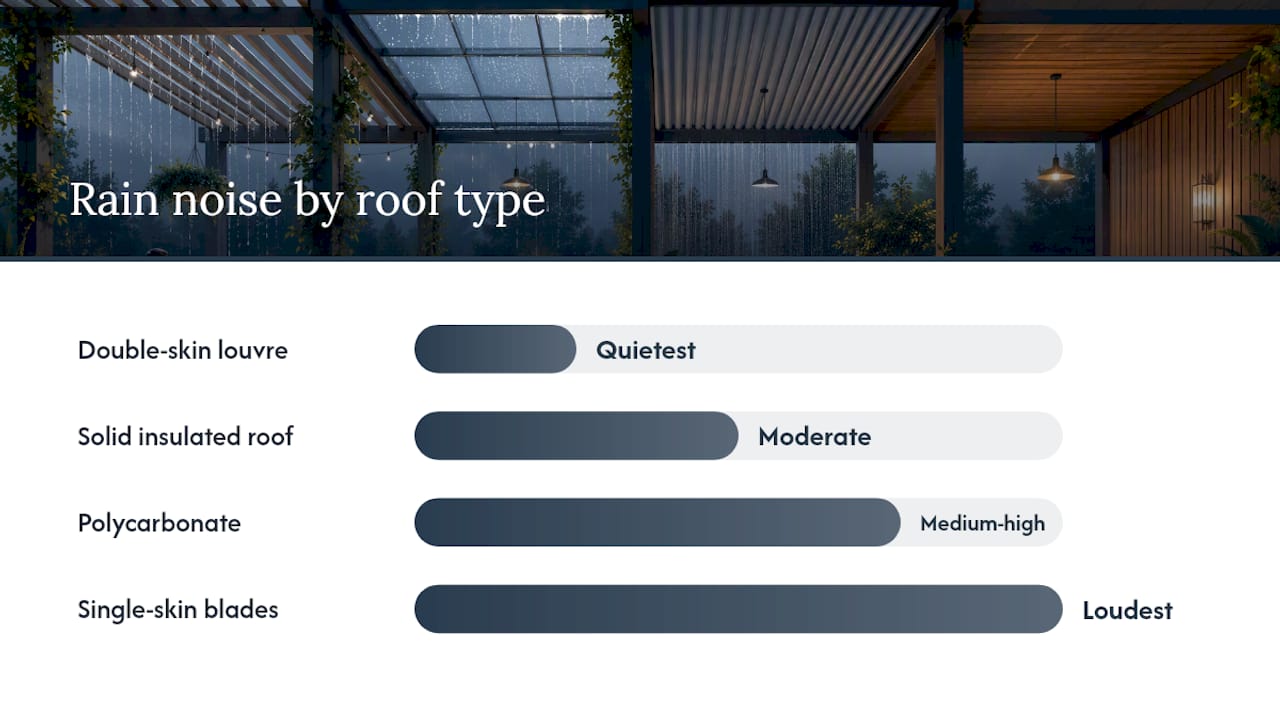
Solid insulated roofs and polycarbonate sit in the middle. A solid roof with proper insulation behind it can be genuinely quiet, though insulation adds cost and can trap heat in summer if ventilation isn’t considered. Polycarbonate performs reasonably well but tends to sound harsher than metal at the higher end of rainfall intensity, and thinner sheets flex noticeably.
Retractable fabric roofs aren’t designed for sustained heavy rain at all. Fabric can flap in wind-driven rain, creating its own noise, and pooling water risks leaks rather than drumming. Our guide to all-weather pergolas covers where fabric genuinely works and where it falls short.
If you’re comparing roof options from scratch, our broader pergola roof types guide walks through the trade-offs in more depth.
What actually reduces rain noise on a pergola?
Start cheap, then escalate. There’s no reason to jump straight to professional acoustic treatment when half the noisy pergolas out there just need tightening up.
Free or near-free fixes: add rubber or foam washers at metal contact points, tighten every fastener in a deliberate pattern (not randomly, which can worsen vibration), and fill any gaps where panels meet the frame.
Medium-cost upgrades: acoustic pads under panel edges, rubber isolator mounts between frame and posts, a secondary soft roof layer, or fabric underlays fitted beneath a hard roof.
Professional-grade treatments: dry-film damping compounds and foil-faced insulation, applied properly and tested.
The professional tier has real, measured backing. ISO 10140 testing found that a 1 mm dry-film damping compound reduced rainfall sound intensity by around 10 to 11 decibels on its own. Combined with 80 mm of foil-faced insulation, the same testing recorded total reductions of roughly 20 decibels, a genuinely dramatic drop from “disruptive” towards “background”.
Damping compounds and insulation aren’t DIY-friendly jobs, and rushing them creates its own problems. Applied badly, they can trap moisture against metal and encourage hidden corrosion, so mechanical decoupling and correct fastener seating should always come first, with chemical damping added afterwards rather than as a shortcut. Our piece on improving outdoor acoustics goes into more detail on how these treatments are applied in practice.
Soft landscaping helps too, though it’s a supporting act rather than the main event. Dense planting or perimeter shrubs around a pergola absorb some reflected sound and soften the overall impression of noise, without doing anything to the roof itself.
Pro Tip: Test your fix in real rain before spending more money. A £20 bag of washers sometimes solves what a homeowner assumed needed a £2,000 insulation job.
Installation and maintenance checks that keep noise down
Most noisy pergolas were quiet once. Fixings loosen over time, especially after a hot summer that expands and contracts metal repeatedly, and that’s usually when the drumming starts.
Run through this sequence once or twice a year, and definitely after any storm that seemed unusually loud:
Listen during light rain first, then again during heavier rain, and mark the loudest panels.
Tighten fasteners in a consistent pattern across the whole roof, not just the noisy section.
Add damping washers or rubber spacers at any point where metal touches metal.
Check interlocking joints between louvre blades for gaps that let water and vibration through.
Confirm integrated gutters and drain paths are clear, so closed blades channel water away rather than pooling it.
If tightening and spacers don’t shift the noise after a proper test in real rain, that’s your signal the panels themselves may need insulation, damping treatment, or in some cases a stiffer frame. Our aluminium frame construction guide explains how frame stiffness itself affects resonance, which matters more than most homeowners assume.
When should you call in a professional?
DIY fixes solve the majority of noise complaints, but not all of them. Call a professional installer or acoustic specialist when:
Noise persists after you’ve tightened fixings and added spacers properly
You notice structural movement, sagging, or repeated loosening despite retightening
Fasteners keep coming loose again within weeks, suggesting a frame or fixing design issue
Leaks appear alongside the noise, pointing to a drainage or interlock problem rather than just acoustics
When you do bring someone in, ask specific questions. Request evidence of ISO-tested acoustic solutions rather than vague promises, and ask for before-and-after examples if the installer offers damping or insulation work. A competent professional will typically diagnose the noise source first, apply mechanical decoupling before any chemical damping, then assess whether insulation is worthwhile, and finally check that drainage paths still work correctly once any panel work is finished. Rushing straight to a damping compound without fixing loose fasteners first almost always wastes money.
Does pergola size and shape affect how loud rain sounds?
Bigger roofs generally sound louder, simply because more surface area means more raindrops striking at once and a wider expanse of panel that can resonate. A compact pergola over a small seating nook rarely produces the same wall of sound as a full-width structure spanning a patio.
Shape matters just as much as size. Long, unsupported spans between posts flex more under load and wind, and that flex amplifies vibration from raindrop impact, which is why larger pergolas often benefit from additional intermediate support posts or cross-bracing, not just for structural reasons but acoustically too.
Roof pitch interacts with size in an important way. A large flat roof gives rain more opportunity to pool and re-strike the same area, while a pitched or angled roof of the same size sheds water faster and reduces that repeated-impact noise. Square or near-square pergolas also tend to distribute vibration more evenly across the frame than long rectangular ones, which can concentrate resonance along the longest unsupported edge.
If you’re planning a large pergola over a dining or lounge area, it’s worth discussing span and support spacing with your installer before finalising the design, rather than treating size purely as an aesthetic decision. A wider roof with proper intermediate support and double-skin panels can end up quieter than a smaller structure with poor bracing and thin single-skin panels.
Making rain under a pergola genuinely enjoyable
Rain on a well-built pergola roof can be genuinely relaxing rather than something to escape, and a surprising number of homeowners actively enjoy sitting out during a light shower once the noise is under control. The trick is arranging the space so rain becomes ambience rather than an obstacle.
Position seating away from the loudest zones you identified during your diagnostic walk-round, typically the centre of large unsupported panels, and closer to perimeter posts where the structure is stiffer and quieter. Soft furnishings help more than people expect: cushions, rugs, and fabric-covered seating absorb some of the reflected sound bouncing around underneath a hard roof, making the space feel calmer even before you touch the roof itself.

Side screens or partial glazing add a layer of comfort during wind-driven rain, cutting draught and spray without blocking the view or the sound of rain outside the immediate seating area. If you like the idea of relaxing rain sounds without the disruption, a double-skin roof paired with a soft rug and a couple of well-placed cushions does more for the experience than any amount of extra insulation.
For anyone hosting during unpredictable weather, keep a simple fallback plan: a retractable side screen or blind that can be deployed quickly turns a sudden downpour from a scramble indoors into a minor adjustment.
Andrew / Infinity Awnings: what we actually see on site
Most call-outs for “noisy pergola” turn out to be loose fixings or gaps, not a fundamentally bad roof. The usual fix sequence is tighten, then add spacers, then reassess before anyone talks about damping compounds or insulation. Customers who follow that order almost always report a noticeable improvement before reaching for the expensive options, and the ones who go straight to double-skin louvres from the outset rarely call us back about noise at all.
— Andrew
Get a pergola built quiet from the start
You can retrofit washers, spacers and damping compounds onto an existing pergola, but it’s far cheaper and more reliable to specify a quiet roof before installation than to fix a noisy one afterwards. Infinity Awnings designs, supplies and installs pergolas across Yorkshire, Derbyshire, Nottinghamshire and Lincolnshire, with double-skin louvre roof options built in as standard rather than an expensive afterthought.
Choosing an installer who understands acoustic construction, not just weatherproofing, is what separates a pergola you enjoy sitting under in the rain from one you avoid during a storm. Every install we quote factors in span, support spacing and blade construction together, because those decisions matter more to noise than any retrofit fix ever will.
If you’re planning a new pergola or thinking about replacing a noisy one, get in touch for a free quote and site inspection, and we’ll talk through which roof construction suits your space before you commit to anything.
Sources
Recommended
Comments