
IP44 vs IP65 Lights: Which Rating Suits Your Outdoor Space?

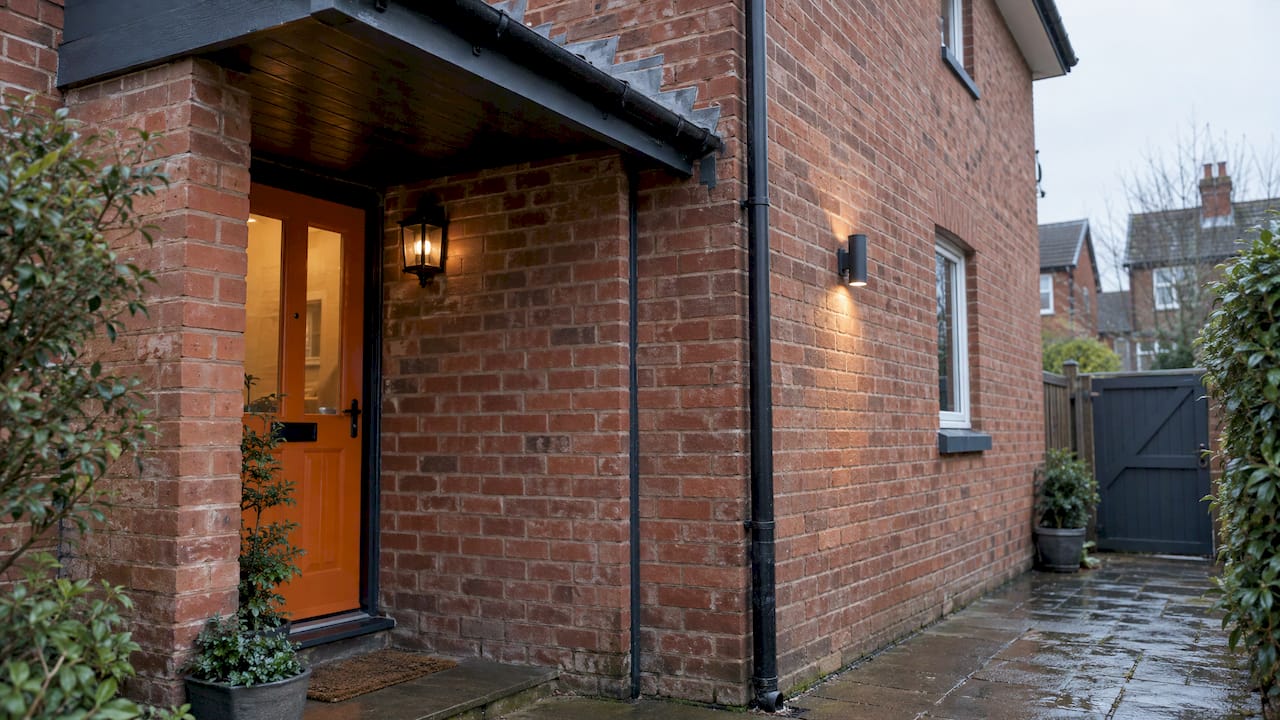
IP44 is enough for a light in a genuinely sheltered spot, such as under a deep porch or a pergola roof. IP65 is the safer choice anywhere rain can be driven at the fitting, and it can be used wherever IP44 is required. At Infinity Awnings we fit LED lighting under awnings, pergolas and verandas across Yorkshire, Derbyshire, Nottinghamshire and Lincolnshire, so the real question is always the same: how wet does that exact spot get?
This guide explains the two ratings in plain terms, shows where each belongs on a home, pub garden, hotel terrace or school canopy, and covers the things an IP number does not tell you.
TL;DR
IP44 means protection against objects over 1 mm and water splashing from any direction. IP65 means fully dust-tight and protected against water jets from any direction.
IP44 suits sheltered positions: under a deep canopy, a covered porch or a pergola roof. IP65 suits exposed walls, open corners and anywhere wind-driven rain reaches the light.
A higher IP number is not automatically a better all-round rating. Standing water, ground-level fittings and coastal sites each need their own check.
Fixed outdoor lighting must be installed to BS 7671 by a competent person, with RCD protection on the circuit.
Table of Contents
What the two digits mean
An IP rating (Ingress Protection) is a two-digit code set out in BS EN 60529. The first digit, from 0 to 6, rates protection against solid objects and dust. The second, from 0 to 9, rates protection against water. IP44 protects against objects over 1 mm and splashing water, while IP65 is dust-tight and protected against water jets.
In everyday terms:
IP44 | IP65 | |
Solids and dust | Keeps out objects over 1 mm, such as wires and most insects | Completely dust-tight |
Water | Splashes from any direction | Jets from a nozzle, from any direction |
Typical use | Sheltered outdoor walls, porches, soffits, canopies | Exposed walls, gable ends, open corners, spike lights |
Not designed for | Hosing, pressure washing, standing water | Sitting in a puddle or pond |
The difference matters because splashing and jetting are different kinds of water. A splash is what you get from rain falling and bouncing off a surface. A jet is closer to what hard rain driven by a gale does to the face of a building. IP65 is a jet rating, not an immersion rating, so neither fitting belongs where water collects.
Is IP44 good enough outdoors?
Yes, in the right place. The Electrical Contractors’ Association has said that an IP44 luminaire should be fine on an external domestic wall exposed to rain, and IP44 is the rating most domestic outdoor wall lanterns carry. Under BS 7671 Section 714, outdoor lighting equipment must be at least IP33, with IP44 the usual practical minimum.
The qualifier is “in the right place”. IP44 is the sensible pick where the light sits under something: a porch, a soffit, a deep eaves overhang, or the roof of a pergola or veranda. It is less suited to an open gable end, a fence post in the full force of the weather, or any spot where a hose or pressure washer might be pointed.
Always check the maker’s datasheet too. It states the approved mounting position and orientation, and that is what counts, not the number alone.
When IP65 is the better choice
Choose IP65 when the light is exposed. That means:
wall lights on a gable end, open corner or the front of a building facing the prevailing weather
lights on fences, posts and bollards
areas that get washed down, such as a restaurant terrace, a bar courtyard or a hotel entrance
spots where you want extra margin because the position is hard to reach for repairs
Because a higher rating always satisfies a lower requirement, IP65 can go anywhere IP44 is specified. Under a porch it simply buys extra margin against wind-driven rain. Where wiring or a hose could meet the fitting, BS 7671 guidance is that fittings exposed to water jets, hoses or flooding need IP65 or higher.
For a commercial customer the logic is practical. A venue that cleans its terrace regularly, or a school playground that is hosed down, should specify for the wettest day, not the average one.
Where the rating stops helping
IP65 is not the top of the ladder, and a higher number is not a universal upgrade. Three situations catch people out.
Standing water and ground-level lights
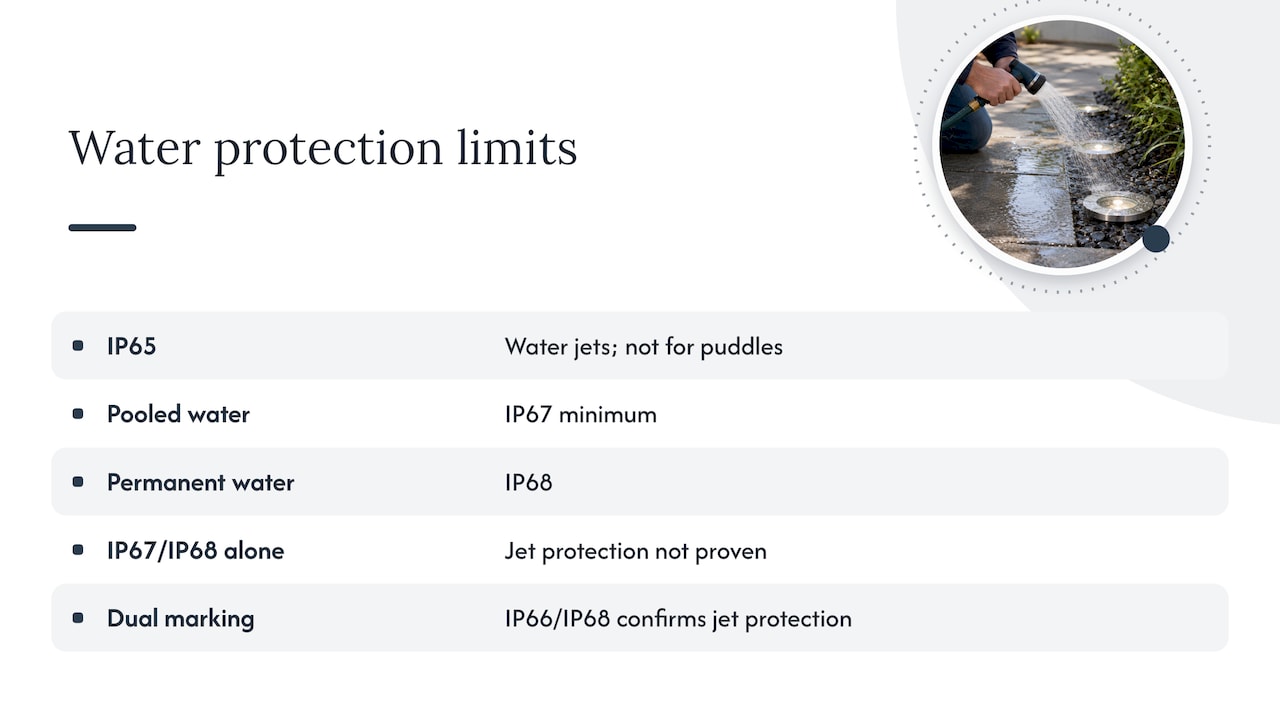
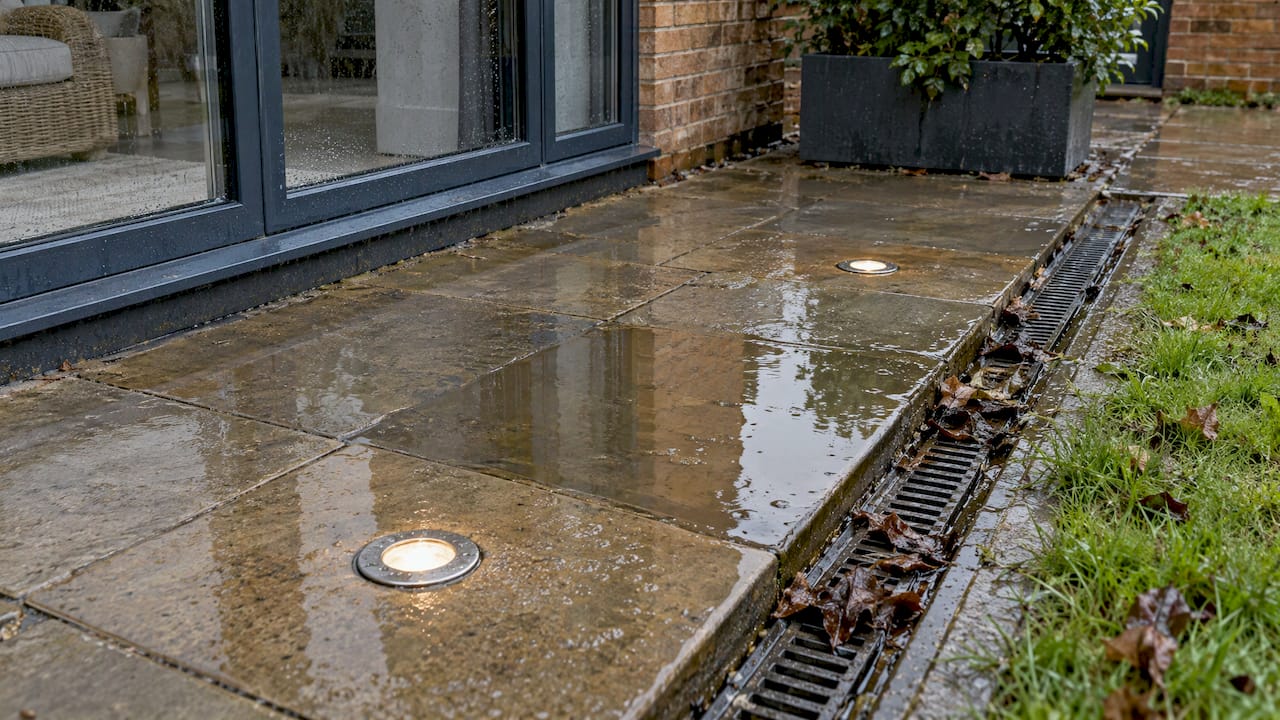
An IP65 light should not sit in a puddle. Lights set into decking, steps or paving, where water pools if drainage blocks, need IP67 as a minimum. Lights that sit permanently under water need IP68. The ratings above 6 describe immersion, not jets, so a fitting marked only IP67 or IP68 is not automatically proven against jets unless it is dual-marked, for example IP66/IP68.
If your outdoor space includes a pond or fountain, the setup around it needs thought as well as the rating, and this guide to pond and fountain lighting setup covers the safe-installation side of it.
Coastal and salty air
Salt corrodes metal and gaskets whatever the IP number says. A coastal-approved fitting with a lower IP rating can be a better choice than a non-coastal IP65 one. This is why we specify marine-grade materials for seaside awnings, as explained in our guide to coastal awnings in the UK. For Lincolnshire and Yorkshire coast properties, check the fitting’s coastal approval as well as its IP code.
Age, sun and frost
The IP test is carried out on a new sample. Gaskets can harden and shrink over the years, polycarbonate diffusers can yellow in sunlight, and freezing water can open a seal that rain alone would not. Impact resistance is a separate rating (IK), and it matters on a school canopy or a pub garden where lights can get knocked.
Water also often enters along the cable rather than through the lens. A properly sealed cable joint and a correctly fitted gland matter as much as the fitting itself.
Which rating where: a quick guide by location
Here is how the choice usually works out around the shading structures we install.
Position | Sensible minimum |
Under a deep porch or canopy | IP44 |
Beneath a solid pergola or veranda roof | IP44, with IP65 for extra margin |
Under a retractable awning arm or cassette | IP65, since the awning is often open to wind-driven rain and gets hosed down |
Exposed wall, gable end or open corner | IP65 |
Spike lights and bollards | IP65 |
Recessed deck, step or in-ground lights | IP67 |
Pond and continuously submerged lights | IP68 |
Treat these as minimums and choose for the worst week of the year, not a dry July.
Lighting for awnings, pergolas and verandas
A retractable awning is a good example of why the label is not enough. When it is rolled in, the lights are tucked away. When it is out, rain can blow in from the open side. A pergola with a louvred or solid roof gives more cover, but the sides are often open and the lights on the posts take the weather. A veranda with a fixed roof and glazing gives the most shelter.
If you want lighting to be part of the structure from day one, it is cleaner to plan it into the design than to retrofit it later. Our article on pergola lighting ideas that avoid rewiring shows how, and our homeowner’s guide to LED lighting outdoors covers why LED is the usual choice.
Wiring and legal checks that matter as much as the rating
The IP number only describes the fitting. The installation has to be safe too.
Competent person. Fixed outdoor lighting must be designed, installed and tested to BS 7671, the UK wiring regulations. Use a registered electrician for mains-powered outdoor lighting.
RCD protection. Outdoor circuits need 30 mA RCD protection under BS 7671. An RCD is a device that cuts the power quickly if it detects a leak of current, for example through damp.
Cable runs. Underground cable is normally armoured (SWA) or in duct, buried at roughly 500 to 600 mm with route markers, according to the same guide.
Notification. A new external circuit in England is notifiable under Building Regulations Part P, so it must be certified or notified through the proper route.
Low-voltage options. Many awning and pergola lighting kits run from a low-voltage driver, which is still wired to a mains supply. The driver and its supply need the same care.
Our guides on electric awning wiring to BS 7671, pergola electrics and outdoor socket regulations go into the detail of supplies, RCDs and costs for each structure.
A worked example
Take a typical Yorkshire semi with a rear patio. The owner wants a pergola with four downlights and a wall light by the back door.
The wall light sits under the pergola’s roof edge and a small porch canopy, so IP44 is acceptable, though IP65 costs little more and covers wind-driven rain. The pergola downlights are above head height under a roof, so IP44 would pass, but because the sides are open and the patio is regularly brushed and hosed, many owners choose IP65. A set of low step lights beside the patio, set into the paving, are different: water will sit on them, so they need IP67. All of it runs from a circuit with RCD protection, installed by a competent electrician and certified.
The three rating choices there came from three different questions: how sheltered, how often washed, and whether water can pool.
What we think about IP44 and IP65
Most of the lighting questions we get come from people who have been told one rating is simply “better”. In practice the right rating comes from the position of the light, not from the number on the box. Over 15 years of fitting awnings, pergolas and verandas across Yorkshire, Derbyshire, Nottinghamshire and Lincolnshire, we have found it pays to plan the lighting, the electrics and the structure as one job. A pergola roof, an awning cassette and a veranda each change how much weather reaches a light, so we choose the fitting with the structure in mind. Our customers range from homeowners to bars, restaurants, hotels and schools, and the brief is the same: a space that is usable and looks right in the evening as well as by day. We offer LED lighting, heaters, weather sensors and electric operation as options on our awnings and pergolas, so everything is specified together. Andrew
Plan the lighting with the structure
If you are considering an awning, pergola or veranda and want the lighting designed in from the start, we supply and install them for homes and businesses across Yorkshire, Derbyshire, Nottinghamshire and Lincolnshire. You can browse our retractable awnings, pergolas and verandas, or ask for a free quote through our main site.
For commercial terraces we also supply commercial awnings and canopies, with options such as LED lighting and heaters. Heaters have their own rules, covered in our patio heater guide.
FAQ
Are IP44 lights suitable for outdoor use?
Yes, in sheltered positions such as porches, soffits and under canopies or pergola roofs. They are the rating most domestic outdoor wall lanterns carry. Keep them away from hoses, pressure washers and anywhere water collects.
What does IP65 mean in LED lights?
The 6 means the fitting is completely dust-tight, and the 5 means it is protected against water jets from any direction. It is not designed to sit in standing water. For that you need IP67 or IP68.
Is IP44 better than IP65?
No. IP65 offers more protection, and it can be used anywhere IP44 is required. IP44 is enough where the light is sheltered, so the better choice depends on how exposed the spot is.
Do I need an electrician to fit outdoor lights?
For mains-powered fixed lighting, yes. It must be installed and tested to BS 7671 by a competent person, with RCD protection. A new external circuit in England is also notifiable under Part P.
Sources
Recommended
Comments