
Planting Around a Pergola: Climbers, Base Planting and Care

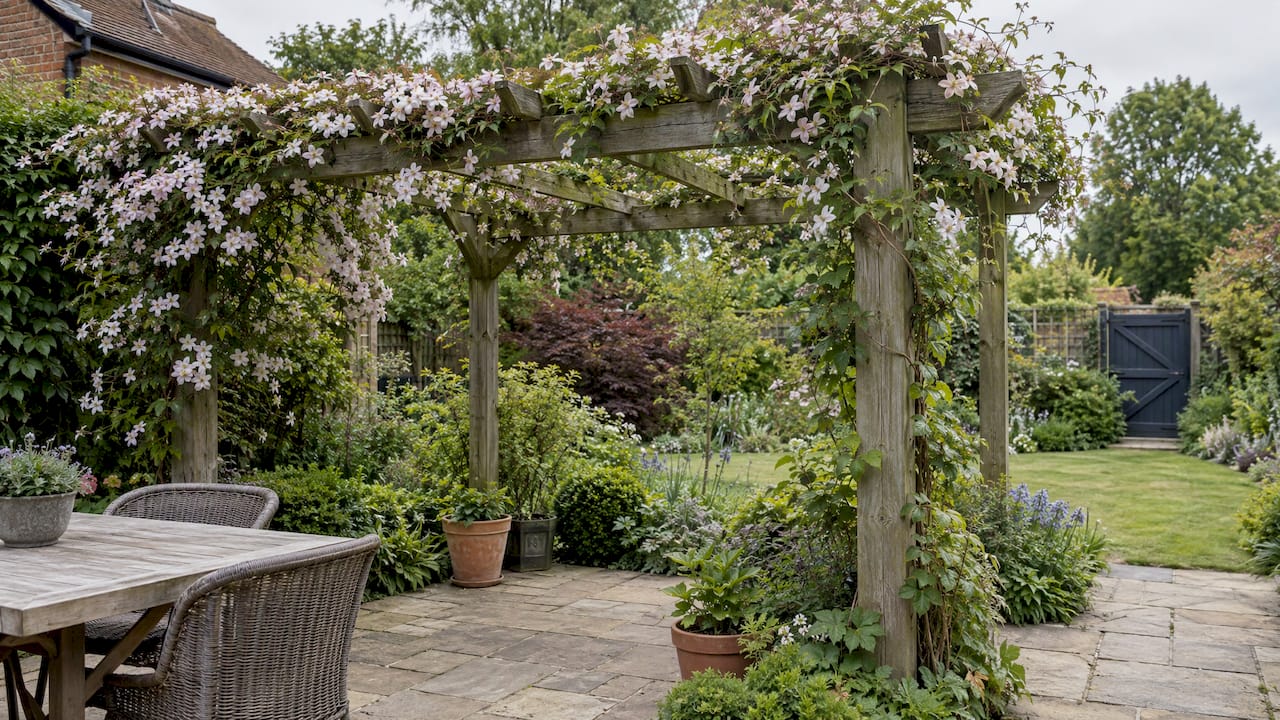
The best planting around a pergola works in two layers: strong climbers up the posts to form a living canopy, and bushy, low plants at the base so the posts never look bare. Get the structure right first, because a well-built pergola with solid posts, enough clear height and the right sun aspect carries climbers for decades. If you are still deciding on the frame, our pergolas are supplied and installed across Yorkshire, Derbyshire, Nottinghamshire and Lincolnshire, and the planting below suits any sturdy timber or metal frame.
TL;DR
Plant two climbers at each pillar of a larger pergola, pairing a vigorous rose with a gentler clematis or honeysuckle, as the RHS suggests.
Spring or autumn is the best time to plant most climbers; grapevines go in during the dormant season, ideally early spring.
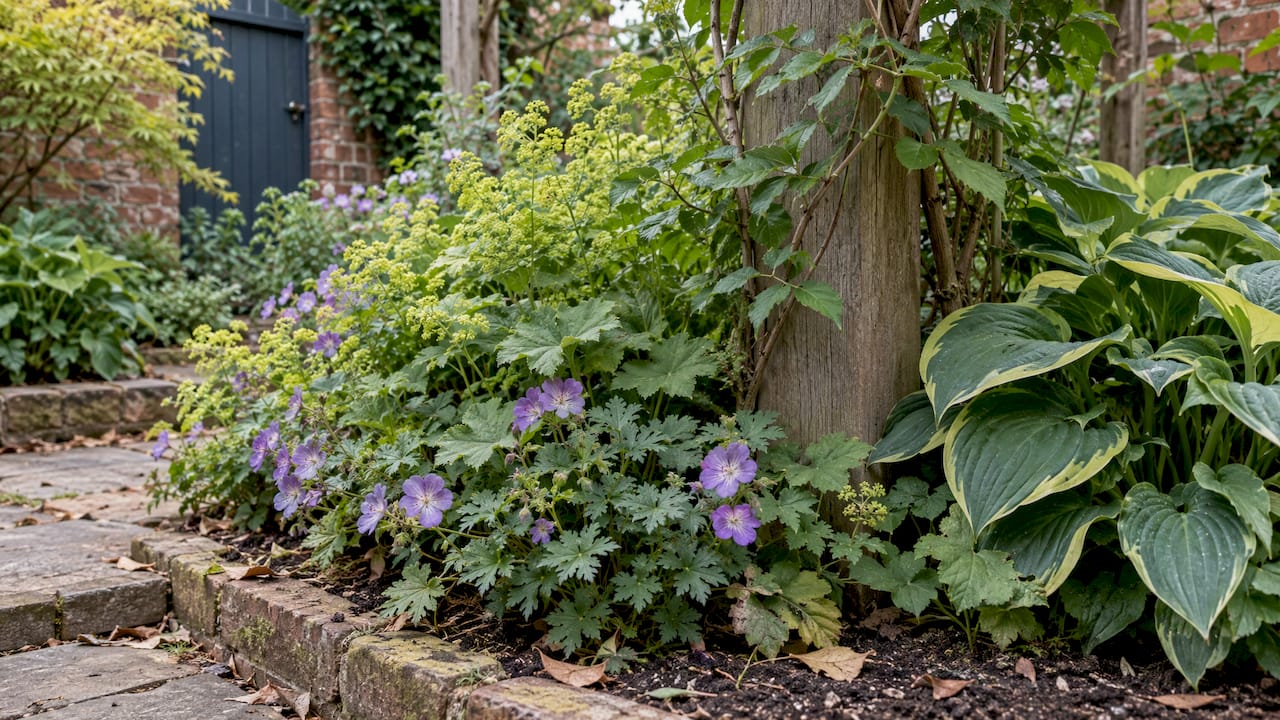
Fill the base with hardy geraniums, lady’s mantle or hostas so the posts do not look bare.
Wisteria, grapevines and vigorous clematis need regular pruning, so choose them only if you will keep up with it.
Match the plant to the light: most flowering climbers want sun, while evergreens suit shadier spots.
Table of Contents
Start with the pergola, not the plant
Before choosing plants, look at three things: how much sun the pergola gets, how tall and wide it is, and how strong the posts and cross-beams are. The RHS advises choosing a climber that will grow to the right size for the space in height and width, and checking the label for whether it wants sun or shade.
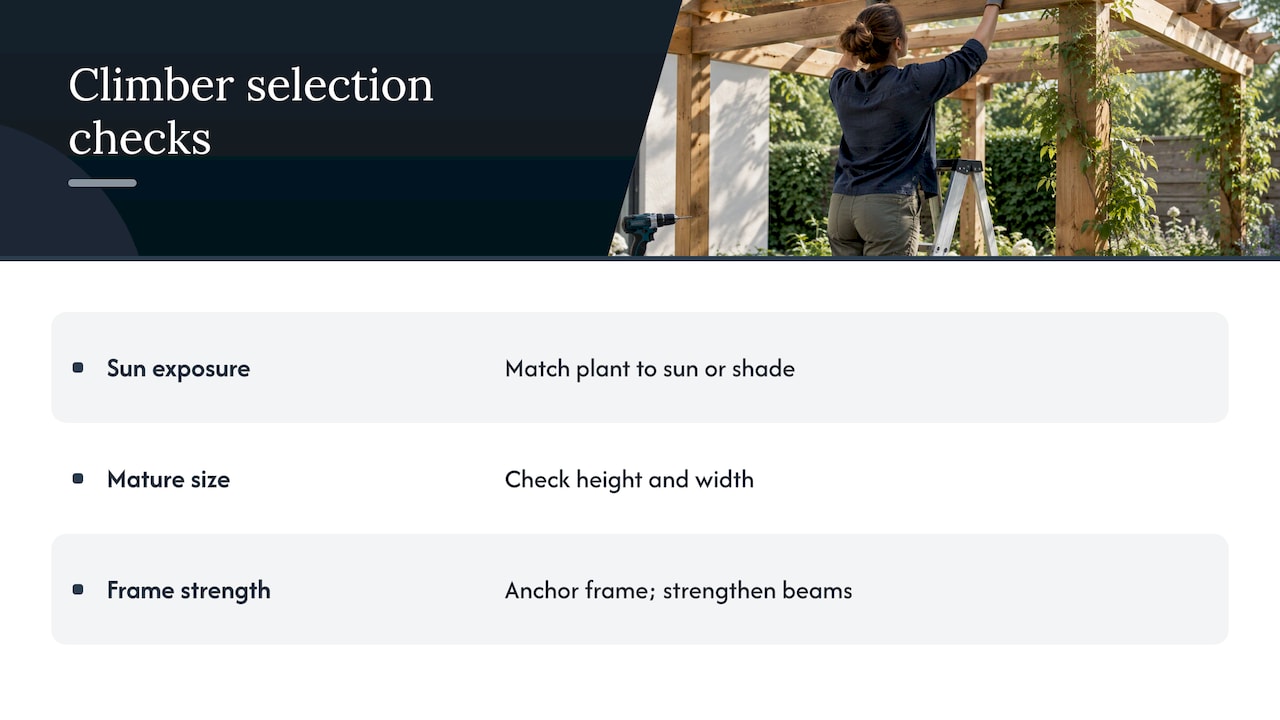
Sun matters most. Most flowering climbers need a good amount of light, so put them at the south-facing corners, while evergreen shade-tolerant plants suit low-light gardens, according to Homebuilding. Wisteria in particular does best in full sun on a south or west-facing side, and light shade reduces its flowers.
Weight is the second consideration. A mature wisteria or grapevine is heavy, so the frame must be well anchored and the beams strong. Our guide to pergola installation step by step explains what a secure build involves, and the essential features of pergolas covers what to look for in the frame itself.
Finally, think about height. One garden design guide recommends at least 2.4 metres of clear internal height so that the structure never feels cramped once foliage hangs from the beams.
The best climbers for a pergola
For a UK garden, the RHS recommends rambling or strongly growing climbing roses, clematis needing little or no pruning, and vigorous scrambling climbers such as summer-flowering honeysuckles. Its wider list also includes Clematis montana, wisteria, Solanum and Vitis.
Clematis
Clematis is the easiest place to start. Plant expert Jamie Shipley told Homebuilding that clematis can reach 3m and thrive in sun or part shade, which is the full height of many pergolas. Clematis montana is a vigorous deciduous choice: designers recommend it, or hops, for good summer shade that drops its leaves and lets winter light in. Clematis armandii gives vanilla-scented white flowers in late winter and early spring and is evergreen.
Roses and honeysuckle
Ramblers and strong climbing roses cover a post quickly. Choose single open-flowered varieties and you also feed pollinators, with hips for birds afterwards, as BBC Gardeners’ World notes. Honeysuckle is scented and good for wildlife: the RSPB says honeysuckles offer nectar to long-tongued moths, and its guide also credits clematis for bees and hops for caterpillars.
Wisteria
Wisteria is the classic pergola plant and the most demanding. It usually takes three to four years to flower after planting and needs regular pruning and training. Its stems also thicken every year, so check and loosen ties annually, since wisteria can lift tiles and pull guttering apart if it strays onto a house.
Grapevines
Grapevines give a dense leafy canopy and, with luck, fruit. The RHS says one plant may be enough to cover a pergola, provided you prune regularly to control vigour. Expect one or two bunches in the second or third summer. Vitis coignetiae, the crimson glory vine, is an ornamental alternative with strong autumn colour.
Evergreen options for privacy
If you want cover all year, star jasmine (Trachelospermum jasminoides) gives reliable evergreen coverage with scented white summer flowers, and semi-evergreen Lonicera japonica covers faster while the others establish, according to Garden Ninja. The RHS cautions that large-leaved and evergreen climbers can scorch in drying winds, so keep them out of exposed positions.
Plant | Light | Character | Care level |
Clematis montana | Sun or part shade | Deciduous, vigorous, spring flowers | Low |
Clematis armandii | Full sun | Evergreen, scented, early flowers | Low |
Climbing or rambling rose | Sun | Scented, wildlife friendly | Medium |
Honeysuckle | Sun or part shade | Scented, good for moths | Medium |
Wisteria | Full sun, south or west | Dramatic racemes, very vigorous | High |
Grapevine | Full sun | Dense shade, fruit | High |
Star jasmine | Sheltered sun | Evergreen, scented | Low to medium |
How to plant a climber at a pergola post
The method is simple, and the details are what decide whether the plant thrives.
Choose the season. The RHS says spring or autumn, when the weather is cool and damp, is best for most climbers, with less hardy types going in during spring. Grapevines go in during the dormant season, with early spring generally preferable to avoid winter damage.
Keep a gap from the post. For walls the RHS advises planting 45cm from the base so rain reaches the roots, as its growing guide explains. On an open pergola, the same logic applies: do not plant hard against a post where soil is dry and poor.
Improve the soil. Fork garden compost or well-rotted manure in at the foot of the upright.
Dig the hole. Make it two to three times wider than the pot but about the same depth. Plant large-flowered clematis more deeply than they sat in the pot.
Cut back spindly stems to within 15cm of the ground, which encourages branching from the base.
Angle it towards the support with small canes, then fix vertical wires or wire mesh up the pillar.
Tie in the shoots. Train them straight up the posts for quick canopy cover, or spiral them around the posts for flowering pillars. All steps above come from the RHS pergola guide.
For grapevines, install horizontal wires across the top of the pergola, spaced 25 to 30cm apart, so the fruiting canes have something to run along.
Planting around the base
Posts that rise from bare soil look unfinished, and the base is also where climbers get leggy. BBC Gardeners’ World recommends bushy plants such as hardy geraniums, lady’s mantle and hostas around the bottom of the posts. They shade the soil, hide the climbers’ bare stems and keep the roots cooler.
For more height, the same guide suggests attaching trellis panels to the posts to grow additional climbers. A designer’s trick from Gardens Illustrated is to flank a pergola with upright evergreens: one Berkshire pergola clad in Clematis montana and roses is framed by four columnar yews.
Containers and tiered planting
If the pergola stands on a patio, you cannot dig beds, so use large pots. A grapevine can live in a spacious container, ideally with at least six hours of direct sun a day and a pot roughly twice as wide and deep as the rootball, according to a UK grape grower, who recommends less vigorous varieties such as ‘Regent’ and ‘Boskoop Glory’. For privacy, one approach is tiered planting: tall perennials in containers at the base, with climbers on trellis above.
Planting for shade and privacy
A pergola changes how exposed a space feels, even with an open timber roof. Trees and shrubs at the boundary cannot block a view from directly above, so overhead planting does a job that hedging cannot. Place the pergola over the main seating or dining area rather than in a corner, and let deciduous climbers give summer shade and winter light.
Where you need dependable shade from the first summer, climbers alone take time. Wisteria and grapevines need a few years to fill a frame. A solid or louvred roof gives cover immediately, and many owners combine the two. Our articles on pergola roofing and pergola roof types set out the options, and creating shaded dining areas shows how planting and a roof work together. For connecting planting with the structure and the wider terrace, this outdoor living space design guide offers further ideas.
For a bar, restaurant or hotel terrace, the same logic applies at larger scale: planted pergola bays give a softer look, while a retractable roof gives guaranteed cover on the day a guest books a table.
Keeping growth under control
Vigorous plants are the point of a pergola, and they need a plan.
Bare bases. Pillars can become bare at the foot. Spiral new shoots around the posts, or cut back one or two main stems in early spring to stimulate growth from the bottom, says the RHS.
Mildew. Climbers whose roots dry out become prone to powdery mildew, especially honeysuckle and clematis. Water well in the first seasons and mulch.
Wisteria pruning. The RHS says prune twice a year: in July or August cut the current year’s whippy shoots back to five or six leaves, then in January or February cut them to two or three buds. Its wisteria pruning guide adds that varieties with long racemes are best where they can hang free.
Grapevines. Prune hard in winter to boost fruit, and tie in and train gently as they grow.
Ties. Check and loosen them each year as stems thicken.
Plants and structures succeed or fail together. A climber is only as good as the frame carrying it, and a frame is only as good as its design for the garden’s sun, wind and use. That is why we start with the site: where the sun falls, where people sit and how much weight the posts will take once a wisteria matures. With over 15 years in outdoor shading, we supply and install pergolas, verandas and awnings from brands such as Weinor, Llaza, Selt, Tarasola and Morvelle, in manual or electric versions, with options such as LED lighting, heaters and side screens. Many customers combine a pergola with planting: the frame gives immediate shade and the climbers add scent and colour over the following seasons. Our advice is to plan the planting before the build, so posts, wires and spacing suit what you want to grow. Andrew
What we have learned about planted pergolas
Planning a planted pergola with us
We design, supply and install pergolas, verandas and retractable awnings for homes, hospitality venues and schools across Yorkshire, Derbyshire, Nottinghamshire and Lincolnshire, with a consultative, no-pressure approach and free quotes. Tell us how you want to use the space and what you plan to grow, and we will design a frame to suit. See our pergola range or request a quote for residential awnings and canopies.

For more layouts to plan planting around, read our pergola design ideas.
FAQ
What is the easiest climber to grow on a pergola?
Clematis is a forgiving choice. It climbs with little added support, reaches around 3m and grows in sun or part shade, according to plant expert Jamie Shipley. Choose a type needing little or no pruning, as the RHS suggests, to keep upkeep low.
What can I plant at the base of a pergola?
Bushy plants such as hardy geraniums, lady’s mantle and hostas hide bare posts and shade the soil. In a paved area, use large containers instead and combine them with climbers on trellis above.
How long before a pergola is covered by plants?
It depends on the plant. Grapevines can cover a pergola from a single plant, with a first small crop in the second or third summer. Wisteria usually takes three to four years to flower. A roof on the frame gives shade in the meantime.
When should I plant climbers on a pergola?
Spring or autumn suits most climbers, with less hardy types best in spring. New grapevines go in during the dormant season, and early spring is generally preferable.
Sources
Recommended
Comments