
Property manager shading guide: choose and specify right
- Andrew Crookes
- 2 days ago
- 8 min read
For most UK property managers, a motorised louvred pergola is the best long-term investment, and a commercial-grade retractable awning is the fastest route to covered outdoor space. Both are available through Infinityawnings, which draws on 15+ years of industry experience and official partnerships with Weinor, Llaza, Selt, Tarasola, and Morvelle.
Three immediate actions before you award any contract:
Shortlist a supplier with manufacturer-authorised installer status and verifiable commercial references.
Book a site survey so dimensions, fixing points, wind exposure, and drainage are assessed before specification is finalised.
Reserve a maintenance allowance in your asset budget. Fabric replacement is a scheduled cost over time, not a surprise.
Table of Contents
How do the main shading types compare?
Choosing the right class of solution saves money and avoids retrofitting. The table below maps the four main categories against the criteria that matter most in procurement.
Shading type | Best for | Seasonal performance | Typical installed cost | Durability | Maintenance | Operation | Common extras |
Commercial retractable awning | Fast deployment, overhead shade | Seasonal | Moderate cost | Moderate durability | Annual service, fabric replacement | Manual or electric | LED, side screens |
Louvred pergola | Year-round trading, hospitality | Year-round | Higher cost | High durability | Low (mechanical checks) | Motorised | Heaters, lighting, sensors |
Veranda / canopy | Permanent covered space, residential | Year-round | Moderate to higher cost | High durability | Low–moderate | Fixed or electric blind | Glazed sides, guttering |
External blinds / screens | Wind and privacy screening | Seasonal | Lower cost | Moderate durability | Fabric checks | Manual or electric | Cassette housing |
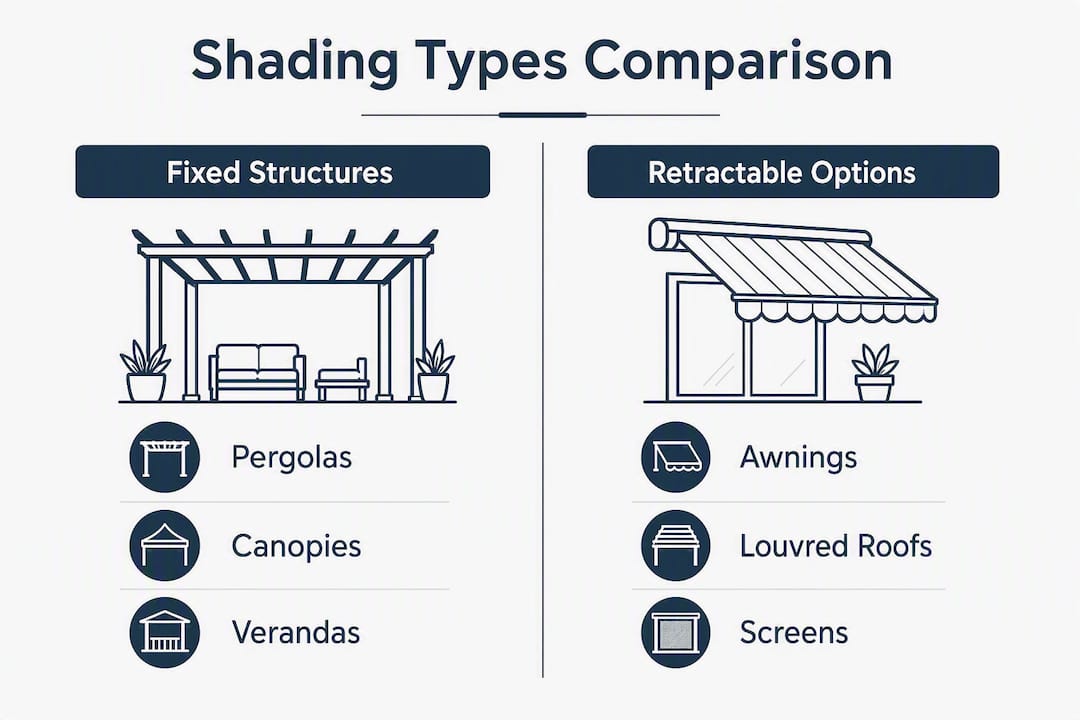
A few points the table cannot fully capture. Commercial retractable awnings must retract in sustained winds above Beaufort 3–4 (roughly 12–28 km/h), which limits their usefulness on exposed sites. Louvred pergolas from brands such as Weinor and Tarasola close automatically via rain sensors and hold their position in significantly higher wind loads, making them the only genuinely year-round option for commercial terraces.
Industry practice supports treating the awning as a near-term, flexible solution while budgeting a pergola as a longer-term capital improvement. The two are not mutually exclusive: some managers deploy an awning in year one and upgrade to a pergola once planning and budget are confirmed.
Which solution fits your property type?
Pub and restaurant terraces
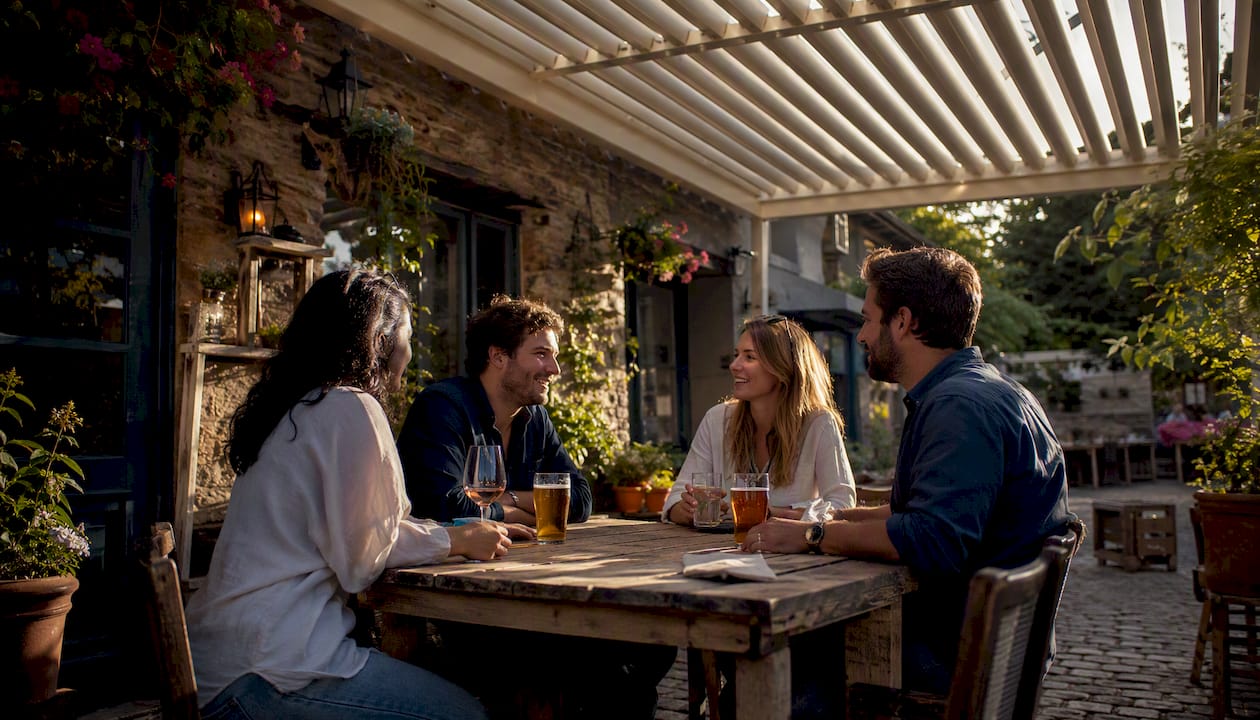
A louvred pergola with integrated LED lighting and infrared heaters is the strongest choice. Louvred pergolas can add up to three fully tradeable months to an outdoor calendar when combined with side screens and heating. Mounted infrared heaters warm people directly and use less energy than gas patio heaters, making them the practical choice for a covered terrace. Accessibility matters here: ensure a minimum 2-metre clear height and level access for wheelchair users under BS 8300.
Hotel terraces and courtyards
Hotels typically need a solution that looks premium and performs quietly. A motorised Weinor or Llaza system with concealed cabling and a neutral fabric palette suits this context. Automated louvre closure and rain sensors mean the structure manages itself during busy service periods.
Communal apartment amenity spaces
Retractable awnings work well here because they are lower cost, require no structural groundworks, and can be retracted when not in use. For season extension in communal spaces, add side screens and a small infrared heater. Check the lease and freeholder consent requirements before ordering.
School outdoor teaching areas
Freestanding canopies or verandas are the standard choice: they require no wall fixing, can be positioned away from the building, and meet DfE guidance on outdoor learning environments. Specify UV-stable fabric and a minimum 20-year frame warranty for educational settings.
Residential gardens and landlord properties
A domestic-grade retractable awning from Morvelle or Selt covers most landlord needs at a proportionate cost. For smaller residential properties, manual operation is often sufficient and removes the need for electrical supply works.
What belongs in your supplier brief?
A vague brief produces incomparable quotes. Use this numbered checklist when preparing your RFQ.
Site dimensions and drawings. Provide a scaled plan with projection depth, width, and fixing-wall height. Note any obstructions (gutters, pipes, windows).
Wind-load rating. State the required Beaufort rating or BS EN 1991-1-4 wind zone for the site. Commercial sites typically require a higher rating than domestic.
Fixing method. Specify masonry, steel bracket, or freestanding. Freestanding requires foundation design and structural sign-off.
Drainage and guttering. Pergolas and verandas need integrated guttering and a specified discharge point. Include this in the scope.
Operation. State manual or electric. For electric, specify Somfy-compatible motors or equivalent, and note any building management system (BMS) integration requirement.
Sensors. List required sensors: wind, rain, and sun. Confirm whether these feed into a BMS or operate independently.
Electrical supply. Note the nearest isolator point, whether a dedicated circuit is required, and that an NICEIC or NAPIT-certified electrician must sign off the installation.
Extras to price separately. LED lighting, infrared heaters, side screens, and branded valances should each appear as line items, not bundled into a single figure.
Pro Tip: Insist on a separate line item for planned fabric replacement and a recommended service schedule. This gives you the true total cost of ownership and prevents budget surprises at year five.
What do UK projects typically cost and how long do they take?
Installed cost ranges for commercial projects vary significantly based on size, features, and specifications, with commercial retractable awnings generally more affordable than louvred pergolas and verandas or canopies costing more depending on complexity.
Factors that move a quote upward: restricted site access, non-standard fixing substrates, BMS integration, and branded or bespoke fabric.
Typical project timeline from first contact to handover involves several stages including site survey, specification, planning checks if required, manufacture, installation, and final documentation. Timeframes vary by project complexity and need for permissions.
Fabric lifespan note: Commercial awning fabrics commonly last 5–8 years. Budget fabric replacement as a scheduled asset cost from day one, not a reactive spend.
Routine servicing covers realignment, bearing lubrication, fabric inspection, and motor checks. Annual servicing is the standard commercial recommendation and protects warranty continuity.
What UK regulations do you need to check first?
External shading is often permitted development, but several situations require a planning application or prior approval.
Listed buildings and conservation areas almost always require listed building consent or conservation area consent, regardless of size.
Structures exceeding permitted development limits (height, projection, or proximity to a boundary) need a full planning application.
Pavement licences and highways consent apply where a structure overhangs or sits on public highway. Check with the local authority highways team.
Advertisement consent is required for awnings carrying a logo or brand name visible from the public highway in many local authority areas.
Party wall considerations arise when fixing into a shared or boundary wall.
The Planning Portal’s interactive guidance is the correct starting point for any permitted development check in England.
Pro Tip: Submit a pre-application enquiry to your local planning authority before ordering. It costs little, takes 4–8 weeks, and removes the risk of installing a structure that requires retrospective consent.
For insurance, notify your buildings insurer before installation of any structural addition. Confirm that the wind rating of the chosen system matches the site’s exposure, and that electrical works are certified. For outdoor heating, review seasonal fire safety precautions as part of your risk assessment.
How do you vet a shading supplier properly?
Ask for a line-item quote separating labour, materials, delivery, and commissioning.
Confirm warranty terms in writing: fabric warranty (typically 2–5 years), mechanical warranty (5–10 years), and electrical components separately.
Verify manufacturer-authorised installer status for the brand being supplied. Infinityawnings holds official partnerships with Weinor, Llaza, Selt, Tarasola, and Morvelle.
Check public liability insurance (minimum £2 million for commercial work) and working-at-height certification.
Request two or three references from comparable commercial projects completed in the last three years.
Red flags to walk away from: a site survey conducted by phone or email only; a warranty described in a single sentence with no exclusions listed; no commissioning certificate offered; no planned maintenance option; and any supplier who cannot name the motor manufacturer or fabric brand being installed.
What do real installations look like?
Hotel terrace, Yorkshire. A Weinor motorised louvred pergola with integrated LED lighting and two infrared heaters was installed over a 6m × 4m courtyard terrace. The hotel extended outdoor food and drink service from a seven-month to a ten-month calendar, with automated louvre closure triggered by the rain sensor removing the need for staff intervention during service.
Pub garden, Nottinghamshire. A 5m commercial retractable awning provided immediate overhead cover for the summer season while the operator confirmed planning for a permanent pergola the following year. The phased approach kept capital outlay proportionate.
Residential apartment complex, Derbyshire. Side screens and a Selt retractable awning were added to a communal roof terrace, increasing resident use of the space through spring and autumn. Freeholder consent was obtained before works began.
Key takeaways
The strongest shading decisions combine the right product class with a complete supplier brief, a regulatory check, and a maintenance budget built in from day one.
Point | Details |
Match product to use case | Louvred pergolas for year-round commercial use; retractable awnings for fast, lower-cost seasonal cover. |
Budget total cost of ownership | Fabric replacement every 5–8 years is a scheduled cost; include it alongside annual servicing in your asset budget. |
Check planning before ordering | Use the Planning Portal and submit a pre-application enquiry for listed buildings, conservation areas, or oversized structures. |
Demand a complete brief | Your RFQ must include dimensions, wind rating, fixing method, motor spec, sensors, electrics, drainage, and line-item extras. |
Infinityawnings as your supplier | Infinityawnings offers free site surveys, manufacturer-authorised installation across Yorkshire and surrounding counties, and ongoing service contracts. |
Working with property managers: a note from Infinityawnings
Property managers face a procurement challenge that most residential buyers do not: they need a solution that performs reliably across multiple seasons, satisfies insurers and planners, and requires minimal management once installed. Over 15 years of working with commercial clients across Yorkshire, Derbyshire, Nottinghamshire, and Lincolnshire, the pattern is consistent. The projects that run smoothly are the ones where the specification was complete before the first quote was requested.
Infinityawnings offers free site surveys, downloadable technical guides, and direct support through planning and specification stages. If you are at an early stage, the guides are a useful starting point before committing to a survey.
How Infinityawnings supports your next shading project
Property managers procuring outdoor shading need a supplier who can handle the full scope: design, manufacture, installation, and ongoing maintenance, without passing the coordination burden back to the client.
Infinityawnings covers exactly that. With manufacturer partnerships across Weinor, Llaza, Selt, Tarasola, and Morvelle, the team can specify and install everything from a single commercial awning to a fully integrated louvred pergola system with heating, lighting, and automated sensors. The service area covers Yorkshire, Derbyshire, Nottinghamshire, and Lincolnshire, with free site surveys available across all four counties.
To get a scoped, line-item quote for your next project, contact Infinityawnings to arrange a free site survey. Bring your site plan and a list of the extras you need priced separately, and the team will return a specification-ready quote you can take straight to budget approval.
Useful sources
Planning Portal: do you need permission? — the primary interactive tool for permitted development checks in England.
The Town and Country Planning (General Permitted Development) (England) Order 2015 — the primary legislation governing permitted development rights.
The Town and Country Planning (General Permitted Development etc.) (England) (Amendment) (No. 2) Order 2023 — covers Class OA solar canopy provisions on non-domestic off-street parking.
Infinityawnings: exterior shading terminology guide — specification language for briefs and RFQs.
Infinityawnings: commercial shading guide — manufacturer partnerships and commercial system options.
Infinityawnings: how to maintain retractable awnings — service schedules and maintenance checklists.
Greater Cambridge Planning: external shading guidance — practical planning context for external shading installations.
Seasonal fire safety precautions: a facility manager’s guide — risk assessment guidance for outdoor heating in commercial settings.
Recommended