
15 Years' Installer Lessons for Roof Mounted Awnings in the UK


A professionally supplied and installed roof mounted awning is the safest and most reliable way to add shade to a patio, terrace or outdoor seating area, and the right first step is booking a site survey rather than comparing fixings online. Specialist companies supply and install both retractable and fixed roof mounted systems across residential and commercial properties, backed by proper structural checks and a written quote. Getting a surveyor on site before you commit protects your warranty and your roofline.
TL;DR:
Professional installation ensures load assessments are accurate and warranties remain valid by avoiding DIY or guesswork fixings.
Regulations require proper planning, supervision, and suitable access methods like scaffolding or MEWPs, especially when working more than 2 meters above ground.
Costs are mainly driven by span, projection, structural reinforcement, and electrical wiring for motors, sensors, or lighting systems.
A thorough site survey and detailed written quotes, including lead times and warranty coverage, are essential before committing to an installer.
Proper ongoing maintenance involves annual inspections, checking fixings, fabric wear, and electrical faults to prevent costly failures.
Table of Contents
Why choose a professionally supplied roof mounted awning
A roof mounted awning attached to a fascia, wall or roofline extends the usable months of a patio, terrace or café seating area by keeping sun and light rain off the space beneath it. For homeowners this means an outdoor room that works from spring through autumn; for restaurants, bars and hotels it means more covers without adding floor space.
The value of professional supply and installation over a DIY or handyman fix comes down to a few practical things:
Durable fixings: a professional installer assesses the fascia, wall or roof structure before drilling, rather than guessing at load capacity.
Manufacturer warranty: most warranties are only valid when the product has been fitted by an approved installer.
Integrated extras: lighting, heaters and wind sensors are wired in properly rather than bolted on afterwards.
Finished appearance: matched fabric, framing and mounting hardware look coordinated rather than improvised, which matters for kerb appeal and resale value.
Commercial operators get an added benefit: a well specified system can be sized and positioned to maximise seating capacity under cover, which is often the deciding factor when weighing up the cost of installation against extra trading days.
Installation and safety: what regulations and good practice demand
Roof mounted awning installation is work at height, and in the UK that means it falls under the Work at Height Regulations 2005, which the Health and Safety Executive enforces on any job where a fall could cause injury. The regulations require the work to be properly planned, supervised and carried out by people with the right skills and equipment, and they push installers to avoid working at height altogether where that is reasonably practicable.
Where roof access cannot be avoided, HSE guidance sets out a hierarchy of access methods:
Scaffolding or mobile elevating work platforms (MEWPs) for anything beyond a short, low-risk task.
Loading bays and temporary working platforms where a scaffold isn’t practical but sustained access is still needed.
Ladders, reserved for low-risk, short-duration jobs only, never as the default for roof mounted work.
One rule installers rarely mention to customers: any working platform used where someone could fall more than 2 metres must be inspected after assembly and at regular intervals, with records kept. A competent installer will also check for fragile roof coverings, build in a weather contingency for exposed or elevated sites, and be able to produce inspection reports if you ask. Guidance in Health and safety in roof work (HSG33) recommends general access scaffolds or MEWPs for safe roof access precisely because they reduce the time anyone spends on a fragile surface. If your site has known access difficulties, our guide to structural support options explains what reinforcement might be needed before installation day.
What to expect from a professional supply and installation
A typical project runs through six stages: enquiry, site survey and structural checks, specification and quote, manufacture lead time, installation, then commissioning and handover. Knowing this sequence helps you compare quotes on equal terms rather than on price alone.
Several factors drive cost and timeline more than anything else:
Span and projection: a wider or deeper awning needs stronger fixings and often a bigger frame.
Fixed versus retractable: retractable systems cost more upfront but adapt to weather and season.
Motorisation and electrical integration: wiring in a motor, sensor or lighting circuit adds both material and labour cost.
Structural reinforcement: older fascias or weak brickwork may need extra bracketry before the awning goes up.
Access costs: scaffold or MEWP hire can be a significant part of the bill on a short, awkward job, as HSG33 notes when it comes to roof access provision.
Pro Tip: Ask every supplier for their manufacture lead time and their warranty terms in writing before you sign anything, not just their fitting price.
Before your survey, it helps to have rough measurements and photos of the wall or roofline ready, which our guide to measuring for awnings covers in more detail. A good installer will also explain what post-installation inspection or maintenance package they offer, since that often affects whether your warranty stays valid.
Choosing materials and specification for your awning
Turning a rough idea into a workable specification starts with the fabric. UV protection, waterproofing and fade resistance all vary by product, and the right choice depends on how exposed the site is and how the space gets used, whether that’s a shaded reading corner or a working terrace with tables in constant use.
Framing matters just as much as fabric:
Corrosion resistance: coastal or exposed sites benefit from higher grade fixings, such as 316 stainless steel, detailed in our coastal specification guide.
Load ratings: check the frame and fixing load ratings against relevant standards before committing, as explained in our guide to awning load ratings.
Operation mode: manual systems are simpler and cheaper; electric motors add convenience and can integrate wind or rain sensors that retract the awning automatically.
Extras: LED lighting and heaters extend the usable season but bring the installation into the territory of fixed electrical work.
Any motor, sensor or lighting circuit must comply with BS 7671, the wiring regulations that govern fixed electrical installations, and should be signed off by a competent electrician rather than left to whoever fits the frame. Our guide to electric awning wiring sets out what compliant wiring looks like in practice.
Maintenance, inspections and avoiding common failures
A roof mounted awning needs checking after any extreme weather event and at least once a year, with records kept alongside any scaffold or MEWP inspection reports from the original installation.
Three issues account for most premature failures:
Loose fixings, usually from vibration or thermal movement, which a yearly check catches before they become a safety issue.
Fabric wear, particularly at fold points and valances, where prompt repair is far cheaper than full replacement.
Electrical faults in motorised systems, which should always go to a qualified electrician rather than a general handyman.
Routine cleaning and clearing debris from gutters and fixings prevents most of this. When considering a maintenance plan, ask what’s included in a service visit, what an emergency call-out costs, and how quickly the supplier can respond. Our step-by-step maintenance guide and our rundown of common installation errors both cover the faults that turn into expensive repairs if ignored.
Criteria for selecting a qualified and reputable installer
Not every company that sells awnings is equipped to fit them safely to a roof or fascia, so it pays to check a few things before signing a contract.
Look for evidence of structural competence first: does the company carry out a proper site survey, including checks on the fascia, wall or roof structure, before quoting? A supplier who quotes from a photo alone without visiting the site is skipping a step that protects both your building and your warranty.
Check how long they’ve operated and what brands they supply. An installer with a long track record and official supplier status for established manufacturers, such as Weinor, Llaza, Selt, Tarasola or Morvelle, has both the experience and the manufacturer backing to stand behind their work. Ask whether their operatives hold the training and equipment needed for the access method the job requires, whether that’s scaffold, a MEWP or straightforward ground level fitting.
Finally, look at how they handle the parts of the job that are easy to skip: written quotes, clear lead times, and a defined process for electrical sign-off where motors or lighting are involved. A supplier who is vague about any of these is worth questioning further before you commit.
Questions to ask potential suppliers before you commit
A short list of direct questions during the quote stage will tell you more about a supplier’s reliability than any brochure.
Ask who will carry out the structural survey and what happens if they find the fascia or wall isn’t strong enough for the specified awning. Ask what access method they’ll use for the installation, given that scaffold, a MEWP and a simple ladder all carry very different safety implications and cost profiles.

Ask for the manufacture lead time in writing, and what the warranty covers, including whether annual inspection is a condition of keeping it valid. If the project includes a motor, lighting or heaters, ask who certifies the electrical work and whether you’ll receive a certificate for it, since fixed wiring should be documented under BS 7671.
Finally, ask what maintenance or service package they offer after installation and how they handle an emergency call-out if something fails outside normal hours. A supplier who answers these clearly, without hedging, is usually the one who has done this many times before.
Common red flags when hiring an installer
A few warning signs tend to predict a poor experience long before installation day.
Be wary of a quote given without a site visit, since that usually means no one has actually checked the fascia, wall or roof structure the awning will be fixed to. Pressure to sign on the spot, with discounts that expire the same day, is a classic sign of a sales-led rather than survey-led process.
Vague answers about access method, lead time or warranty terms are another signal. If a company can’t say whether they’ll use scaffold or a MEWP for an elevated job, or won’t put lead times and warranty terms in writing, that vagueness tends to carry through into the installation itself. The same goes for any supplier who can’t say who handles electrical certification when a motor or lighting is part of the job: that’s not a detail to leave unresolved.
Cash-only pricing with no paperwork, or an unwillingness to provide references from previous commercial or residential clients, are both reasons to keep looking.
Reading reviews and testimonials properly
Reviews are useful, but only if you read past the star rating. Look for detail: does the reviewer mention the survey process, how the installer handled access or structural issues, and whether the finished job matched what was quoted?
Testimonials that specifically mention timelines being met, tidy site management, and electrical work being signed off properly tell you more than a generic five-star comment. For commercial clients, it’s worth looking for reviews from similar settings, such as other hospitality venues or schools, since the access and scheduling challenges on those sites differ from a domestic patio job.
Treat a complete absence of reviews, or reviews that all read as if written by the same person, with some scepticism. A supplier with a genuine history of residential and commercial work will usually have a spread of feedback that reflects different project types and sizes.
What years of fitting roof mounted awnings has taught us
Across more than 15 years of supplying and fitting awnings, pergolas and verandas for homes and businesses, the specification choices that hold up longest are rarely the cheapest on paper. Stronger frame fixings, better fabric grades and properly certified electrics cost more at quote stage and save money over the life of the installation.
Safety runs through every job the same way: a site survey before anything is quoted, operatives trained for the access method the roof demands, and a paper trail of inspection records that follows HSE guidance rather than shortcuts it. On coastal or exposed sites we specify higher corrosion resistance as standard, and on older buildings with fragile roof coverings we plan access to minimise time spent on the roof itself rather than assuming a ladder will do.
— Andrew
How Infinity Awnings can help with supply and installation
Infinity Awnings designs, supplies and installs retractable awnings, pergolas and verandas for homeowners and for commercial clients including restaurants, bars, hotels and educational settings, across residential and commercial properties alike.
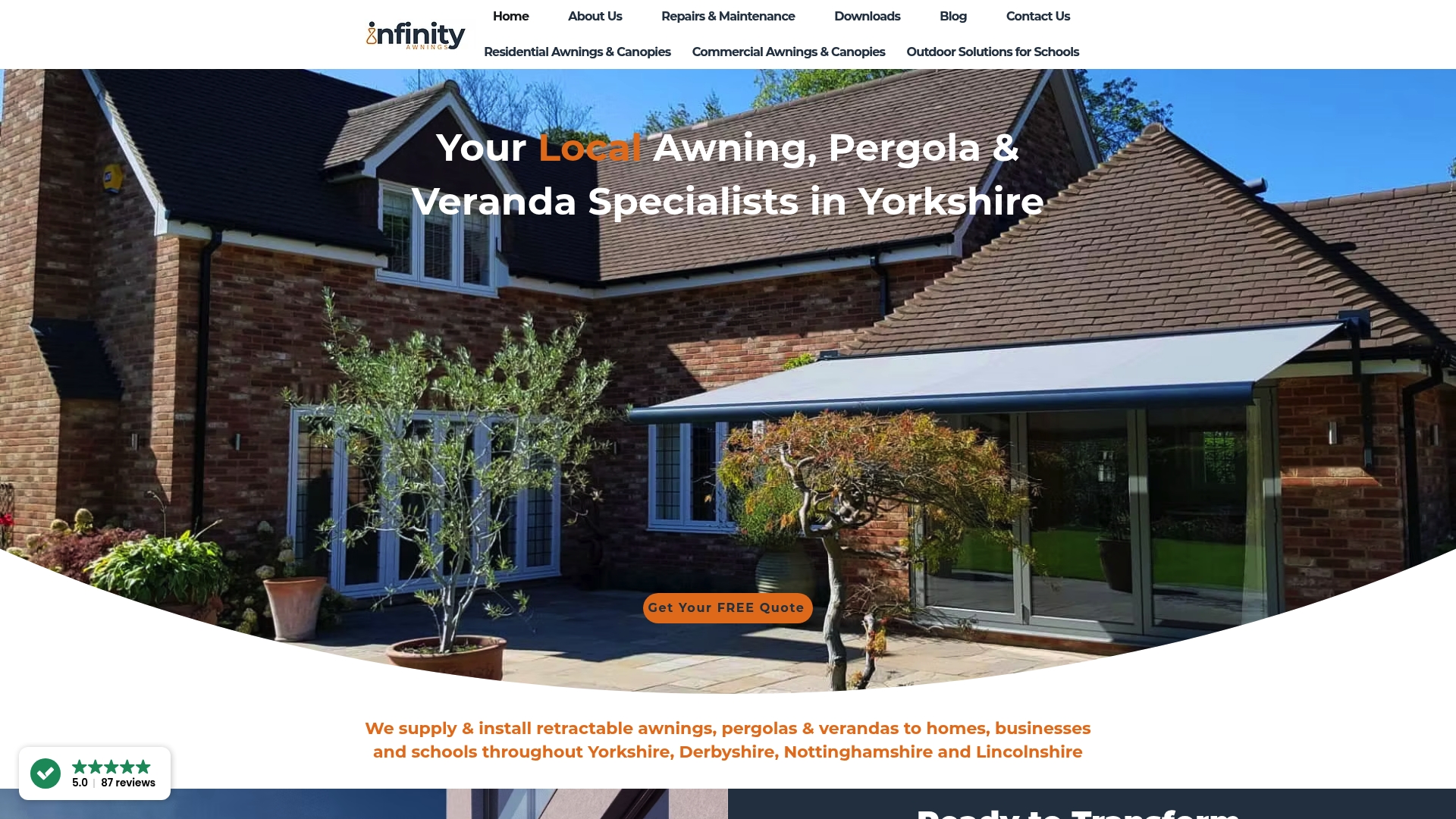
Ahead of your site survey, it helps to have rough measurements, a few photos of the wall or roofline, and any known issues with the fascia or structure ready to share. From there we assess the fixings, talk through fabric and framing options, and put together a written quote before any work is booked in.
Residential patios and terraces: see our retractable awnings and patio awnings ranges.
Commercial and hospitality spaces: see our commercial awnings and canopies options.
Schools and nurseries: see our outdoor solutions for schools page.
Request a site survey or a written quote through Infinityawnings and we’ll take it from there.
Sources
For anyone wanting to verify the safety and technical points covered above, these are worth bookmarking:
FAQ
Do I need planning permission for a roof mounted awning?
Most roof mounted awnings on a private home fall under permitted development, but rules vary depending on the property, its location and any previous alterations. Our guide to awning regulations explains the main factors to check before installation, and a reputable installer will flag anything that needs formal consent during the site survey.
Who is responsible for checking the roof structure before installation?
A professional installer carries out a structural check of the fascia, wall or roof as part of the site survey, before any quote is finalised. This protects both the building and the awning’s warranty, since most manufacturers require proof that fixings were assessed and installed correctly.
Does a motorised awning need an electrician?
Yes. Any motor, sensor or lighting circuit tied to an awning counts as fixed electrical work and must comply with BS 7671, so it should be wired and signed off by a competent electrician rather than the general installer alone.
How long does supply and installation typically take?
Timelines vary with manufacture lead time, access requirements and the complexity of the specification, so it’s worth asking each supplier for their current lead time in writing at the quote stage. Straightforward retractable installations tend to move faster than commercial jobs needing scaffold or MEWP access.
Will my warranty cover the awning if I fit it myself?
Most manufacturer warranties require professional installation and often expect regular inspection to remain valid, so a DIY fit can void cover from the outset. Confirming warranty terms and the expected inspection cadence with your supplier before signing avoids an unpleasant surprise later.
Recommended
Comments