
How to Stop an Awning Flapping and Secure It in Storms


A flapping awning is telling you something: the wind is stronger than the awning is built to work in, or something in the set-up has loosened. For a wall-mounted retractable awning, the first fix is to wind it in. The lasting fix is to check the pitch, the fixings, the fabric tension and the support, and to put a wind sensor on the motor. Those are jobs a specialist installer should carry out, and this guide shows what each one involves.
It is written for homeowners, pub, restaurant and hotel owners, schools and property managers with a retractable or folding arm awning. Caravan and motorhome awnings are a different product, and we cover them in one short section so you do not buy the wrong fix.
TL;DR
Retract the awning when the wind passes the limit for its wind resistance class, and do it before strong wind arrives, not during it.
Flapping on a wall-mounted awning usually comes from slack fabric, wrong pitch, loose fixings, worn arms or an unsuitable wall, not from a missing gadget.
A pitch of around 14 degrees is ideal, according to the British Blinds and Shuttering Association (BBSA), so rain runs off rather than pooling on the fabric.
A wind sensor helps, but it is not a failsafe: you remain responsible for retracting the awning.
Persistent flapping, a rattling bracket or a sagging arm needs a professional inspection before the next gale.
Table of Contents
Why a wall-mounted awning flaps
A retractable awning is a sheet of tensioned fabric on a roller, held out by folding arms. Wind does two things to it. It lifts the leading edge, and it pushes air under the fabric. If the cloth is not held taut, it ripples and snaps. Each snap passes load into the arms, the front bar and the wall brackets.
That load is the real concern, more than the noise. The BBSA, the UK trade body for the blinds and awnings sector, says in its product characteristics guidance for folding arm awnings that these awnings, when fixed to a wall with no other support, are sun-shading products and are not designed for adverse weather. They are made for sunshine and light breezes. A gale is outside their job description.
In practice, flapping has five common causes:
The wind is simply too strong. The awning is extended beyond its rated limit.
The pitch is wrong. Too flat and rain pools; too steep and the fabric catches more wind at the front edge.
The fabric has lost tension. This can come from the arms needing adjustment, the roller needing re-tensioning, or fabric that has stretched or aged.
The fixings or the wall are not doing their job. Brackets that have worked loose, or that were put into a poor substrate, let the whole frame move.
There is no extra support where the width or projection calls for it.
How windy is too windy for an awning?
There is no single speed that suits every awning. The BBSA guidance says an awning must be retracted when the wind exceeds the wind resistance class stated by the manufacturer. That class comes from testing. Awnings sold in the UK are assessed against BS EN 13561:2015, the British adoption of the European standard for external blinds and awnings, whose wind-load requirements were aligned with the revised EN 1932 test methods. The standard does not cover the wind resistance of non-retractable products such as Dutch awnings.
So your first job is to find the class on your paperwork or the manufacturer’s data sheet. If you cannot find it, ask your installer. Then treat it as a ceiling, not a target.
The second half of the BBSA advice matters just as much: retracting in high wind can itself damage the awning, so it should be fully retracted before strong winds prevail. If you wait until the fabric is cracking like a sail, the arms are already under heavy load and winding in puts more strain on them. A useful habit is to look at the forecast gusts, not just the average wind speed, and to bring the awning in when the day turns unsettled, even if it looks calm at that moment.

Fixes in the order that works
1. Retract it
This is the instant answer. If the fabric is flapping, wind it in now, calmly and fully. A half-open awning is the most vulnerable, because the arms are partly extended and the fabric has no support from the roller.
For a restaurant terrace or hotel patio, make this a named job on the opening checklist. Someone should be responsible for checking the forecast and for winding in at close, so the awning is never left out overnight on a windy forecast.
2. Check the pitch
Pitch is the angle of the fabric from the wall. The BBSA gives 14 degrees as ideal, because it lets water from a light shower run off instead of collecting on the cloth. A flat awning that holds water is heavy, stretched and prone to damage, and one that is too steeply angled can act more like a sail. If your awning has been set at an unusual angle, or the angle has crept as the arms settled, it is worth having it reset. We explain the reasoning in more detail in our guide to setting awning pitch between 10 and 15 degrees.
3. Look at the fixings and the wall
If you can see or hear movement at the brackets, stop using the awning until it is checked. A loose bracket means the load is going into the wall, and wind will find that weakness.
What the brackets are fixed into matters as much as the brackets. Brick, solid masonry, timber fascia and cladding all behave differently. We have written separately on what actually holds when mounting on cladding and on four checks to stop fixings failing on fascia-mounted awnings. If your awning is on a fascia or cladding, read those before the next storm season.
4. Restore fabric tension
Tension is adjusted at the arms and the roller. A properly tensioned cloth is smooth across its width with no slack along the front bar. If the cloth looks baggy, or ripples even in a light breeze, the arms or tension settings need adjusting. This is a job to leave to an installer: the arms are spring-loaded and can cause injury if they are adjusted wrongly.
Fabric also ages. Old, stretched or poorly maintained cloth never sits as it did when new. Our guides on how to maintain retractable awnings and choosing awning fabric cover the routine cleaning and the choices that affect long-term performance.
5. Add structural support where the size demands it
Wide, deep awnings put more leverage on the wall. Where the span is large, or the wall cannot take the whole load, posts or a framework change how the awning carries wind. Our overview of structural awning support options sets out the choices. For some sites, a pergola or veranda is the better structure from the start, because it is built to be fixed and braced.
6. Fit a wind sensor
A wind sensor measures wind at the awning and sends a signal to the motor to retract it. That means the awning can be wound in while you are out, at work, or asleep. It is a sensible addition for a motorised awning, and we supply weather sensors as part of our customisation options.
Two cautions come from the BBSA and are worth knowing. If your awning works automatically from sensors, do not change the limits that were set. Some wind sensors also only work when the awning is fully extended, and sensors are not a failsafe: it remains the user’s responsibility to make sure the awning is retracted. Position matters too, since a sensor that sits in a sheltered spot reads low. See our notes on where to fit a wind sensor and how wind sensors protect your outdoor space.
A note on anti-flap kits and rail stoppers
Search results for this problem are full of caravan and motorhome products, and they can mislead owners of wall-mounted awnings. An anti-flap kit, sometimes called a de-flapper, is a clamp that grips the fabric of a caravan awning and locks onto a rafter pole or guyline. Awning rail stoppers are small plugs that slide into the end of a rail channel to stop a canopy sliding along it in a side wind. Both belong to pitched, pegged, pole-supported awnings on vehicles.
A wall-mounted retractable awning has a roller, folding arms and a front bar, so those clamps do not fit its design. Its flapping is solved by the steps above: correct pitch, tension, secure fixings, support and retraction. If your awning is a caravan awning, a pegged-down storm strap over the roof and reinforcing poles once the awning is secure is the usual advice from caravan press such as Practical Caravan’s awning guide.
Securing your awning before a storm
A short routine takes a couple of minutes and protects a significant investment.
Check the forecast the evening before, looking at gust speed as well as average wind.
Fully retract the awning before the wind builds. Do not leave it partly open.
Make sure the cover or hood, if fitted, is closed properly and the front bar sits snug against the housing.
Bring in loose items such as parasols, heaters and furniture that could be blown into the fabric.
Switch the motor to a safe mode if your control has one, and do not override sensor limits.
After the storm, inspect before you extend. Look for dents, bent arms, torn stitching, loose brackets and any gap in the wall around the fixings.
Weather can affect more than the awning. Wind and rain work on the whole exterior of a building, and general advice on protecting your roof from weather year-round is a handy reminder to check gutters, fixings and fittings near the awning after a bad spell.
When to call in an installer
Some signs mean the awning should stay wound in until someone has looked at it:
A bracket that moves, rattles or has a gap behind it.
An arm that sags, or one that has stopped folding evenly.
Fabric that is torn, frayed at the seams or visibly stretched.
A motor that does not respond, or a sensor that has stopped working.
Flapping that appears in light wind when it was not there before.
If you are a property manager or school, add awnings to your planned maintenance schedule, ideally with a check before autumn. Our installers cover Yorkshire, Derbyshire, Nottinghamshire and Lincolnshire for repair and maintenance as well as new installs. If you are choosing a new awning for an exposed site, tell us about the exposure at the start, because it affects the type, size, support and the sensor we would specify.
Our view on flapping awnings
Most of the awnings we are asked to look at because they flap are not faulty products. They are awnings that have been asked to do something outside their design, or have drifted out of adjustment since fitting. After more than 15 years of fitting awnings, pergolas and verandas across Yorkshire and the surrounding counties, we put the same advice first every time: choose the structure for the exposure. A folding arm awning is a brilliant sun-shading product for a sheltered terrace. On a windswept site, a pergola or veranda with a fixed frame may be the better answer, and we would rather say so at the quote stage than at the first gale. Work with premium brands such as Weinor, Llaza, Selt, Tarasola and Morvelle gives you wind resistance data and fabrics you can plan around. Add a weather sensor, set the pitch properly, and make sure the wall can carry the load. That combination is what keeps a good awning quiet and in one piece for years. Our approach is consultative and without pressure: we look at the site, the wall, the wind and how you use the space, and we recommend what fits. Andrew
Get the right awning for your site
If your awning flaps, or you are planning one for an exposed terrace, we supply, install, repair and maintain retractable awnings, pergolas and verandas for homes and businesses across Yorkshire, Derbyshire, Nottinghamshire and Lincolnshire. Options include manual or electric operation, weather sensors, side screens, LED lighting and heaters. Start with our page on retractable awnings, pergolas and verandas and ask for a free quote.
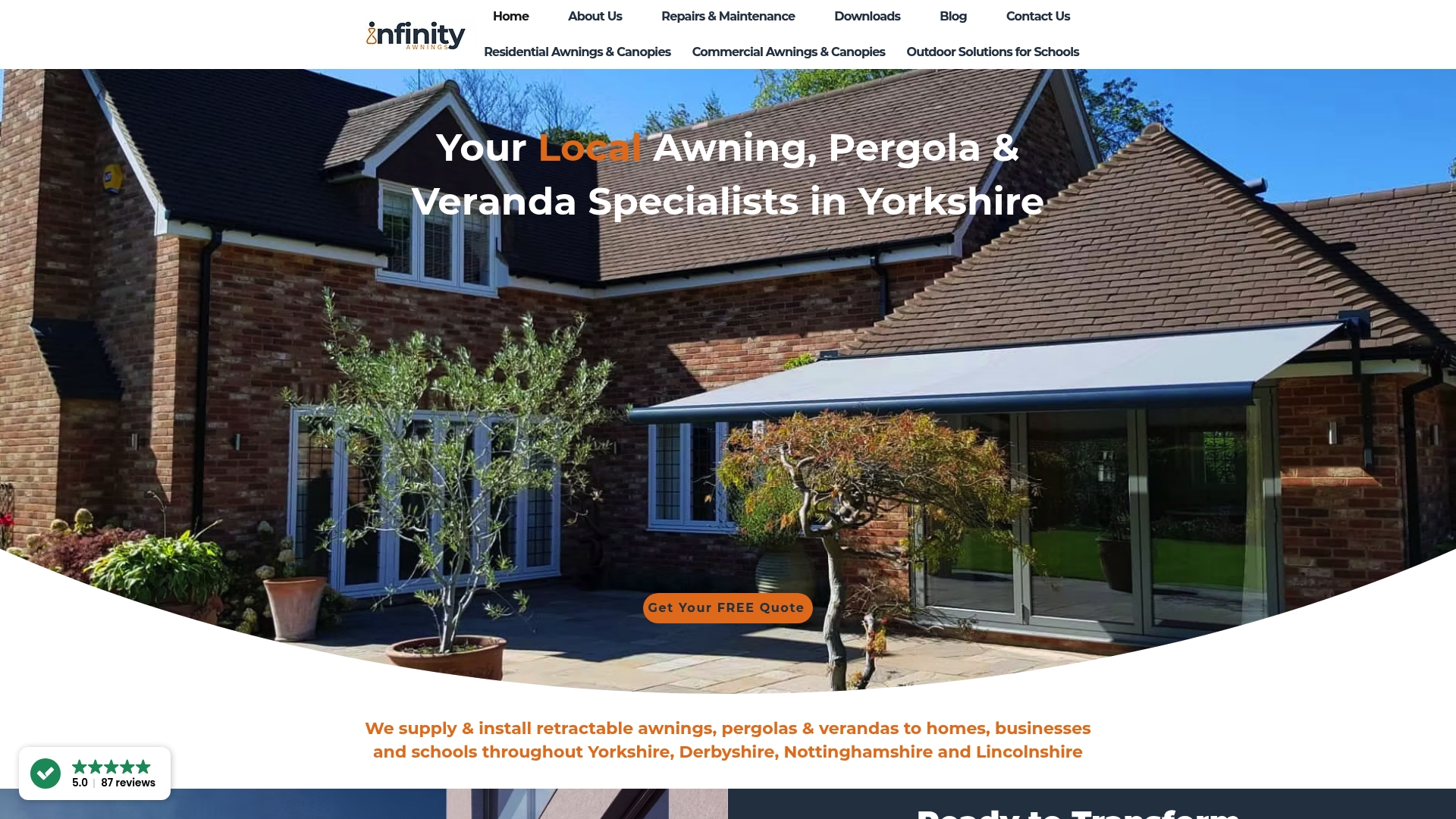
For homes, see residential awnings and canopies. For bars, restaurants and hotels, see commercial awnings and canopies. Schools and nurseries can look at our outdoor solutions for schools.
FAQ
How windy is too windy for an awning?
It depends on the wind resistance class your manufacturer states for the awning. Retract it when the wind exceeds that limit, and ideally before strong wind arrives, because the BBSA warns that retracting in high wind can cause damage. Check your data sheet or ask your installer for the class.
Can a wind sensor secure my awning in a storm?
A sensor can retract the awning automatically when the wind rises, which is a real help when you are away. It is not a failsafe, though. Some sensors work only when the awning is fully extended, and the user remains responsible for making sure it is retracted. Do not change the limits that were set.
Why does my awning flap even in light wind?
The usual causes are slack fabric, a pitch that has changed, loose brackets or an arm that needs adjusting. Keep the awning retracted and have it inspected, because light-wind flapping on an awning that was previously quiet suggests something has moved.
What is an awning anti-flap kit, and will it work on my wall-mounted awning?
An anti-flap kit is a clamp that grips the fabric and locks to a pole or guyline on a caravan or motorhome awning. A wall-mounted retractable awning has no such poles, so the fix is correct pitch, tension, fixings and support, plus retraction in strong wind.
Is it safe to leave my awning out overnight?
Only if the forecast is calm. Check the gusts for the night, and retract the awning if there is any chance of strong wind. For a business, make winding in part of the closing routine.
Sources
Recommended
Comments