
Awning Lifespan: 10–25 Years with a 4 step UK installer tested maintenance plan
- Andrew Crookes

- 2 hours ago
- 12 min read
Most awnings last somewhere between 10 and 25 years, though the honest answer depends entirely on what you’re looking at. Fabric typically wears out first, often within 8 to 15 years, while a well-built aluminium or steel frame can keep going for 20 to 30. Climate, how often the awning gets used, and whether anyone ever oils the moving parts all shift those numbers dramatically in either direction. Regular inspection and a proper maintenance schedule are what separate the awning that lasts fifteen years from the one that fails in five.
TL;DR:
Fabric lifespan varies greatly; vinyl-coated fabric can last up to 25 years, while canvas typically wears out in 5 to 12 years.
Frames made of aluminum or treated steel often outlive fabrics and can last 15 to 30 years, enabling fabric replacements to extend overall life.
Regular seasonal maintenance, inspections every 3 to 5 years, and proper lubrication with dry silicone spray significantly prolong an awning’s durability.
Coastal environments accelerate corrosion and fabric photodegradation, necessitating more frequent checks and protective measures.
Proper professional installation into stable, correctly pitched structures prevents early wear and costly repairs over the system’s lifespan.
Table of Contents
What are the warning signs an awning needs repair or replacing?
Is it cheaper to repair, replace fabric, or replace everything?
How many years should you expect from a well-cared-for awning?
Can you leave an awning out all year, or does it need winter storage?
What causes mechanical failure compared with fabric failure?
How can Infinityawnings help extend your awning’s working life?
Typical lifespan by awning type and material
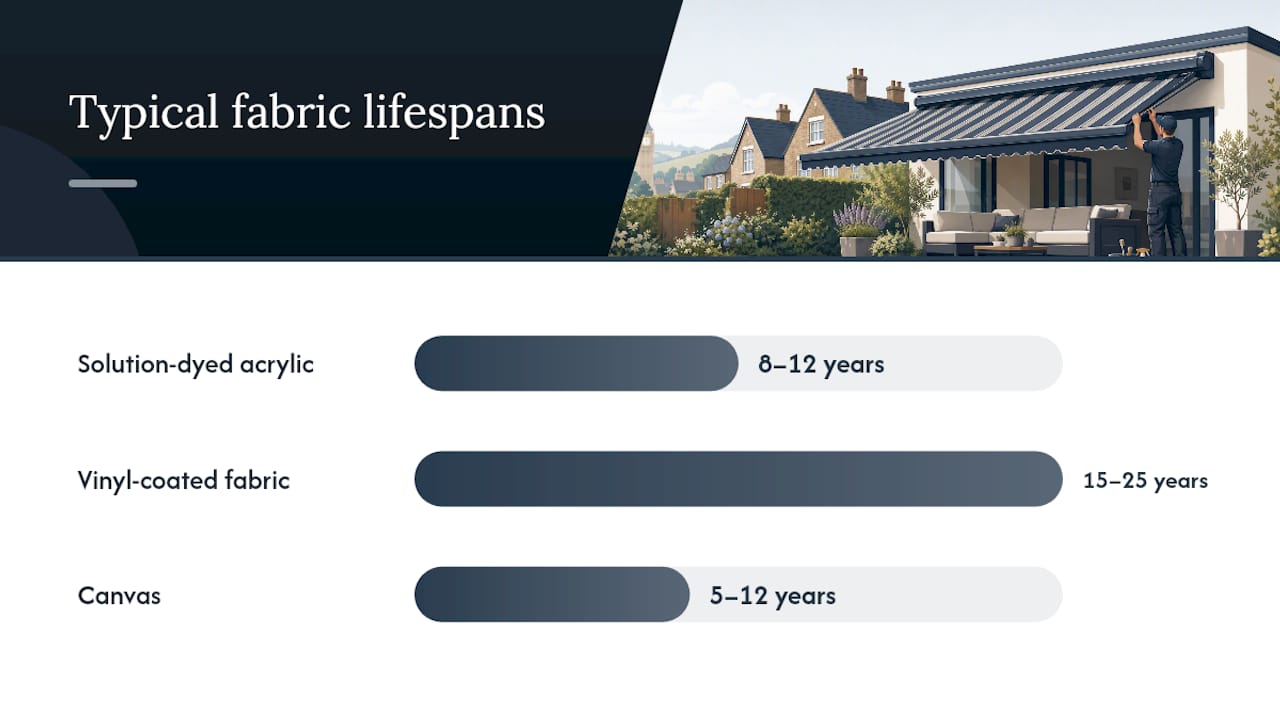
Not all awnings age the same way, and the material you choose matters more than most buyers realise at the point of sale. Solution-dyed acrylic fabric, the standard for premium retractable systems, typically holds up for 8 to 12 years with reasonable care. Vinyl-coated fabric is the tougher option, often lasting 15 to 25 years because the coating resists water and grime far better than woven acrylic. Canvas sits at the other end, usually managing 5 to 12 years depending on how much sun and rain it takes.
Frames tell a different story. Aluminium and treated steel structures can run for 15 to 30 years, which means the frame on your awning will almost certainly outlive at least one fabric replacement. That’s actually good news: swapping the canopy rather than the whole unit is usually the cheaper, smarter move once the fabric starts to go.
Retractable systems, taken as a whole, generally deliver 10 to 15 years of service, and a premium model that gets serviced properly can run well beyond that window. Air awnings, the inflatable beam-style canopies popular with caravan and motorhome owners, are more variable. Quality models last 5 to 15 years, but budget versions under heavy use can wear out in as little as two to five.
Awning type / material | Typical lifespan | Main caveat |
Solution-dyed acrylic fabric | 8–12 years | Fades and weakens faster with constant sun exposure |
Vinyl-coated fabric | 15–25 years | Heavier and stiffer, but far more water resistant |
Canvas | 5–12 years | Needs regular reproofing to avoid rot and mildew |
Aluminium/steel frame | 15–30 years | Outlasts fabric; corrosion risk near the coast |
Retractable system (overall) | 10–15 years | Depends heavily on servicing frequency |
Air/inflatable awning | 5–15 years (2–5 for budget models) | Storage quality affects seam and valve life enormously |
How does your climate and usage shorten an awning’s life?
Where you live and how often you use the awning matter as much as what it’s made from. Coastal salt air corrodes untreated fittings and pits aluminium components faster than almost any other condition, which is why coastal properties often need shorter service intervals than inland ones. UV exposure breaks down fabric fibres at a molecular level, a process called photodegradation, and it’s the single biggest reason fabric fades and weakens years before the frame shows any wear.
Wind is the other major stress factor, and it works mechanically rather than chemically. Every gust that catches an extended awning puts load through the arms, the elbow joints, and the mounting brackets, and repeated flexing eventually loosens fixings or cracks joints that were never designed for constant movement.
A few patterns are worth knowing before they catch you out:
Standing water pooling on a shallow-pitched fabric encourages mildew and speeds up rot, particularly on canvas.
Frequent extension and retraction cycles wear motor bearings and arm pivots faster than occasional use, even on a premium system.
Coastal properties often need annual fitting checks rather than the standard multi-year interval.
Heavy, wet snow left sitting on a deployed awning can bend arms permanently within a single storm.
Move from DIY checks to professional inspection the moment you notice uneven retraction, a new grinding sound, or visible pitting on metal fittings. Those are early warnings, and catching them early is far cheaper than catching them late.
What maintenance schedule actually extends awning lifespan?
A simple seasonal routine does more for longevity than any single repair ever will. Think of it less as chores and more as insurance against a much bigger bill later.
Spring: Wash the fabric with mild soap and water, check for winter damage, and test the retraction mechanism before the season’s first real use.
Summer: Inspect fittings monthly during heavy use, retract during storms, and wipe down fabric after pollen-heavy weeks to stop staining setting in.
Autumn: Give the fabric a final clean, apply a reproofing treatment if it’s canvas or ageing acrylic, and check all seams for early fraying.
Winter: Retract fully, cover exposed frames if the unit stays outdoors, and avoid deploying the canopy during frost, snow or high wind.
Alongside the seasonal work, book a professional tune-up every 3 to 5 years. A technician will check motor tension, arm alignment, and bolt tightness, all things that are easy to miss from ground level but expensive to ignore. Coastal or exposed properties should shorten that interval, closer to every two or three years.
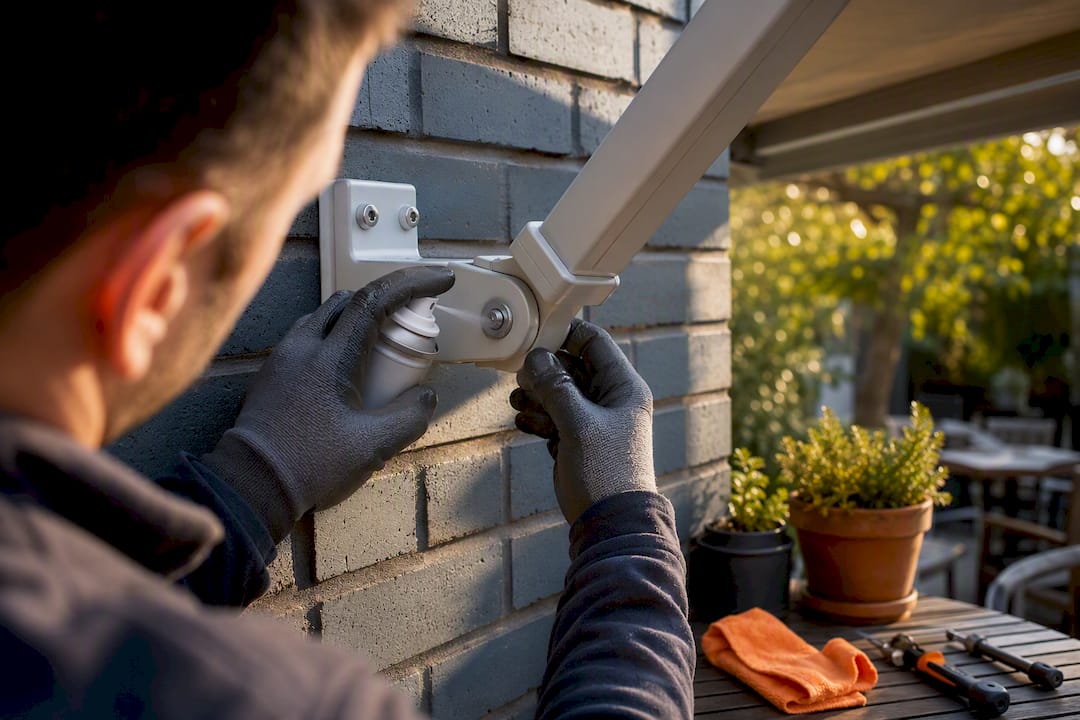
Lubrication deserves its own mention because it’s the step most owners get wrong. Reach for a dry silicone spray on pivot points and arm joints, never a general-purpose solvent spray. WD‑40 is specifically discouraged for this job because it attracts dirt and grit over time, which then acts like sandpaper inside the joint rather than protecting it. Avoid pressure washers on the fabric too; the force can drive water into stitching and seams that were never meant to handle that kind of pressure.
Pro Tip: Keep a small tube of dry silicone spray next to your garden tools and give the arm joints a light treatment every spring and autumn. It takes two minutes and does more for mechanical longevity than almost anything else on this list.
For a fuller breakdown, Infinityawnings’ step-by-step awning maintenance guide walks through each task with photos, and the essential maintenance checklist is worth bookmarking for quick seasonal reference.
What are the warning signs an awning needs repair or replacing?
Fabric and mechanics fail in different ways, and reading the signs correctly saves you from paying for the wrong fix.
Fabric that soaks through rather than beading water has lost its protective coating and needs reproofing or replacing.
Persistent staining that won’t shift with cleaning usually signals mildew growing inside the weave, not just on the surface.
A thinning, papery feel to the fabric means UV damage has weakened the fibres beyond a simple clean.
Seams pulling apart at the stitching point to frame failure rather than fabric failure, and often to a misaligned arm.
Grinding or clicking noises from the motor housing point to worn gears or a failing capacitor.
Sagging that returns after adjustment, rather than after impact, often means internal spring tension has gone, not the fabric.
As a rule of thumb, fabric replacement makes sense when the frame is under ten years old and structurally sound. Once you’re finding frame corrosion, cracked joints, or a motor that’s already been repaired once, a full replacement usually works out cheaper over time than chasing repairs on a unit near the end of its working life.
How do you choose an awning that will last longer?
Longevity starts at the point of purchase, not the point of maintenance. Solution-dyed acrylic and high-grade vinyl fabrics resist fading and moisture far better than budget polyester blends, and powder-coated aluminium frames shrug off corrosion in a way untreated steel simply can’t.
A handful of features consistently separate awnings that last from the ones that don’t:
A cassette or hood housing protects the rolled fabric from UV and rain when retracted, extending fabric life significantly.
Wind sensors that trigger automatic retraction prevent the storm damage that shortens both fabric and frame life.
Stainless steel fastenings resist the corrosion that eventually seizes cheaper fixings, especially in coastal areas.
A robust motor with a longer duty-cycle rating tolerates frequent daily use without premature burnout.
Installation quality matters just as much as the components themselves, and a manufacturer’s warranty that covers both fabric and mechanism, not just one or the other, is a genuinely useful signal of build confidence. Choosing the right fabric at the outset, rather than defaulting to the cheapest option, tends to reduce the total amount you spend across the awning’s working life.
What do awning technicians actually see go wrong?
An experienced technician has spent years fixing the same handful of problems on units that should never have failed that early. The pattern is almost always the same: owners clean the fabric religiously but never touch the mechanical side. Arm joints run dry, guide tracks fill with grit, and the motor ends up straining against friction that a two-minute lubrication job would have prevented.
The fix, when caught early, is often trivial. A tune-up that realigns the arms and replaces a worn bearing can add years to a system that looked ready for the skip. Infinityawnings’ guide to maintaining retractable awnings and the repair and maintenance overview both cover the specific checks worth doing before calling in a technician.
Does poor installation shorten an awning’s working life?
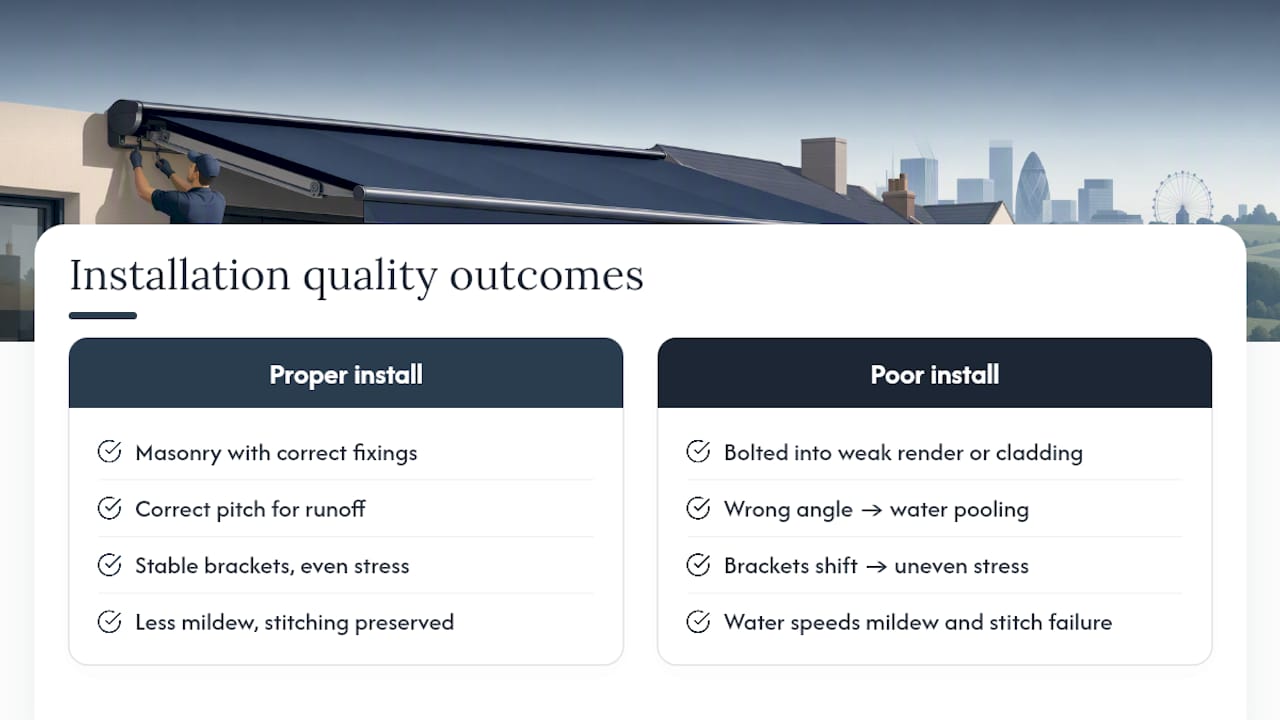
Installation quality affects lifespan more than most buyers expect, and it’s the one factor that’s almost invisible until something goes wrong. An awning bolted into weak render, unbacked cladding, or a mounting point that can’t handle wind load will eventually pull loose, regardless of how good the fabric or frame is. Once a bracket starts to shift even slightly, every extension cycle puts uneven stress through the arms, and that accelerates mechanical wear that has nothing to do with material quality.
The mounting method matters too. A cassette system bolted directly into solid masonry with the correct fixings will hold for decades; the same unit fixed into a weaker surface, or fitted at the wrong angle for water runoff, can develop sagging or frame distortion within a few seasons. Getting the pitch right also affects fabric life, since a poorly angled awning lets water pool rather than run off, which speeds up mildew and stitching failure.
This is one area where a DIY approach genuinely creates risk rather than saving money, because incorrect fixings or missed structural checks tend to surface only after the warranty period has ended. A poorly executed installation in any home improvement project tends to create exactly this kind of delayed, expensive problem, and awnings are no exception. Professional installation, matched to the actual wall structure and local wind exposure, is one of the few upfront decisions that pays off for the entire lifespan of the system.
Is it cheaper to repair, replace fabric, or replace everything?
Working out the real cost of ownership means looking past the sticker price of a repair. A fabric swap on a sound frame is almost always the most economical route, since frames routinely outlast the fabric skin by a decade or more. It’s a fraction of the cost of a full new system and resets the awning’s appearance completely.
Full replacement starts to make financial sense once you’re dealing with a corroded frame, a motor that’s already failed once, or fittings that no longer match current wind-rating standards. At that point, repeated repairs become a drain rather than a saving, because you’re patching a system whose underlying structure is already compromised.
The lifecycle argument favours spending more upfront. Choosing premium materials and professional fitting from the start tends to reduce total spend over the awning’s life compared with buying cheap and replacing fabric or fittings every few years. A £150 fabric reproofing job every few years is a rounding error next to the cost of two premature full replacements. Think in terms of cost per year of service, not cost at the till, and the calculation usually favours quality over the lowest quote.
How many years should you expect from a well-cared-for awning?
Setting realistic benchmarks helps you judge whether your awning is ageing normally or failing early. At the 5-year mark, a well-installed retractable system should show no more than light fabric fading and should retract as smoothly as day one. By 10 years, expect the fabric to be nearing the end of its practical life if it’s acrylic, while the frame and motor, assuming regular servicing, should still be performing well.
At 15 years, you’re at the upper end of what most retractable systems achieve without significant intervention, and a fabric replacement at this point is normal rather than a sign of poor build quality. Beyond 20 years, you’re relying almost entirely on frame durability, since treated aluminium and steel structures can reach 30 years, but almost no original fabric survives that long untouched.
These benchmarks assume the seasonal maintenance and periodic professional servicing covered earlier. Skip that routine and every one of these milestones arrives years earlier than it should.
Can you leave an awning out all year, or does it need winter storage?
Leaving a retractable awning permanently deployed is one of the fastest ways to shorten its life, and it’s a more common mistake than you’d think. Wind loading, heavy rain, and especially wet snow put continuous stress on the arms and fabric when the canopy stays extended through weather it was never designed to handle. Retracting during storms and heavy weather is the single most effective habit for avoiding mechanical damage, and any fitted wind sensor should be left switched on rather than overridden.
That said, most retractable awnings are built to stay mounted outdoors year-round, provided they’re retracted for the winter months. The frame and cassette are designed to handle exterior conditions; it’s the extended fabric, not the hardware, that suffers most from prolonged exposure. If your system doesn’t have a protective cassette or hood, a breathable cover over the rolled fabric during winter adds a meaningful layer of protection against damp and frost.
Air awnings and lightweight canopies are the exception. These generally do better fully deflated and stored indoors over winter, since the seams and valves are more vulnerable to cold-weather stiffening than a fabric roll protected inside a cassette.
What causes mechanical failure compared with fabric failure?
Mechanical and fabric problems have almost nothing in common, which is exactly why diagnosing the wrong one wastes both time and money. Motors fail from strain, usually caused by dry, gritty arm joints forcing the mechanism to work harder than it should, or from age-related capacitor wear after years of regular cycling. Arms fail from repeated flex under wind load, developing play at the pivot points that eventually shows up as uneven or incomplete retraction.
Fabric, by contrast, fails from exposure rather than movement. UV breaks down fibres, standing water encourages mildew, and stitching weakens from years of flapping in the wind. The two failure paths rarely overlap, which is why a technician checking a “sagging” awning often finds the real problem in the spring tension or arm alignment rather than the canopy itself. Attempting to adjust high-tension internal springs without training is genuinely risky, since a misaligned arm or damaged spring can release with considerable force. That distinction, spring versus fabric, is often the difference between a £40 adjustment and a fabric replacement that wasn’t actually needed.
Repair or upgrade: which makes more sense long term?
Fabric replacement is the right call when the frame is under ten years old and shows no corrosion or joint play. It’s cheap, fast, and resets the awning’s appearance without touching anything structural. The calculation flips once you’re looking at a tired motor or a frame with hidden damage, because a repair on that unit is just delaying a replacement you’ll pay for anyway, probably at a worse moment.
If you are replacing rather than repairing, it’s worth spending a little more for a cassette housing and a stronger motor rated for daily use. Picture two owners: one pays less upfront and replaces fabric every seven years on a basic frame, the other spends more once on a protected system and gets fifteen years before touching it. Over two decades, the second owner spends less overall and deals with far fewer callouts.
— Andrew
How can Infinityawnings help extend your awning’s working life?
If your awning is showing its age, whether that’s tired fabric, a motor that’s starting to strain, or a frame that’s never quite sat right since installation, a professional inspection tells you exactly what you’re dealing with before you spend a penny on repairs. Infinityawnings has spent over 15 years installing and servicing shading systems across Yorkshire, Derbyshire, Nottinghamshire, and Lincolnshire, working with established manufacturers including Weinor, Llaza, Selt, Tarasola, and Morvelle.
The team handles the full range: new installations, scheduled servicing, fabric replacement, and motor tune-ups, so you’re never stuck choosing between a botched DIY fix and an expensive full replacement you didn’t actually need. If you’re weighing up a fabric swap against starting fresh with something built to last, a look at Infinityawnings’ range of pergolas is worth your time before you decide. Get in touch for a free quote and let a professional assessment settle the question of repair versus replace.
Sources
Recommended
Comments