
Awning Warranty in the UK: What It Covers and What the Law Adds


An awning warranty is a promise from the manufacturer or installer to repair or replace certain faults for a set period. It sits on top of your legal rights and never replaces them. Whether you are shading a patio, a restaurant terrace or a school playground, the paperwork you should read before signing is the same: how long the promise lasts, what it names as covered, who carries out the work and what you must do to keep it valid. As a Yorkshire supplier and installer of retractable awnings, pergolas and verandas, we think a buyer who understands this makes a better decision and has a smoother ownership experience.
TL;DR
A warranty or guarantee adds to your legal rights. It does not take them away, whatever the document says.
Under the Consumer Rights Act 2015, faulty goods can be rejected for a full refund within 30 days, and rights for faulty goods can last up to 6 years in England, Wales and Northern Ireland (5 in Scotland).
Read the duration, the split between parts and labour, the conditions (registration, maintenance) and whether the cover passes to a new owner.
Keep your proof of purchase, installation date and servicing records together. They make a claim quick.
Commercial buyers and schools should read the contract terms closely, because consumer protections are written for individual buyers.
Table of Contents
Warranty, guarantee and statutory rights: three different things
People use these words interchangeably, but they come from different places.
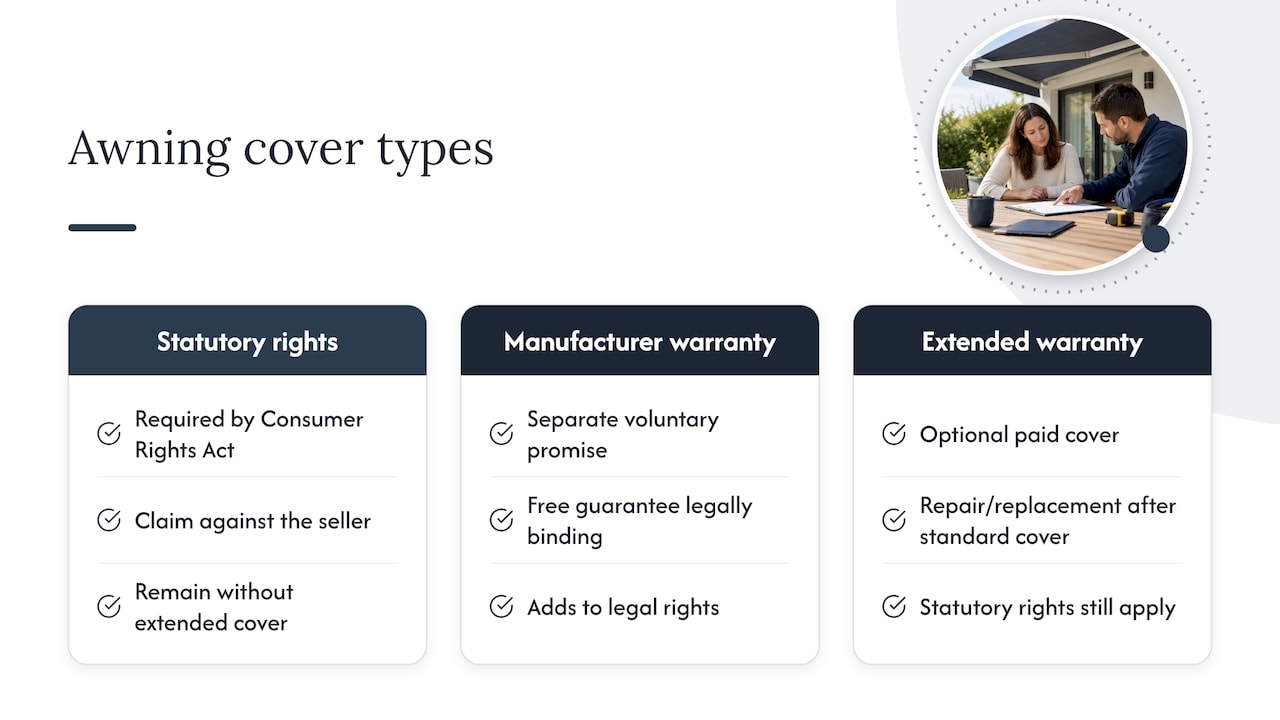
Statutory rights come from law. When you buy goods from a trader as a consumer, the Consumer Rights Act 2015 (in force since 1 October 2015) requires them to be of satisfactory quality, which covers fitness for purpose, appearance and finish, freedom from minor defects, safety and durability. You have these rights against the seller, because your contract is with the seller.
A manufacturer’s warranty or guarantee is a separate, voluntary promise. Citizens Advice is clear that warranties and guarantees add to your legal rights. A free guarantee supplied with goods is also legally binding on whoever gives it. Under section 30 of the Act, the explanatory notes say it must be in plain English, name the guarantor, state that your statutory rights are unaffected, set out its duration and territorial scope, and give the essential details for making a claim.
An extended warranty is optional paid cover that can pay for repair or replacement once the standard manufacturer’s warranty runs out. GOV.UK also states you keep your statutory rights whether or not you buy one.
The practical upshot: when you compare awning quotes, treat the warranty as one part of the package, and remember that the seller’s legal responsibility for faulty goods exists regardless.
What the Consumer Rights Act gives you on an awning
A retractable awning or pergola is a considered purchase, often installed by the trader who sold it. The Act has a few timings worth knowing.
The 30-day right to reject
If the goods are faulty, you have a short-term right to reject them for a full refund within 30 days. The 30 days start the day after ownership transfers, delivery is complete and, where the trader installs the goods, the trader has told you the installation is finished. For an awning, that matters: the clock runs from completion of the installation, not from the day you paid a deposit.
Repair or replacement, then the longer period
After the first 30 days, the usual first remedy is repair or replacement. Citizens Advice states that legal rights for faulty goods last up to 6 years, or 5 in Scotland. That is a limit on the time you have to bring a claim, not a six-year guarantee: an awning that has simply worn out after years of ordinary use is a different matter from one that was faulty when supplied. What counts is whether the goods met the standard of satisfactory quality, which takes into account the description, the price and all the circumstances, including how long a product like that should reasonably last.
Terms cannot take your rights away
Section 31 of the Act stops a trader excluding or restricting liability for these statutory rights, and any term that makes exercising them harder is void, as the explanatory notes set out. So a warranty that says a claim must go through a particular route, or that its expiry ends all responsibility, cannot override your legal position.
The House of Commons Library makes a related point: if a good has an inherent fault, the retailer cannot avoid responsibility by sending you to the manufacturer’s guarantee. A guarantee does not replace or limit your rights against the retailer.
How long do awning warranties last?
There is no single UK standard. Duration, and what is covered within it, differs by product and by supplier. An awning is made up of several things that behave differently over time: the frame and arms, the motor and controls, the fabric, and the installation itself. Warranty documents often treat these separately, so one awning can carry a longer period on structural parts and a shorter one on fabric, electrics or labour.
When you read a quote, look for a plain statement of each of these:
What to look for | Why it matters |
Length of cover, and the date it starts | Starting from installation rather than order date can add months |
Frame and arms | Usually the longest-lasting part of an awning, so the period matters most here |
Motor, sensors and remote controls | Electrical parts are often covered separately |
Fabric | Covers manufacturing faults such as a seam failing or a defect in the weave; check how colour fading is treated |
Labour | Who pays for the engineer’s visit and for how long |
Accessories | Lighting, heaters and side screens may carry their own terms |
Who gives the guarantee | Installer, manufacturer or both |
The fastest way to compare two quotes is to put those rows side by side. A longer headline figure means little if it applies only to the frame.
Reading the small print
Citizens Advice recommends checking the small print of any warranty. Two points stand out for awnings.
Only the original buyer may be able to claim. Unless the document grants what is known as third party rights, cover may not pass to someone else. If you are buying a home with an awning already fitted, or you may sell, check whether the warranty can be transferred.
Hard-to-understand or onerous terms can be unfair. Terms that make a claim very difficult, or that are particularly hard to follow, may count as unfair terms, which gives you extra rights.
Beyond that, read for the conditions the document attaches. Typical areas to look at are:
Registration. Some warranties only start once you register. Citizens Advice notes that if you have not returned a registration card, your guarantee may not be valid, although you might be able to register online or ask the seller for advice.
Servicing. Some documents expect regular maintenance. If so, keep the invoices.
Weather and use. Awnings are designed to be retracted in strong wind. A document may describe the wind conditions it assumes, so understand how your sensor or manual retraction fits in.
Modifications and repairs. Work by someone other than the supplier may affect cover, so check the wording before a third party adjusts anything.
Cosmetic issues. Check whether marks or scuffs noticed after installation are treated differently from functional faults.
None of these should be read as a reason to hesitate over an awning. They are simply the questions that turn a vague promise into a clear one, and a good supplier will happily talk you through them.
How to register and claim, step by step
Keep the paperwork together on day one. File the invoice, the warranty document, the installation completion date, and the model and fabric details. Photograph the awning once installed.
Register if the document asks you to. Do it promptly, and keep the confirmation. A registration requirement missed is the easiest way to complicate a claim later.
Report a fault as soon as you see it. Note the date, take clear photos or a short video, and describe what happened and what the weather was doing. Early reporting also helps if the fault is within the 30-day rejection period.
Make the claim in the way the document sets out. Citizens Advice says a claim usually needs proof of purchase, details of the problem and a copy of the warranty. Write rather than only phoning, so you have a record.
If the claim is refused, ask the right question. A refused warranty claim is not the end. Ask the seller to assess whether the awning met the statutory standard, given the product, price, age, fault and your evidence. ConsumerWise makes the point that an expired warranty only ends a voluntary promise, not your legal rights.
Escalate if needed. If you remain unhappy with the response, ask which complaint or dispute resolution route is open to you. Citizens Advice offers consumer guidance if you need help with the next step.
If the supplier closes
Citizens Advice states a manufacturer’s warranty should still be valid if the seller goes out of business. You would contact the manufacturer using the details on the warranty paperwork, the manual or the manufacturer’s website. This is one reason to keep the manual and warranty card for the life of the awning, and to buy from a supplier who deals with named manufacturers. We supply and install awnings and pergolas from brands including Weinor, Llaza, Selt, Tarasola and Morvelle, so owners have a manufacturer behind the product as well as the installer.
Extended warranties: check what you already have
If you are offered paid extra cover at the point of sale, GOV.UK’s advice is to check whether you are already covered through contents insurance or your bank account, and notes you do not have to buy at the point of purchase. For an outdoor structure the sensible comparison is between what the standard warranty covers, what your home or business insurance covers and what is left over.
Storms are the clearest example. Warranties generally concern faults in manufacture or installation, while storm damage usually falls under insurance. We explain how that split works in our guide to storm damage and awning insurance in the UK.
Homes, businesses and schools
The consumer rights above are written for individuals buying for personal use. They are what protects a homeowner with a patio awning.
A restaurant, bar, hotel, nursery or school is usually buying as an organisation, so the contract terms and the warranty document carry more weight. If you are a business owner, property manager or architect specifying shading for a client, make sure the contract spells out:
who gives the warranty and from what date it runs, ideally completion of installation;
whether commercial use changes the period or the terms;
how call-outs work for a site open to the public, including response expectations;
who is responsible for maintenance, and how often;
what happens to the cover if the building changes hands or the tenant changes.
For larger outdoor spaces, such as terraces or playground canopies, the structure, fixings and installation quality matter as much as the fabric. Our guide to common installation errors with retractable roofs shows why a properly planned installation is the foundation of any warranty.
Keeping cover valid and the awning lasting
The habits that protect a warranty are the same ones that extend an awning’s life. Retract it in strong wind, clean the fabric as the manufacturer advises, keep moving parts free of debris, and have it checked on a regular schedule, keeping a record each time. Our awning lifespan guide sets out a maintenance plan, and the owner’s repairs and maintenance guide covers what to look for season by season.
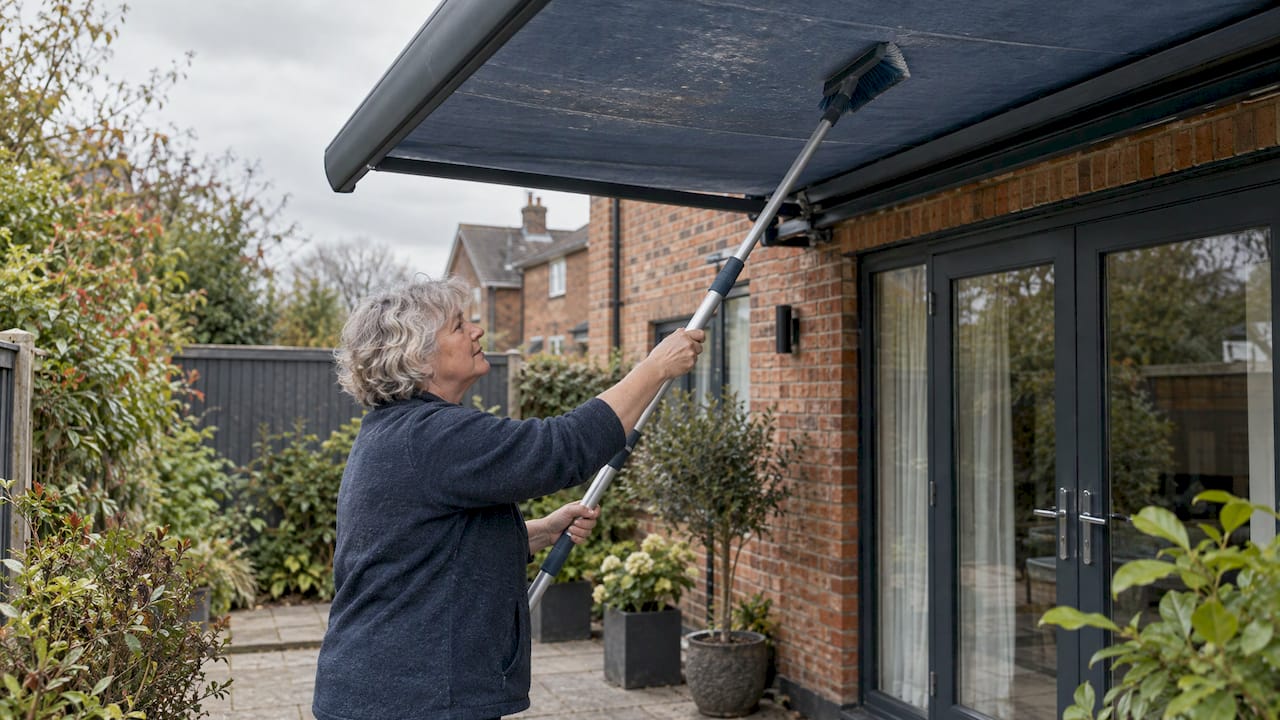
If something does go wrong after the warranty period, or you simply want an annual check, our awning repair and maintenance service covers the work.
When budgeting, remember that warranty terms are one factor among several. Our guide to what to check in an auto-retract awning quote and our breakdown of motorised patio cover pricing show how to compare like with like.
Our view
We have spent more than 15 years fitting awnings, pergolas and verandas across Yorkshire, Derbyshire, Nottinghamshire and Lincolnshire, and our advice on warranties is simple: read the document before you sign, not after something goes wrong. A warranty is only as useful as it is clear. You should know who is giving it, when it starts, what it names and what you have to do to keep it. That is why we prefer a consultative, no-pressure approach to quoting: a customer who understands the paperwork is a customer who can enjoy the awning. We supply premium products from manufacturers such as Weinor, Llaza, Selt, Tarasola and Morvelle, and we install them ourselves, so the people who fit your awning are the people you talk to about it afterwards. We also offer repair and maintenance, because an awning that is serviced regularly performs better and leaves no doubt about how it has been looked after. Keep your invoice, your installation completion date and your servicing records in one folder. If you ever need them, you will be glad you did. Andrew
Talk to us about your project
If you are planning a patio awning, a pergola, a veranda or shading for a commercial or school site, we can design, supply and install it and talk through the warranty paperwork with you. Start with our retractable awnings, pergolas and verandas and ask for a free quote.
Homeowners can see our residential awnings and canopies, and businesses and schools can look at our commercial awnings and canopies and outdoor solutions for schools.
FAQ
Does a warranty replace my legal rights?
No. Warranties and guarantees add to your legal rights, as Citizens Advice explains. A free guarantee must state that your statutory rights are unaffected, and the seller stays responsible for faulty goods whatever the manufacturer’s guarantee says.
How long can I claim for a faulty awning?
Your legal rights for faulty goods last up to 6 years in England, Wales and Northern Ireland and 5 in Scotland, according to Citizens Advice. That is a time limit for bringing a claim, not a guaranteed lifespan. Whether a fault counts depends on whether the awning was of satisfactory quality when supplied.
What if my warranty has expired?
An expired warranty ends the voluntary promise only. You can still ask the seller to consider whether the awning met the Consumer Rights Act standard, giving the age, the fault and your evidence. Fair wear and tear from years of normal use is treated differently from a fault that was there from the start.
Is the warranty transferable if I sell my house?
Not necessarily. Citizens Advice notes that only the original buyer can usually claim unless the document grants third party rights. Check this before you sell or buy a property with an awning fitted, and pass on the invoice and paperwork.
Does the warranty cover storm damage?
Warranties are generally about faults in manufacture or installation, while storm damage is normally a matter for insurance. Read your warranty’s wording on weather, and see our guide to storm damage and awning insurance for how the two fit together.
Sources
Consumer Rights Act 2015, Part 1, Chapter 2, legislation.gov.uk
Consumer Rights Act 2015 Explanatory Notes, legislation.gov.uk
Faulty goods, digital content, services, House of Commons Library
What you need to know before you buy an extended warranty, GOV.UK
A warranty is not the same as your legal rights, ConsumerWise
Recommended
Comments