
Awning Wind Class: What 0, 1, 2 and 3 Mean in the UK


An awning wind class is a performance rating, set by testing to the European standard EN 13561, that tells you how much wind pressure a retractable awning withstood while open. Class 0 means no performance is declared. Higher classes mean the awning was tested against stronger wind pressure. It is not a promise that the awning is safe to leave out in a gale, and the class only holds if the awning is the tested size and is fixed to a sound wall.
This guide explains what each class means, how to read the rating on a quote or label, what changes the real-world result, and when to wind the awning in. It is written for homeowners, and for pubs, restaurants, hotels and schools choosing a shading system.
TL;DR
Wind class is a tested rating of resistance to wind pressure (measured in N/m²), not a speed at which the awning is safe in every situation.
Folding arm awnings are rated in classes 0 to 2. Conservatory, vertical and similar awnings go up to class 3. Pergola awnings and guided blinds can reach class 6.
The rating depends on the tested size and on a correct fixing. A poor wall or fascia can fail before the awning does.
Retract the awning when the wind exceeds the limit in the manufacturer’s instructions. Sensors help but are not a failsafe.
Ask for the class at your chosen size and projection, in writing, before you order.
Table of Contents
What an awning wind class actually measures
The standard behind the rating is BS EN 13561:2015, which sets performance requirements for external blinds and awnings fitted to buildings. It covers retractable products. It does not cover the wind resistance of non-retractable products such as Dutch awnings.
The test applies a load to the awning and checks it for damage and failure. The result is expressed as a class. Each class pairs a nominal wind pressure with a safety wind pressure 1.2 times as high, according to the Delegated Regulation (EU) 2019/1188 on legislation.gov.uk.
Two points follow from that:
The class describes pressure on the fabric and frame, in newtons per square metre. Wind speed is only a translation of that pressure, and manufacturers publish their own speed guidance for each class.
The standard treats a retractable awning as something that is not meant to stay open permanently. The text says it must be retracted once the wind passes the manufacturer’s stated value for its class.
So the class is a design and testing rating. It is never a licence to leave the awning out in worsening weather.
The classes for each awning type
Not every awning is rated on the same scale. The regulation sets out three tables, depending on how the product is built.
Awning type | Classes available | What the top class means |
Folding arm awnings | 0 to 2 | Class 2 is 70 N/m² and over |
Trellis arm, pivot arm, slide arm, façade, skylight and conservatory awnings, vertical roller blinds | 0 to 3 | Class 3 is up to 110 N/m² and over |
Pergola awnings and blinds with fabric in side guide rails | 0 to 6 | Class 6 is up to 400 N/m² and over |
For folding arm awnings, the nominal pressure bands are under 40 N/m² for class 0, 40 to under 70 for class 1, and 70 and over for class 2. All of this comes from the regulation’s tables.
The practical lesson: a class 2 folding arm awning and a class 2 pergola awning are not the same product, and a pergola awning’s class 3 is a modest figure on its own scale. When you compare quotes, compare like with like. A fabric roof held by fixed posts and side guides behaves differently from a cantilevered arm projecting off a wall.
Class 0, 1, 2 and 3 in plain terms
Class 0: no performance declared, or not tested. Treat it as a sun-only product.
Class 1: tested against the lowest band of pressure. Suitable for sheltered spots where you will be on hand to retract it.
Class 2: the top class for folding arm awnings. It is the usual benchmark for a patio awning facing open ground.
Class 3: available on the awning types in the second table, such as conservatory awnings and vertical blinds.
On a folding arm awning, then, class 2 is the highest rating you will see. If someone offers a folding arm awning as class 3, ask for the test evidence.
How wind class relates to wind speed
People search for a mph figure, and it is a fair question. Manufacturers translate each class into a wind force on the Beaufort scale in their instructions, and those numbers differ slightly between brands and between models. The honest way to use a speed is to read it from the instruction booklet for your exact model, then treat it as the upper limit and not the target.
Three reasons to retract well before you reach it:
Gusts are stronger than the average wind speed forecast.
Wind funnels along terraces, between houses and around the corners of buildings, so the pressure on your awning can exceed what the forecast suggests.
Wind that pushes up under an extended arm lifts the whole structure at its wall fixings, which is the weakest point.
The British Blind and Shutter Association (BBSA) says awnings must be retracted when the wind speed exceeds the wind resistance class stated by the manufacturer. It also warns that retracting during high winds can cause damage, so the awning should be fully retracted before strong wind arrives. Wind it in early, not at the last minute.
What changes the real-world result
A class on a brochure is the result of a laboratory test on a specific configuration. Your patio is a different situation. Here is what moves the outcome.
Size and projection
The rating applies to the size that was tested. A longer projection puts more leverage on the arms and the wall brackets. Ask for the class at the width and projection you are ordering, not at a smaller model in the same range. A wide, deep awning can sit in a lower class than the headline figure for the range.
The wall it is fixed to
The awning is only as strong as what holds it. The BBSA notes that special brackets (spreader plates) may be needed to spread the load for a secure fixing. It adds that on bungalows the awning may need to be raised to give the correct height clearance, which leaves a gap between the awning and the building.

That is why a survey matters. Brick, block, cavity walls, timber fascias and rendered insulation all need different fixings. If you want the detail, our guides on cavity wall awning fixing and fascia mounted awnings explain what holds and what fails.
Pitch and water
The BBSA says a pitch of 14 degrees is ideal to stop water pooling on the fabric. Standing water adds weight and changes how the awning behaves in wind. Folding arm awnings fixed to a wall with no other support are sun shading products. The BBSA states they are not designed for use in adverse weather.
Exposure of your site
A south-facing terrace on an open hillside in the Pennines sees very different gusts from a walled courtyard in a town centre. A pub garden with open ground beyond the fence is another case again. When we survey a property we look at what the wind can do on that specific spot, not only at the label.
Pergolas and guided blinds: a different scale
Pergola awnings and fabric blinds that run in side guide rails sit on the 0 to 6 scale, because the fabric is held on both sides and supported by posts. That construction can reach higher classes than a cantilevered arm. It does not mean every pergola is storm-proof. The class still depends on the size tested, the posts’ fixings and the ground or deck underneath.

If you are comparing a retractable pergola with a folding arm awning, read how guided blinds and pergola closures are classified, then ask for the declared class of the exact product you are being quoted. Our own article on pergola wind resistance claims explains how to read headline figures such as 75 to 100 mph.
How to check the wind class of an awning
This is the question most buyers skip, and it is the easiest to get right. Work through it in order.
Ask which standard the class refers to. For retractable awnings sold in the UK it should be EN 13561, with the result expressed as a class.
Ask for the class for your exact size. Request the width and projection on the quote, with the class written next to them.
Check the product documentation. Awnings placed on the market should come with a declaration of performance or product information stating the declared wind resistance class. Ask to see it, and keep it with your installation papers.
Find the manufacturer’s wind limit. The instruction booklet should state the wind force at which you must retract the awning.
Confirm the fixing method. The survey should record the wall type and the bracket and anchor specification, including whether spreader plates are used.
Ask what happens with a sensor. Find out what the wind sensor is set to and where it is mounted.
A good installer will give you all of this without fuss. On our quotes we set out the product, the size, the operation (manual or electric) and any sensors, so you can see exactly what is being supplied.
Wind sensors: useful, but not a safety guarantee
Electric awnings can be fitted with a wind sensor that retracts the awning when the wind rises. The BBSA’s conservatory awnings page recommends a sun and wind sensor so the awning can extend in sunny conditions and retract when wind speed passes safe operating limits.
The BBSA is also clear about the limits of the technology. Its folding arm guidance says sensors are not a failsafe device, that some wind sensors may not work unless the awning is fully extended, and that it remains the user’s responsibility to make sure the awning is retracted.
In practice that means:
Set the sensor threshold below the class limit for the awning, not at it.
Position the sensor where it actually feels the wind the awning feels. See our guide to wind sensor placement.
Check the sensor and motor operate before the windy season.
Retract manually when a storm warning is issued, and when you leave the property for a few days.
For more on how sensors work and what they add, read wind sensors for awnings and our overview of auto retract awnings.
Choosing the right class for your property
There is no single correct class. Match it to the site and the way you use the space.
Situation | What to look for |
Sheltered back garden, awning used on sunny days only | A folding arm awning with a declared class and a manual or electric crank you can reach quickly |
Exposed terrace, open fields or a hillside | Highest available class at your size, a robust fixing survey and an automated sensor |
Pub, restaurant or hotel terrace, used by guests | A structure suited to regular use, such as a pergola or a guided system, with staff procedures for retracting |
School or nursery | A fixed or semi-fixed canopy designed for the site, with a documented fixing specification |
Bungalow or cavity wall | A survey that deals with height clearance and load spreading before you pick the model |
For commercial sites, projection and span matter even more. Our guide to commercial awning sizes and wind limits goes through the measurements. For schools, safety considerations for school awnings covers fixings, use and supervision.
Day-to-day habits that protect your awning
The class tells you what the awning was built for. Your habits decide how long it lasts.
Check the forecast in the morning, including gusts, and retract if the wind is building.
Retract the awning at night and when no one is home, even on calm evenings.
Do not extend it in rain, and clear standing water before retracting.
Retract fully, not partly. A half-open arm is more exposed than a closed one.
Have the fixings and tension inspected once a year. Our wind resistance guide covers choosing and caring for an awning.
Know the load limits of your model. See awning load ratings for more.
Our view on wind class
We have been fitting awnings for more than 15 years across Yorkshire, Derbyshire, Nottinghamshire and Lincolnshire, and the wind question comes up on almost every survey. Our advice is to treat the wind class as one input in a decision, alongside the wall, the size and the way you live with the space. We work with premium brands including Weinor, Llaza, Selt, Tarasola and Morvelle, and we choose the product to suit the site, not the other way round. The best installations are the ones where the product, the fixing and the controls were specified together. Electric operation with a weather sensor takes a lot of the daily worry away, and a proper survey means the awning is fixed to something that will hold. We would rather talk you through the options without pressure than sell you the wrong awning. Ask us for the class at your size, and we will put it in writing. Andrew
Talk to us about the right awning for your site
We design, supply and install retractable awnings, pergolas and verandas for homes, businesses and schools. That includes manual or electric operation, fabric choices, LED lighting, heaters, weather sensors and side screens, plus repair and maintenance for existing awnings.
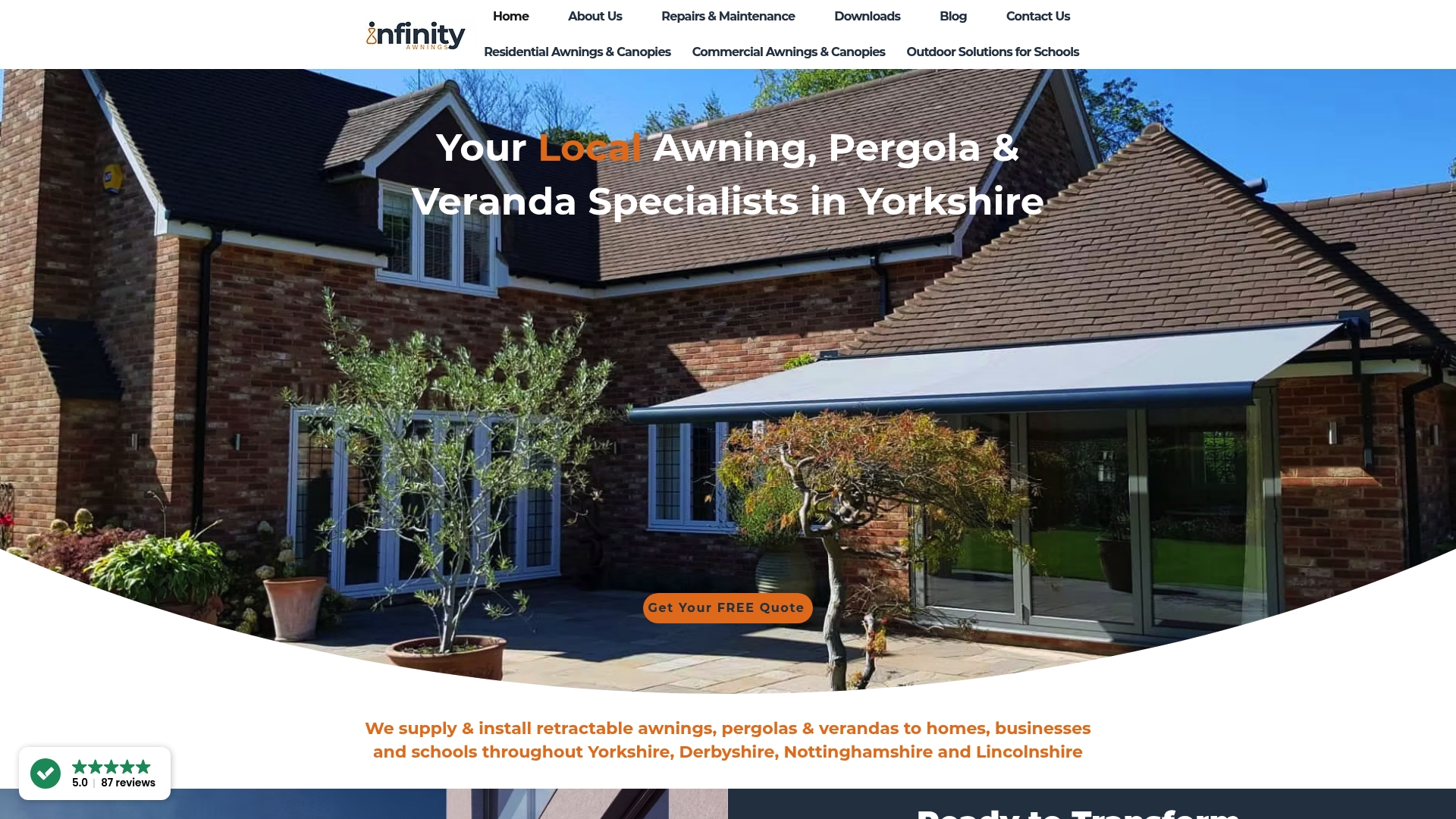
If you want the wind class, size and fixing confirmed for your property, start with our retractable awnings range or request a free quote. Homeowners can see our residential awnings and canopies, and businesses can look at our commercial awnings and canopies.
FAQ
What wind class should a patio awning have?
For a folding arm awning, class 2 is the highest class available, so it is the usual choice for a patio that faces open ground. In a sheltered garden class 1 can be adequate if you retract the awning promptly. Whatever the class, ask for it at the size and projection you are ordering.
Is a class 3 awning storm-proof?
No. Wind class is a tested performance rating, and the standard assumes a retractable awning will be retracted once wind exceeds the manufacturer’s limit. No class makes an awning suitable to leave open in a storm. Retract it before strong wind arrives.
Does a wind sensor mean I can leave my awning out?
No. The BBSA says sensors are not a failsafe, that some do not work unless the awning is fully extended, and that the user is responsible for retracting the awning. Use the sensor as a back-up to your own checks, not a replacement.
Why can the same awning have different classes at different sizes?
The rating applies to the configuration that was tested. A larger projection puts more leverage on the arms and brackets, which can lower the class achieved. The wall fixing also has to cope with the load, so the survey and bracket choice matter as much as the product.
Do pergolas use the same wind classes as awnings?
Pergola awnings and fabric blinds with side guide rails are rated on a wider scale, classes 0 to 6, while folding arm awnings stop at class 2. A number on one scale cannot be compared directly with a number on another, so compare products of the same type.
Sources
Recommended
Comments