
Avoid RCD Failures: UK Electric Awning Wiring to BS 7671

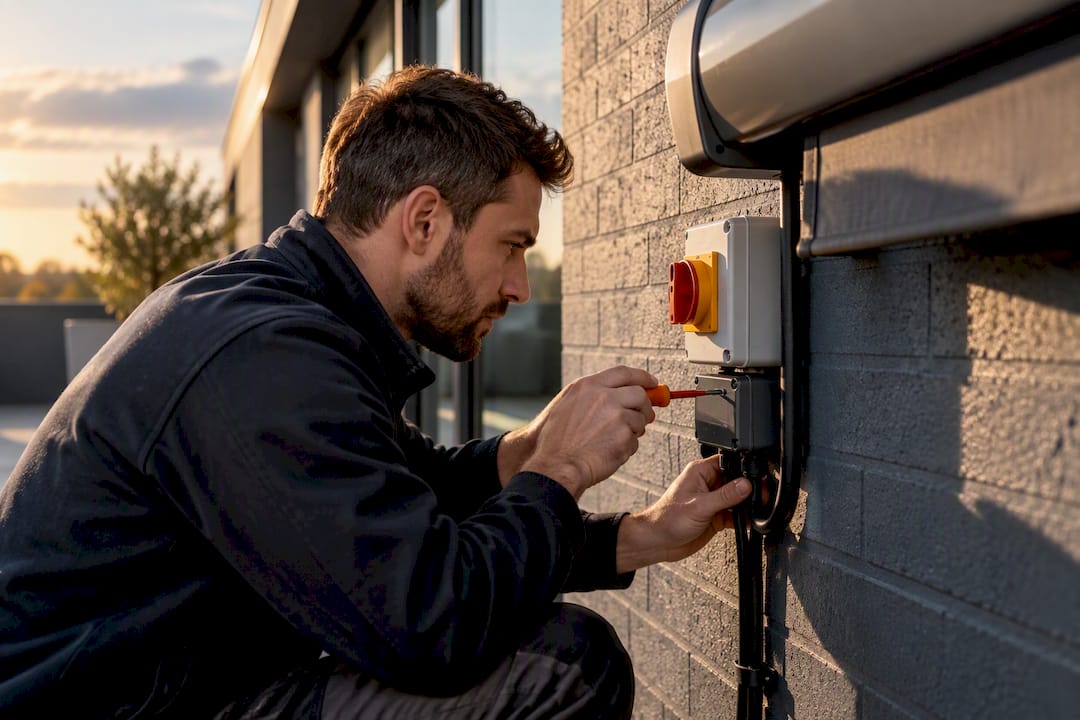
Wiring an electric awning counts as fixed outdoor electrical work, so it falls squarely under BS 7671 and, in most cases, Part P of the Building Regulations. The circuit must carry 30mA RCD protection, and the work needs certifying by a registered electrician or through a competent person scheme. If your awning installer isn’t coordinating with one, stop and arrange it before any cable is put in the ground.
TL;DR:
All outdoor awning wiring must comply with BS 7671, with 30mA RCD protection on circuits and certification by a registered electrician or competent person scheme.
Buried cables require steel wire armoured (SWA) cable with at least 500mm depth and warning tape, while surface runs may use Hi-Tuf or SWA secured with UV-stable ties.
Using a plug-in socket, fused spur, or dedicated circuit depends on the awning’s load and whether additional features like heaters are included; larger loads or added appliances often require a dedicated circuit.
Proper commissioning includes testing trip times (not exceeding 300ms at 30mA) and issuing certificates such as EIC or Minor Works Certificates, especially for new circuits from the consumer unit.
Infinity Awnings coordinates the entire installation process, combining structural and electrical surveys in one visit, ensuring compliance, and providing certification for a legally sound setup.
Table of Contents
What UK regulations apply to electric awning wiring?
Any permanent electrical connection outdoors sits under the same rulebook as garden lighting, hot tubs, and outbuilding sockets: BS 7671, the IET Wiring Regulations. This is the technical standard that governs cable selection, protection, earthing, and testing for every fixed installation in England, Wales, Scotland, and Northern Ireland. There’s no separate “awning” clause. Instead, awning circuits get treated as outdoor power connections, and Section 714 of the standard, which covers outdoor lighting and equipment, sets much of the practical guidance installers lean on for cable suitability and environmental protection.
Regulation 411.3.3 is the one that matters most day to day: it requires 30mA RCD protection on socket outlets and mobile equipment used outdoors, which covers the vast majority of awning motor connections. Combined with damp conditions, exposed metalwork, and the risk of a homeowner drilling into a cable years later, that RCD is the single biggest safety layer in the whole job.
Part P then decides the paperwork route. It applies to fixed electrical installations in dwellings, including work carried out outside the house itself, such as new circuits run out to a garden structure. Some awning connections count as notifiable work, particularly where a new circuit is added at the consumer unit; simpler extensions from an existing outdoor circuit sometimes don’t need Building Control notification, but that distinction doesn’t excuse anyone from BS 7671 compliance or certification. Non-notifiable doesn’t mean unregulated, according to Electrical Safety First’s Part P guidance — it still has to be inspected, tested, and certificated properly.
There are three recognised routes to compliance:
Competent person self-certification through schemes such as NICEIC, NAPIT, or ELECSA, where the registered electrician certifies their own work and notifies Building Control on your behalf.
Third-party certification, where an independent registered electrician inspects work carried out by someone else and issues the certificate.
Local authority Building Control, used less often for domestic awning jobs but available where no competent person scheme applies.
On the RCD itself, expect the electrician to test and record trip timing during commissioning: industry guidance points to trip times not exceeding 300ms at 30mA and 40ms at 150mA, figures verified with a proper RCD tester rather than a plug-in socket checker.
What cable and containment does an awning circuit need?
Cable choice depends almost entirely on the route. For any run buried in soil, garden beds, or under paving, steel wire armoured cable (SWA) is the standard choice, because the armour gives mechanical protection against spades, fence posts, and general garden disturbance that twin and earth simply can’t survive underground. Hi-Tuf cable, a tougher sheathed cable without the steel armour, works for shorter surface runs along a wall or under decking where mechanical damage risk is lower and burial isn’t involved.
Terminating SWA properly means glanding it correctly at both ends, with the armour bonded to earth through the gland and gland plate. Some installers use the armour itself as the circuit protective conductor, but many prefer running a separate CPC alongside it, since a poorly seated gland can create an intermittent earth fault that’s a nightmare to trace during testing.
Route type | Recommended cable | Minimum burial depth | Extra protection needed |
Open garden lawn | SWA | 500mm | Warning tape and cable route marker |
Under driveway or paved area | SWA | 600mm | Cable tiles or ducting, warning tape |
Wall or soffit surface run | Hi-Tuf or SWA | Not applicable | Clipped securely, UV-stable cable ties |
Where required depth can’t be achieved | SWA in conduit | As close to standard as possible | Conduit plus cable tiles |
A few practical points that trip up DIY jobs more than professional ones:
Route marker tape goes above the cable, not beside it, so a future digger hits the tape before the cable.
Cable tiles or purpose-made ducting are mandatory wherever the standard burial depth can’t be met, such as around shallow tree roots or existing services.
Voltage drop matters on longer runs feeding a motor with a start-up current spike; an undersized cable on a 25 metre run can cause nuisance stalling even if it never trips the RCD.
Every wall penetration where cable enters the building needs sealing against water ingress, since moisture breach at a wall entry point is one of the most common failure points on outdoor circuits.
Should you use a plug, a fused spur, or a new circuit?
Awning motors themselves are usually light loads, often under 200W, which tempts people into thinking a standard outdoor socket and a weatherproof plug will do the job. Sometimes it will. But a permanent, dedicated connection to a fixed structure often pushes the installation into “fixed wiring” territory rather than “portable appliance,” and that changes what’s required.
Three options cover almost every awning job:
A weatherproof plug-in socket on an existing RCD-protected outdoor circuit. This works well where the socket is already correctly installed, IP-rated for its exposure (IP44 minimum in sheltered spots, IP65 where it’s more exposed, per outdoor socket guidance), and close enough that no new cable run is needed. It’s the quickest route and often the cheapest.
A switched fused spur, wired permanently from an existing circuit with its own fuse and isolation switch. This suits a motor-only awning with no heater or lighting add-ons, and it avoids the cost of a new circuit while still giving a dedicated, isolatable connection.
A dedicated circuit run from the consumer unit, protected by its own RCBO or RCD-protected way. This is the right call when the awning includes heaters, substantial LED lighting, or when the existing outdoor circuit is already close to capacity.
The decision usually comes down to what else is going on the awning. Adding an infrared heater with higher power can make a spur that was fine for the motor alone start looking marginal, especially once you check what else already shares that circuit indoors. Installers frequently move to a dedicated circuit at that point, partly to avoid nuisance tripping and partly because it makes future testing and fault-finding far cleaner.
How do controls, LEDs and heaters change the wiring?
Remote-controlled awnings typically wire the motor through a receiver unit mounted near the motor housing, with a wall-mounted switch or keypad as a secondary control point. Whichever control method you choose, BS 7671 expects an accessible means of isolation near the equipment, not buried behind fabric or awkward to reach once the awning is fitted. That’s worth checking on-site before the electrician leaves, not after the awning arms are covering the switch.
LED lighting integrated into the awning valance usually runs on low voltage through a transformer, which needs mounting somewhere dry and IP-rated, commonly inside the awning’s headbox rather than exposed on the wall. Getting that transformer placement wrong is a common reason lighting strips fail within a season.
Infrared heaters change the maths considerably. A single 2kW heater on an existing spur can tip a circuit into overload territory once you add the motor and lighting load, which is exactly why many installers step up to a dedicated circuit with its own RCBO once heaters enter the picture.
Isolation switches must be reachable without reaching past or through the awning fabric.
LED transformers belong in a dry, IP-rated enclosure, never left exposed to weather.
Heater loads above a moderate power level usually justify a dedicated circuit rather than a shared spur.
Every add-on should be listed before the electrician quotes the job, not added after wiring is finished.
Pro Tip: Ask your awning supplier for the motor’s full-load current and any heater wattage before the electrician surveys the property. A five-minute spec check avoids a second visit if the original circuit turns out too small.
What tests and certificates should you receive?
Commissioning an awning circuit follows the same sequence as any fixed electrical installation, and skipping steps here is where corners genuinely get cut.
Continuity testing of protective conductors, confirming the earth path is intact along the entire cable run, including through any SWA gland terminations.
Insulation resistance testing, checking the cable’s insulation hasn’t been compromised during installation, particularly important after burial or a tight wall penetration.
Earth fault loop impedance testing, verifying the protective device will operate fast enough during a genuine fault.
RCD trip and timing tests, confirming the 30mA device disconnects within the expected timeframe, generally within 300ms at rated current.
Functional testing of the motor, remote, and any heaters or lighting, plus a final visual inspection of terminations and IP-rated enclosures.
Which certificate you receive depends on the scope of work. A brand-new circuit run from the consumer unit gets an Electrical Installation Certificate (EIC). A simple addition, such as a switched fused spur off an existing circuit, is usually covered by a Minor Electrical Installation Works Certificate. Where the property hasn’t had an inspection in years, many electricians recommend an Electrical Installation Condition Report (EICR) alongside the awning work, checking the wider installation rather than just the new addition.
A registered competent person handles notification to Building Control directly through their scheme, usually within 30 days of completing notifiable work. Keep every certificate issued. Mortgage lenders, insurers, and future buyers all ask for them, and a missing EIC on a consumer unit modification is a genuinely awkward gap to explain years later.
What should a pre-installation survey check?
A proper survey catches problems before cable is bought, not after it’s in the ground. Before quoting, an installer or electrician should confirm the motor’s electrical specification, check how far the nearest suitable circuit sits from the fitting point, and assess whether the existing consumer unit has spare capacity and adequate RCD coverage.
On-site checks matter just as much once work starts:
Route planning to minimise wall penetrations and avoid existing pipework or cabling.
Sealing every cable entry point against water ingress before the awning is fitted.
Confirming IP ratings on every outdoor enclosure, junction box, and socket used.
Positioning the isolation switch somewhere genuinely reachable once the awning is deployed.
Labelling the new circuit at the consumer unit and filing test results with the certificate.
Cost tends to move on a handful of predictable factors: whether SWA and burial are needed versus a short surface run, whether the consumer unit needs a new way or an upgrade, the length of cable run from house to awning, and whether heaters or sensors are being added on top of a basic motor. Combining the job with an EICR adds a modest amount to the invoice but often saves a second call-out later.
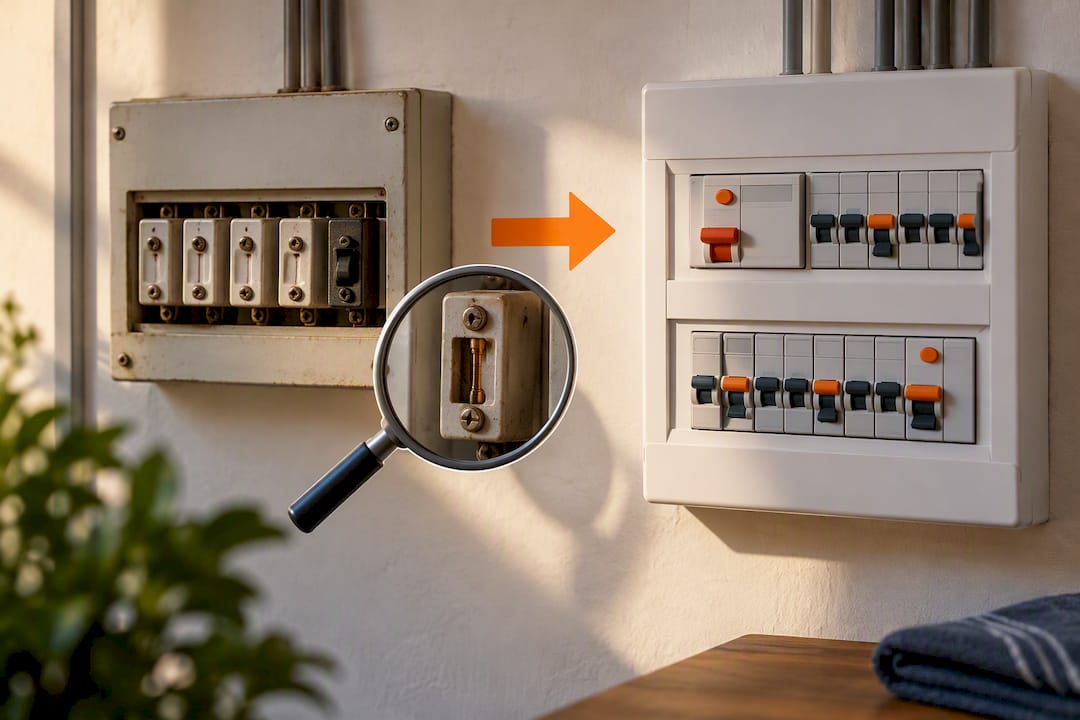
Pro Tip: If your consumer unit still uses old-style fuse wire rather than RCBOs or a modern RCD split, budget for an upgrade conversation before the awning quote. Retrofitting protection after the awning is fitted usually costs more than doing it at the same time.
How Infinity Awnings coordinates compliant installations
Infinity Awnings works across Yorkshire, Derbyshire, Nottinghamshire, and Lincolnshire fitting retractable awnings, pergolas, and verandas, and electric models are the majority of what goes in on residential and commercial properties alike. The standard workflow puts the awning survey and the electrical survey in the same visit wherever possible, so cable routing decisions get made once, not twice.
That coordination matters most on older properties, where the fitter and the registered electrician need to agree on wall penetration points and cable routing before any bracket goes up, avoiding rework where a fixing later conflicts with a cable run. On commercial sites such as bars, restaurants, or school canopies, load calculations tend to be more involved from the start, since heaters and lighting are almost always specified alongside the awning itself, not added afterwards.
Homeowners and businesses considering an install should:
Ask upfront whether the awning fitter coordinates directly with a registered electrician or subcontracts separately.
Request copies of the EIC or Minor Works Certificate once wiring is complete, not just an invoice.
Consider combining the job with an EICR if the property’s last inspection predates the awning purchase.
For anyone weighing up how the electrical side fits with the wider project, our guide to planning permission versus building regulations covers the notification side in more detail, and the step-by-step installation guide walks through how fitter and electrician typically split the work on site.
Safety versus cost: getting the balance right
Cutting corners on an awning’s electrics rarely saves what it looks like it saves. The 30mA RCD and correct weatherproofing at every junction are the two things worth spending on without hesitation, because a shock risk outdoors, in wet grass, near a metal frame, is not a theoretical problem.
Where a property’s wiring hasn’t been checked in a decade or more, paying for an EICR alongside the awning work is the sensible move rather than an upsell. It catches faults elsewhere in the installation before they become the awning’s problem, and it avoids a second electrician visit within a year of the first.
Correct wiring protects more than the person underneath it. A motor running on an undersized or poorly earthed circuit fails faster, and water ingress at a badly sealed junction can quietly ruin a fabric investment long before anyone notices the fault.
— Andrew
Get a compliant awning installation from Infinity Awnings
Infinity Awnings supplies and fits retractable awnings, pergolas, and verandas, and every electric installation is coordinated with a registered electrician so the wiring meets BS 7671 and carries proper certification. Rather than leaving you to find and brief an electrician separately, the survey covers both the structure and the electrics in one visit.

That’s a genuine practical advantage over piecing the job together yourself: one point of contact, one survey, and paperwork that matches what actually got installed. If you’re considering an electric awning, request a free survey and written quote and ask for copies of the EIC or Minor Works Certificate once the electrics are signed off. For residential projects specifically, the residential awnings and canopies page has more detail on what’s included.
Where to check the official standards
For primary reference, consult BS 7671:2018 directly and Approved Document P on gov.uk. Always ask any electrician for their registration number with NICEIC, NAPIT, or ELECSA, and request certificates before making final payment.
Sources
FAQ
What are the latest electrical wiring regulations in the UK?
The current standard is BS 7671:2018, known as the 18th Edition, with amendments issued periodically rather than a full rewrite each year. Outdoor circuits, including awning wiring, must comply with its requirements for RCD protection, cable selection, and earthing.
Can I do electrical work without the 18th Edition?
Any electrician working on a UK installation should be certified to the current edition, since older editions don’t reflect requirements like mandatory RCD protection for outdoor circuits under Regulation 411.3.3. Using an electrician who isn’t up to date on BS 7671:2018 risks work that fails inspection or invalidates certification.
What are the regulations for outdoor electrical cable in the UK?
Outdoor cable must be suitable for the environment it’s run through, typically SWA for buried runs and Hi-Tuf or SWA for surface runs, with 30mA RCD protection on the circuit throughout. Minimum burial depths sit at 500mm in open garden ground and 600mm under driveways, with warning tape or cable tiles required above the cable.
Does an electric awning always need Building Control notification?
Not always. Some outdoor circuit extensions are non-notifiable, but the work must still comply fully with BS 7671 and be certificated. A new circuit from the consumer unit typically is notifiable and gets handled through a competent person scheme.
Does Infinity Awnings arrange the electrical work for an electric awning?
Infinity Awnings coordinates directly with registered electricians during installation, covering both the awning fitting and the electrical connection in one process. Pricing depends on the property and specification, so current quotes are available by requesting a free survey.
Recommended
Comments