
Fire-rated awnings for schools: ensuring safety and compliance

TL;DR:
Many UK schools have installed outdoor awnings without verifying fire safety standards, risking safety and legal compliance. Properly certified fire-rated awnings with UKAS-accredited testing ensure materials perform safely during a fire and meet regulatory requirements. Ongoing inspection, documentation, and appropriate material choices are essential for long-term safety and liability protection.
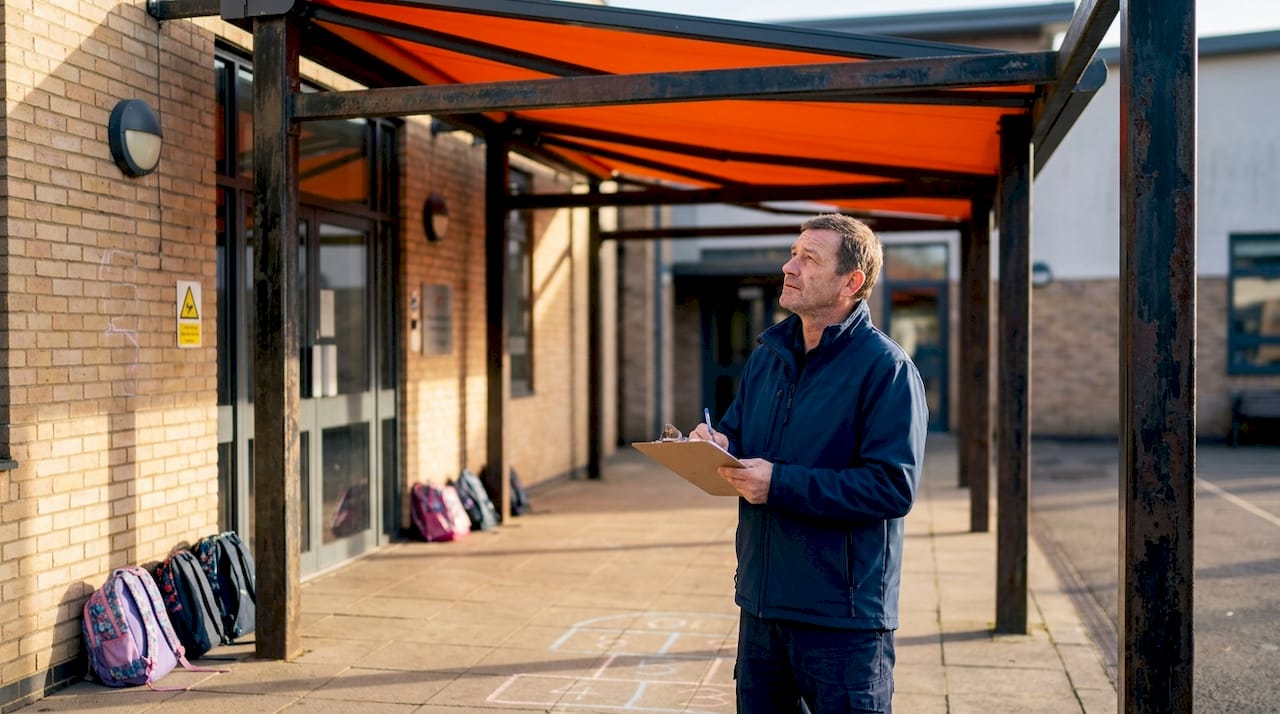
Many schools across the UK have invested in outdoor awnings to create usable playground shelters, covered dining areas, and shaded learning spaces, yet a surprising number of those structures have never been verified against any fire safety standard. The assumption that a fabric roof is automatically low risk is deeply flawed, and for facility managers and school administrators, that assumption carries real legal and reputational consequences. This guide cuts through the confusion, explaining exactly what fire-rated awnings require, which standards apply in UK educational settings, and how to specify, purchase, and maintain a compliant structure with confidence.
Table of Contents
Key Takeaways
Point | Details |
Regulatory compliance | Use only awnings with verified BS/EN fire-rating certificates to meet UK school safety standards. |
Material selection | Choose awning fabrics and frames proven to resist fire and withstand school environments. |
Supplier documentation | Always request and retain lab-tested certificates from suppliers for future inspections. |
Maintenance routine | Schedule regular checks and upkeep to ensure continued fire safety and compliance. |
Why fire-rated awnings matter in educational settings
Schools present a genuinely distinct fire risk profile compared to other commercial environments. Think about what typically surrounds an outdoor awning in a school: adjacent timber fencing, stored sports equipment, wheelie bins, and the kind of seasonal clutter that accumulates in any busy site. When an awning sits close to a building exit or covers a thoroughfare used by hundreds of pupils every day, the material it is made from can directly influence how quickly a fire spreads and how safely people can evacuate.
The legal responsibility here does not sit with the awning manufacturer alone. Facility managers and school administrators carry a duty of care that extends to every structure on site, whether permanent or retractable. Under the Regulatory Reform (Fire Safety) Order 2005, responsible persons must assess and manage fire risks for all parts of a building and its associated outdoor spaces. An awning that has not been certified to an appropriate standard is a gap in that assessment, and gaps have consequences in the event of both an inspection and an incident.
A common misconception is that any fabric sold as “outdoor grade” or even “weather resistant” offers meaningful fire protection. It does not. Standard outdoor fabrics resist moisture and UV degradation, but without a fire-resistance treatment verified by laboratory testing, they can ignite and spread flame rapidly. The distinction between a marketing claim and a tested awning material safety standard is not subtle once you understand it, but many procurement decisions are still made without asking the right questions.
Key fire hazards to consider in school external areas include:
Ignition sources close to covered areas such as kitchen extractor vents, electrical equipment, and BBQ facilities at events
Combustible materials stored beneath or near the awning structure
High occupancy during break times creating evacuation complexity
Awnings positioned over emergency exit routes or fire door zones
Proximity to adjacent buildings where radiated heat could ignite untreated fabric
BS/EN standards are required for UK/EU schools when selecting fire-rated awnings, and you must verify requirements with your local Authority Having Jurisdiction and planning department. Exploring the full range of outdoor shading solutions designed with educational environments in mind is a useful starting point for understanding what appropriate specification looks like.
A fire-rated awning is not simply a product feature. It is documented proof that the materials used have been independently tested and confirmed to perform within defined limits when exposed to flame or heat. Without that documentation, you have a claim, not a certification.
Fire-rated awning standards: navigating regulations and compliance
Understanding how fire rating categories work in practice is genuinely useful before you speak to any supplier. In the UK and European Union, fabric and frame materials for structures in public buildings, including schools, are assessed against the EN 13501 series of standards. These tests classify materials from A1 (non-combustible) through to F (no performance determined), with the intermediate classes B, C, and D representing varying levels of limited combustibility and flame spread.
For school awnings, you would typically expect the fabric to achieve at least a Class B or C classification, and the supporting frame to be non-combustible, meaning aluminium or steel rather than timber or untreated plastics. The classification is only meaningful when accompanied by a Declaration of Performance and a test report from an accredited laboratory. UK and EU regulators require compliance with BS/EN fire-resistance standards for fabric and frame materials in educational settings, and you should always request and verify lab-tested certificates before signing any purchase order.
The difference between a genuine classification and a generic “fire resistant” marketing claim can be subtle on paper but enormous in practice. A supplier who uses phrases like “flame retardant treated” without providing a laboratory report from a UKAS-accredited or equivalent testing body is offering you a claim, not compliance. Always distinguish between these two positions when reviewing UK awning regulations and corresponding supplier documentation.
Standard | Region | What it covers | Required documentation |
EN 13501-1 | UK / EU | Reaction to fire for construction products | Test report, Declaration of Performance |
BS 5867 | UK | Curtains and drapes in public buildings | Fabric test certificate |
NFPA 701 | USA | Flame propagation of textiles | Lab report, product data sheet |
AS/NZS 1530 | Australia | Fire resistance of building components | Accredited lab certificate |
Pro Tip: When evaluating quotes, ask each supplier to provide the EN 13501 classification directly alongside the accredited laboratory name and report reference number. Cross-reference the report date, because fire-resistance treatments on fabrics can degrade and older certifications may not reflect the material you will actually receive. A reputable supplier will provide this without hesitation.
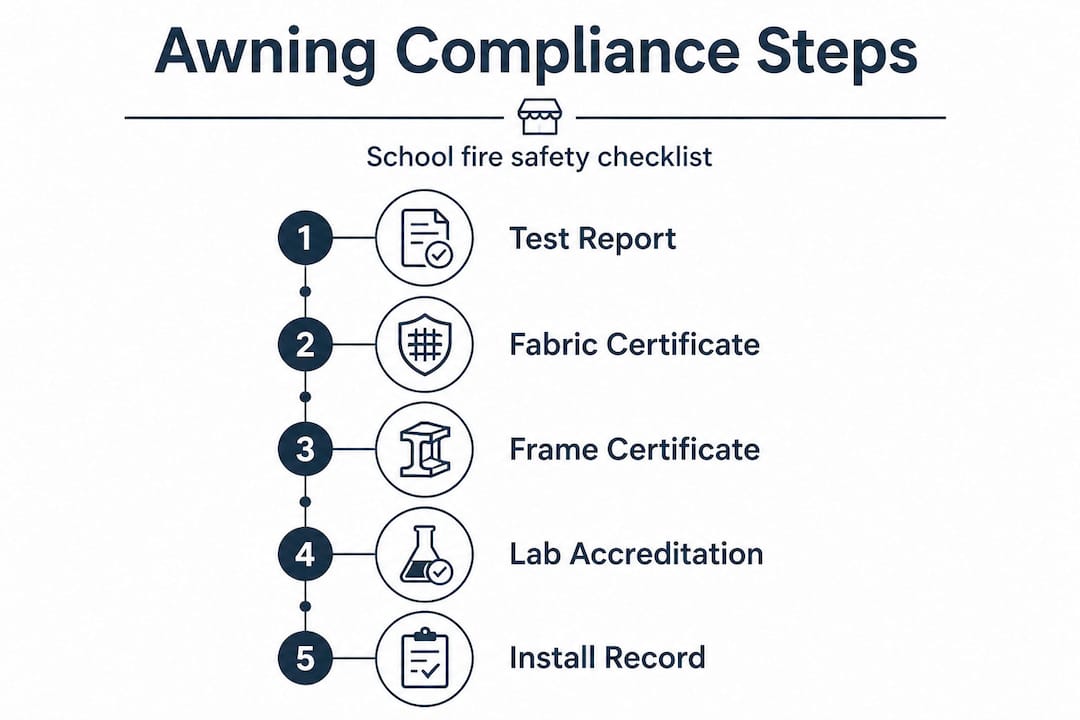
The checklist for planning and installation compliance should include: a copy of the EN 13501 test report, the manufacturer’s Declaration of Performance, evidence that the fabric lot number matches the tested product, and confirmation from your local authority that the installation does not require additional building regulation approval. Keeping these documents in a site file rather than relying on a supplier to produce them later is a straightforward safeguard that many schools overlook.
Material options for fire-rated school awnings
Selecting the right materials for a school awning involves balancing fire performance, structural durability, maintenance requirements, and budget. The good news is that the range of genuinely fire-rated materials has expanded considerably, and you do not have to compromise on aesthetics to achieve compliance.
Aluminium frames are the most widely specified choice for educational settings. Aluminium is non-combustible, lightweight, corrosion-resistant, and requires minimal maintenance beyond periodic cleaning. It achieves an A1 or A2 fire classification by default, meaning it will not contribute to fire spread. Its long service life, typically 20 to 30 years with appropriate installation, makes it a strong long-term investment for schools.
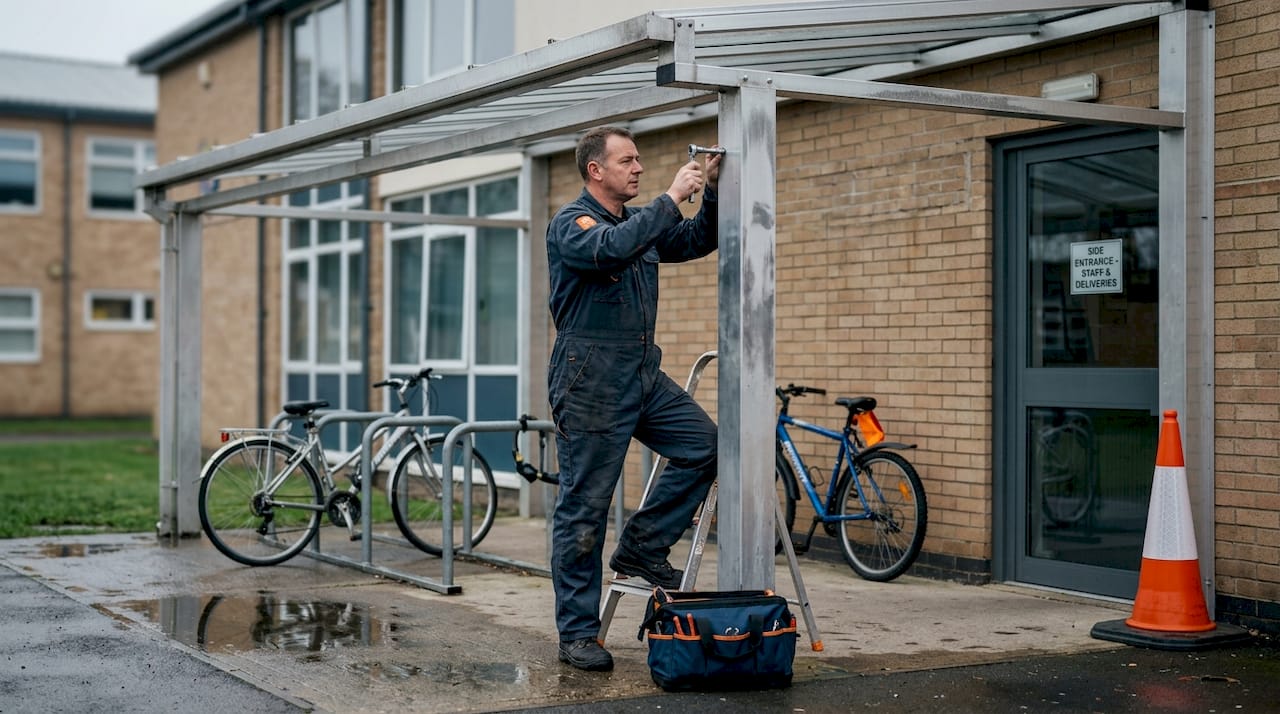
Steel frames offer greater structural rigidity and are particularly suited to larger span applications such as covered walkways between buildings. Mild steel requires a protective coating to prevent corrosion, but powder-coated or galvanised steel frames retain their fire-performance classification effectively. Like aluminium, steel is non-combustible and appropriate for the most exposed or high-risk locations.
Treated polyester fabrics represent the primary fire-performance variable in an awning specification. Standard acrylic and polyester fabrics can be treated with flame-retardant finishes to achieve Class B or C classification under EN 13501. However, material selection must align with fire resistance standards for not only safety but also long-term durability appropriate to educational environments. It is worth noting that some treatments are applied post-manufacture and may require periodic re-treatment, whereas inherently flame-retardant fibres maintain their classification throughout the product’s lifespan.
Material | Fire classification | Expected lifespan | Maintenance level | Relative cost |
Aluminium frame | A1 non-combustible | 20 to 30 years | Low | Medium |
Steel frame | A1 non-combustible | 15 to 25 years | Medium | Medium to high |
Treated polyester fabric | Class B to C | 8 to 15 years | Low to medium | Low to medium |
Inherently FR fabric | Class B | 10 to 20 years | Low | Higher initial cost |
PVC-coated polyester | Class C to D | 10 to 15 years | Low | Low to medium |
Questions worth asking any supplier about school awning materials include:
Is the fire-resistance treatment inherent to the fibre, or applied as a surface finish?
Does the EN 13501 classification apply to the finished product as supplied, including any coatings?
What is the manufacturer’s recommended re-treatment or replacement cycle for the fabric?
Does the frame material carry its own fire classification certificate?
Is there a maintenance protocol that would void the certification if not followed?
Reviewing a thorough choosing school awnings guide can help you formalise a specification before approaching suppliers, which strengthens your position considerably in procurement conversations.
Practical steps: specifying, installing, and maintaining fire-rated awnings
Getting from initial need to installed, compliant structure is a process that rewards careful planning at every stage. The schools that manage it smoothly are those that treat fire compliance as a procurement filter rather than an afterthought.
Define your requirements clearly. Before approaching any supplier, document the location, dimensions, occupancy level, proximity to fire exits, and any planning constraints specific to your site. This shapes every decision that follows.
Request documentation upfront. Ask potential suppliers to provide EN 13501 test certificates, Declaration of Performance documents, and frame material classifications at the quotation stage. Any supplier unable to provide these before contract should be removed from consideration.
Involve your local authority. Some awning installations in school grounds require planning permission or building regulation approval, particularly those attached to listed buildings or those exceeding certain dimensions. Engage early to avoid retrospective compliance issues.
Use a specialist installer. Installation affects both structural integrity and fire performance. An awning fixed incorrectly to a wall can create gaps that compromise the protected zone. Specialist installers understand fixing specifications and waterproofing details that generic contractors often miss.
Document the installation. Obtain an installation certificate, retain the product data sheets, and photograph fixings and fabric details before covering. This record forms part of your site fire safety file.
Schedule annual inspections. Ongoing maintenance and proactive checks are necessary even for certified fire-rated awnings to ensure continued safety compliance. At a minimum, inspect fabric for tears, fading, or contamination that could affect fire resistance, check frame fixings, and operate any motorised components.
Maintain a compliance log. Record inspection dates, findings, any fabric cleaning treatments applied, and the contact details of your supplier and installer. This log is what you produce to your insurer or building control officer when asked.
Pro Tip: Build your awning inspection into the same calendar cycle as your annual fire risk assessment. That way, the outdoor structures review is never missed and your documentation stays cohesive for any third-party audit. The awnings maintenance guide provides a clear inspection framework that translates well to educational settings.
Common pitfalls in this process include neglecting to update documentation after fabric replacement, assuming that a new fabric panel supplied by the original manufacturer automatically carries the same certification as the original, and failing to re-check compliance after any structural alterations to the surrounding building. The outdoor solutions for schools resource is a practical reference for facility managers building a long-term management approach to these structures.
The hidden pitfalls and real value of fire-rated school awnings
Here is something most awning articles will not tell you plainly: the single greatest risk in school awning procurement is not choosing the wrong product. It is accepting the wrong documentation. We have seen schools invest genuinely in quality structures, receive a folder of impressive-looking paperwork, and still be unable to demonstrate compliance at audit because the certificates referred to a different fabric batch, a different frame finish, or a test conducted under a superseded standard.
The most overlooked step is demanding proper lab-tested certification from reputable suppliers, not just accepting claims. Brand reputation is useful context, but it is not a substitute for a current, specific, traceable test report. A supplier with decades of experience who cannot produce an EN 13501 certificate matching your exact specification is, in compliance terms, no better than an unknown manufacturer.
The real value of a properly specified fire-rated awning comes from the process around it. A school that has documented its needs, verified its supplier credentials, engaged its local authority, and maintained a complete installation file has done something genuinely protective. It has closed a gap in its fire risk assessment and created an evidence trail that supports both insurance and regulatory obligations.
There is also a longer-term financial logic here. Schools that cut costs by accepting unverified materials often face much higher costs when those structures need replacing ahead of schedule, or when a compliance failure emerges during an Ofsted or building control review. The additional cost of specifying certified materials and using specialist installers is modest relative to the cost of remediation. Reviewing a detailed safety explained article helps put material investment into perspective.
Explore tailored fire-rated awning solutions for your school
If you are reviewing your school’s outdoor structures and want to ensure they meet current fire safety requirements, Infinity Awnings has over 15 years of experience supplying and installing certified outdoor shading solutions to educational institutions across Yorkshire, Derbyshire, Nottinghamshire, and Lincolnshire.
Our fire-rated pergolas and fire-rated verandas are specified with appropriate frame materials and certified fabrics, and our team can guide you through the documentation process from quotation to installation sign-off. We work directly with facility managers and bursars to ensure the right products are matched to site requirements, with all supporting compliance paperwork in place. Request a free site consultation and take the first practical step towards compliant, long-lasting outdoor structures for your school.
Frequently asked questions
What fire safety certification should school awnings have in the UK?
School awnings should carry certification to the relevant BS or EN fire-resistance standards, specifically EN 13501-1 for fabric and frame materials, with supporting lab-tested documents from a UKAS-accredited or equivalent testing body. UK/EU BS/EN compliance and verified local authority sign-off are both required.
How often should fire-rated awnings in schools be inspected?
Awnings should be inspected at least annually, and after any severe weather event, to confirm that fire resistance and structural safety remain effective. Ongoing inspection and maintenance are necessary to sustain compliance, particularly when fabric panels have been cleaned, repaired, or partially replaced.
Are all ‘fire resistant’ school awnings compliant with UK regulations?
No. Only those with proper BS/EN certification and supporting accredited test reports meet UK regulatory standards. A product described as “fire resistant” without a classified test report is a marketing claim, not a compliance document, and BS/EN compliance evidence must always be requested and checked against your local authority requirements.
What materials are most suitable for fire-rated awnings in educational environments?
Aluminium and steel frames are preferred for their non-combustible A1 classification, combined with inherently flame-retardant fabrics that retain their classification throughout the product’s working life. Material selection must align with fire resistance standards to ensure both safety performance and the durability expected in a busy educational environment.
Recommended
Comments