
Noise reduction with awnings: facts, myths, and outdoor comfort
- Andrew Crookes

- May 5
- 10 min read
TL;DR:
Retractable fabric awnings provide excellent shade and weather protection but offer negligible noise reduction. Solid barriers and glazing outperform awnings in decreasing airborne noise levels significantly; combining these features with planting enhances overall comfort. Strategic layering of soundproof barriers with awnings creates a more pleasant outdoor space despite persistent environmental noise.
Retractable awnings are one of the most popular outdoor upgrades for homeowners and businesses across Yorkshire, Derbyshire, Nottinghamshire, and Lincolnshire. They look great, cut glare, and extend usable outdoor space well into the autumn months. But a growing number of buyers ask a different question: will an awning help reduce noise from the road, neighbours, or nearby businesses? It is a fair question, but the honest answer may surprise you. No reliable benchmarks confirm that fabric awnings provide significant airborne noise reduction, unlike solid barriers which can achieve 3 to 5 dB of measurable attenuation. This guide separates myth from reality and shows you what genuinely works.
Table of Contents
Key Takeaways
Point | Details |
Awnings alone won’t cut noise | Research shows fabric awnings have a negligible impact on reducing outdoor noise. |
Combine solutions for best results | Pair awnings with solid barriers or dense vegetation to enhance comfort and reduce disturbance. |
Focus on comfort gains | Awnings shine in creating usable, shaded outdoor spaces even if sound remains. |
Direct evidence matters | Choose outdoor upgrades with realistic expectations about what each feature can deliver for noise and lifestyle. |
How do awnings interact with outdoor noise?
With common myths out of the way, let us clarify how awnings and noise actually interact based on acoustic science.
Sound behaves very differently outdoors than it does inside a room. Airborne noise, which is the term for sound travelling through the air from sources like traffic, machinery, or music, radiates in all directions and wraps around objects. A fabric awning, even a high-quality one from a brand like Weinor or Tarasola, is a thin, flexible membrane stretched over a frame. It simply does not have the mass, density, or sealing properties needed to interrupt that radiation meaningfully.
“Balconies provide only minor noise screening because distance from the source is the primary factor in attenuation, and fabric awnings add no quantified acoustic benefit. Studies on outdoor barriers consistently show 3 to 5 dB for short solid structures, a modest but measurable result that fabric cannot match.”
The physics behind this are straightforward. Noise reduction through a barrier depends on its surface density, its continuity (no gaps), and its height relative to the sound path. Fabric scores poorly on all three counts. Even if an awning arm extends several metres over your patio, the canopy above you does nothing to block the noise arriving from the sides or bouncing off adjacent walls.
Here is what actually influences outdoor noise levels at your property:
Distance from the source. Every time you double the distance from a noise source, you gain roughly 6 dB of natural reduction. Positioning seating further from a road edge matters enormously.
Height and solidity of barriers. A solid timber or masonry fence, tall enough to interrupt the direct line between the noise source and your ears, provides real acoustic benefit.
Surface reflections. Hard surfaces like concrete patios reflect and amplify noise. Soft landscaping, including lawn and dense planting, absorbs some energy.
The direction the noise is arriving from. If traffic noise comes primarily from one direction, a solid screen on that side is far more effective than any overhead canopy.
It is worth reading more about awnings and outdoor acoustics if you want a deeper picture of how shading structures interact with sound environments. Meanwhile, understanding the broader retractable awnings benefits helps set the right expectations before you invest.
Awnings versus other outdoor noise solutions
Knowing that fabric awnings have limits, how do they compare to other noise-reducing solutions?
The table below gives you an at-a-glance comparison so you can plan your outdoor space with clear-eyed expectations.
Solution | Noise reduction (dB) | Key strength | Key limitation |
Retractable fabric awning | Negligible (unmeasured) | Shade, shelter, UV protection | No acoustic mass or sealing |
Solid timber fence (1.8 m+) | 3 to 5 dB | Cost-effective, widely available | Requires planning consideration |
Glass or polycarbonate screen | 4 to 6 dB | Stylish, lets light through | Higher cost, needs solid framing |
Masonry or brick wall | 5 to 10 dB | Maximum noise reduction | Expensive, permanent, requires planning |
Dense hedgerow or planting | 2 to 3 dB | Natural, wildlife-friendly | Slow to establish, takes space |
Pergola with glass sides | 4 to 7 dB | Combines shelter with screening | Higher investment, needs good installation |
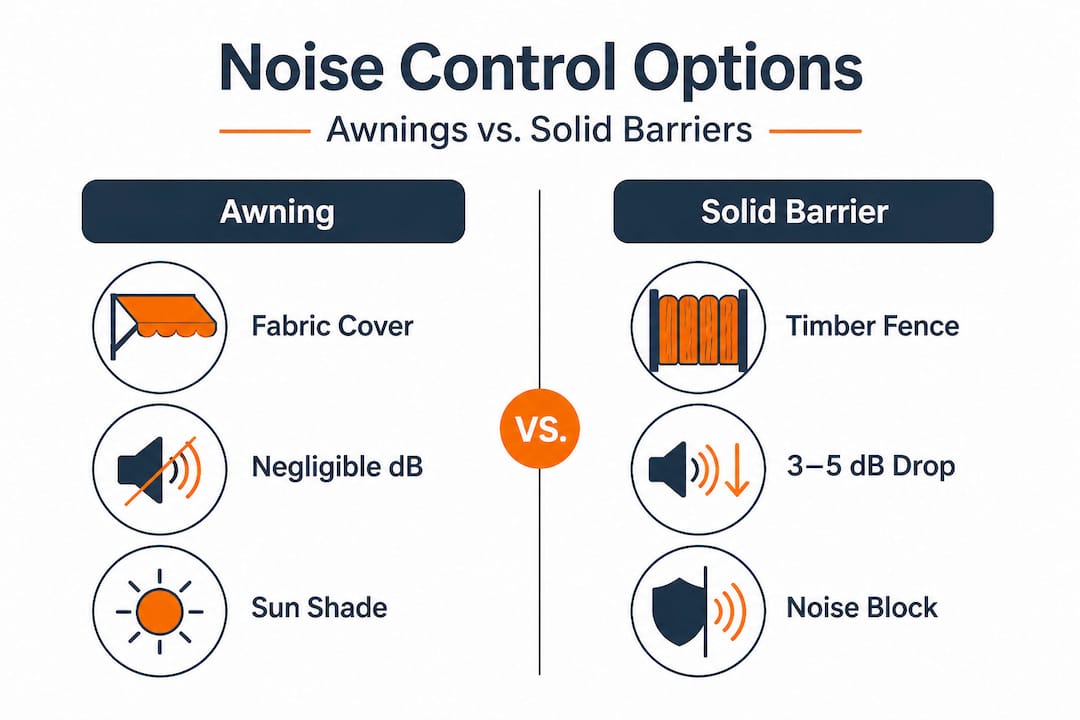
As the table makes clear, solid barriers or glazing outperform fabric awnings for noise control. Awnings deliver genuine value in the comfort column, through shade, shelter from drizzle, and extending outdoor season, but they should not be marketed or purchased primarily as noise-reducing products.
There are practical steps you can take when installing retractable awnings alongside other features to make the most of your outdoor area:
Identify the primary noise direction at your property before you buy anything.
Install a solid screen or fence on the side facing the noise source.
Add an awning overhead to deal with sun and rain, improving time spent outdoors.
Use dense planting along boundaries for additional absorption and visual privacy.
Choose seating positions that place you furthest from the noise source and closest to any solid barrier.
Pro Tip: If your main noise source is a busy road or a neighbour’s garden, a 1.8-metre solid timber fence on that boundary combined with a retractable awning overhead will deliver far more comfort than either feature alone. The fence handles the sound; the awning handles the sun and rain.
When awnings support outdoor comfort despite noise
While awnings won’t silence the outside world, they do help create more liveable spaces. Let us see how.
Even in a noisy environment, comfort is about more than sound. Your experience outdoors depends on temperature, glare, shelter from rain, and how long you can realistically stay outside before the elements drive you back inside. This is where retractable awnings genuinely excel, and why they remain a worthwhile investment even for properties near busy roads.
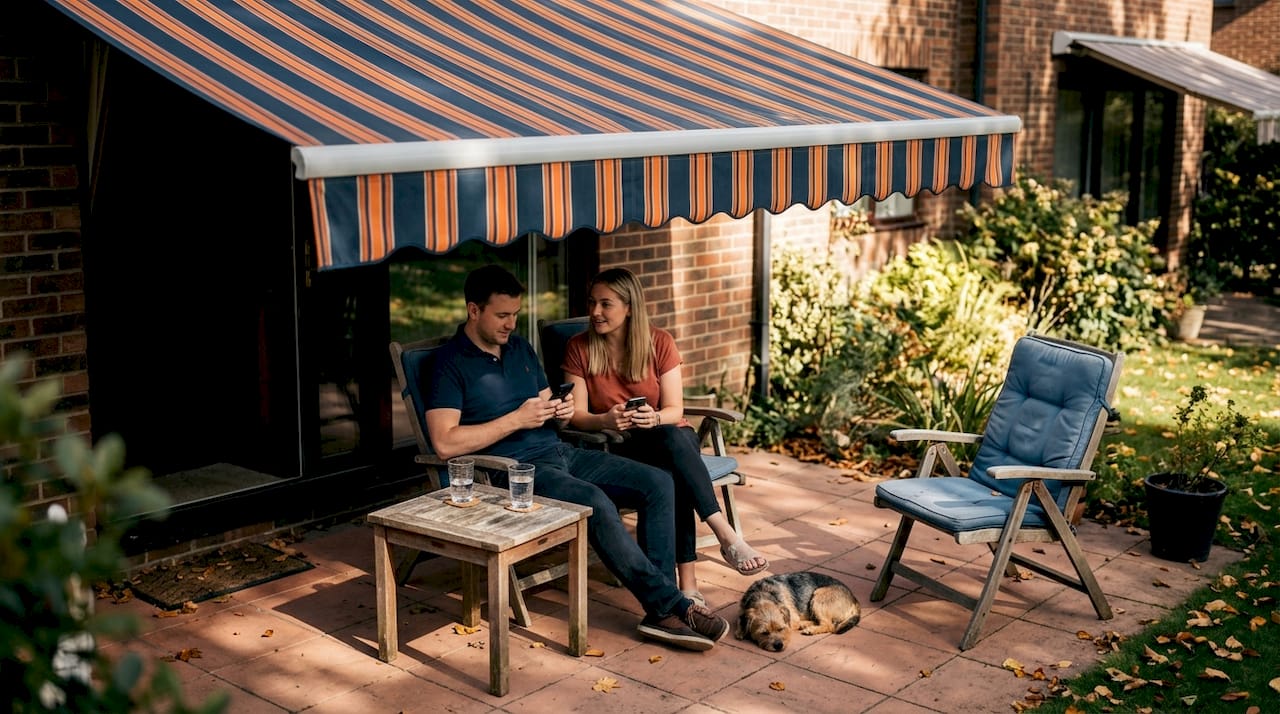
Consider a restaurant terrace on a main street in Sheffield or Nottingham. The traffic noise is constant. But a well-shaded terrace with quality awnings means diners are comfortable, shielded from afternoon sun, and sheltered from the light drizzle that Yorkshire summers regularly produce. The noise has not disappeared, but the overall experience is dramatically better than sitting exposed. That is a real commercial benefit.
The comfort improvements awnings deliver include:
Solar heat reduction. Quality awnings can reduce heat gain through adjacent windows and doors by a significant margin, keeping indoor spaces cooler and making the transition between inside and outside more comfortable.
UV protection. Extended exposure to UV radiation is a genuine health concern. Fabric awnings, particularly those using high-grade Selt or Morvelle fabrics, block the majority of UV reaching the space below.
Rain shelter. A retractable awning allows outdoor areas to remain in use during light rain, which in the East Midlands and Yorkshire is a near-daily consideration for much of the year.
Privacy screening. While not designed as sound barriers, wider awnings and side panels can reduce visual intrusion from the street, making outdoor spaces feel more enclosed and relaxed.
Extended outdoor season. By blocking wind, rain, and sun, awnings effectively add weeks to the outdoor season, improving return on investment for both domestic gardens and commercial venues.
Comfort factor | Awning benefit | Noise benefit |
Shade and UV | Significant | None |
Rain shelter | Significant | None |
Heat reduction | Up to 77% reduction in solar heat gain | None |
Visual privacy | Moderate with side panels | None |
Noise reduction | Negligible | Negligible |
It is also worth noting that no benchmarks confirm significant noise reduction from fabric awnings, which reinforces the importance of evaluating these products honestly. The benefits of outdoor shading are real and substantial, but they lie firmly in the comfort, energy, and weather-protection columns rather than the acoustic column.
For businesses looking at how shading affects the customer experience, our article on awnings and customer comfort is a useful read. You can also explore how electric awnings and energy saving work together, since controlling solar gain indirectly improves the overall outdoor environment by reducing the heat bouncing off glass doors and windows.
Combining awnings with other strategies for noise relief
For those needing both comfort and quieter outdoor living, here is how to combine awnings with proven noise solutions.
The most effective outdoor spaces are designed in layers. Think of it like this: one product rarely solves all your problems, but the right combination of features addresses each challenge individually. For noise, that means bringing in solutions with actual acoustic mass. For comfort, shade, and shelter, that means an awning. Together, they create an outdoor space that works across all the dimensions that matter.
Solid barriers or glazing consistently outperform fabric awnings for noise, but there is no reason you cannot have both. Here is what a layered approach looks like in practice for a typical Yorkshire or Nottinghamshire property:
Step one: install a solid boundary screen. This might be a close-board timber fence, a garden wall, or a polycarbonate glass screen positioned between your outdoor seating area and the noise source. This alone can provide 3 to 5 dB of measurable reduction, which is the difference between feeling exposed and feeling sheltered.
Step two: add dense planting inside the boundary. Bamboo, laurel, and thick mixed hedgerows all absorb some sound energy and create a psychological sense of enclosure that reduces how intrusive noise feels. Planting also helps manage energy and airflow around your outdoor structure.
Step three: install your retractable awning. Now that you have addressed the primary noise vector, your awning handles the sun, rain, and heat. This is its proper role, and it performs it exceptionally well.
Step four: consider wind and sensor controls. Adding wind sensors for awnings ensures your awning retracts automatically in strong gusts, protecting your investment and keeping your outdoor setup functional throughout the season.
Pro Tip: Dense planting of at least 1.5 metres in depth, using evergreen species like laurel or yew, can take the acoustic edge off neighbour or traffic noise while also providing year-round visual privacy. It is slow to establish but requires zero maintenance costs once mature, making it one of the best-value investments you can pair with an awning installation.
The goal is not perfection. You will not achieve library-level quiet on a suburban street in Doncaster or Lincoln. But a well-designed combination of solid screening, planting, and a quality awning can reduce perceived noise enough that outdoor dining, conversation, and relaxation become genuinely pleasant rather than something you give up on after twenty minutes.
Why the best noise strategy is rarely just an awning
Summing up all the research and hands-on practice, here is what most property owners across Yorkshire, Derbyshire, Nottinghamshire, and Lincolnshire miss when seeking outdoor quiet.
We understand why awnings get associated with noise reduction. Marketing materials from some manufacturers describe them as creating “sheltered” or “enclosed” spaces, language that implies acoustic privacy as well as physical shelter. Buyers in noisier areas naturally connect those words with the idea of quiet. But there is a meaningful gap between feeling sheltered and experiencing genuine acoustic reduction.
The research is unambiguous on this point. Solid barriers or glazing outperform fabric awnings for noise in every measurable way. Fabric has no acoustic mass, no sealing properties, and no ability to interrupt the lateral and reflective paths that airborne sound travels. Expecting a fabric canopy to quieten a busy road is like expecting a curtain to stop a draught through an open window.
What we have consistently seen over more than 15 years in this industry is that clients who invest only in an awning for noise relief feel mildly disappointed, while those who invest in a combination of solid screening, planting, and a quality awning feel the money was well spent. The awning is not the noise solution. It is the comfort solution. And comfort is valuable in its own right, entirely separate from acoustic performance.
If you want detailed analysis of how outdoor structures interact with sound, we recommend our detailed outdoor acoustics analysis which looks at this topic from multiple angles. The key takeaway is consistent: layer your solutions, manage your expectations, and choose each product for what it genuinely does rather than what you hope it might do. That approach delivers real satisfaction and genuine return on investment.
Transform your outdoor comfort with tailored solutions
Even if an awning will not quieten a noisy street, the comfort improvements it delivers are substantial and real. Shade, UV protection, rain shelter, and extended outdoor season are benefits that every garden and commercial terrace in our region can use. That is not a consolation prize. It is a genuinely valuable upgrade.
At Infinity Awnings, we help homeowners and businesses across Yorkshire, Derbyshire, Nottinghamshire, and Lincolnshire design outdoor spaces that work year-round. Whether you are looking at our full range of retractable awnings, exploring garden pergola solutions that can incorporate solid glass panels for real acoustic shielding, or considering veranda installation services that combine overhead cover with structured side screening, we can guide you through the options honestly. Request a free quote today and let us help you build an outdoor space that genuinely delivers on comfort.
Frequently asked questions
Do retractable awnings block traffic noise for homes and businesses?
No, fabric awnings have minimal effect on airborne noise such as traffic. Solid barriers are needed for measurable noise reduction, typically providing 3 to 5 dB compared to the negligible performance of fabric canopies.
How much noise reduction can a solid outdoor barrier provide?
Typical short solid barriers provide between 3 and 5 dB of reduction outdoors, which is enough to make a noticeable difference to perceived noise levels in a garden or terrace setting.
Can combining awnings with other features help reduce noise?
Yes. Pairing an awning with solid screens, dense planting, or glass panels addresses both comfort and noise. Solid barriers and glazing handle the acoustics while the awning manages sun and rain.
Is there any benefit to choosing a retractable awning if I want less outdoor noise?
Retractable awnings significantly improve outdoor comfort and usability, but they do not reduce environmental noise in any measurable way. The value lies in shade, UV protection, and weather shelter.
Which outdoor features best improve both noise and comfort?
Solid screening, pergolas with glass sides, and dense garden borders deliver the best combination of measurable noise reduction and comfort, particularly when combined with a quality retractable awning overhead.
Recommended
Comments