
How awnings boost home energy efficiency: essential guide

TL;DR:
Up to 70% of unwanted summer heat enters homes through unshaded windows.
Outdoor awnings can reduce solar heat gain by up to 70%, lowering cooling costs.
Properly installed and used awnings can save households 10 to 25% on energy bills.
Up to 70% of unwanted summer heat enters your home through the windows, yet most homeowners focus their energy-saving efforts on loft insulation and boiler upgrades. If your living room turns into a greenhouse every July, the real culprit is likely unshaded glazing. Outdoor shading reduces solar heat gain by up to 70%, cutting cooling costs by 10 to 25%. This guide walks you through exactly why awnings work so well, how to choose the right one, and how to install it for maximum impact across Yorkshire, Derbyshire, Nottinghamshire, and Lincolnshire.
Table of Contents
Key Takeaways
Point | Details |
Awnings cut energy bills | Installing awnings can reduce your cooling costs by up to 25% for sun-exposed homes. |
Best practice: south and west | Targeting south- and west-facing windows yields the highest energy savings. |
Quality fabrics matter | Light, UV-reflective materials enhance both comfort and efficiency. |
Install for local climate | Motorised, sensor-driven awnings work best in changeable Northern weather. |
Why energy efficiency matters in Yorkshire and beyond
Summers across our region have grown noticeably warmer over the past decade. Yorkshire, Derbyshire, Nottinghamshire, and Lincolnshire all sit in a band of England that experiences significant temperature spikes between June and September, particularly in properties with large south or west-facing windows. Older housing stock, which makes up a large proportion of homes here, was rarely designed with solar shading in mind. The result is rooms that overheat quickly and take hours to cool down, even after the sun has moved on.
The financial pressure this creates is real. Running portable fans or air conditioning units to compensate pushes electricity bills higher at exactly the time of year when many households are already stretched. Saving energy with awnings is one of the most straightforward ways to break that cycle, because you are stopping heat at the source rather than trying to remove it after it has already built up indoors.
There is also a regulatory dimension worth knowing about. Building Regulations Part L and Part O now require new builds and major renovations to demonstrate adequate solar shading to prevent overheating. This reflects a broader national concern: 90% of UK homes may face overheating risks by the 2030s. Even if your home is not subject to those regulations right now, the trend is clear.
“Overheating is no longer just a comfort issue. It is a health risk, an energy cost, and increasingly a compliance matter for UK homeowners.”
Here is a quick summary of why regional homeowners should act now:
Warmer summers are increasing indoor temperatures in homes built without shading
Energy bills rise sharply when cooling devices are used to compensate
South and west-facing windows are the biggest contributors to heat build-up
Part L and Part O regulations are tightening requirements around solar control
Shading explained for Yorkshire homes shows how local sun angles make external shading especially effective here
The good news is that awnings address all of these points in one practical, attractive upgrade.
How awnings reduce solar heat gain and lower energy bills
Solar heat gain is simply the warming effect caused by sunlight passing through glass. Unlike heat conducted through a wall, solar heat gain is almost instantaneous. The moment direct sun hits an unshaded window, the temperature inside begins to climb. This is why a room can feel unbearably warm even on a day when the outside air temperature is only moderate.
Awnings work by intercepting that sunlight before it ever reaches the glass. Awnings block solar heat gain before it enters homes through windows, reducing the need for air conditioning significantly. A well-positioned awning creates a shaded zone over the window, so the glass itself stays cooler and far less heat transfers into the room behind it.
The numbers are striking. Outdoor shading cuts cooling costs by 10 to 25% for typical UK households. On a south-facing window in midsummer, a horizontal awning with adequate projection can block the vast majority of direct solar radiation during peak hours. The benefits of outdoor shading go beyond temperature too, including reduced glare, protection for furniture, and extended use of outdoor spaces.
Window orientation | Solar heat gain risk | Awning effectiveness |
South-facing | Very high (midday sun) | Excellent with horizontal awning |
West-facing | High (afternoon sun) | Excellent, especially after 2pm |
East-facing | Moderate (morning sun) | Good for early risers |
North-facing | Low | Minimal benefit needed |
Pro Tip: If you can only fit one awning, put it on your largest south or west-facing window. That single change will deliver the greatest reduction in solar heat gain for the lowest outlay.
For a broader look at types of shading solutions available for UK homes, it is worth comparing retractable awnings, fixed canopies, and pergola systems to find the best match for your property.
Choosing the most effective awnings for your home
Not all awnings perform equally when it comes to energy efficiency. The fabric, the colour, the control system, and the projection depth all play a role in how much heat is actually blocked.
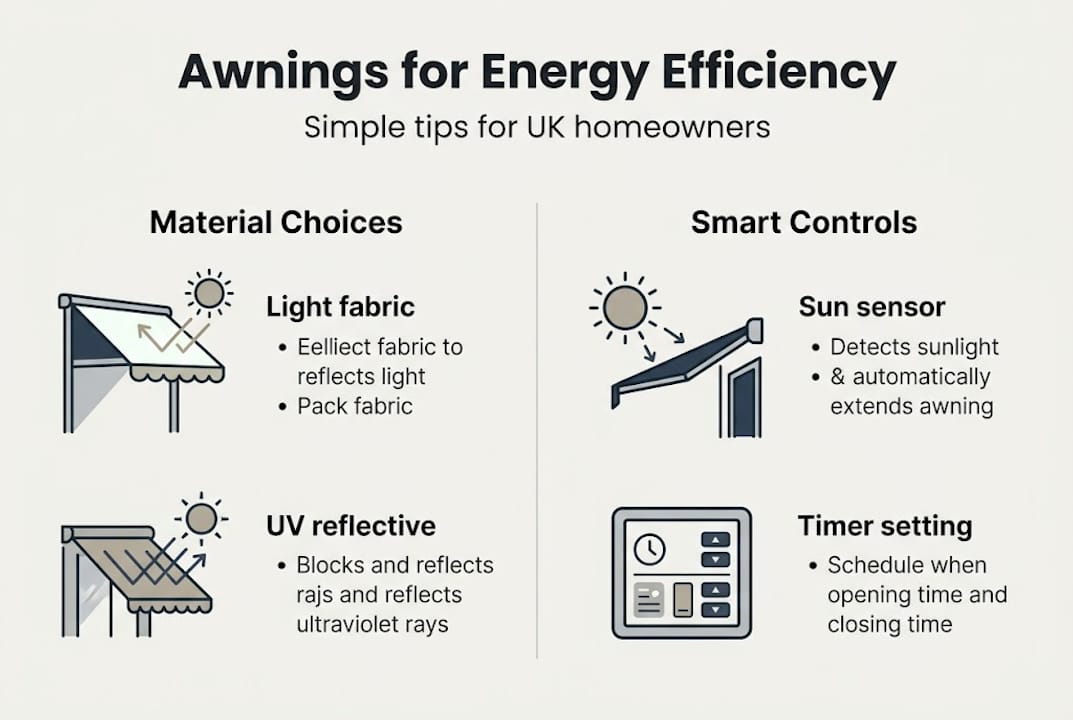
Fabric and colour are the starting point. Light-coloured, UV-reflective fabrics enhance performance significantly, while motorised versions with sensors optimise shading for changing weather conditions. A pale or mid-tone fabric reflects a greater proportion of solar radiation back into the atmosphere before it can warm the awning itself. Dark fabrics absorb more heat and can radiate some of it downward, reducing the benefit. Look for fabrics with a high UV-block rating, ideally above 95%.
For detailed guidance on materials, our article on best awning fabrics covers the technical differences between acrylic, polyester, and solution-dyed options in plain terms.
Feature | Energy benefit | Practical benefit |
Light-coloured fabric | Reflects more solar radiation | Keeps outdoor area cooler |
UV-reflective coating | Blocks up to 95% UV | Protects furniture and skin |
Motorised operation | Responds quickly to sun changes | Convenient, no manual adjustment |
Wind/sun sensors | Auto-retracts in bad weather | Protects awning from damage |
Deep projection | Shades more of the window | Greater heat reduction |
Motorised and sensor-controlled awnings are worth the additional investment for most Yorkshire homeowners. Wind is a genuine concern in our region, and a motorised awning fitted with a wind sensor will retract automatically before gusts can damage it. A sun sensor ensures the awning extends whenever solar intensity crosses a set threshold, so you get consistent shading without having to think about it. The advantages of electric awnings for Yorkshire homes are particularly relevant given our changeable weather.
Pro Tip: Pair a sun sensor with a timer so your awning extends before the hottest part of the day, not just when you notice the room getting warm. Prevention is far more effective than reaction.
For a structured approach to comparing your options, the shading selection tips guide walks through projection depth, fixing methods, and fabric grades in one place.
Maximising energy savings: installation best practices
Choosing the right awning is only half the job. Where and how it is installed determines whether you see modest improvements or genuinely significant savings.
Follow these steps to get the most from your installation:
Prioritise south and west windows first. These receive the most direct sun and contribute most to overheating. South and west windows should be your first priority, with motorised versions recommended for wind-prone areas.
Match projection depth to window height. A deeper awning projection shades more of the window at lower sun angles, which is especially important in spring and autumn when the sun sits lower in the sky.
Fix at the correct height above the window. Installing the awning too low reduces the shaded area; too high and the angle becomes less effective at midday.
Consider combining with internal blinds. Layering external awnings with internal roller blinds compounds the effect. Simulation research shows horizontal awnings reduce building energy consumption by 12 to 34% individually, rising to 55% when combined with other measures.
Use motorisation for consistency. Manual awnings often go unused when homeowners are out, meaning the house heats up unchecked. Motorised versions with sensors operate independently.
The outdoor shading benefits for UK homes article expands on how combining shading layers works in practice, with real examples from properties across the region.
55% energy reduction is achievable when awnings are combined with complementary measures such as improved glazing, internal blinds, and smart controls. That figure comes from building energy simulation research and represents the upper end of what a well-planned approach can deliver.
Pro Tip: Ask your installer to check the overhang angle before fitting. A 45-degree pitch is often cited as the sweet spot for balancing summer shading with winter solar gain, which you actually want during colder months.
For inspiration on how other homeowners have approached this, shading examples for UK spaces shows a range of real-world installations.
Our experience: what most energy guides miss about awnings
Most energy efficiency guides treat awnings as a simple add-on, a box to tick alongside loft insulation and double glazing. After more than 15 years fitting shading solutions across Yorkshire and the surrounding counties, we have learned that the real gains come from somewhere most guides never mention: behaviour and local context.
A top-quality awning fitted to the wrong window, or left retracted because it is fiddly to operate, saves nothing. We have seen homeowners invest in premium products and then barely use them because the manual winding mechanism felt like a chore. Motorisation is not a luxury here; it is what turns a good product into a genuinely effective energy tool.
Local sun angles matter more than most people realise too. The fundamentals of outdoor shading explain how latitude affects the angle at which sunlight hits your windows, and properties in Lincolnshire versus North Yorkshire can have meaningfully different shading requirements even though they are in the same broad region.
The 55% combined savings figure is real, but it requires the right product, the right placement, and consistent use. That combination is what we help our customers achieve.
Take the next step: transform your home’s efficiency
If the idea of cutting your cooling costs by up to 25% while making your home more comfortable sounds appealing, the practical next step is straightforward. Infinity Awnings has been helping homeowners across Yorkshire, Derbyshire, Nottinghamshire, and Lincolnshire find the right shading solution for over 15 years.
Whether you are looking at retractable awnings for a south-facing patio door, or exploring garden pergolas as a more permanent shading structure, our team can advise on the best fit for your property and budget. Every installation is tailored to your home’s orientation, window sizes, and local conditions. Visit Infinity Awnings to request a free quote or download our shading guide, and take the first step towards a cooler, more energy-efficient home this summer.
Frequently asked questions
How much can awnings reduce my home’s cooling costs?
Modern awnings can cut cooling costs by 10 to 25%, particularly when fitted to sun-exposed south or west-facing windows.
Which windows should I prioritise for awning installation?
South and west-facing windows receive the most direct sun and deliver the greatest energy savings when shaded with a well-positioned awning.
Are motorised awnings worth the investment for UK homes?
Yes. Motorised awnings with sensors react automatically to changing weather, maximising shading efficiency while protecting the awning from wind damage.
What is the difference between light- and dark-coloured awning fabrics?
Light-coloured fabrics reflect more sunlight and are measurably more effective at blocking heat than darker alternatives, which absorb and re-radiate warmth.
Can awnings be combined with other energy-saving upgrades?
Absolutely. Combined shading measures including awnings, blinds, and improved glazing can raise total energy savings to over 50% compared to unshaded glazing alone.
Recommended
Comments