
Outdoor branding through awning design: a practical guide

TL;DR:
Outdoor branding through awning design customizes structures as architectural assets that enhance brand visibility and engagement. Infinityawnings has over 15 years of experience helping businesses create cohesive, durable, and well-lit branded awnings across multiple locations.
Outdoor branding through awning design is the strategic use of custom-designed awnings as architectural extensions that amplify brand visibility and drive customer engagement. Unlike a painted sign or a vinyl banner, a well-designed branded awning becomes part of the building itself. It communicates quality, reinforces identity, and works around the clock. Branding experts recommend viewing awnings as architectural extensions with integrated form, proportion, and lighting, rather than as mere signage bolted onto a façade. Infinityawnings has spent over 15 years helping businesses across Yorkshire, Derbyshire, Nottinghamshire, and Lincolnshire achieve exactly that.
1. What are the top design elements for awning branding?
A branded awning succeeds when every visual element serves the brand, not just the structure. Colour, typography, logo placement, and material texture must all work together to create a single, coherent impression.
The most effective awning designs follow these principles:
Brand colours first. Match fabric and frame colours precisely to your brand palette. Off-brand shades read as careless, even to customers who cannot name the discrepancy.
Simple over cluttered. One logo, one tagline, one clear message. Awnings with too many elements compete with themselves and confuse pedestrians at a glance.
Typography at scale. Fonts that look fine on a business card can become unreadable at street level. Use bold, clean typefaces with generous letter spacing.
Edge and valance placement. Branding on the valance or front edge delivers the most effective street-level exposure for pedestrians, not the main cover area.
Form and proportion. The awning’s shape should complement the building’s architecture. A curved awning on a Georgian façade creates tension; a straight cassette profile suits it.
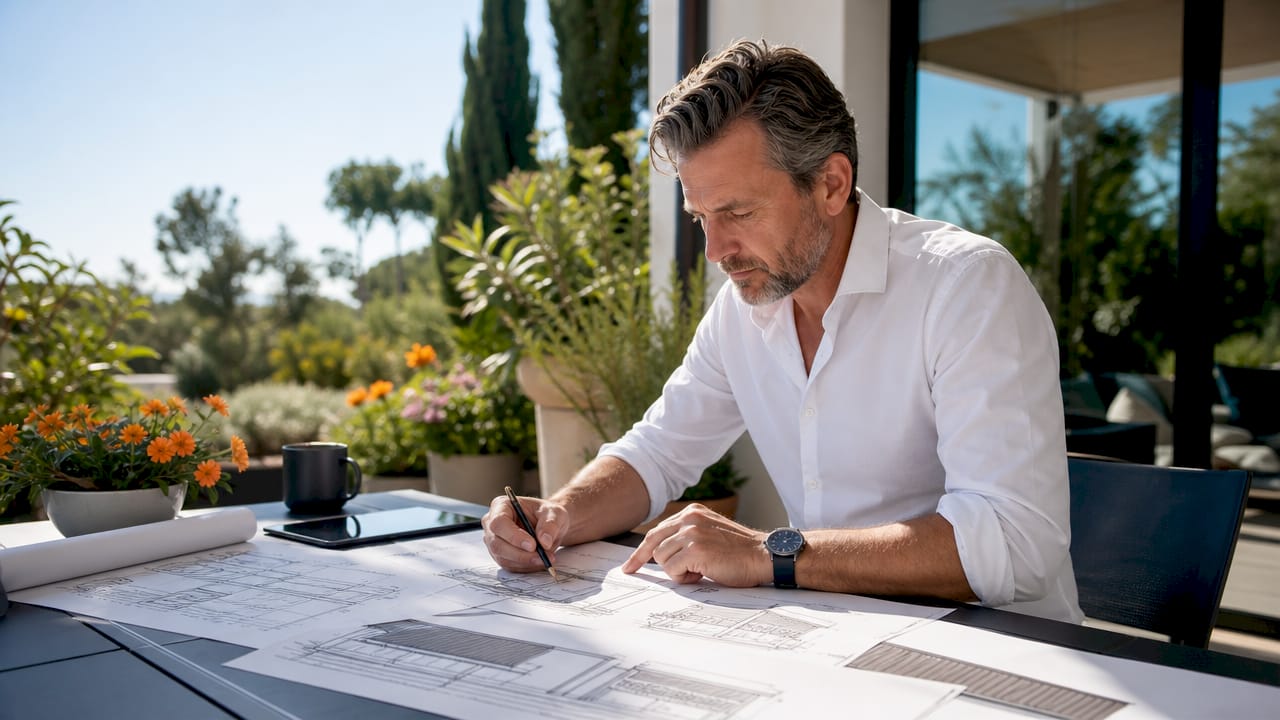
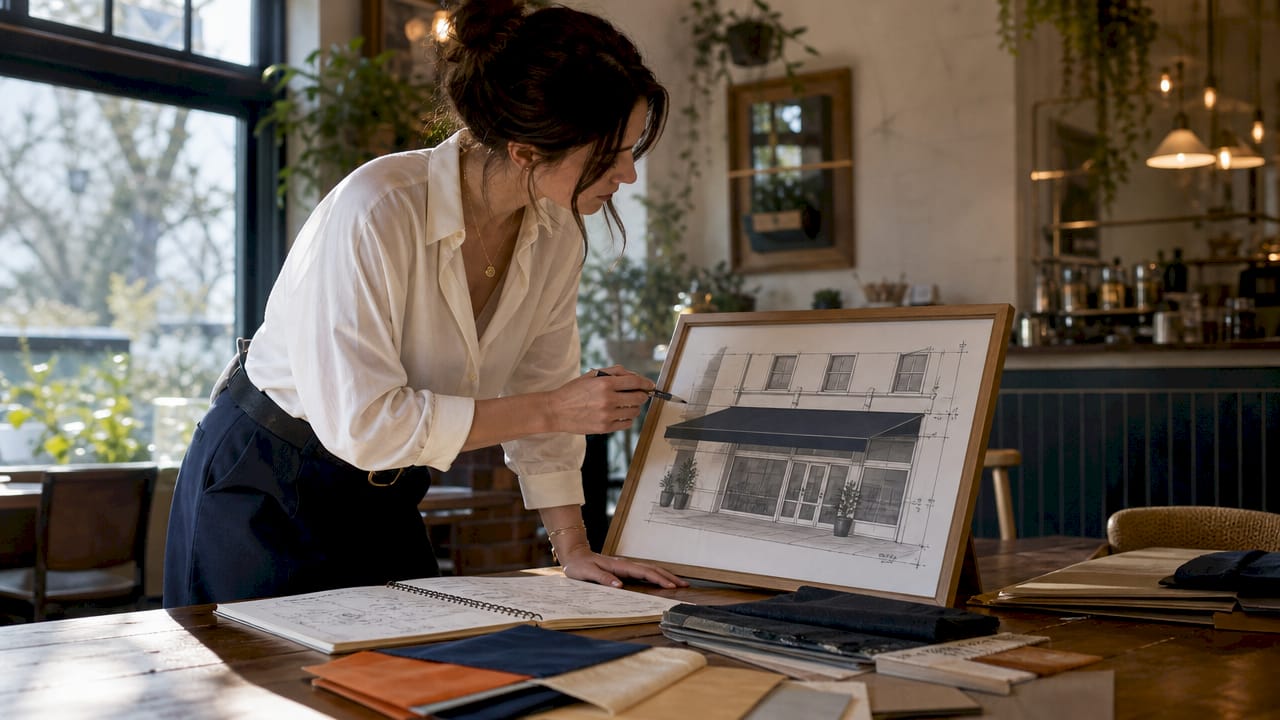
Pro Tip: Commission a scaled elevation drawing before finalising your design. Seeing the awning in context with the full building façade reveals proportion problems that a flat artwork file never will.
Branding should be integrated during the design phase, not applied as graphics after construction. That distinction separates a cohesive brand statement from an afterthought.
2. How do material choices affect branded awnings?
Material selection is the single biggest factor in how long your branded awning looks professional. Cheap fabric fades, sags, and distorts printed graphics within a season. Premium materials hold colour, resist weather, and protect the customers beneath them.
Quality awning fabrics can block up to 98% of UV rays and keep outdoor areas up to 20°F cooler. That cooling effect matters enormously for hospitality businesses where outdoor seating comfort drives revenue.
Key material considerations include:
UV-blocking acrylic fabrics. Solution-dyed acrylics resist fading far better than coated polyester. The colour is locked into the fibre, not printed on the surface.
Digital print compatibility. Not all fabrics accept high-resolution digital printing. Specify a fabric rated for large-format print if your design includes photographic imagery or fine detail.
Frame material. Powder-coated aluminium frames resist corrosion and can be colour-matched precisely to brand specifications. Steel frames are heavier and require more maintenance in wet climates.
Backlit materials. Translucent fabrics allow internal LED illumination to shine through evenly, creating a glowing brand panel after dark.
Brands like Weinor and Tarasola, both available through Infinityawnings, produce fabrics engineered specifically for commercial use, with long-term colour stability and structural integrity built in.
3. What lighting strategies maximise brand visibility after dark?
Lighting transforms a branded awning from a daytime asset into a 24-hour brand presence. A dark awning at night is a missed opportunity, particularly in urban high streets and hospitality districts where footfall continues well into the evening.
“Modern backlit materials create balanced illumination without distracting hotspots, keeping the brand legible and visually consistent from dusk to closing time.”
Lighting professionals advise using illuminated awnings for round-the-clock visibility, with materials that diffuse light evenly to avoid harsh, uneven patches. Hot spots draw the eye to the light source rather than the brand message, which defeats the purpose entirely.
Effective lighting approaches include:
Integrated LED strips. Mounted inside the awning cassette or along the valance frame, LED strips provide consistent, low-energy illumination. Learn more about integrated LED awning options and how they extend brand presence after dark.
Backlit fabric panels. Translucent fabric with internal lighting creates a lightbox effect, making the entire awning face glow uniformly.
Downlighting for outdoor areas. LEDs directed downward illuminate seating areas and entrance paths, reinforcing the brand environment rather than just the awning itself.
Colour temperature matters too. Warm white (around 3,000K) suits hospitality and retail brands with warm palettes. Cool white (5,000K and above) suits clinical, technical, or contemporary brands.
4. How can businesses standardise awning design across multiple sites?
Brand consistency across multiple locations is one of the hardest problems in commercial property management. Each site has different dimensions, planning constraints, and building styles. Yet customers expect the same visual experience at every branch.
Standardising frame shape, edge detailing, and colour matching is the most reliable method for achieving consistent branding across multiple premises while managing local building codes. The approach treats the awning’s structural language as a brand asset, not just its printed graphics.
Design element | Standardisation approach |
Frame shape | Specify one cassette profile across all sites; adapt width only |
Colour | Use RAL or Pantone references for powder-coat and fabric matching |
Edge detailing | Fix valance depth and profile; adjust projection per site |
Typography | Lock font, size ratio, and placement zone in a brand specification document |
Lighting | Specify LED colour temperature and lumen output as a brand standard |
Planning regulations vary across local authorities, but the structural and colour standards above can almost always be preserved even when projection depth or mounting height must change. Work with a supplier who understands both brand requirements and local planning frameworks.
5. What installation steps protect your brand investment?
A perfectly designed awning can still look poor if the installation is careless. Uneven mounting surfaces cause visible distortions in wide awnings, and those distortions undermine the brand impression immediately.
Critical installation steps include:
Survey the wall before ordering. Check for plumb, level, and structural integrity. Brick and render can hide voids that will not support fixing loads.
Confirm projection and tilt. Tilt angle affects both shade coverage and the viewing angle of any branding on the underside or valance.
Coordinate print and fabrication timelines. Fabric printing and frame fabrication should complete simultaneously so neither waits in storage, which risks damage.
Use fixings rated for the awning’s wind load. Undersized fixings are the most common cause of awning failure in exposed commercial locations.
Pro Tip: Ask your installer to provide a fixing specification in writing before work begins. A reputable supplier will always confirm wall construction type, fixing centres, and load ratings as standard practice.
Infinityawnings carries out full site surveys before every commercial installation, which removes the guesswork from the process entirely.
6. How do retractable awnings add flexibility to outdoor branding?
Retractable awnings give businesses control that fixed canopies cannot. On bright days, the awning extends to shade customers and display the brand. On days when weather or aesthetics call for an open façade, it retracts cleanly into its cassette.
Retractable awnings increase the usability of exterior spaces significantly, which matters for restaurants, bars, and hotels where outdoor seating directly affects revenue. The branding remains visible whenever the awning is deployed, which is precisely when customers are present and engaged.
Electric operation, available across Weinor and Llaza ranges supplied by Infinityawnings, allows awnings to be extended or retracted with a single button press or via a wind sensor. That reliability means the awning is always in the right position without staff intervention.
7. What is the return on investment for branded commercial awnings?
Branded awnings are not just a marketing cost. They are a property and business asset with measurable returns. Quality awnings recover 50–60% of installation costs through increased property value and improved usability of outdoor spaces. For commercial properties, that figure compounds when increased outdoor seating capacity or footfall is factored in.
The impact on outdoor aesthetics and property appeal is well documented across residential and commercial sectors alike. A well-specified branded awning signals investment, quality, and permanence to passing customers in a way that temporary signage never achieves.
The financial case is strongest when the awning is specified correctly from the outset. Cheap materials that fade or distort within two years eliminate the return entirely and require replacement spend on top.
Key takeaways
Outdoor branding through awning design delivers the strongest results when brand identity, material quality, lighting, and installation precision are treated as a single integrated brief from the start.
Point | Details |
Integrate branding early | Design brand elements into the awning’s structure, not as graphics added afterwards. |
Prioritise material quality | Solution-dyed acrylic fabrics and powder-coated aluminium frames protect brand appearance long term. |
Place branding on the valance | The front edge delivers the best street-level visibility for pedestrians. |
Use lighting for 24-hour presence | Backlit fabrics and integrated LEDs keep the brand visible after dark without hot spots. |
Standardise across sites | Fix frame profile, RAL colour codes, and typography ratios as brand standards before specifying each site. |
Why most businesses get awning branding wrong
Andrew here. After seeing hundreds of commercial awning installations across the north of England, the most common mistake I encounter is treating the awning as the last decision, not the first. A business owner finalises their shopfront fit-out, then asks for an awning to be added on. By that point, the colour palette is fixed, the signage is up, and the awning has to work around everything else rather than with it.
The businesses that get it right bring the awning into the conversation at the architectural stage. They specify fabric colour alongside interior finishes. They decide on frame profile when they choose window frames. The result looks effortless because it was planned that way.
Lighting is the second area where I see consistent underinvestment. A business that trades until 10pm in winter is dark for half its trading hours. An illuminated awning during those hours is not a luxury. It is the primary brand signal on the street.
My honest advice: treat your awning as you would treat your shopfront glazing. Specify it properly, invest in quality, and it will work for you for fifteen years. Cut corners, and you will be replacing it in three.
— Andrew
How Infinityawnings supports your outdoor branding goals
Infinityawnings works with businesses across Yorkshire, Derbyshire, Nottinghamshire, and Lincolnshire to design, supply, and install branded awnings that function as genuine architectural assets.
Every commercial project begins with a full site survey and a design consultation focused on brand requirements, not just shade coverage. The product range includes awnings from Weinor, Llaza, Selt, Tarasola, and Morvelle, covering everything from retractable fabric awnings with integrated LED lighting to pergolas and canopy structures that create permanent branded outdoor environments. Request a free quote and see how a properly specified awning transforms your exterior from functional to unmistakable.
FAQ
What is outdoor branding through awning design?
Outdoor branding through awning design is the practice of using custom-designed awnings as architectural brand assets, integrating colours, logos, and lighting into the structure rather than applying graphics as an afterthought.
Where should a logo be placed on a commercial awning?
The valance or front edge of the awning provides the best street-level visibility for pedestrians and delivers stronger brand exposure than the main cover area.
How long do branded commercial awnings last?
Lifespan depends on material quality and maintenance, but solution-dyed acrylic fabrics on powder-coated aluminium frames typically perform well for ten to fifteen years in commercial settings.
Can awning branding be standardised across multiple locations?
Yes. Fixing frame profile, RAL colour codes, valance depth, and typography ratios as brand standards allows consistent visual identity across sites even where projection or mounting height must vary.
Do illuminated awnings require specialist installation?
Integrated LED awnings require electrical connection and should be installed by a supplier experienced in both awning fabrication and lighting integration to avoid uneven illumination or compliance issues.
Recommended
Comments