
2m Clearway, No Drilled Fixings: UK Pavement Canopies Compliant


A removable canopy or umbrella can sit under a standard pavement licence; a fixed or structural canopy almost always cannot and needs planning permission or Highways Act consent instead. Every licence carries two national conditions, no obstruction and no smoking in the licensed seating, and your council can add its own on top. Before you order anything, check your local authority’s planning and highways pages or work through the application steps below.
TL;DR:
Canopies that are genuinely designed to be removable can be covered under a pavement licence, but fixed structures like fixed frames or bolted canopies require separate planning permission or highways consent.
A canopy with overhangs, guttering, or fixed fixing points that can’t be easily removed by staff will typically be classified as a fixed structure and fall outside pavement license rules.
Councils usually require canopies to meet technical standards such as minimum height clearance, wind resistance, and non-drillable anchoring systems to ensure safety and removability.
Proper application involves detailed plans, proof of insurance, and prior consultation with planning and highways departments to avoid delays or enforcement notices.
Ongoing compliance demands strict adherence to clearance, obstruction limits, and proper storage routines, with regular checks recommended to prevent disputes or revocation.
Table of Contents
When a canopy or awning is a planning or highways matter, not a pavement licence
Typical technical rules for canopies and coverings under a pavement licence
How to apply for a pavement licence: preparation, notice, fees and timelines
Conditions, enforcement and what happens if something goes wrong
Practical compliance checklist for choosing and operating a canopy
Industry perspective: how an experienced installer supports compliance
What is a pavement licence and who can apply
A pavement licence is permission from your local council to place removable furniture on the public highway next to your premises, most often the footway directly outside a café, bar, restaurant or shop. The regime started under the Business and Planning Act 2020 as a temporary Covid-era measure and was made permanent by the Levelling Up and Regeneration Act 2023, so it’s now a standing part of how hospitality businesses trade outdoors.
Eligibility is fairly broad. Any business selling food or drink for consumption on the premises, including takeaways with a small seating offer, can apply if the relevant stretch of highway sits directly outside or adjacent to the building. The highway itself must be one the council controls and is willing to licence; some roads are excluded on traffic or safety grounds.
The word doing all the legal work here is “removable.” That covers:
Tables, chairs and freestanding umbrellas or parasols
Planters, barriers and menu boards used to define the seating area
Pop-up gazebos or canopies that staff can fold, lift and store at close of business without tools
What a pavement licence does not authorise is any structure fixed to the building or the ground. Drilled anchors, permanent frames, guttering, or anything bolted into the pavement surface fall outside the scope entirely, no matter how temporary the operator considers it. If it needs a spanner to take down, it’s not “removable furniture” in the eyes of most councils, and treating it as such is one of the fastest routes to an enforcement notice.
When a canopy or awning is a planning or highways matter, not a pavement licence
This is where operators most often trip up, and it’s worth being blunt about it: a pavement licence covers what you can carry away at the end of service, not what stays bolted to your shopfront overnight. Councils across the country draw this line the same way. Local guidance from York makes clear that anything attached to a building, including canopies, awnings or fixed frames, usually needs planning permission or a separate highways consent rather than a pavement licence.
Several features tend to push an installation across that line:
Any fixing directly into a wall, fascia or shopfront
Roof structures with guttering or drainage that discharges onto the pavement
Overhangs that extend beyond the property boundary into the highway
Permanent posts or footings set into the ground rather than weighted or clipped in place
Anything that a single member of staff cannot physically remove and store within a reasonable time
If your premises sit within a conservation area or the building is listed, the bar for consent is higher again, and even a modest retractable awning can trigger a planning application where an identical one on an unlisted building would sail through. It’s worth checking whether your veranda or canopy needs planning permission before you commit to a design, because retrofitting a compliant structure after refusal costs far more than getting the enquiry right at the start.
The practical answer is to ask before you order. A short pre-application conversation with your council’s planning team, and a parallel enquiry to the highways department if any part of the structure will touch or overhang the pavement, can save weeks of delay and avoid the far more expensive scenario of installing first and receiving an enforcement notice second.
Pro Tip: Ask your installer to specify whether a canopy is genuinely removable by design, meaning no tools, no drilled fixings, and a realistic storage routine, before you apply for anything. A supplier who understands the distinction between pavement licence furniture and structural canopies will save you a wasted planning application.
Typical technical rules for canopies and coverings under a pavement licence
Even where a canopy qualifies as removable furniture, councils attach detailed technical conditions to how it must look and behave on the highway. Birmingham’s pavement licensing policy is a useful benchmark because it spells out requirements that most other authorities mirror in some form.
Expect conditions covering:
Clearance and height: a minimum clear height under any canopy, commonly around 2 metres, so pedestrians and anyone using a mobility aid can pass beneath it without stooping.
No overhang beyond the licensed area: the canopy must sit entirely within your red-line boundary and must not obstruct sightlines for other pedestrians or road users.
Anchoring without drilling into the highway: councils generally require weighted bases, clip systems or ballast rather than fixings driven into the pavement surface, which keeps the structure genuinely removable and avoids damaging council-owned surfaces.
Windproofing: a canopy that can’t withstand normal weather becomes a hazard rather than an amenity, so councils expect a design rated for realistic wind loads, not a flimsy pop-up that collapses in a stiff breeze.
Fire-rated or non-combustible fabric: particularly important where heaters are used nearby.
Ventilation for partially enclosed coverings: anything with side panels or a roof that traps air needs enough airflow to avoid becoming a de facto enclosed structure, which would raise separate building-control and fire-safety questions.
Heating is its own conversation. Councils increasingly steer operators towards electric heaters and away from gas. Birmingham’s policy, in line with wider industry advice, warns against LPG heaters positioned under combustible fabric canopies, and it’s easy to see why: a fabric roof, a naked flame heater and a windy evening are not a combination any insurer wants to underwrite. If you’re specifying heating for an outdoor seating area, commercial shading guidance for UK businesses is worth reading alongside your council’s own policy, since fabric choice and heater compatibility are decided together, not separately.
Keep heaters, whatever the fuel, at a sensible distance from any fabric edge, and never position them where a gust could push flame or radiant heat directly onto the canopy material.
Accessibility, pedestrian clearances and barrier design
Councils build their pavement licence conditions around one non-negotiable principle: the footway has to stay usable for everyone, not just for diners. Guidance referencing the Department for Transport’s Inclusive Mobility advice, echoed in Manchester’s pavement licence guidelines, sets out the numbers most authorities work to.

The preferred clear width past any seating, barrier or canopy is generally around two metres. Where the pavement is narrow or has obstructions like lamp posts and bins, councils may accept narrower clearances down to around one and a half metres as a minimum, treating tighter spaces as exceptions based on local circumstances. The reasoning is straightforward: two wheelchair users, or a wheelchair user and someone with a pushchair, need that width to pass each other comfortably without one party stepping into the road.
Barriers matter almost as much as width. Councils typically expect:
High colour contrast on barrier edges so partially sighted pedestrians can identify the boundary
A tap rail or detectable lower edge that a long cane will pick up
No advertising boards fixed to or standing within the barrier line, since these are usually excluded from pavement licence furniture altogether and create a trip hazard
Where several premises on the same street each hold a licence, councils also weigh the cumulative effect on the footway. A width that looks generous outside one café can become genuinely unsafe once five neighbouring businesses have each claimed their own strip, which is why some authorities cap the total proportion of pavement any one licence can occupy on busier streets.
How to apply for a pavement licence: preparation, notice, fees and timelines
Getting the paperwork right the first time avoids the most common cause of delay, which is a council bouncing an incomplete application back to you and restarting the clock.
Prepare your plan. You’ll need a scale drawing with the proposed licensed area marked in red, precise measurements of the footway width before and after your furniture is in place, a list of every item you intend to place outside (tables, chairs, canopies, barriers), and photographs of the site as it currently stands. Torbay’s pavement licence guidance is a good example of the level of detail councils expect, right down to marking where smoke-free zones will sit within the layout.
Gather your insurance evidence. Most councils require proof of public liability insurance, often with a minimum indemnity level specified in their policies, before they’ll register the application.
Submit and pay the fee. National guidance caps the fee at a modest level for new applications, with a lower cap for renewals, though the exact figure and any local surcharges vary by council, so check your authority’s current fee schedule directly.
Display the public notice. You must put up a notice on your premises, visible to passers-by, for the full 14-day consultation period. Photographing the notice in place, dated, is sensible proof if a dispute ever arises over whether consultation happened properly.
Wait out the determination period. The council has a set number of working days after the notice period closes to decide. If it fails to determine the application within that window, the licence is treated as deemed granted under the statutory rule, though this is a fallback, not a strategy, since deemed-granted licences carry the same conditions and can still be revoked if something’s wrong.
Respond to any objections. Neighbours, residents’ associations or other businesses can object during consultation. Councils weigh these against the no-obstruction condition and increasingly against security considerations too; ProtectUK guidance notes that authorities may consult police and counter-terrorism advisers on hostile-vehicle risk and crowding, particularly on busy high streets, so be ready to explain what mitigation measures your layout includes.
A licence, once granted, typically runs for up to two years, though many councils issue shorter terms and require renewal with fresh evidence of insurance and an updated plan.
Pro Tip: Keep a dated photo record of your notice display and your seating layout from day one. If a licence is ever challenged or a neighbour complains, being able to show exactly what was consulted on and exactly what you installed is the fastest way to resolve it without enforcement action.
Conditions, enforcement and what happens if something goes wrong
Two conditions apply to every pavement licence in England, regardless of council: no obstruction of the highway beyond what’s specified in the licence, and no smoking within the licensed seating area. In practice, “no obstruction” means keeping to your agreed footprint, respecting the clear pedestrian width, and not letting furniture drift outside the red line during service, especially on a busy Friday night when it’s tempting to squeeze in one more table.
Councils layer their own conditions on top. Commonly seen additions include:
Restricted operating hours for outdoor seating, often earlier closing than the pavement licence’s own end date
A requirement to store all furniture indoors overnight
Minimum public liability insurance, commonly £5 million, as referenced in policies like South Ribble’s pavement café licensing policy
A requirement to display the licence and an approved layout plan somewhere visible on the premises
Enforcement is not idle wording in a policy document. Under the Business and Planning Act 2020, local authorities can amend, suspend or revoke a licence where conditions are breached, and they can remove furniture themselves and recover the cost from the licence holder. That’s a materially worse outcome than simply losing the licence: you pay for the removal and lose your outdoor trading capacity in one move.
If a council raises a concern, the fastest route is usually to negotiate a variation rather than wait for revocation, adjusting the layout, reducing hours, or adding a barrier feature the council has asked for. Where a licence is revoked and you believe that decision was wrong, most councils publish an internal review or appeal route, worth pursuing before considering anything more formal.
Practical compliance checklist for choosing and operating a canopy
Before you order a single pole or panel, work through this list.
Before ordering:
Confirm with planning and highways whether your proposed canopy design counts as removable or fixed
Check your council’s specific pavement licence policy for local variations on clearance width and heater rules
Measure the footway accurately, including obstacles like lamp posts, bins and existing street furniture
Plan where furniture will be stored overnight or during closed hours
Specifying the product:
Choose fire-rated or non-combustible fabric
Avoid any design that requires drilling into the pavement; insist on weighted or clip-fit bases
Check the manufacturer’s wind rating against realistic conditions for your street, not just a showroom sample
Confirm heater compatibility, favouring electric options over LPG under fabric
Running it day to day:
Store removable items every night without exception
Brief staff on the licensed boundary and the no-obstruction condition
Display your licence and layout plan on the premises as required
Keep public liability insurance current and the certificate accessible
Pro Tip: Treat your pavement licence conditions the way you’d treat a food hygiene rating: check them against reality every few weeks, not just when the licence is first granted. Councils do carry out spot checks, and a canopy that’s drifted outside its red line is one of the easiest things for an inspector to spot from across the street.
Industry perspective: how an experienced installer supports compliance
A canopy that satisfies your council on paper and one that actually survives a British winter outside a pub doorway are not always the same product. This is where a specialist supplier earns its fee rather than just its invoice. A specialist installer works through a site survey before recommending anything, which matters because the difference between a genuinely removable canopy and one that quietly becomes a fixed structure often comes down to detail a non-specialist wouldn’t think to check, like whether a base plate needs ballast or a bolt.
The businesses that benefit most from involving a specialist early are the ones sitting closest to the boundary between the two regimes: a listed pub frontage, a bespoke shape that needs engineering sign-off, or a design ambitious enough that a council planner will want reassurance before granting anything. Getting advice on fabric, wind rating and heater compatibility at the design stage, rather than after a council raises a query, avoids the costly rework that comes from redesigning a canopy that’s already been fabricated.
— Andrew
Get a compliant canopy specified and installed properly
Infinity Awnings is the practical alternative to guessing your way through a pavement licence application: rather than ordering a canopy first and hoping it fits council rules, a site survey establishes what’s genuinely removable, what’s fire-rated, and what will actually stand up to wind on your street before you spend a penny.
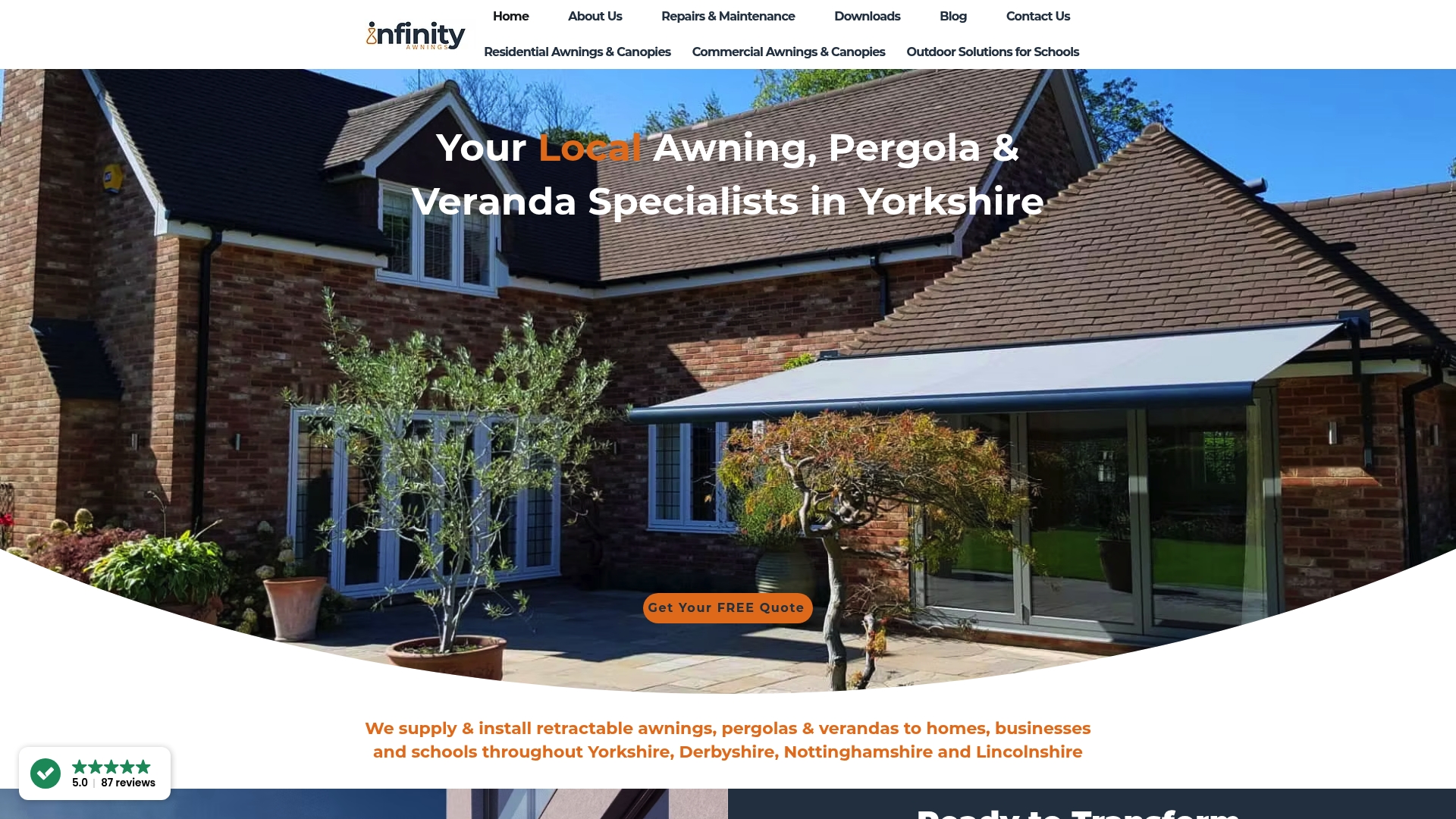
The team supplies and installs commercial awnings and canopies across Yorkshire, Derbyshire, Nottinghamshire and Lincolnshire, working from premium brands including Weinor, Llaza, Selt and Morvelle, and advises hospitality operators on which designs stay within pavement licence rules and which will need a separate planning conversation first. If your business needs outdoor shading that satisfies both your customers and your council, request a free quote and site visit to get a design specified against your actual footway measurements rather than a generic template.
Sources
Before applying, bookmark the GOV.UK pavement licences guidance, which covers conditions, fees and the deemed-granted rule, alongside the Business and Planning Act 2020 provisions on enforcement. Then find your own council’s published pavement licence policy and its planning and highways contact pages, since local variations on width, fees and technical requirements can differ meaningfully from the national baseline.
FAQ
Do I need a pavement licence for outdoor seating?
Yes, if you’re placing tables, chairs, umbrellas or removable canopies on the highway outside food or drink premises in England. Fixed structures fall outside pavement licences entirely and need planning or highways consent instead.
How much is a pavement licence?
Fees are capped nationally for new applications, with a lower cap for renewals, though your council may add local charges on top; check your authority’s current published fee before applying, since GOV.UK guidance sets the caps but doesn’t fix a single UK-wide price.
Can I put a board on the pavement?
Advertising boards are generally excluded from pavement licence furniture and are treated as a trip hazard and sightline obstruction by most councils. Stick to the furniture types your local policy explicitly permits, typically tables, chairs, barriers and removable canopies.
How long does it take to get a pavement licence?
Applications go through a 14-day public consultation followed by a council determination period; if the deadline passes without a decision, the licence is treated as deemed granted under the statutory rule. A complete, well-prepared application with the right plans and insurance evidence moves through fastest.
Does a canopy count as removable furniture?
Only if staff can take it down and store it without tools, typically overnight. Anything drilled, bolted or fixed to a building or the pavement is treated as a structural installation requiring separate planning or highways permission, not a pavement licence.
Recommended
Comments