
Awning Pooling in UK Venues: Use BS EN 13561 Checks Before Retrofit


If your awning is holding water in a sagging pocket, retract it now if that’s safe to do, and photograph the problem before you touch anything else. Standing water is not always an emergency, but a sagging front edge, moving brackets, or water draining towards a doorway is: stop using the awning and get a professional survey booked. A qualified installer will check the wind-resistance class, the installation, and the drainage route before recommending a repair.
TL;DR:
Most pooling results from insufficient pitch, stretched fabric, blocked gutters, or structural sag, all of which reduce water runoff efficiency.
Visible sagging, moved fixings, or water discharging onto entrances signal a safety risk requiring immediate professional inspection.
Temporarily, owners should retract the awning if safe, improve pitch if adjustable, and photograph pooling issues for future reference.
Retrofitting with proper gutters, pitched frames, and wall flashing can prevent pooling but must be done in accordance with manufacturer guidance to avoid new problems.
Routine inspections, including weekly checks for commercial properties and quarterly full service, help prevent pooling and support warranty claims.
Table of Contents
What causes water pooling on retractable and fitted awnings?
Most pooling comes down to one of four things, and they often overlap. The first, and most common, is insufficient pitch. Manufacturer manuals for folding-arm awnings typically call for a minimum slope of around a low to moderate angle commonly specified by manufacturers, and below that, water simply cannot run off fast enough before the next shower arrives, as the Hornbach semi-cassette awning manual makes clear when it warns these products are not designed to act as roofs in sustained rain.
Fabric tension matters too. A cover that has stretched at the seams, or was never tensioned correctly on the roller, creates a natural dip exactly where water collects. Blocked or missing gutters on pergolas and verandas are another frequent culprit, particularly where leaves and moss build up unnoticed over a season.
Low pitch angle, often below the 14 to 15 degree minimum manufacturers specify
Stretched fabric, loose seams or incorrect roller tension
Blocked, undersized or entirely absent gutters and discharge points
Structural sag from fixings that have loosened or shifted over time
Structural sag deserves its own mention. BS EN 13561 sets declared performance and installation instructions for external awnings, and wind-resistance class only holds true when the fixings, substrate and mounting match the tested configuration. Deviate from that, and both rain and wind performance suffer.
Risks and when to call a professional
Pooling on its own is rarely dangerous, but certain signs mean you should stop using the awning and arrange a survey without delay.
Visible sagging at the front bar — this usually points to fabric or arm failure under load, not just a cosmetic dip.
Brackets or fixings that have moved since installation, which suggests the mounting is no longer taking load as designed.
A distorted or misaligned cassette, often the first visible sign that internal components have shifted.
Water discharging onto customers, staff, or an entrance rather than draining away cleanly, which is both a slip hazard and, for commercial sites, a liability issue.
Councils are explicit about this for hospitality venues: Basildon Borough Council’s outdoor hospitality guidance recommends frequent checks of outdoor structures and keeping written records, precisely because water pooling and drainage failures are treated as safety considerations, not just maintenance niggles.
Immediate, safe short-term actions owners can take
While you wait for a professional visit, there’s a short list of things that genuinely help and a shorter list of things that make matters worse.
Retract the awning if wind conditions and the fixings allow it safely.
Increase the pitch slightly if your model has an adjustable angle designed for that purpose.
Clear debris from gutters only if you can reach them without climbing onto the structure itself.
Photograph the pooling, note the date, time and weather conditions, and keep this for your insurer or installer.
Do not cut or puncture the fabric to drain water, do not climb around fixings to inspect brackets yourself, and never leave a heavy pool sitting on a low-pitched awning overnight, since sustained weight accelerates fabric stretch and seam failure.
Pro Tip: Keep a simple phone folder of dated photos every time you notice pooling. When you eventually call a supplier, that timeline often speeds up diagnosis and can support a warranty or insurance claim.
Durable prevention and retrofit solutions
Adjusting pitch or clearing a gutter buys time, but it doesn’t fix a structure that was never designed to shed heavy or sustained rain. For covered seating, terraces used year-round, or any site where guests sit underneath the canopy in wet weather, a purpose-built pergola or veranda with engineered drainage is usually the better long-term specification than asking a folding-arm awning to behave like a roof.

Retrofitting an existing frame can also solve the problem without a full replacement. Adding a permanent pitch or fitting proper guttering to a pergola often removes the pooling entirely, though Fylde Council’s design note on canopies rightly stresses that any retrofit gutter needs integrating with proper wall flashing, or you simply trade a pooling problem for a damp one.
Common retrofit and design fixes include:
Pitched aluminium frames with a built-in fall towards a downpipe
Integrated gutters and downpipes routed to a proper discharge point, not just off the edge onto a path
Cassette upgrades where the existing roller housing is the source of sag
Z-flashing at the wall junction to stop water tracking back into brickwork
316 stainless steel fixings on coastal or exposed sites, where standard fittings corrode faster and loosen sooner
If you’re commissioning a retrofit or a replacement, ask your installer to confirm the drainage route, the declared wind-resistance class under Commission Delegated Regulation (EU) 2019/1188, the mounting substrate, and the manufacturer’s operating instructions before you sign anything.
Routine maintenance and inspection schedule
A schedule you actually follow prevents most pooling before it starts, and keeps you covered if a warranty or insurance question ever comes up.
Weekly (commercial sites): a quick visual check for sagging, standing water, or debris in gutters.
Quarterly: a fuller service inspection covering fixings, fabric tension, and drainage flow.
Annually: a full clean of fabric and frame, lubrication of moving parts, and a check of any wind-sensor calibration.
Manufacturer instructions and calibrated wind sensors matter for more than convenience. Supplier maintenance guides commonly recommend lubricating moving parts every four to six months and avoiding operation in snow or high wind, according to Awnings Online’s operation and maintenance guide. For commercial premises, a dated log of these checks supports your duty-of-care position and can matter if you ever need to make an insurance claim. Our step-by-step maintenance guide gives homeowners a simple version of this same routine, and our essential maintenance checklist works well as a copyable log.
How professionals diagnose, repair and guarantee a lasting fix
A proper survey starts with the substrate, not the fabric. A competent installer checks what the awning is actually fixed to, inspects anchor type and condition, and confirms the mounting matches the manufacturer’s tested configuration, since deviating from that arrangement quietly reduces the wind and rain performance the product was rated for.
From there, the common fixes are predictable:
Re-tensioning fabric that has stretched or lost tracking
Reinforcing or replacing brackets that have loosened
Fitting gutters or downpipes where none existed
Replacing a distorted cassette, or specifying a different product entirely where the original was never suited to the site
A written proposal should state the wind-resistance class, the manufacturer’s operating instructions, and a recommended inspection cadence, not just a price. Companies operating in the awning supply and installation industry often serve a range of substrates and exposure conditions that make pooling faults inconsistent from one site to the next. Our guide on fixings failing on fascia-mounted awnings covers the checks worth asking about directly.
Why specification and installer choice matter
Two mistakes cause most of the pooling I see: pitch set at the minimum on paper rather than the minimum in practice once fabric has settled, and gutters treated as an afterthought rather than part of the original drawing. Insist on a written drainage route before installation, not after the first heavy rain. Early professional input costs less than retrofitting a fix later.
— Andrew
How Infinity Awnings can help with a survey, repair or retrofit
If you’re dealing with recurring pooling, a proper survey settles the question of whether you need a repair or a different product altogether. Some suppliers and installers spend many years providing retractable awnings, pergolas, and verandas across various counties, working with reputable brands; this range matters when the fix is a bespoke pergola with integrated drainage rather than a like-for-like awning replacement.
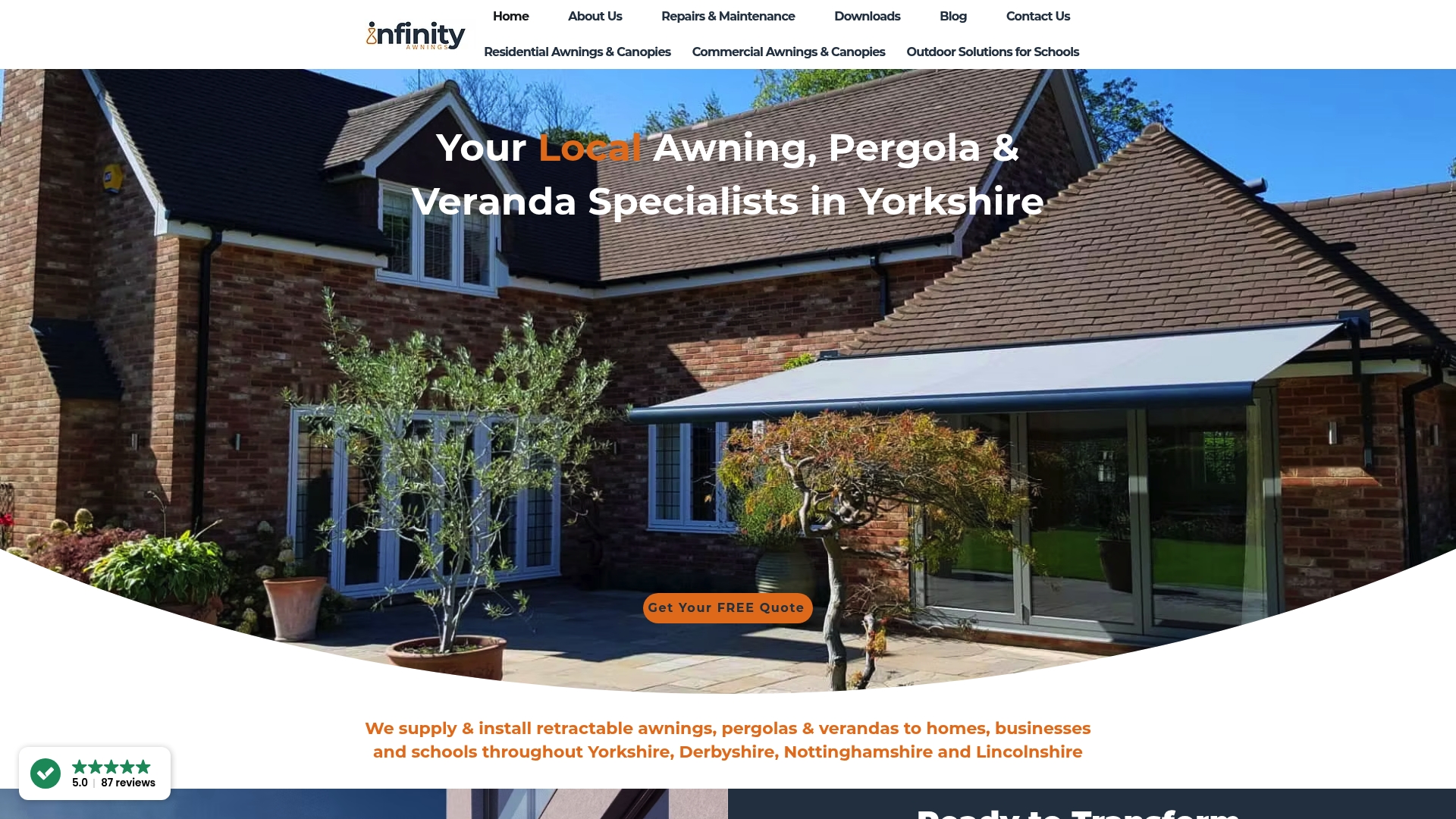
A free survey covers the fixings, substrate, drainage route and wind exposure at your property, and you’ll get a written quote setting out the recommended product, wind class and maintenance plan, not just a price. Whether you need a retractable awning re-tensioned or a full pergola with proper guttering, get in touch for a free survey and quote and stop the pooling before it does more damage to the fabric, frame, or the wall behind it.
Sources
FAQ
Is water pooling on an awning always a safety issue?
Not always. A shallow puddle on a slightly under-pitched awning is usually a maintenance issue, but sagging, moving brackets, or water discharging onto entrances are safety signs that need a professional visit.
Can I fix pooling myself by adjusting the pitch?
Sometimes, if your awning has a manufacturer-approved adjustable pitch and the arms and fixings are undamaged. If adjusting the pitch doesn’t resolve it, the fault likely lies in fabric tension, fixings, or drainage, which needs a professional check.
How often should awnings be inspected to prevent pooling?
Commercial sites should run a quick weekly visual check, a fuller quarterly service inspection, and an annual clean and lubrication, in line with supplier maintenance guidance. Domestic awnings can generally follow the quarterly and annual steps alone.
What’s the difference between a retractable awning fault and a design fault?
A fault is usually a fixable issue, like loose fixings or stretched fabric. A design fault means the product’s pitch, drainage or wind class was never suited to the site, and often means moving to an engineered pergola or veranda instead.
Does Infinity Awnings offer repairs as well as new installations?
Yes. Some professional awning providers offer survey, repair, and retrofit services alongside new supply and installation. Current pricing for specific jobs is typically available following a site survey.
Recommended
Comments