
Weather protection in design: what architects must know

TL;DR:
Weather protection in design involves implementing layered building envelope systems to prevent damage from environmental forces. Early integration of these systems ensures durability, reduces costly repairs, and enhances occupant comfort by managing moisture, air, and thermal performance effectively. Incorporating outdoor structures like awnings and pergolas with proper drainage and material specifications extends weather resilience beyond the building facade.
Weather protection in design is the intentional incorporation of materials, systems, and strategies that shield a building from damage caused by rain, wind, temperature fluctuations, and solar radiation. In the industry, this is formally known as building envelope design, and it goes far beyond simple waterproofing. A properly designed weather protection system works as a continuous layered barrier managing moisture, air pressure, thermal performance, and structural integrity simultaneously. Get it right from the start, and a building performs well for decades. Get it wrong, and you are looking at costly repairs, occupant discomfort, and premature structural failure.
What is weather protection in design?
Weather protection in design is the coordinated use of cladding, membranes, flashing, insulation, and sealants to defend a structure against environmental forces. The term “building envelope” is the recognised industry standard for this concept. It describes every element that separates the interior of a building from the exterior climate. Understanding what is weather protection in design means recognising that no single material or product does the job alone. Each layer has a specific role, and the system only performs when those layers work together without gaps or discontinuities.
The stakes are significant. Climate-related extreme weather events are projected to cause nearly 15 million deaths by 2050. That figure underlines why resilient architectural design is no longer optional. Buildings that fail under environmental stress do not just cost money to repair. They put occupants at risk.
What are the main components used in weather protection?
The building envelope is made up of several distinct layers, each targeting a different environmental threat. Understanding what each layer does helps you specify the right materials and avoid common design failures.
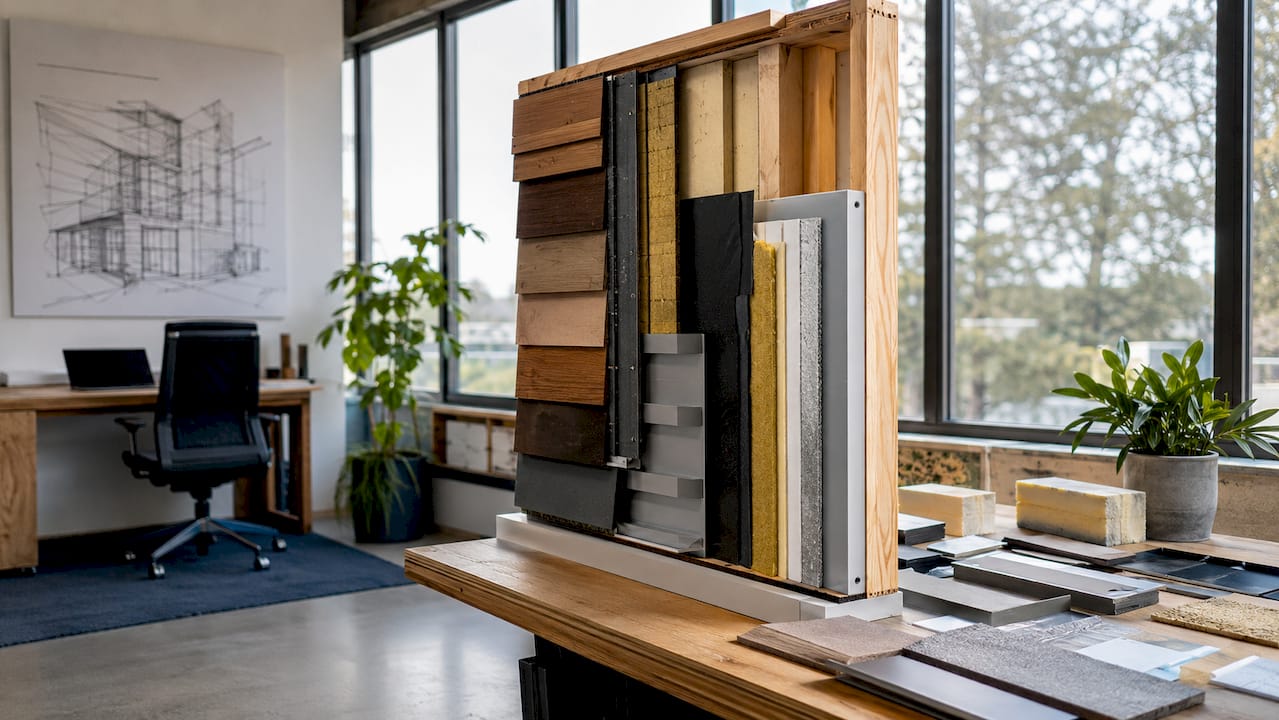
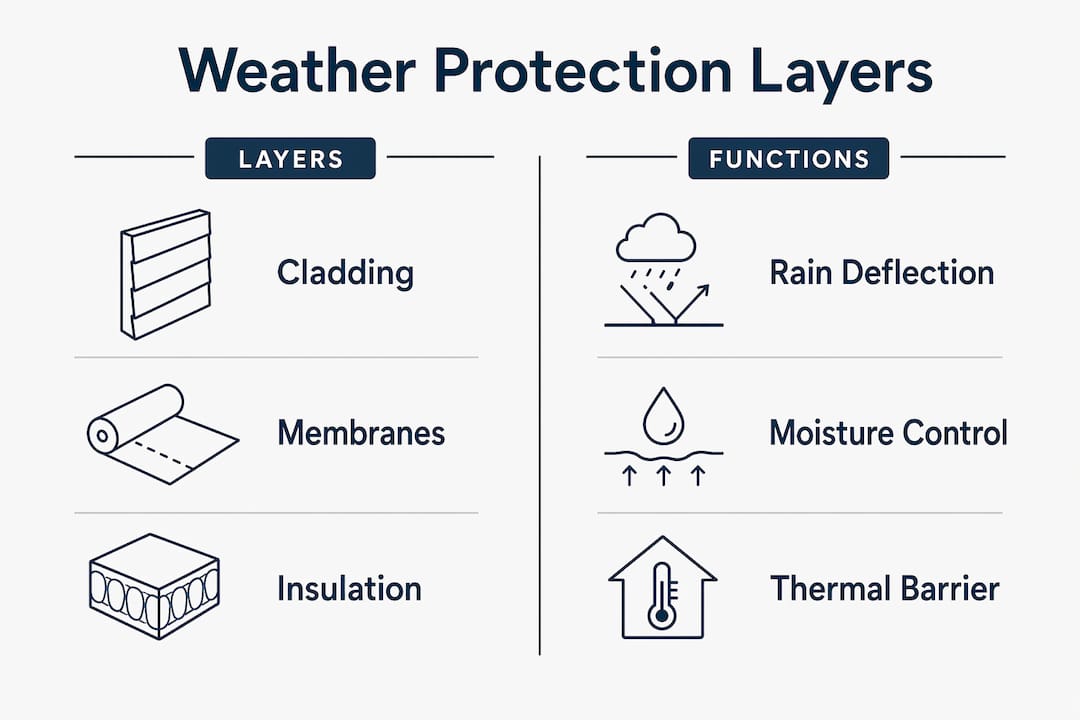
Outer cladding is the first line of contact with the weather. Materials like brick, fibre cement, metal panels, and timber cladding deflect rain and wind before they reach the structure. The choice of cladding affects UV tolerance, moisture shedding, and thermal mass. Flashing seals the transitions between cladding, roofing, and openings. Without correctly detailed flashing at windows, doors, and roof junctions, water finds a way in regardless of how good the primary cladding is.
Membranes and vapour barriers sit behind the cladding to manage moisture that penetrates the outer layer. A breather membrane allows vapour to escape from inside the wall while blocking liquid water from outside. Insulation reduces heat transfer and, when correctly positioned relative to the vapour barrier, prevents condensation forming within the wall build-up. Sealants close the remaining gaps at joints and penetrations, though they are the most maintenance-dependent element in the system.
Material | Primary Function | Key Advantage | Limitation |
Brick cladding | Rain deflection and thermal mass | Durable, low maintenance | Heavy, slow to build |
Fibre cement board | Rain screen and UV resistance | Lightweight, paintable | Requires careful joint detailing |
EPDM membrane | Waterproofing flat roofs | Flexible, long lifespan | Vulnerable to puncture |
Mineral wool insulation | Thermal and acoustic control | Fire resistant, breathable | Requires protection from moisture |
Polyurethane sealant | Joint and gap sealing | Flexible, adhesive | Degrades under prolonged UV exposure |
Pro Tip: Specify membranes and sealants from the same manufacturer where possible. Products from Sika, Tremco, or Soprema are engineered to work together, which reduces the risk of incompatibility failures at critical junctions.
How does weather protection differ from waterproofing?
Waterproofing and weather protection are not the same thing, though the terms are frequently used interchangeably on site. Understanding the distinction shapes better design decisions.
Waterproofing is a targeted intervention. It creates a physical barrier against liquid water ingress at specific locations, such as flat roofs, basements, and wet rooms. It addresses one threat: water in liquid form.
True weather protection is a system managing airflow and pressure to prevent moisture ingress, not just a layer of sealant or membrane. The differences matter in practice:
Wind-driven rain forces water horizontally into gaps that gravity-fed waterproofing never addresses. Managing seams and corners with tested pressure-equalised details is more effective than applying generic sealants.
Moisture vapour moves through walls by diffusion, not liquid flow. A waterproof layer alone can trap vapour and cause interstitial condensation, which damages insulation and structural timber from within.
Temperature swings cause materials to expand and contract. Sealants and flashings that are not specified for thermal movement will crack and fail over time.
Solar radiation degrades polymers, fades pigments, and drives moisture into micro-cracks in masonry. UV-stable materials are a weather protection requirement, not a cosmetic upgrade.
Wind load creates positive and negative pressure on facades. Cladding fixings and cavity barriers must be engineered for suction forces, not just outward pressure.
Weather resistance, then, is the ongoing management of all these forces together. Waterproofing is one component within that broader system.
Why should weather protection be integrated early in design?
Weatherproofing is often treated as a late-stage concern, addressed during technical design or even on site. This is one of the most expensive mistakes in construction. Most leaks occur at penetrations and transitions rather than through primary materials. Pipe penetrations, structural fixings, window reveals, and roof-to-wall junctions are where the system breaks down. If these details are not resolved at design stage, contractors improvise on site, and improvised weatherproofing fails.
Engaging weatherproofing specialists early in the design process prevents these failures and improves building envelope performance across the board. Early coordination means penetrations are located where they can be properly flashed, transitions between materials are detailed before they become conflicts, and the full sequence of layers is specified as a system rather than a collection of individual products.
The structural argument is equally strong. Regions experiencing extreme heat, such as areas exceeding 40°C for 100 days annually, require high-performance building envelopes that prioritise both thermal control and moisture management from the outset. Retrofitting these properties into a completed building is significantly more costly than designing them in from the start.
Pro Tip: Schedule a weather protection review at RIBA Stage 2 or equivalent. Bring in a specialist to audit penetration locations, material transitions, and cavity continuity before the technical design is locked. This single step eliminates the majority of envelope failures.
What practical strategies protect outdoor and semi-enclosed spaces?
Designing for weather protection does not stop at the building facade. Gardens, patios, terraces, and semi-enclosed commercial spaces all require deliberate weather-resistant design techniques to remain usable and structurally sound.
Ancillary structures such as awnings, canopies, and pergolas extend the protected zone beyond the building envelope. Awnings improve home weather resistance by shielding walls, windows, and outdoor seating from direct rain and solar gain. Pergolas with solid or louvred roofing systems create transitional spaces that function in rain, wind, and sun. These structures are not decorative additions. They are functional weather protection elements that extend the usable life of outdoor surfaces and reduce solar heat gain through glazed facades.
Follow these steps when integrating weather protection into outdoor space design:
Assess the site’s exposure category. Wind speed, prevailing rain direction, and solar orientation all vary by location. A terrace in Yorkshire faces different loads than one in Lincolnshire. Use Ordnance Survey data and BS EN 1991 wind load standards to establish your baseline.
Select materials rated for the exposure. Powder-coated aluminium, marine-grade stainless steel fixings, and UV-stabilised fabrics from brands like Weinor and Tarasola are specified for long-term outdoor performance, not just initial appearance.
Design drainage before anything else. Drainage management in outdoor structures is more critical than material water resistance for longevity and safety. Standing water accelerates corrosion and adds structural load. Specify minimum 1:80 falls on all horizontal surfaces and size gutters for peak rainfall events.
Detail for ice and snow loads. Lightweight structures like awnings can fail under extreme winter storms due to insufficient consideration for ice accumulation. Specify retractable systems that can be closed during heavy snowfall, and check anchor geometry against local snow load data.
Integrate the structure with the building envelope. Where a pergola or canopy connects to a wall, the junction must be flashed and sealed to the same standard as any other building envelope penetration. A poorly detailed connection point will channel water directly into the wall construction.
The role of awnings in architecture extends beyond shade. When correctly specified and installed, they reduce solar heat gain through windows, protect external wall finishes, and create comfortable outdoor environments that extend the functional season of a space.
Outdoor Structure | Primary Weather Benefit | Key Design Consideration |
Retractable awning | Solar and rain shielding | Retract in high winds; check wind rating |
Fixed pergola | Partial rain and sun cover | Drainage detailing at roof and wall junction |
Louvred pergola | Adjustable rain and sun control | Motor and control system weatherproofing |
Veranda | Full overhead protection | Structural connection to main building envelope |
Key takeaways
Effective weather protection in design is a layered building envelope system that must be specified, coordinated, and detailed from the earliest stage of a project to prevent costly failures and ensure long-term durability.
Point | Details |
Weather protection is a system | Cladding, membranes, insulation, and sealants must work together, not independently. |
Early integration prevents failures | Most leaks occur at penetrations; resolve these at design stage, not on site. |
Weather resistance exceeds waterproofing | Managing wind, vapour, thermal movement, and UV requires more than a single barrier layer. |
Outdoor structures need the same rigour | Drainage, snow load, and envelope junctions are critical for pergolas, awnings, and canopies. |
Material specification drives performance | UV-stable, thermally rated materials from proven brands outperform generic alternatives over time. |
Why layered weather protection is the only approach worth specifying
After more than 15 years working with outdoor structures across Yorkshire, Derbyshire, and beyond, the pattern I see most often is the same: weather protection is treated as a finishing detail rather than a foundational decision. A client specifies a beautiful pergola or a premium awning, the installation looks excellent on day one, and then two winters later the fixings are corroding, the fabric is sagging under pooled water, and the wall junction is letting moisture into the render. None of that is inevitable. All of it is the result of treating weather protection as an afterthought.
The misconception I push back on most is the idea that better materials solve the problem. They help, but material quality cannot compensate for poor drainage design or an undetailed wall connection. I have seen top-specification aluminium structures fail because nobody calculated the gutter capacity for a Yorkshire downpour. I have seen budget-grade awnings from Weinor outlast expensive bespoke canopies because the drainage and fixing details were correct from the start.
The climate argument is becoming harder to ignore as well. Extreme weather events are increasing in frequency across the UK. Designing outdoor spaces that only perform in average conditions is designing for a climate that no longer exists. The proactive approach is to specify for the worst credible event, not the typical one.
Sustainability and weather protection are also more connected than most designers acknowledge. A well-protected building envelope reduces heat loss, cuts energy demand, and extends the service life of every material within it. That is a sustainability outcome achieved through good detailing, not through specifying expensive green products.
— Andrew
Protect your outdoor space with pergolas from Infinityawnings
If the principles above have made you think differently about your outdoor space, the next step is choosing a structure built to deliver them. Infinityawnings designs and installs pergolas across Yorkshire, Derbyshire, Nottinghamshire, and Lincolnshire, combining premium materials with correct drainage detailing and professional envelope connections.
Every pergola in the Infinityawnings range is specified for UK weather conditions, with aluminium frames, UV-stabilised roofing options, and proper wall junction detailing as standard. Whether you are designing a residential terrace or a commercial hospitality space, the team brings the same layered approach to outdoor weather protection that this article describes. Explore the full range of garden pergola solutions and request a free quote to get started.
FAQ
What is weather protection in building design?
Weather protection in building design is the coordinated system of cladding, membranes, flashing, insulation, and sealants that shields a structure from rain, wind, temperature change, and solar radiation. The industry term for this system is the building envelope.
How does weather resistance differ from waterproofing?
Waterproofing targets liquid water ingress at specific locations. Weather resistance manages multiple forces including wind-driven rain, moisture vapour, UV radiation, and thermal movement across the entire building envelope.
Why do most building envelope leaks occur at penetrations?
Most leaks occur at penetrations and transitions rather than through primary materials because these junctions are where different materials and systems meet. Without correct flashing and sealing details resolved at design stage, water finds a path through.
What outdoor structures improve weather protection?
Awnings, pergolas, canopies, and verandas all extend weather protection beyond the building facade. Their effectiveness depends on correct drainage design, material specification, and proper connection to the main building envelope.
When should weather protection be considered in a project?
Weather protection should be integrated from the earliest design stage, ideally at RIBA Stage 2 or equivalent. Late-stage weatherproofing decisions lead to compromised details, higher costs, and increased risk of long-term failure.
Recommended
Comments