
Make UK Terraces Usable: Wind Protection, Mesh for Homes, Glass for Roofs

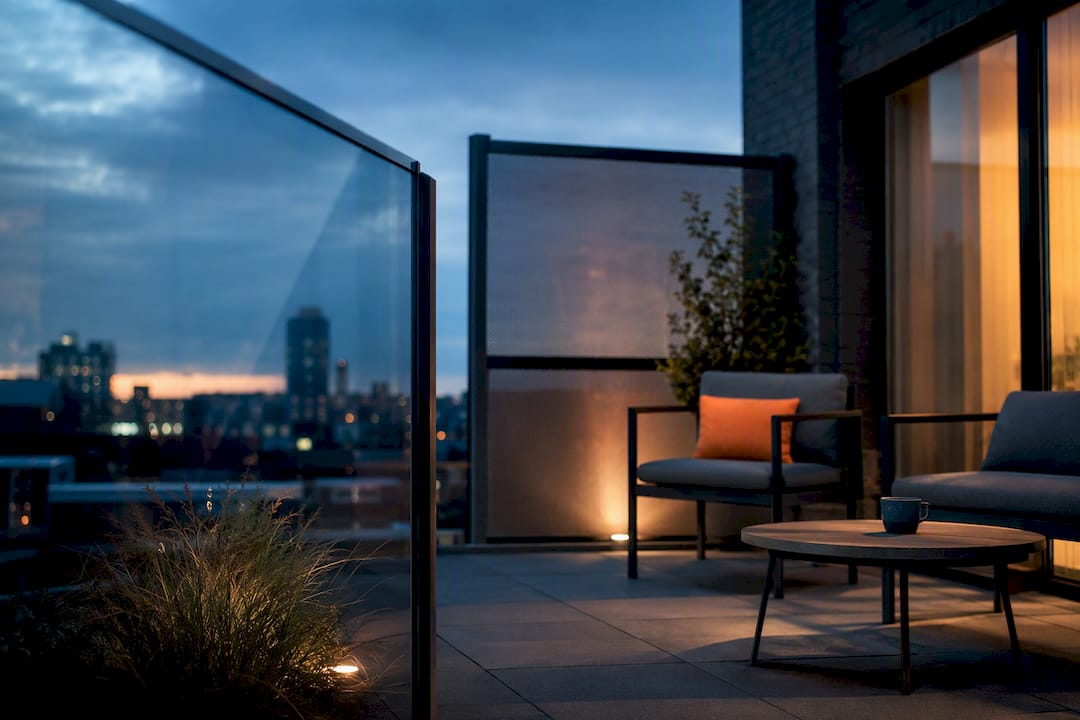
Mesh or drop-down blinds solve most domestic terrace problems because they filter wind rather than fight it, which keeps structural loading manageable and installation simple. Glass windbreaks earn their higher price on rooftops, hotel terraces and anywhere the view matters as much as the shelter. Anything fixed to a roof, a large glazed run, or a perimeter installation needs a wind-load check before anyone reaches for a drill.
TL;DR:
Mesh blinds are suitable for most domestic patios because they filter wind with minimal structural stress, while glass windbreaks are preferred for rooftop and commercial settings.
Fixing and material specifications, such as toughened or laminated glass and open-weave mesh, are critical to system longevity and should be tailored to exposure conditions.
Proper wind-load assessments and detailed installation plans are essential, especially on raised terraces or rooftops, and should be confirmed by professionals before proceeding.
Combining different solutions, like mesh along sheltered sides and glass at exposed edges, often delivers better comfort and cost-effectiveness than a uniform approach.
Costs vary widely based on system complexity, size, and site access, making personalized quotes and expert surveys vital for accurate budgeting.
Table of Contents
Which type of wind protection for terraces suits your space?
Do you need planning permission for terrace wind protection?
What does a professional wind-protection survey actually involve?
How wind protection changes the way a terrace actually feels
Making wind protection look like it belongs, not like an afterthought
How Infinity Awnings can help with wind protection for your terrace
Which type of wind protection for terraces suits your space?
The right answer depends on exposure, budget and whether you need to keep sightlines open. Here’s how the main options stack up against real-world use cases.
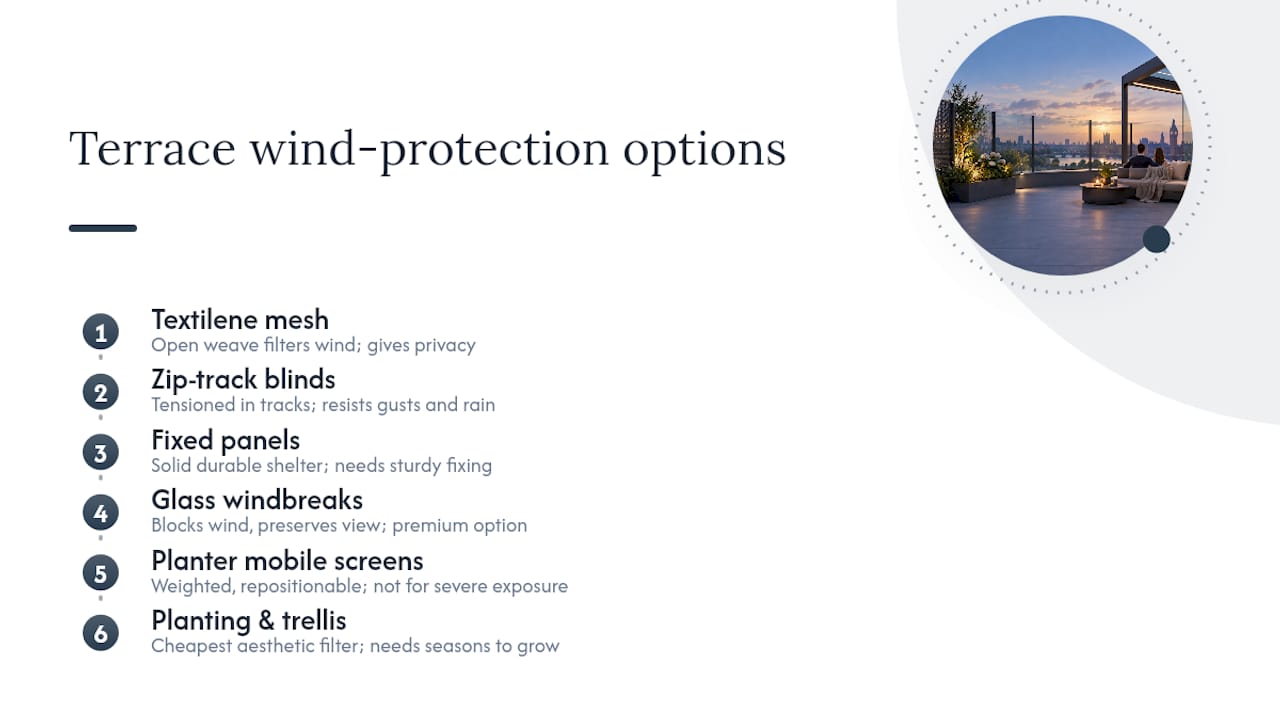
Textilene drop-down mesh blinds are the default choice for most gardens and domestic patios. The open weave lets a portion of the wind pass through instead of hitting a solid surface, which cuts the sideways force on the frame holding it up. They also give privacy from neighbours without turning a terrace into a sealed box.
Zip-track tensioned blinds step up performance on plots that catch more than the average gust. The fabric runs inside a track rather than hanging loose, so it resists flapping and holds firm against driven rain on exposed sides far better than a standard drop-down. Worth the extra cost if your terrace faces open fields, water, or a wind corridor between buildings.
Framed fixed panels and composite infills give durable, low-maintenance shelter on one side of a terrace, typically the prevailing wind direction. They don’t move, don’t need winding in each autumn, and shrug off UK weather for years. The trade-off: a solid panel takes the full force of the wind rather than filtering it, so it needs a sturdier frame and secure fixings than mesh does.
Glass windbreaks are the premium option, and for good reason: they block wind while leaving the view completely untouched. Fixed, piston-assisted or motorised glass systems are the standard specification for rooftop terraces and hospitality venues where a bar or restaurant needs customers seated outdoors in March as well as July.
Planter-based mobile screens work where you can’t or don’t want to fix anything into the ground. Weighted planters double as a windbreak and a landscaping feature, and you can reposition them as the sun and wind shift through the seasons. They won’t cope with serious exposure, but for a courtyard or a rented commercial unit, that flexibility often matters more than raw performance.
Natural planting and trellis cost the least upfront and look the best once established. A mature hedge or a trellis with climbers filters wind gently and softens hard landscaping. The catch is time: it can take two or three growing seasons before the planting does anything useful, so it rarely works as a standalone solution on its own in year one.
What materials and mechanisms actually change performance?
The difference between a windbreak that lasts fifteen years and one that fails in three usually comes down to the specification, not the concept.
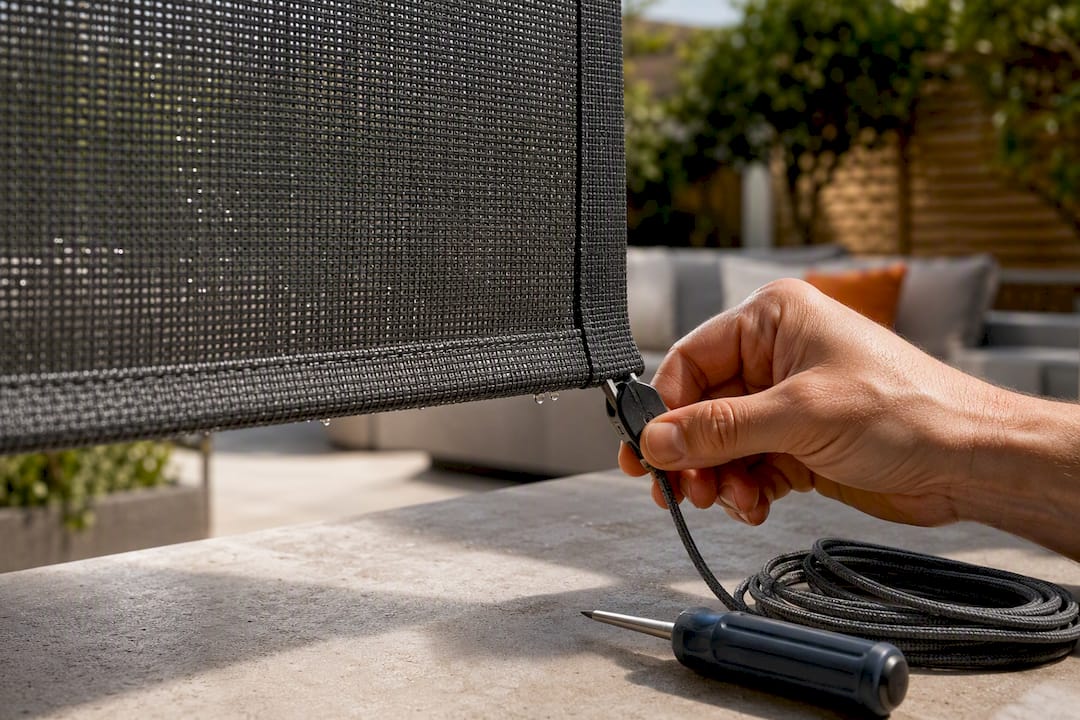
Open-weave Textilene works by letting roughly a third of airflow pass through the fabric rather than deflecting all of it. That filtering effect is what makes it durable: less force on the seams, the frame and the fixings means less wear over time, and most quality mesh blinds need only an occasional wipe-down and a check of the tension cords each season.
Glass introduces a different set of decisions. Toughened glass is the standard for most windbreak panels; laminated glass costs more but holds together if it does break, which is why some rooftop and high-traffic commercial specifications call for it. Edge support matters as much as the glass itself: a panel held only at the base behaves very differently in a gust to one supported along two edges. Height matters too. A 1.8m glass run blocks wind at seating height without turning the terrace into a wind tunnel above head height, whereas anything lower leaves gusts curling over the top.
Frame material and finish affect both looks and lifespan:
Aluminium profiles resist corrosion better than steel in coastal or exposed UK sites.
Powder-coating to RAL colours lets frames match existing joinery, rendering or brickwork.
Planter frames in timber need re-oiling; powder-coated steel or aluminium planters don’t.
Mechanism choice is a genuine trade-off, not just a budget line. Manual and piston-assisted systems suit terraces adjusted several times a day, since there’s nothing electrical to service and no motor to fail. Motorised systems suit premium hospitality settings where staff need one-touch control, but they add wiring, a control unit and an extra maintenance line to the annual check. Integrated drainage channels, heaters and lighting round out a commercial specification, and they’re worth asking about upfront rather than retrofitting later.
How do you choose the right wind-protection solution?
Work through this in order rather than jumping straight to products:
Assess exposure first. Walk the terrace at different times of day and note where the wind actually hits hardest, usually a corner or an edge rather than the whole space.
Pick your primary goal. Comfort for occasional use, an unbroken view, or year-round commercial trading each point towards a different solution.
Decide mobility versus permanence. Renters and seasonal users lean towards planters or drop-down blinds; owners with a settled layout can commit to fixed glass or panels.
Check maintenance and access before you commit. A motorised glass system on a rooftop needs occasional service access. Confirm that’s practical before it’s installed, not after.
When you’re comparing quotes, ask installers these four questions directly:
Do you carry out a wind-load assessment, or work from published wind-load data for the site?
What fixing options are you proposing, and why, given the substrate?
What maintenance schedule and warranty come with the system?
Will you provide structural drawings or sign-off for Building Control if the installation needs it?
Treat vague answers as a warning sign. No wind-load discussion, hand-waving on fixings, unspecified glass for a rooftop, or no clear maintenance plan should all give you pause before signing anything.
Pro Tip: Don’t feel you have to pick one system for the whole terrace. A mixed approach, mesh along the sides where you want airflow and privacy, glass across the exposed perimeter edge, often outperforms a single solution stretched to do a job it wasn’t designed for.
What drives the cost of installing terrace wind protection?
A wind-protection quote is really pricing several separate jobs bundled together, and understanding each one helps you read a quote properly.
Installation typically runs through a survey, a fixing design specific to your substrate, structural or engineering input where the site demands it, groundwork such as foundations or planter bases, delivery and fitting, and commissioning for anything motorised. Skipping the survey stage to save time is usually where problems start.
Several factors move the price up or down:
System type and overall run length (mesh blinds cost less than an equivalent length of glass).
Glass specification, particularly laminated versus toughened and any bespoke sizing.
Structural work or scaffolding needed to fix into a parapet, upstand or existing balustrade.
Electrical works for motorised operation, including a qualified electrician’s time.
Access and specialist fixings on high-exposure or rooftop sites, which often need a different fixing detail entirely to a ground-floor patio.
DIY is realistic for small drop-down mesh blinds on a modest ground-floor patio; decking and balcony windbreak screens are widely sold for exactly this kind of straightforward job. Anything involving a continuous glass run, a rooftop fixing, or structural loading calls for a professional, full stop. Suppliers generally recommend protecting the most exposed edge first and building calmer pockets rather than trying to enclose the whole terrace in one go.
To speed up a quote, send an installer a few photos, rough measurements, your postcode and a note on exposure (corner plot, coastal, overlooked by taller buildings) before they visit. It cuts the back-and-forth considerably.
Do you need planning permission for terrace wind protection?
Roof terraces and raised platforms are the cases most likely to trigger a planning application, and councils commonly refuse them over overlooking and privacy concerns rather than the wind protection itself. Ground-floor patios rarely need consent for wind screens alone, but a raised terrace changes the calculation entirely, and it’s worth checking planning permission versus Building Regulations before you commit to a design.
Building Regulations bring a second, separate set of questions: guarding height, structural loading, and wind uplift resistance on anything fixed at height. Technical guidance for balconies and roof terraces points to BS EN standards for the structural design, and that’s not a box you tick with guesswork. A competent engineer needs to calculate the loads on anything beyond a small domestic mesh blind.
A few mitigations tend to help planning outcomes:
Privacy screening of 1.7 metres or more, which addresses the overlooking objection directly.
Modest set-backs from the boundary or roof edge.
Raised guarding, full-height side screens or vertical partitions, which double as wind protection and privacy in one move.
Lightweight glazed options, which read more sympathetically in a streetscape than a solid parapet extension.
What does a professional wind-protection survey actually involve?
Most installers start with a handful of details before they ever visit: photos of the terrace, rough measurements, your postcode, the floor level and a note on exposure. That combination lets a specifier work out whether a mobile or fixed system fits the site before anyone spends time on a site visit.
From there, the process usually runs through an exposure assessment, a provisional layout (a straight run, an L-shape, or zoned sections), fixing and engineering decisions, a check against planning and Building Regulations, then installation and commissioning. Experienced teams tend to hit the same snags repeatedly: awkward parapet details, drainage that wasn’t accounted for at design stage, and thermal movement allowances on long glass runs. Solving those on the first visit rather than the second is what fifteen years on the tools actually buys you, alongside working relationships with brands like Weinor, Llaza, Selt, Tarasola and Morvelle that keep specification honest rather than aspirational. A free survey and quote remains the fastest way to find out which category your terrace falls into.
Why terraces need wind protection in the first place
Wind at seating height behaves very differently to wind measured on a weather forecast. A terrace tucked between two taller buildings, at the end of a garden, or up on a rooftop often sees accelerated, turbulent gusts that a flat open field never would, an effect known as the Venturi or funnelling effect. That’s why a terrace can feel unusable on a day that seems calm everywhere else nearby.
The practical symptoms are familiar to anyone who has tried to eat lunch outdoors on a British terrace: napkins and paper menus taking flight, candles and patio heaters that won’t stay lit, umbrellas that flex and creak until someone gives up and brings them in, and a general sense that sitting outside means bracing rather than relaxing. On a commercial terrace, that translates directly into empty tables during shoulder seasons when the temperature would otherwise be fine.
Corners and edges usually suffer worse than the centre of a terrace, because wind splits and accelerates around obstructions rather than flowing evenly across a flat surface. That’s a big part of why suppliers recommend tackling the most exposed edge or corner first rather than trying to wall off the whole space from day one. A partial fix at the worst point often delivers more comfort per pound spent than a full perimeter enclosure done to a lower specification.
How wind protection changes the way a terrace actually feels
Blocking or filtering wind does more than stop things blowing away. It changes the microclimate of the space in ways that are easy to underestimate until you’ve sat in a sheltered terrace on a breezy day.
Wind chill drops the felt temperature significantly even when the air temperature itself is perfectly pleasant. Cut the wind speed at seating height and a terrace that reads as 12°C on a forecast can feel more like 16 or 17°C to the people sitting in it. That’s the single biggest reason hospitality venues invest in glass windbreaks rather than parasols alone: parasols block sun and light rain, but they do very little against a horizontal gust.
Noise is the second, less obvious factor. Wind generates its own background roar, particularly around hard surfaces and gaps between buildings, and it also carries road or street noise more effectively across an open terrace. A well-placed screen, whether mesh or glass, cuts both at once, which is why guests on a sheltered terrace often describe it as calmer, not just warmer.
There’s a trade-off worth naming honestly: too solid a barrier on a small terrace can create dead air pockets that feel stuffy on hot, still days, and it can trap smoke from a nearby heater or barbecue rather than letting it disperse. That’s part of the case for filtering solutions like mesh over full solid enclosure in gardens that also need to work in July, not just November. Getting the balance right between shelter and airflow is the actual skill in a good specification, not just picking the tallest barrier available.
Making wind protection look like it belongs, not like an afterthought
The best terrace shelters read as part of the architecture rather than a bolt-on fix, and that distinction shows up in the details most homeowners don’t think to ask about until they’re staring at a finished job that doesn’t quite sit right.
Colour matching is the simplest lever. Powder-coated aluminium frames in a RAL shade that echoes your window frames, fascias or existing outdoor furniture make a glass windbreak or mesh blind look specified rather than added on. A mismatched frame colour is one of the most common regrets homeowners raise after the fact, and it costs nothing extra to get right at the ordering stage.
Height and proportion matter just as much as colour. A screen sized purely for wind performance, taller than it needs to be, can dominate a small terrace and block borrowed views over a garden or towards the sky. Suppliers working from an accurate survey generally aim for the lowest height that still shelters seating level, which keeps the terrace feeling open even with a solid or near-solid barrier along one edge.
Integration with a pergola or existing roof structure is where wind protection earns its keep twice over. Side screens mounted onto a pergola frame, rather than a separate freestanding system, cut down on visual clutter and usually cost less to fix since they’re using an existing structure rather than needing new foundations. Planting, whether as the primary screen or as dressing around a glass or mesh installation, softens hard edges and ties the whole terrace back into the wider garden rather than leaving it looking like a separate glazed box.
When to filter wind and when to engineer it out
Most gardens need filtering, not blocking. Mesh does the job at lower cost and lower risk. Rooftops, large glass runs and commercial terraces need proper engineering, because the consequences of getting it wrong are structural, not cosmetic. Spend on maintenance access early and the system earns its keep for well over a decade.
— Andrew
How Infinity Awnings can help with wind protection for your terrace
Infinity Awnings is the practical alternative to piecing together a DIY windbreak from separate suppliers: one survey, one specification, one team responsible for the fixings, the glass or mesh, and the finish. We supply and install pergolas, retractable awnings and matching side screens designed to work as a single system rather than a set of afterthoughts bolted onto whatever structure was there before.
Getting a fast, accurate quote is straightforward: send a few photos of the terrace, rough measurements, your postcode and a note on exposure (corner plot, rooftop, coastal, overlooked), and a free survey follows from there. Experience and supplier partnerships with several brands can help ensure that the specification reflects what suits the site rather than what happens to be in stock.
Whether you’re weighing up a mesh blind for a garden terrace or a full glazed run for a commercial rooftop, get in touch for a free survey and quote and find out which approach fits your space before you commit to anything.
Sources
FAQ
What is the best outdoor wind blocker for a patio?
For most domestic patios, drop-down mesh (Textilene) blinds offer the best balance of performance, cost and low maintenance, since they filter wind rather than take its full force. Exposed or coastal patios often perform better with zip-track tensioned blinds, which resist flapping and driven rain far more effectively than a standard drop-down system.
How can I protect my balcony from wind?
Raised guarding, full-height side screens or vertical partitions are the standard mitigations recommended for wind-exposed balconies, and any fixed installation should follow a proper wind-load assessment first. Because balconies sit at height, always check whether the work needs Building Control sign-off before fixing anything permanent.
What is the best wind blocker for a balcony?
Glass windbreaks tend to suit balconies best because they shelter seating without blocking the view, and fixed or piston-assisted glass systems are commonly specified for exactly this reason. On a balcony with restricted floor space, a fixed glass panel also avoids the storage and winding mechanism that a mesh blind needs.
What is the best material for blocking wind?
Open-weave Textilene mesh is the best material for filtering wind on most terraces, since it lets some air through and reduces the sail effect that stresses frames and fixings. Toughened or laminated glass is the stronger option where a solid, view-preserving barrier is needed, particularly on rooftops and commercial terraces.
Do I need planning permission to add wind protection to my terrace?
Ground-floor patio screens rarely need planning permission, but raised or roof terraces commonly do, and refusals are often linked to overlooking and privacy rather than the wind protection itself. Check with your local authority before installing anything on a raised platform, and see guidance on planning permission versus Building Regulations for the distinction.
How much does terrace wind protection cost to install?
Cost depends on system type, glass specification, structural or electrical work and site access, so prices vary significantly between a small mesh blind and a full glazed rooftop run. Infinity Awnings provides free surveys and bespoke quotes rather than published price lists, so current pricing is available through a direct enquiry.
Recommended
Comments