
10 ways to enhance your outdoor space in 2026

TL;DR:
Enhancing outdoor spaces requires thoughtful planning, focusing on shade, lighting, and focal points to maximize usability and comfort. Strategic investments in trees, structural shade, and layered lighting create functional, inviting environments that encourage more outdoor time. Prioritizing quality and cohesiveness over quantity results in a lasting, well-designed garden or balcony suited for all seasons.
Your garden, patio, or balcony has far more potential than most homeowners realise. Whether you have a sprawling backyard or a compact urban terrace, the right combination of improvements can turn an underused area into somewhere you actually want to spend time. The challenge is knowing which ways to enhance outdoor space will deliver real results versus which ones just look good on a mood board. This article cuts through the noise and gives you a considered, practical list of methods that work, grounded in current design thinking and real-world outcomes.
Table of Contents
Key takeaways
Point | Details |
Plan before you purchase | Define how you want to use your space before choosing furniture, plants, or structures. |
Shade changes everything | Adding trees or a pergola improves comfort, extends usability, and reduces heat build-up significantly. |
Lighting extends your day | Layered outdoor lighting lets you enjoy your garden or patio well into the evening, safely and atmospherically. |
Quick updates make a difference | Mulching, potted plants, and refreshed paintwork deliver visible impact without major expenditure. |
Quality beats quantity | A few well-chosen, durable additions outperform a crowded space full of mismatched elements. |
1. Start with a clear plan for your space
Before spending a penny, define your space’s purpose clearly. Designers consistently recommend asking yourself one question before anything else: what do I actually want to do out here? Dining, entertaining, relaxing with a book, playing with children, growing vegetables. The answer shapes every decision that follows, from layout and zoning to material selection and planting.
Zoning is particularly useful in medium to large gardens. You can designate one area for a dining set, another as a lounging zone with softer seating, and a third as a planted border or kitchen garden. Even on a small balcony, the principle applies.
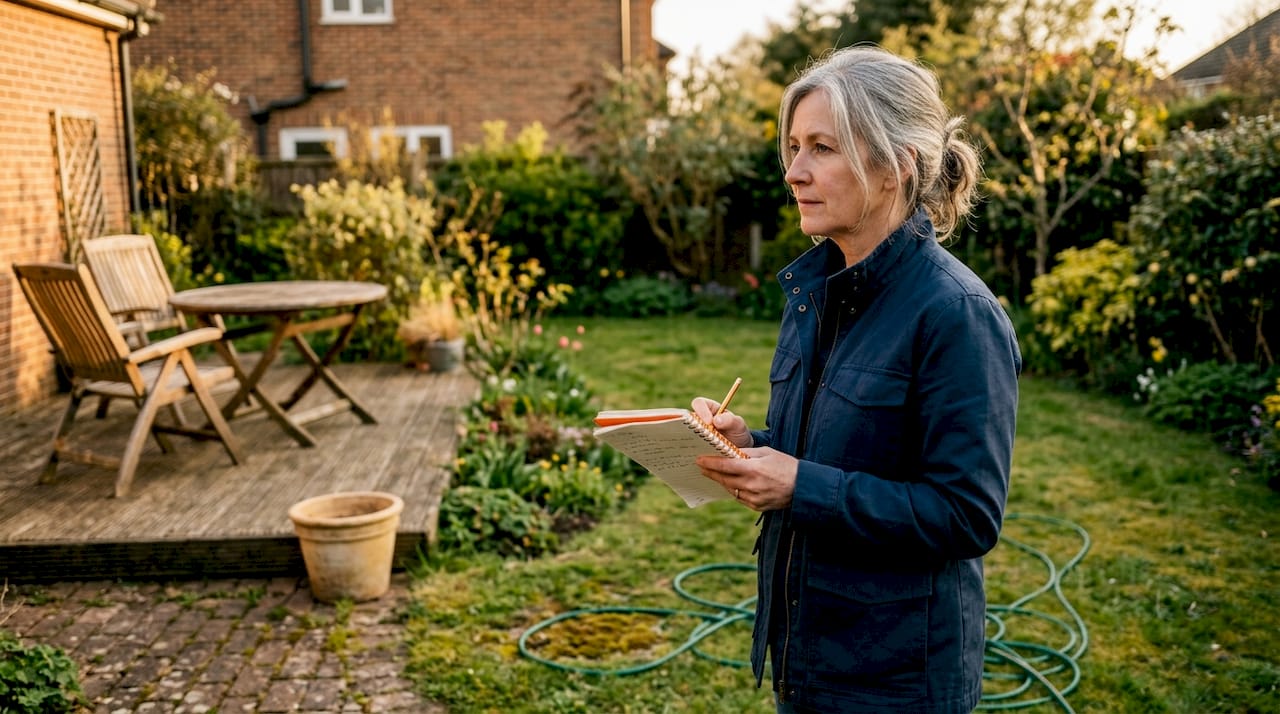
Pro Tip: Walk through your outdoor space at different times of day before making any changes. Note where the sun hits in the afternoon, where it feels exposed or draughty, and where you naturally gravitate to sit. This assessment takes twenty minutes and saves you from costly mistakes.
Site constraints such as soil type, drainage, and any local planning restrictions are worth understanding early too. Treating these as creative parameters rather than obstacles often leads to more cohesive results.
2. Add shade with trees and structural solutions
Shade is the single most transformative improvement you can make to any outdoor space in the British climate and beyond. A well-placed tree or shade structure does not just look attractive. It actively cools the area beneath it, reduces glare, and makes the space usable during the warmer hours of the day.
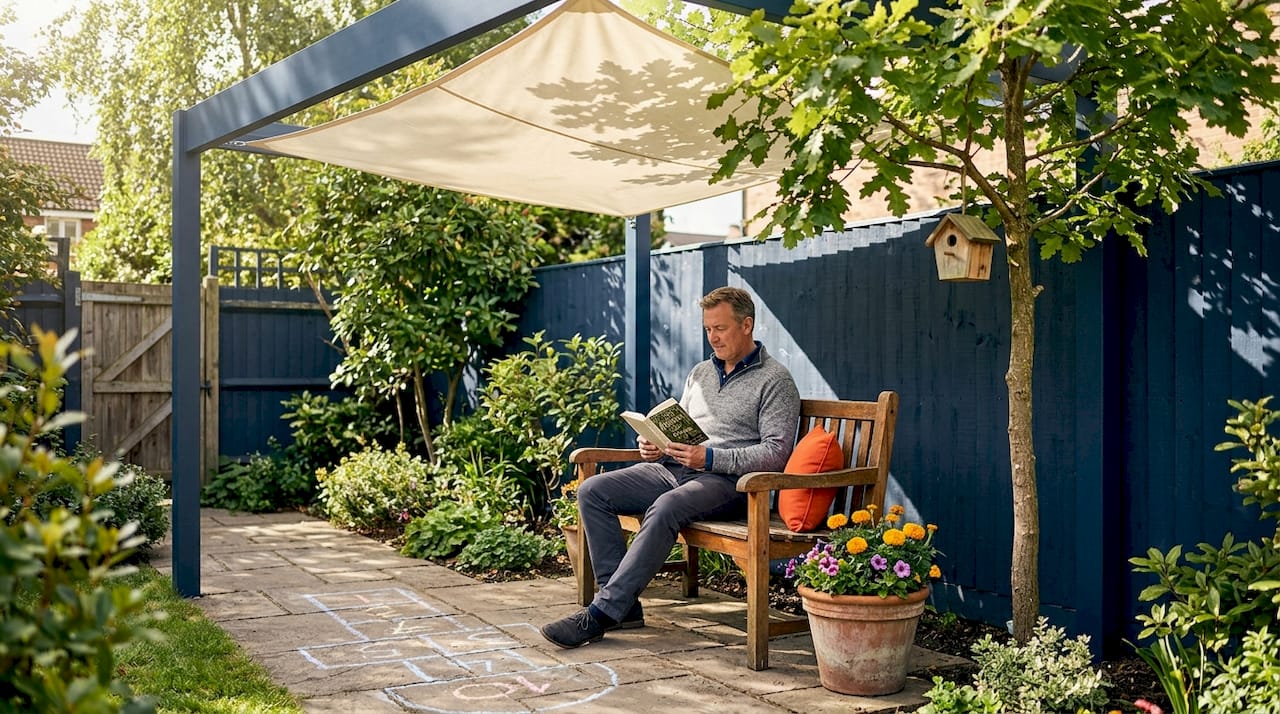
A mature deciduous tree placed on the west-facing side of your patio intercepts afternoon sun before it hits heat-absorbing surfaces like paving or decking. The cooling effect is measurable, not just perceptible. California’s Green Schoolyards Programme demonstrated this at scale: by planting over 6,000 trees across 215 schools since 2022, the programme significantly reduced extreme heat and improved wellbeing in outdoor areas.
Shade type | Best for | Maintenance level | Season of use |
Deciduous tree | Long-term cooling, wildlife | Low once established | Spring to autumn |
Pergola with canopy | Structured outdoor rooms | Low to medium | Year-round |
Retractable awning | Flexible, immediate shade | Low | Spring to autumn |
Shade sail | Budget-friendly coverage | Low | Spring to summer |
For immediate results, a pergola or retractable awning gives you flexible shade control without waiting years for a tree to mature. Pair a pergola with climbing plants like wisteria or clematis and you get the best of both approaches.
Pro Tip: For small gardens, a large umbrella or shade sail mounted at an angle covers more ground than one mounted straight overhead. It also creates a more interesting visual line.
3. Layer your outdoor lighting
Good outdoor lighting is one of the most underused ways to improve backyard aesthetics and extend how many hours a day you can enjoy your garden. Most homeowners install one or two lights and call it done. The results tend to be either too dim or harshly bright.
The professional approach uses three layers. Ambient, task, and accent lighting work together to create a balanced, inviting atmosphere without glare. For a standard patio, ambient lighting aims for roughly 1,000 to 1,500 lumens spread across multiple fixtures rather than a single bright source.
Here is how to apply this practically:
Ambient layer: String lights or overhead lanterns at 2.4 to 3 metres height create a warm general glow across dining and lounging zones.
Task layer: Downlights or wall-mounted fixtures positioned near steps, cooking areas, and pathways provide safety and usability.
Accent layer: Uplights aimed at specimen plants, a water feature, or a textured wall create drama and visual depth.
Solar-powered fixtures have improved considerably and work well for accent and pathway lighting where running cables is impractical. For permanent installations, zoning your lighting by function first, then choosing fixtures, prevents the common mistake of buying lights before thinking about what each one is meant to do.
Pro Tip: Use warm white bulbs (2,700 to 3,000 Kelvin) outdoors. Cool white light makes plants look grey and creates a clinical atmosphere that kills the mood of an evening garden entirely.
4. Invest in quality garden furniture
The furniture you choose sets the tone for everything else. A beautiful planted border or a well-designed pergola looks undermined by cheap, mismatched seating that wobbles and stains.
Garden furniture suggestions from designers consistently point to one principle: buy fewer pieces of better quality. A teak or powder-coated aluminium dining set lasts decades with minimal care, while budget plastic alternatives need replacing every few years and end up costing more over time.
Think about what you actually need. A large family that entertains regularly needs a generous dining table and enough chairs for guests. Someone who mainly wants a quiet corner to read needs a deep, comfortable lounger and a side table. Matching furniture to actual use, not aspirational use, is what makes a space feel right.
For smaller spaces, look at modular seating that can be rearranged or folded away. Balcony design ideas often rely on foldable bistro sets or wall-mounted drop-down tables that free up floor space when not in use.
5. Create a focal point
Every well-designed outdoor space has something your eye travels to first. Without a focal point, gardens feel scattered and unresolved, regardless of how many nice elements they contain. Good landscape composition anchors around one primary feature, whether that is a mature tree, a water feature, a fire pit, or a bold planting arrangement.
A fire pit serves double duty as a focal point and a functional feature that extends your outdoor season into autumn and early winter. Position it centrally or at the end of a sightline from your main seating area so it draws the eye naturally.
Water features work well in smaller spaces because they add sound and movement without taking up much room. A simple wall-mounted spout into a trough planter uses minimal floor area and creates an atmosphere entirely disproportionate to its size.
6. Add an outdoor kitchen or grilling station
If you cook outdoors regularly, an outdoor kitchen transforms how you use your garden. Outdoor kitchens increase backyard usability by eliminating the constant back-and-forth between inside and outside, which fragments the entertaining experience considerably.
You do not need to build an elaborate permanent structure. A well-positioned built-in barbecue with a small preparation surface, some weatherproof storage underneath, and a bin nearby covers ninety percent of what most households actually need. Add a mini fridge for drinks and the space becomes genuinely self-contained.
Position your grilling station near your dining area but slightly downwind from your main seating zone, so smoke drifts away rather than across your guests.
7. Use plants strategically for structure and colour
Plants are the most cost-effective way to transform any outdoor space, yet most people either underplant (a few pots dotted about) or overplant (crowded borders with no visual logic).
Layering plants by height creates structure and visual interest throughout the year. Tall shrubs or grasses at the back, mid-height perennials in the middle, and low-growing ground cover or edging plants at the front. This approach works in borders, raised beds, and even large containers.
For year-round interest in smaller gardens or when enhancing garden areas with limited ground space, combine evergreens for winter structure with seasonal bulbs and annuals for colour from spring through to autumn. Hellebores, alliums, and ornamental grasses are reliable performers that require very little attention once established.
For landscaping in small spaces, vertical planting on walls or fences using trained climbers, wall-mounted planters, or a living wall panel significantly increases your planting area without using any floor space.
8. Apply mulch and refresh garden beds
One of the fastest and most satisfying ways to improve backyard aesthetics is fresh mulch. Mulching plant beds suppresses weeds, retains moisture, regulates soil temperature, and gives borders a neat, deliberate appearance that lifts the whole garden.
Bark chip or garden compost mulch applied at roughly 5 to 8 centimetres depth delivers both visual and practical benefits. Combined with compost amendments, the long-term soil health benefits compound over time, with research showing that combining mulch and compost yields better cumulative soil outcomes than mulch alone.
Quick update | Visual impact | Cost | Time required |
Fresh mulch | High | Low | 1 to 2 hours |
Potted seasonal plants | High | Low to medium | 30 minutes |
Repainted fence or trellis | High | Low | Half a day |
Bird feeders and stepping stones | Medium | Low | 1 hour |
Tidied tool storage | Medium | Minimal | 1 hour |
Beyond mulch, a single coat of fresh paint on a fence or garden structure makes a space look intentional and cared for. Charcoal grey, sage green, and deep blue are popular choices that complement planting rather than compete with it.
9. Think about privacy and enclosure
Open, exposed gardens rarely feel relaxing. A sense of enclosure, even partial, makes an outdoor space feel like a room rather than just an area. Tall grasses, bamboo screens, trellis with climbing plants, or a well-placed pergola structure all create that sense of definition.
Privacy does not have to mean high solid fencing. A screen that reaches eye level when seated is often enough to block sightlines to neighbouring windows or roads while keeping the space feeling open above.
For balcony design ideas in particular, privacy screens made from slatted timber or outdoor fabric panels transform an overlooked balcony into a genuine outdoor room.
10. Extend your season with heating and shelter
The British weather limits outdoor use for much of the year. The homeowners who get the most from their gardens are those who plan for shelter and warmth from the start.
An outdoor heater near a covered seating area adds several months of usability to any patio. Infrared wall-mounted heaters are more efficient than freestanding gas patio heaters and position neatly under a pergola or awning canopy. When combined with quality shading solutions that protect against light rain as well as sun, the result is an outdoor space that works in genuinely British conditions rather than only on the six sunny days per year.
My honest take on outdoor improvements
I’ve worked with enough homeowners over the years to know that the biggest mistakes come not from choosing the wrong product, but from skipping the planning stage entirely. People see something they like on social media and buy it before they’ve thought about where it goes, what function it serves, or whether it suits the rest of the space. The result is a garden that looks busy but feels uncomfortable.
What I’ve learned is that shade and lighting are the two investments that genuinely change how much time people spend outdoors. Everything else is secondary. A beautiful planting scheme won’t keep you outside on a hot July afternoon. A fire pit won’t draw you outside on a cool September evening without some shelter overhead. When you get the fundamentals right, the decorative choices become much easier because you’re building on a space that already works.
I’d also say: resist the urge to fill every corner. The gardens I find most satisfying to spend time in have breathing room. They have one or two strong focal points, clear zones, and enough open space that the whole thing feels intentional rather than accumulated. Prioritise quality over quantity in every decision, from furniture to planting to structures. You’ll end up with something that actually improves with time rather than dating badly within two seasons.
— Andrew
How Infinityawnings can help you get it right
If shade and shelter are the foundations of a great outdoor space, a well-designed pergola is one of the most effective structures you can add. Infinityawnings designs and installs bespoke garden pergolas across Yorkshire, Derbyshire, Nottinghamshire, and Lincolnshire, creating covered outdoor rooms that work in all seasons.

From open-frame pergolas that support climbing plants to fully enclosed veranda structures with integrated LED lighting and heating options, every solution is tailored to your garden’s dimensions and your lifestyle. A pergola does not just add shade. It defines the space, protects your furniture, and gives you a reason to be outside in weather that would otherwise drive you indoors. Browse the Infinityawnings website to see examples and request a free quote.
FAQ
What are the most impactful ways to enhance outdoor space?
Adding shade, layering outdoor lighting, and creating a clear focal point deliver the greatest improvement to comfort and usability. Planning your zones before purchasing anything ensures every element works together cohesively.
How do I improve a small garden or balcony on a budget?
Fresh mulch, potted seasonal plants, and a repainted fence create significant visual impact for minimal cost. Vertical planting and foldable furniture are particularly effective for small space landscaping where floor area is limited.
What type of outdoor lighting works best for a patio?
A layered approach combining ambient, task, and accent lighting works best. Aim for 1,000 to 1,500 lumens of ambient light spread across multiple fixtures, and use warm white bulbs at 2,700 to 3,000 Kelvin for the most inviting atmosphere.
Do I need planning permission for a garden pergola in the UK?
Most domestic pergolas fall within permitted development rights and do not require planning permission, but restrictions apply to listed buildings and conservation areas. Always check with your local planning authority before installation.
How can I make my outdoor space usable year-round in the UK?
Combine a covered structure such as a pergola or veranda with an outdoor heater and weather-resistant furniture. Choosing seasonal shading solutions that offer rain protection as well as sun coverage makes the biggest practical difference in the British climate.
Recommended
Comments