
Awning regulations in Yorkshire and nearby areas 2026

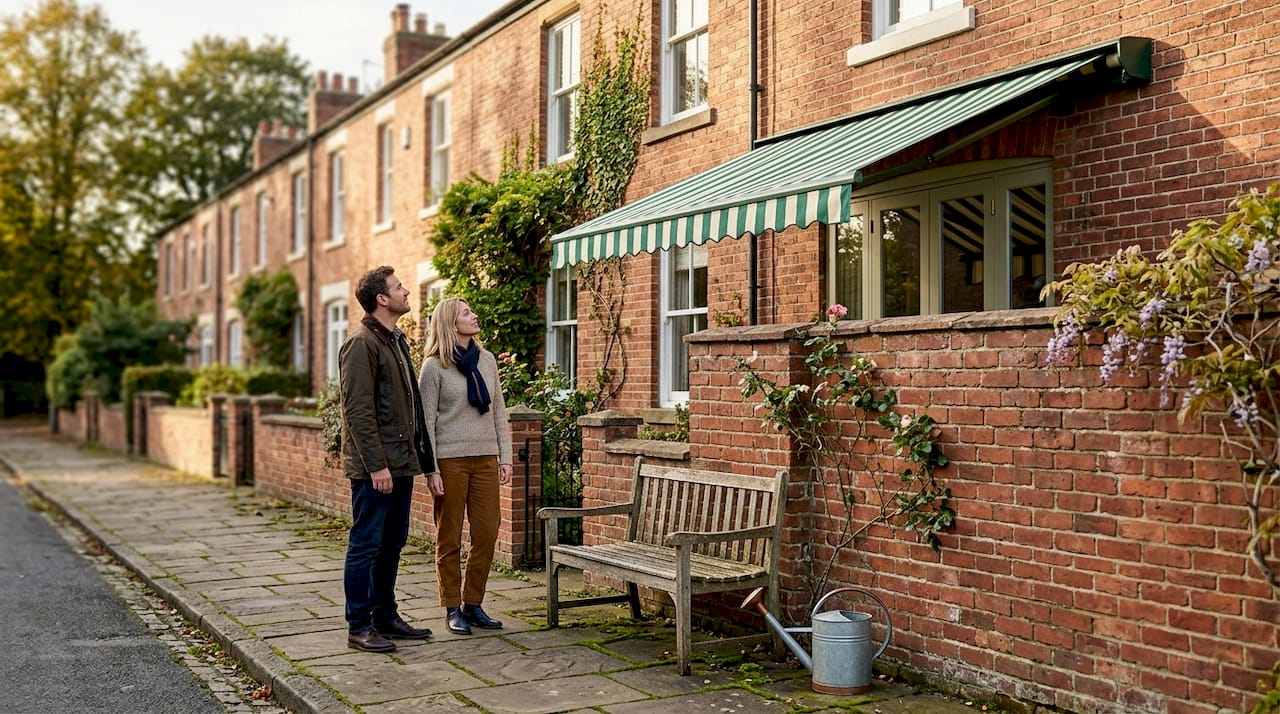
Installing an awning on your Yorkshire property seems straightforward until you start wondering whether you need permission. Many property owners assume awnings are simple additions requiring no approvals, only to discover later that their installation violates local planning rules. Understanding the regulations governing residential and commercial awnings across Yorkshire, Derbyshire, Nottinghamshire, and Lincolnshire prevents costly mistakes and ensures your outdoor shading solution complies with all requirements. This guide clarifies when permissions are needed, what safety standards apply, and how to navigate the approval process confidently.
Table of Contents
Key takeaways
Point | Details |
Residential rear awnings | Generally permitted development if not extending beyond principal elevation, with specific size and design conditions |
Conservation area restrictions | Planning permission required in conservation areas, national parks, and properties under Article 4 Directions |
Commercial awning rules | Almost always need planning permission, advertising consent for branding, and must meet strict safety standards |
Safety clearance requirements | Commercial awnings require minimum 2.4m height above pavement and maximum 0.45m projection from kerb |
Local council consultation | Always verify with your local authority as regional variations and Article 4 Directions affect permitted development rights |
Understanding residential awning regulations
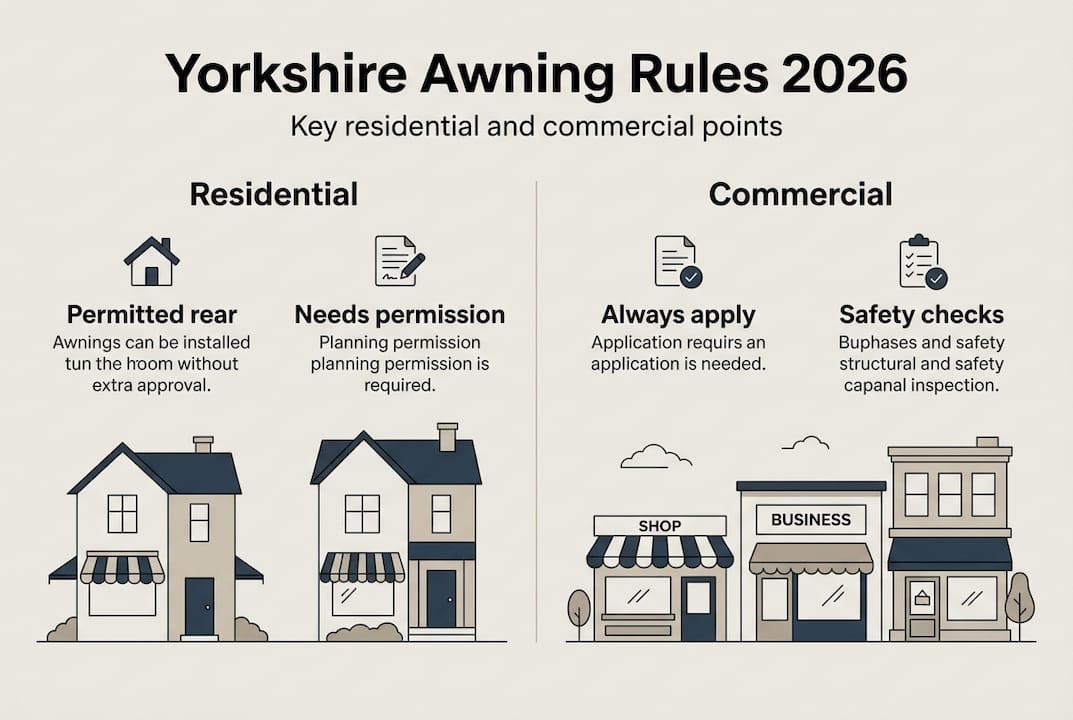
Navigating residential awning rules starts with understanding permitted development rights. In England, residential retractable awnings are generally permitted development if installed at the rear of the property, not extending beyond the principal elevation, proportional to the house, and not creating a veranda, balcony, or raised platform. These rights allow homeowners to enhance outdoor spaces without formal planning applications, provided specific conditions are met.
Location matters enormously. Awnings positioned at the rear of your property typically fall under permitted development, whilst those on side or front elevations facing highways require scrutiny. The installation must not project beyond the original roofline or principal elevation when viewed from the street. Size restrictions apply too, with the awning needing to remain proportional to your property’s scale and not dominating the building’s appearance.
Certain circumstances trigger mandatory planning permission. Planning permission is required for residential awnings on principal or side elevations facing highway, in conservation areas, national parks, Areas of Outstanding Natural Beauty, listed buildings, or under Article 4 Directions. These restrictions protect architectural heritage and maintain neighbourhood character, particularly in historically sensitive zones throughout Yorkshire and surrounding counties.
Article 4 Directions represent a crucial consideration often overlooked by property owners. Local councils can impose these directions to remove permitted development rights in specific areas, making planning permission compulsory for alterations that would normally be exempt. Sheffield, York, and numerous market towns across the region have implemented Article 4 Directions in conservation zones, meaning your rear awning might unexpectedly require approval.
Consulting your local planning authority before installation saves headaches. Each council interprets national guidelines slightly differently, and some maintain additional local requirements. Request pre-application advice or apply for a Lawful Development Certificate to confirm your awning’s permitted status. This proactive approach, whilst requiring modest effort, prevents enforcement action and potential removal orders that could cost thousands.
Pro Tip: Photograph your property from multiple angles before approaching the council, showing exactly where you plan to install the awning. Visual documentation helps planning officers assess your proposal quickly and often speeds up informal advice responses.
For practical guidance tailored to Yorkshire properties, explore awning installation tips for Yorkshire homes to understand regional considerations alongside regulatory requirements.
Navigating commercial awning regulations and safety standards
Commercial awnings face significantly stricter oversight than residential installations. Commercial awnings almost always require planning permission, especially if over public walkways, with branding requiring advertising consent, or on shop fronts, with safety rules mandating minimum 2.4m height above pavement and maximum 0.45m projection from kerb. These regulations protect pedestrian safety and maintain streetscape aesthetics in commercial districts across Yorkshire’s towns and cities.
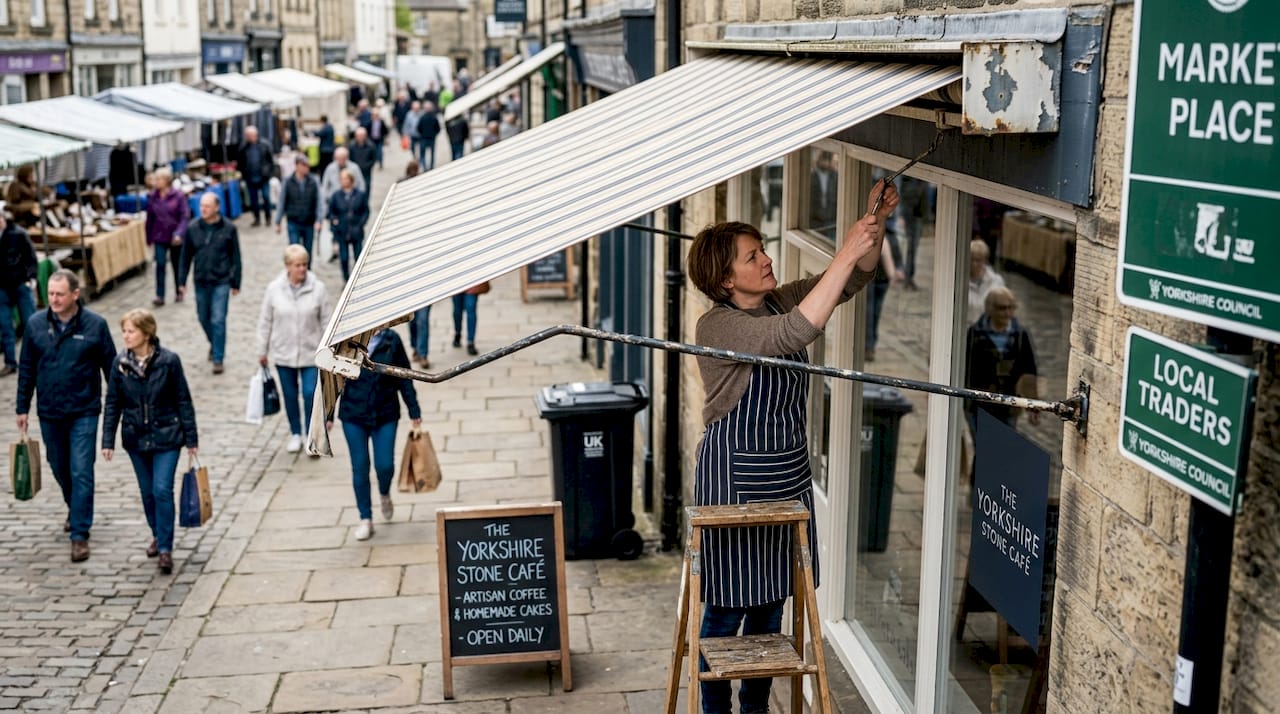
Advertising consent adds another layer of approval for branded awnings. Any text, logos, or graphics on your commercial awning constitute advertising under planning law, requiring separate consent from the local authority. This applies whether you operate a café in Harrogate, a restaurant in Nottingham, or a hotel in Lincoln. The application process examines visual impact, size, illumination, and appropriateness within the surrounding area.
Safety standards for commercial awnings are non-negotiable and rigorously enforced:
Maintain minimum 2.4 metres clearance above pavement level to prevent head injuries
Limit projection to maximum 0.45 metres from the kerb edge to avoid vehicle strikes
Conduct daily visual inspections checking fabric integrity, frame stability, and mechanical operation
Ensure adequate structural support capable of withstanding wind loads and accumulated rainwater
Install warning signage if the awning projects over public areas during extended periods
Electrical compliance becomes critical for motorised installations. Motorised awnings require electrical compliance including RCD protection, with all installations needing structural checks, wind ratings, and potentially building regulations approval even without planning permission. A qualified electrician must certify the installation, providing documentation for insurance and liability purposes.
Timeline planning prevents business disruption. Commercial planning applications typically take eight weeks for determination, though complex cases in conservation areas or involving listed buildings may extend to 13 weeks. Factor in additional time for advertising consent applications, which run concurrently but independently. Starting the approval process three to four months before your desired installation date provides comfortable margin for unexpected delays or requests for additional information.
Requirement | Residential | Commercial |
Planning permission | Often permitted development | Almost always required |
Advertising consent | Not applicable | Required for branding |
Minimum height clearance | No specific requirement | 2.4m above pavement |
Daily safety checks | Recommended | Mandatory |
Electrical certification | Recommended for motorised | Legally required for motorised |
Pro Tip: Engage a planning consultant familiar with your local authority’s preferences for commercial awnings. Their established relationships and knowledge of recent approvals significantly improve application success rates and reduce revision cycles.
Businesses seeking compliant solutions can review commercial awning design for Yorkshire bars for inspiration that balances aesthetic appeal with regulatory compliance.
Local considerations: conservation areas, Article 4 directions, and regional nuances
Whilst national regulations provide the framework, local variations significantly impact awning installations across Yorkshire and neighbouring counties. No specific awning regulations exist uniquely for Yorkshire, Derbyshire, Nottinghamshire, or Lincolnshire beyond national permitted development rules, but checking local councils for Article 4 Directions and conservation area designations remains essential. Each authority interprets and applies national guidelines through their own planning policies and local development frameworks.
Conservation areas dramatically alter permitted development rights. York’s historic centre, Sheffield’s Victorian quarters, Nottingham’s Lace Market, and Lincoln’s Cathedral Quarter all impose strict controls on external alterations. Within these zones, even rear awnings on residential properties typically require planning permission. The local authority assesses proposals against conservation area character appraisals, examining materials, colours, design, and visual impact on the historic streetscape.
National parks and Areas of Outstanding Natural Beauty introduce additional complexity. Properties within the Yorkshire Dales National Park, North York Moors National Park, or Peak District (covering parts of Derbyshire) face enhanced planning scrutiny. Permitted development rights are more restricted, and awning installations must demonstrate sensitivity to landscape character and traditional building styles. Natural materials and muted colours often feature as planning conditions in these protected landscapes.
Article 4 Directions vary considerably between councils:
York applies Article 4 Directions across multiple conservation areas, removing permitted development rights for most external alterations
Sheffield maintains Article 4 coverage in conservation areas and some residential zones near the city centre
Nottingham focuses Article 4 Directions on conservation areas and specific heritage streets
Derby, Lincoln, and smaller market towns typically apply Article 4 Directions selectively to conservation areas
Residential and commercial zoning affects awning regulations differently. Residential zones generally benefit from permitted development rights unless specifically removed, whilst commercial and mixed-use areas almost universally require planning permission for awnings. Properties on boundary lines between zones should clarify their designation with the local planning department before proceeding.
Location Type | Typical Requirement | Key Consideration |
Residential rear (non-conservation) | Often permitted development | Check Article 4 Directions |
Conservation area | Planning permission required | Design must suit character |
Commercial high street | Planning and advertising consent | Safety standards mandatory |
National park | Enhanced planning scrutiny | Landscape sensitivity |
Obtaining pre-application advice proves invaluable for borderline cases. Most councils offer this service for modest fees, providing written guidance on whether your proposal needs permission and highlighting potential issues before formal application. For properties in conservation areas or under Article 4 Directions, requesting a Lawful Development Certificate confirms permitted status definitively, creating a legal record protecting against future enforcement.
Property owners investing in quality installations should explore premium awnings for Yorkshire homes to understand how superior materials and design can satisfy both aesthetic preferences and planning requirements.
Practical steps for compliant awning installation in 2026
Achieving a compliant awning installation requires methodical planning and attention to regulatory detail. Following a structured approach prevents enforcement issues and ensures your outdoor shading solution meets all legal requirements whilst delivering the functionality and aesthetics you desire.
Begin with thorough research and early council engagement:
Identify your property’s planning designation by checking the local authority’s online planning portal for conservation areas, Article 4 Directions, and listed building status
Review your council’s local development framework and supplementary planning documents addressing shopfronts, advertisements, or residential alterations
Contact the planning department for informal advice, describing your proposed awning’s location, size, materials, and whether it includes branding
Request pre-application advice for complex cases, particularly commercial installations or properties in sensitive locations
Obtain a Lawful Development Certificate if you believe the awning is permitted development but want legal certainty
Design considerations must balance aesthetics with compliance. Choose awning styles, colours, and materials that complement your property’s character and surrounding area. In conservation areas, traditional designs with muted colours typically gain approval more readily than contemporary styles with bold patterns. Commercial awnings should align with existing shopfront features and respect neighbouring businesses’ visual harmony.
Structural and electrical safety cannot be compromised. Always consult your local planning authority for pre-application advice or a Lawful Development Certificate to confirm permitted status, especially for edge cases like verandas or installations in conservation areas. Engage qualified professionals for structural calculations confirming the building can support the awning’s weight and wind loads. For motorised awnings, certified electricians must install wiring with appropriate circuit protection and weatherproofing.
The formal application process, when required, follows these stages:
Complete the planning application form with accurate site plans, elevations, and photographs showing the proposed awning location
Submit advertising consent applications separately if your commercial awning includes branding or signage
Pay the relevant fees, which vary by council and application type
Respond promptly to any requests for additional information or clarifications from planning officers
Address neighbour objections or concerns raised during the consultation period with factual responses
Await the decision, typically within eight weeks for standard applications
Common mistakes that delay or derail applications include ignoring local planning policies, submitting poor-quality drawings that don’t clearly show the awning’s appearance and position, failing to consult neighbours in advance about potential concerns, choosing inappropriate materials or colours for conservation areas, and underestimating structural requirements leading to unsafe installations.
Pro Tip: Photograph neighbouring properties with existing awnings that have gained approval. Referencing these precedents in your application demonstrates your proposal aligns with established local character and planning decisions.
Post-approval responsibilities ensure ongoing compliance. Retain all planning permission documents, building regulations certificates, and electrical safety certificates for future property sales. Conduct regular maintenance checking fabric condition, frame integrity, and mechanical operation. For commercial awnings, implement daily safety inspection logs as evidence of due diligence.
For comprehensive guidance on selecting compliant awning styles, review the awning selection guide covering design options suitable for various property types and planning contexts.
Find compliant awning solutions with Infinity Awnings
Navigating awning regulations across Yorkshire, Derbyshire, Nottinghamshire, and Lincolnshire becomes straightforward with expert guidance. Infinity Awnings brings over 15 years of experience designing and installing compliant outdoor shading solutions for residential and commercial properties throughout the region. Our team understands local planning requirements, conservation area sensitivities, and safety standards, ensuring your awning project proceeds smoothly from concept to completion.
We offer professional consultation on planning requirements, helping you determine whether your proposed awning needs permission and guiding you through the application process when necessary. Our installations meet all structural and electrical compliance standards, with certified professionals handling every aspect of the project. Whether you’re enhancing a period property in York’s conservation area or adding branded awnings to a Nottingham restaurant, we deliver tailored solutions that satisfy both your vision and regulatory requirements. Explore our comprehensive services or discover awning installation in Hull and installation tips for Yorkshire homes for local insights.
Frequently asked questions
What permissions are needed for residential awnings in Yorkshire?
Residential awnings installed at the rear of properties typically fall under permitted development rights, requiring no planning permission if they don’t extend beyond the principal elevation and meet size requirements. However, planning permission becomes mandatory for awnings on principal or side elevations facing highways, in conservation areas, national parks, or under Article 4 Directions. Always verify your property’s planning designation with the local council before installation.
When is planning permission mandatory for commercial awnings?
Planning permission is required for virtually all commercial awnings, particularly those over public pavements, on shop fronts, or in commercial districts. If your awning includes any branding, logos, or text, you’ll also need separate advertising consent from the local authority. The application process examines safety, visual impact, and appropriateness within the streetscape, typically taking eight weeks for determination.
How do conservation areas affect awning regulations?
Conservation areas remove most permitted development rights, making planning permission compulsory for awning installations regardless of location on the property. Local authorities assess proposals against conservation area character appraisals, scrutinising materials, colours, and design to ensure compatibility with the historic environment. Article 4 Directions in these areas further restrict alterations, requiring enhanced justification for contemporary designs or non-traditional materials.
What safety standards must commercial awnings meet?
Commercial awnings must maintain minimum 2.4 metres clearance above pavement level to prevent pedestrian head injuries and project no more than 0.45 metres from the kerb edge to avoid vehicle strikes. Daily visual safety inspections are mandatory, checking fabric integrity, frame stability, and mechanical operation. Motorised awnings require electrical certification with RCD protection, and all installations need structural calculations confirming adequate support for wind loads and water accumulation.
Recommended
Comments