
Win Consent for UK Awning Signage: avoid £168 fee with installer tips

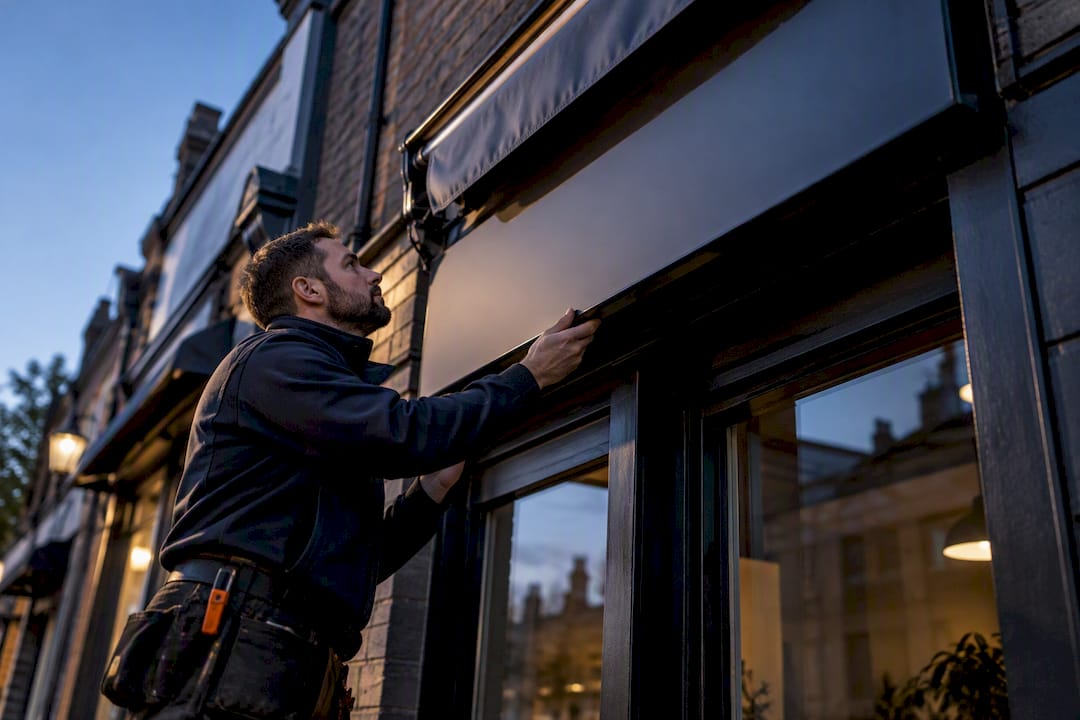
If your awning carries a logo, lettering or illumination, it normally counts as an advertisement and will often need advertisement consent unless it meets strict deemed-consent tests. The awning structure itself is a separate matter, covered by planning permission and, for listed buildings, listed building consent. The next section gives you a quick checklist so you know exactly where you stand.
TL;DR:
Signs with illumination, large area, or projections beyond limits usually require express advertisement consent instead of deemed approval.
Listed buildings and conservation areas demand separate or more stringent approvals, especially if fixings penetrate the façade or alter historic features.
Retraction and symmetry in awning design increase approval chances, while fixed canopies and bright lighting face higher rejection risks.
Prioritize establishing consent requirements and necessary permissions before designing or commissioning awnings to avoid costly delays and refusals.
Application fees range from £168 to £588, with decisions typically issued within eight weeks, but non-compliance can lead to enforcement actions or removal notices.
Table of Contents
The essential rules for awning signage in a nutshell
Two different consent regimes apply to a single awning, and businesses regularly confuse them. Advertisement consent covers the branding, lettering or illumination on the awning. Planning permission (and listed building consent, where relevant) covers the physical structure fixed to the building.
Several triggers commonly push a sign into express consent territory rather than automatic deemed consent:
Illumination of any kind, including internally lit fascia strips or spotlit valances
Total sign area above the deemed-consent thresholds set out in the Control of Advertisements Regulations
Projection beyond the shopfront that encroaches on pedestrian or highway space
Positioning on a gable end, above first-floor level, or facing a main road
Application fees for advertisement consent commonly run to £168 for business signs on the premises and £588 for other adverts, with decisions typically issued within eight weeks, according to PlanningGeek. Always check with your landlord and, if the awning oversails the pavement, with the highway authority before you commission anything.
How do I know if I need advertisement consent?
Work through this in order rather than guessing, because the two consent types answer different questions.
Separate the branding from the structure. Any lettering, logo or illuminated panel is assessed as an advertisement; the frame, arms and fabric are assessed as a building alteration under planning permission rules.
Check listed status and conservation area designation. Search the property address on your council’s planning register or the Historic England list; a listed building typically needs separate listed building consent even where the sign itself might otherwise qualify for deemed consent.
Measure everything. Note the sign area, the height above ground level, how far the awning projects from the wall, and whether it will be illuminated. These figures decide whether deemed consent applies or an express application is unavoidable.
Confirm permissions beyond planning. Get written landlord sign-off if you lease the premises, and check whether the pavement or forecourt sits on adopted highway land, which brings a separate licence into play.
Skipping step two is the most common mistake. A sign that would sail through deemed consent on an ordinary high street can be refused outright on a listed shopfront.
What is deemed consent and when does it apply?
Deemed consent is a form of automatic permission granted under the Town and Country Planning (Control of Advertisements) (England) Regulations 2007. It lets certain everyday signs go up without a formal application, provided they meet fixed conditions on size, position and illumination.
For awning-mounted signage, the classes that usually apply cover business signs on the premises where trade is carried out. Local authorities can still narrow or remove deemed consent rights in sensitive areas, including through Areas of Special Control designated under the government’s advertisement guidance.
Typical conditions that keep a sign within deemed consent include:
Non-illuminated lettering restricted to the fascia valance rather than the full awning canopy
Total sign area within the council’s published limit for that advertisement class
No projection above roughly 4.6 metres or onto a gable end facing a public road
No display that obscures a window, door or architectural feature
A café adding its name to the front valance of a retractable awning will usually pass. A restaurant fitting a backlit box sign across the full width of a fixed canopy almost never will.
Do conservation areas and listed buildings change the rules?
Yes, and the change is significant. Listed building consent sits entirely outside the advertisement consent system, so even a sign that meets every deemed-consent condition may still need separate sign off if fixings penetrate a listed facade.
Planning officers assessing amenity in conservation areas apply a stricter, more subjective test:
Does the awning preserve original shopfront features such as pilasters, cornices or historic glazing bars?
Are the materials and colours sympathetic, favouring traditional canvas tones over bright branded plastics?
Does the design avoid concealing the fascia sign zone that the building was designed around?
Appeal decisions from the Planning Inspectorate repeatedly show the same pattern: retractable awnings that fold flat against the fascia fare far better than fixed, dominant canopies, and refusals often cite excessive projection or the loss of a traditional shopfront rhythm as the deciding factor.
Are illuminated awning signs and highway safety treated differently?
Illuminated signs sit in a different, tougher category almost everywhere in the UK. They commonly fall outside deemed consent entirely and get assessed against both visual amenity and public safety, the only two matters a council can lawfully weigh according to planning guidance on advertisement consent.
Standard conditions attached to any consent typically require that a sign:
Does not obscure a traffic sign, signal or sightline for drivers or pedestrians
Uses fixings that are structurally sound and unlikely to fail in high winds
Does not create glare or distraction for road users after dark
Pro Tip: If illumination is genuinely important to your brand, ask your installer to quote a lower luminance panel and directional shielding at the design stage. A softer, shielded light reads as far less intrusive to a planning officer than a bright, unshielded box sign, and it rarely costs much more to specify upfront.
How do I actually apply for advertisement consent?
Once you have confirmed express consent is needed, the process is straightforward if you prepare the right paperwork in advance.
Get the right form. Your local planning authority issues its own advertisement consent application, and the Planning Portal hosts the standard national form and guidance notes most councils accept.
Assemble scaled drawings. You will need elevations showing the awning in context against the shopfront, a location plan, and photographs of the existing frontage and neighbouring buildings.
Write a short design statement. Address amenity and safety directly: explain the materials, the retracted profile, and why the sign will not obstruct sightlines or dominate the street scene.
Pay the tariff. Expect the standard fee bands referenced earlier, and budget for a decision within roughly eight weeks once the application is validated.
Ask about pre-application advice. Many councils offer a paid pre-application service, which is worth the modest cost on a listed or conservation-area building where the design margin for error is small.
What happens if you display a sign without the right consent?
Displaying an advertisement without the required consent is an offence, and councils hold real enforcement powers, including removal notices and prosecution, as Planning Portal guidance confirms. In practice, most authorities issue a warning and a deadline before escalating.
If you are refused, or enforcement action starts, you have several routes:
Appeal to the Planning Inspectorate, submitting evidence that the sign is retractable, unobtrusive, and comparable to accepted signage nearby
Apply retrospectively for consent if the sign is already up and defensible on its merits
Remove or temporarily cover the sign while you redesign it to fit within deemed-consent limits
Appeals that succeed tend to lean on the same evidence: a retractable mechanism, a design that echoes neighbouring shopfronts, and photographs proving the sign sits flush with the fascia rather than dominating it.
What do installers check before submitting an application?
Awnings that fold flat into the fascia when retracted are consistently easier to get approved than fixed, permanent canopies, because they read as reversible and less visually dominant. That single design choice resolves a large share of the objections planning officers raise.
Material and colour selection matters almost as much. Traditional canvas weaves in muted tones tend to sit far more comfortably against period brickwork than gloss vinyl or saturated branded colours, particularly within a conservation area.
Before submitting anything, a competent installer will typically prepare:
Scaled elevations showing the awning against the fascia and adjoining shopfronts
A physical material swatch or sample for the design statement
Full measurements: sign area, projection depth, and height above pavement level
Pro Tip: Ask your installer for sizing guidance on commercial units before you finalise artwork. Getting the projection and height figures right at the design stage avoids a costly resubmission later.
What the rulebook doesn’t tell you
Most guidance on this topic reads like a compliance checklist, and that’s fine as far as it goes. What it misses is that the biggest risk isn’t ignorance of the rules. It’s businesses assuming a small sign is automatically fine because it “looks harmless.” Deemed consent has hard edges, not soft ones, and illumination or a sensitive location can void it in an instant, whatever the sign looks like.
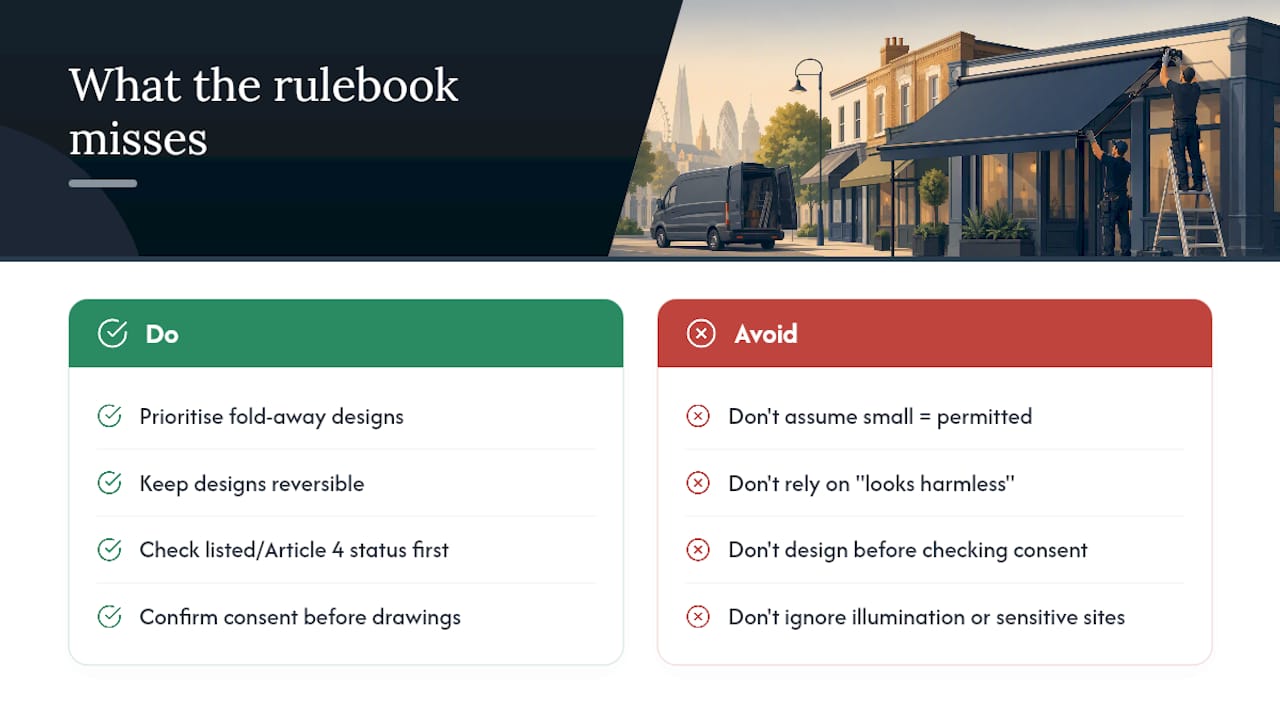
The advice I’d push back on is the blanket recommendation to “keep it simple and you’ll be fine.” Simple doesn’t matter nearly as much as reversible. A modest fixed canopy can get refused where a bolder retractable design sails through, because inspectors weigh permanence and concealment of the fascia far more heavily than size alone. If you take one thing from this guide, prioritise a design that folds away cleanly over one that merely looks understated.
The other gap in most advice is timing. Businesses tend to design the branding first and worry about consent afterwards. Flip that order. Establish the consent position, including listed status and any Article 4 restrictions, before a single drawing gets commissioned. It saves money and it saves the argument with your landlord six weeks before opening day.
— Andrew
Get compliant awning signage designed and fitted properly
Getting the paperwork right is only half the job; the awning still has to be built and fitted to match what was approved. A competent installer surveys the shopfront, produces scaled drawings and a design statement your application needs, and specifies materials and colours that harmonise with the host building, whether traditional or modern.
That combination matters because a design drawn up without consent in mind often has to be redrawn once a planning officer raises an objection, costing weeks. Working with an installer who understands what officers actually look for, retractable profiles, sympathetic fabric, sensible projection depths, cuts that risk out before the application ever goes in. Infinity Awnings supplies and installs both residential and commercial awnings and canopies across Yorkshire, Derbyshire, Nottinghamshire and Lincolnshire, sourcing from established manufacturers including Weinor, Llaza and Selt. If you’re weighing up a shopfront awning and want the consent question answered alongside the design, request a free quote through Infinityawnings and get a survey booked in.
Sources
FAQ
Do you need planning permission for external signage?
The branding on a sign needs advertisement consent, not planning permission, though the two are often confused. A fixed, permanent canopy structure can separately need planning permission, and a listed building will usually need listed building consent regardless of the sign’s size.
What are the safety rules for awning signage in the UK?
Councils can only refuse an advertisement on grounds of amenity or public safety, such as obscuring a traffic sign or creating glare, according to planning guidance. Fixings must be structurally sound and the sign must not obstruct sightlines for drivers or pedestrians.
What is the difference between an awning and a sign?
An awning is the physical retractable or fixed structure fitted to a building, controlled under planning permission rules. A sign is any lettering, logo or illumination applied to that structure, controlled separately under advertisement consent.
Does an awning require planning permission?
A retractable awning without illumination or branding often falls under permitted development and needs no separate planning permission, though this varies by property and area. A fixed, non-retractable canopy is more likely to require full planning permission, and any listed building needs its own consent regardless of the awning type.
How much does advertisement consent cost and how long does it take?
Application fees commonly run to £168 for a business sign on its own premises and £588 for other adverts, according to PlanningGeek. Councils typically issue a decision within eight weeks of a valid application being submitted, per Planning Portal guidance.
Recommended
Comments