
Awning terminology explained: a guide for Yorkshire areas
- Andrew Crookes

- 8 hours ago
- 8 min read
TL;DR:
Understanding industry terms like cassette, pitch, and BS compliance ensures safer, longer-lasting awnings.
Local climate influences choices such as full cassette systems and higher wind resistance standards.
Proper knowledge helps buyers select suitable specifications tailored to their property and regional weather conditions.
When you first start researching awnings for your home or business, the industry language can feel like a foreign dialect. Terms like ‘cassette’, ‘pitch angle’, ‘wind load’, and ‘BS compliance’ appear constantly in brochures and installer conversations, yet rarely come with plain-English explanations. For property owners across Yorkshire, Derbyshire, Nottinghamshire, and Lincolnshire, this confusion can delay a decision or, worse, lead to a purchase that doesn’t suit your building or local climate. This guide cuts through the jargon and gives you the vocabulary you need to shop confidently, ask the right questions, and choose a shading solution that genuinely works for your outdoor space.
Table of Contents
Key Takeaways
Point | Details |
Learn critical terms | Understanding definitions like cassette and pitch helps you choose the right awning for your needs. |
Prioritise compliance | Check for British Standards and local regulations for safety, durability, and legal peace of mind. |
Account for local climate | Features like pitch and wind resistance are especially vital in Yorkshire and surrounding areas. |
Trust regional experts | Local installers know how to match terminology with what works best on your property. |
Why industry terminology matters for awnings
It’s tempting to treat awning terminology as background noise, something installers deal with while you focus on colours and styles. But the language used in product specifications directly affects whether your awning performs safely, lasts well, and adds genuine value to your property. Getting this wrong isn’t just a minor inconvenience; it can mean a product that fails in the first Yorkshire storm or one that voids your building’s energy compliance.
Three terms come up repeatedly in UK awning projects and carry real weight:
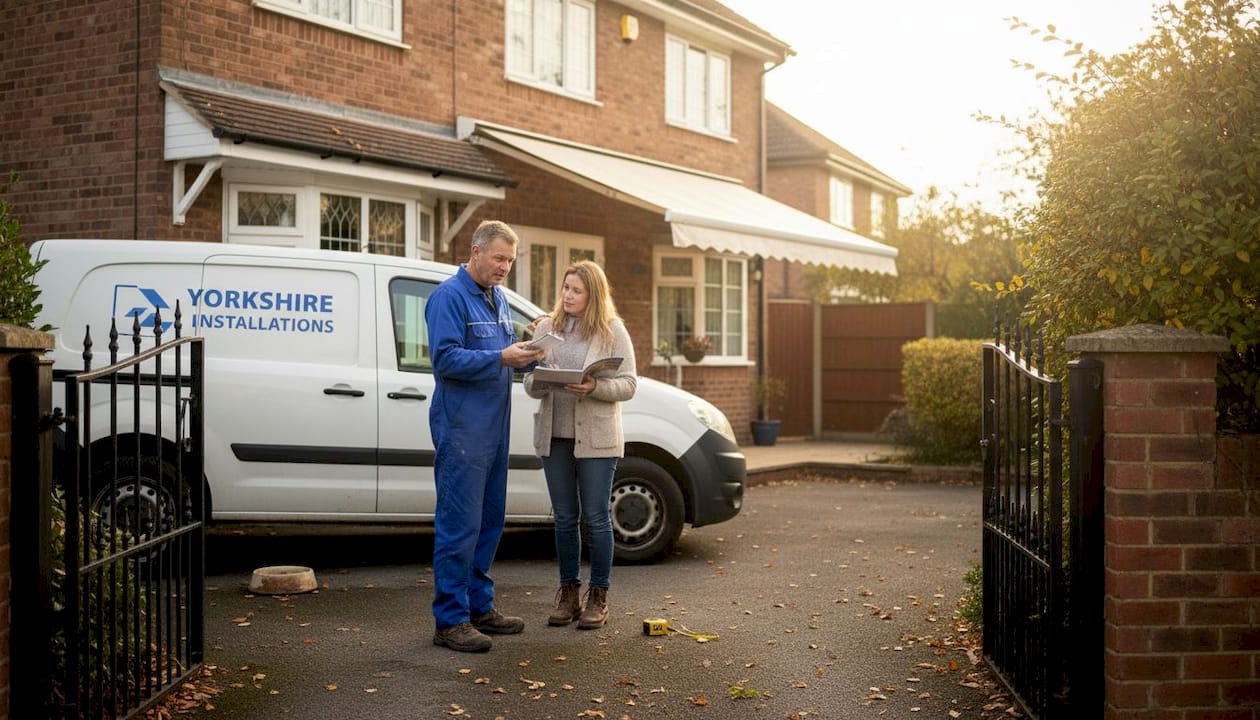
Cassette: The protective housing that covers the fabric and arms when the awning is retracted. A full cassette protects against UV degradation, rain ingress, and debris, extending the life of the fabric considerably.
Pitch: The angle at which the awning extends outward. This is not just aesthetic; it determines how effectively rainwater drains away from the fabric surface.
BS compliance: A shorthand for meeting British Standards, which govern everything from wind resistance to fabric fade ratings. These aren’t optional quality markers; they are the baseline for safe, durable outdoor structures in the UK.
Understanding these terms shapes every decision that follows. When you know what a cassette does, you can evaluate whether a semi-cassette or open-cassette model suits your exposure to the elements. When you understand pitch, you can question whether an installer’s proposed angle is appropriate for your wall height and projection length.
“The difference between a good awning installation and a great one often comes down to whether the buyer understood the specification before signing off on it.”
There are also legal and financial dimensions. British Standards require wind resistance of 40 or more mph for premium products, UV and fade resistance ratings, a pitch of approximately 14 degrees for effective rain runoff, and compliance with Part L and Part O of the Building Regulations for overheating mitigation. These requirements aren’t bureaucratic formalities. They protect your investment and, in commercial settings, your liability.
For residential buyers, understanding premium awnings advantages means recognising that a higher upfront cost often reflects compliance with these standards, not just a brand premium. And for anyone planning a DIY-adjacent project, reviewing awnings installation tips before you begin can prevent costly errors that arise from misunderstanding the technical requirements.
Essential awning terminology explained
With the importance of terminology clear, here’s what you need to know when browsing specifications or talking with installers. These are the terms you will encounter most frequently, and understanding them will transform your conversations with suppliers.
Term | What it means | Why it matters |
Cassette | Protective box enclosing fabric and arms | Extends lifespan, reduces maintenance |
Pitch | Angle of awning projection (degrees) | Affects rain runoff and shade coverage |
Projection | How far the awning extends from the wall | Determines shaded area size |
Wind load | Maximum wind speed the awning can handle | Critical for exposed or elevated sites |
UV rating | Fabric resistance to sun degradation | Affects colour retention and longevity |
Somfy | Leading motor and automation brand | Standard for quality motorised systems |
BS EN 13561 | British Standard for external blinds | Benchmark for quality and safety |
Here are the most important concepts broken down in plain terms:
Retractable vs fixed: A retractable awning folds back when not in use, offering flexibility and protection from bad weather. A fixed awning stays in place permanently, offering consistent shade but no adaptability.
Arms: The lateral support arms that hold the awning fabric extended. Articulated arms fold back neatly; straight arms are simpler but less compact.
Fabric types: Solution-dyed acrylic fabrics (such as those from Sattler or Dickson) are woven with colour throughout the fibre, making them far more fade-resistant than coated fabrics.
Automation: Electric or motorised operation, often integrated with wind and sun sensors. Motorised systems using Somfy are the industry standard, and premium awnings typically last 10 to 15 years while delivering energy savings of up to 25%.
Semi-cassette vs full cassette: A semi-cassette covers the roller but leaves the arms exposed. A full cassette encloses everything, offering superior weather protection.
Pro Tip: When requesting quotes, always ask the installer to confirm which BS or EN standard the product meets. If they cannot answer clearly, that tells you something important about their level of expertise. Reviewing proper installation practices in advance also helps you ask sharper questions. For planning considerations, the regulations guide is an essential read before committing to any project.
Common industry standards and compliance codes
Knowing the terms is vital, but understanding regulation ensures your awning project is safe and lawful. The UK has a clear framework of standards that apply to awnings, and being aware of them puts you in a much stronger position as a buyer.
The two most relevant British Standards are:
BS EN 13561: Covers external blinds and awnings, setting minimum requirements for mechanical endurance, wind resistance, and fabric performance. Any reputable supplier should be able to confirm their products meet this standard.
BS EN 13782: Applies to temporary structures and marquees, but its principles around structural integrity and wind loading are referenced in commercial awning contexts.
Beyond these, Part L and Part O compliance relates to the Building Regulations around energy efficiency and overheating. Awnings that reduce solar gain through glazed areas can contribute to meeting these requirements, which is increasingly relevant as UK summers become warmer.
Here’s how standards typically differ across product tiers:
Specification | Budget awning | Mid-range awning | Premium awning |
Wind resistance | Up to 25 mph | Up to 35 mph | 40+ mph |
UV rating | Basic | Moderate | High (solution-dyed) |
Cassette type | Open or semi | Semi-cassette | Full cassette |
Motor option | Manual only | Optional motor | Somfy integrated |
Expected lifespan | 3 to 5 years | 6 to 9 years | 10 to 15 years |
For properties across our region, wind resistance is not a minor footnote. Premium awnings can withstand gusts exceeding 40 mph, which is a meaningful threshold given the exposed landscapes of the Yorkshire Dales, the Lincolnshire coast, and the upland areas of Derbyshire. Checking regional compliance rules before purchasing is strongly advised, and pairing that with weatherproof awning tips will help you specify correctly for your exact location.
Regional nuances: trends and priorities in Yorkshire, Derbyshire, Nottinghamshire, and Lincolnshire
Local best practice can make all the difference. Let’s look at what distinguishes awning choices in these counties from a generic national specification.
The climate across this region is varied but consistently demanding. Yorkshire sees significant rainfall and strong prevailing westerly winds. Derbyshire’s Peak District edges experience gusts that would stress a poorly specified awning within a season. Nottinghamshire and Lincolnshire face their own challenges, including exposed flatlands where wind loading is a primary concern rather than an afterthought.
Local installers who understand these conditions prioritise the following:
Wind sensors and automation: Rather than relying on manual retraction, quality fitters in this region routinely recommend Somfy wind sensors that automatically retract the awning when gusts reach a preset threshold. This is not a luxury; it is practical protection.
Full cassette systems: Given the frequency of rain and UV exposure across the summer months, full cassette designs are strongly favoured for residential installations where the awning may be left in place for extended periods.
Correct pitch specification: Awnings for shade and light rain are designed to manage typical conditions, not heavy weather. Yorkshire and surrounding firms emphasise BS compliance and automation as the baseline, not a premium add-on.
Commercial-grade fabrics for hospitality: Restaurants, hotels, and bars across Leeds, Sheffield, Nottingham, and Lincoln increasingly specify solution-dyed acrylic fabrics that resist both the sun and the inevitable spills of outdoor dining.
Pro Tip: Before finalising your specification, ask your installer for local case studies or completed projects in your county. A supplier who has installed awnings on exposed Derbyshire farmhouses or Sheffield city-centre restaurants will have practical knowledge that no brochure can replicate. Explore retractable awning benefits for residential context, and browse commercial awning examples to see how local businesses have approached the same decisions.
A fresh perspective: the biggest mistake buyers make with awning terminology
After more than 15 years working with homeowners and businesses across Yorkshire and the surrounding counties, we’ve noticed a pattern. The buyers who struggle most are not the ones who know too little about awning terminology. They are the ones who know just enough to chase the highest specification on paper without considering whether it suits their actual situation.
Maximum wind load ratings, for instance, mean very little if the awning is installed at the wrong pitch or fixed to a wall that cannot bear the load. A 40 mph wind resistance rating assumes correct installation. Similarly, buyers who focus on motorisation features without addressing fabric quality often end up with a beautifully automated awning that fades badly within three summers.
The smarter approach is to start with your specific usage pattern and local conditions, then work backwards to the specification. How often will the awning be extended? Is your property exposed or sheltered? Do you want shade, rain protection, or both? Saving energy with awnings is a genuine benefit, but only when the product is matched to the building’s orientation and glazing. Trust local experts to translate the terminology into a solution that fits your property, not just a spec sheet.
Looking for tailored advice and awning solutions?
Understanding awning terminology is the first step. Applying it correctly to your specific property, location, and usage is where expert guidance makes a genuine difference.
At Infinity Awnings, we have over 15 years of experience helping homeowners and businesses across Yorkshire, Derbyshire, Nottinghamshire, and Lincolnshire choose awnings that meet British Standards, suit local weather conditions, and enhance outdoor spaces with style. Whether you need advice on cassette types, automation options, or commercial-grade fabric specifications, our team speaks your language and knows your region. Get in touch for a free, no-obligation quote and let us match the right solution to your outdoor space.
Frequently asked questions
What does ‘cassette awning’ mean?
A cassette awning has a protective housing that fully encloses the fabric and arms when retracted, shielding them from rain, UV exposure, and debris. Premium cassette systems significantly boost awning lifespan and reduce maintenance requirements.
Why is the pitch angle important for awnings?
The pitch determines how effectively water drains from the fabric surface rather than pooling and causing damage or sagging. A recommended pitch of around 14 degrees is the standard for effective rain runoff in UK conditions.
What does BS compliance mean for my awning?
BS compliance confirms the awning meets British Standards for wind resistance, UV defence, and structural durability, giving you confidence in both safety and longevity. British Standards require wind resistance of 40 or more mph for premium products, alongside UV resistance and Part L and O compliance.
How long do premium awnings typically last?
With correct installation and regular maintenance, high-quality awnings generally last between 10 and 15 years. Premium lifespan of 10 to 15 years is achievable when fabric quality, cassette protection, and proper pitch are all specified correctly from the outset.
Recommended
Comments