
Creating shaded dining areas: a practical guide

TL;DR:
Effective outdoor shading transforms underused spaces into comfortable, functional areas by blocking solar radiation and enhancing airflow.
Selecting the right mix of structures like pergolas, shade sails, or retractable awnings based on sun paths, usage patterns, and durability maximizes usability year-round.
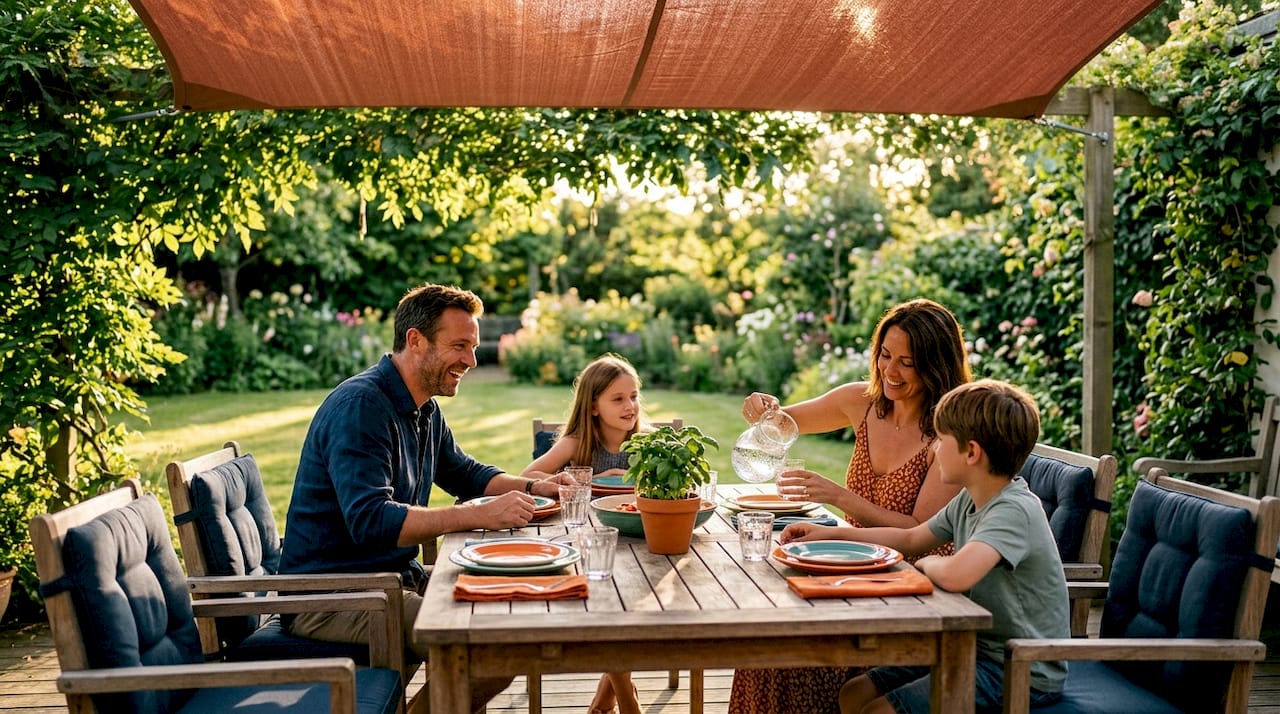
A shaded dining area is defined as any outdoor eating space where a combination of structures, materials, or vegetation is used to block direct solar radiation, reduce thermal exposure, and improve comfort for guests or residents. Whether you manage a restaurant terrace in Yorkshire or want to make your garden patio usable through a British summer, the principles are the same. The right shade solution transforms an underused space into one people actually want to spend time in. This guide covers the best shade types, design strategies, installation steps, and the health benefits that make outdoor shading worth every penny.
What are the best shade options for patios and dining areas?
The most effective shade options for patios fall into four categories: roller shades, shade sails, retractable awnings, and pergolas. Each suits a different budget, aesthetic, and level of permanence. Knowing the trade-offs before you commit saves both money and frustration.
Roller shades and fabric panels
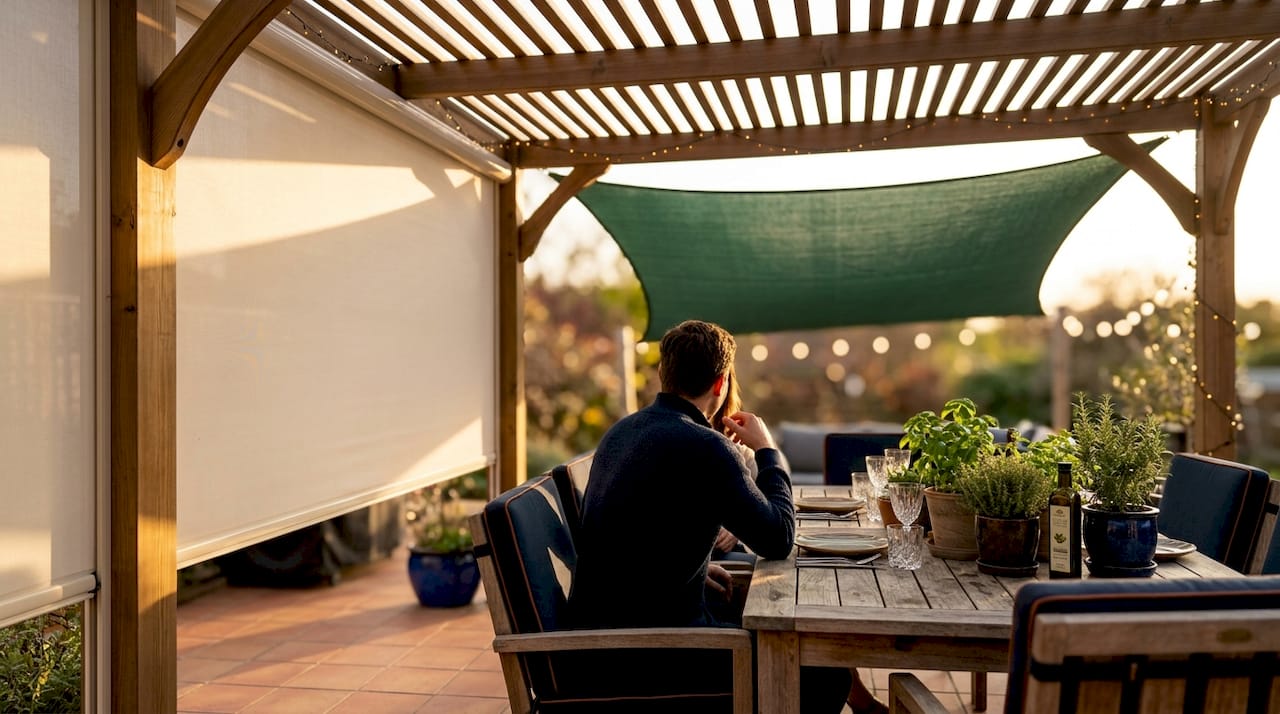
Outdoor roller shades, such as those made by Coolaroo, block up to 90% of UV rays while remaining breathable enough to allow airflow beneath. That breathability matters more than most people realise. A solid PVC blind traps heat; a knitted HDPE shade like Coolaroo’s dissipates it. For windy sites, retractable versions are preferable because fixed shades can act as sails and sustain structural damage in gusts. Roller shades also reduce glare and provide privacy without fully enclosing the space, which keeps the outdoor feel intact.
Shade sails and pergolas
Shade sails offer architectural presence at a relatively low cost. They work best when tensioned between three or four anchor points at different heights, which creates the angled geometry that sheds rainwater. A slope of around 25% is the accepted standard for effective drainage without sacrificing headroom. Too steep and guests feel enclosed; too flat and water pools. Pergolas take this further by providing a fixed overhead framework that can carry climbing plants, retractable canopies, or louvred roof panels. Brands like Weinor and Tarasola, both supplied by Infinityawnings, produce motorised louvred pergolas that adjust to sun angle throughout the day.
Retractable awnings and umbrellas
Retractable awnings are the most flexible patio shading solution for spaces where sun exposure changes significantly across the day. Motorised shades can be set on timers or controlled remotely, which is particularly useful for restaurant operators who cannot monitor conditions constantly. Large cantilever umbrellas serve a similar purpose for smaller zones or individual tables, though they require secure bases and are less suited to high-wind environments.
Shade type | Best for | Key material | Maintenance level |
Roller shades (HDPE) | Patios, verandas | Knitted HDPE fabric | Low |
Shade sails | Open gardens, terraces | PVC or HDPE | Low to medium |
Retractable awnings | Flexible coverage | Acrylic or PVC fabric | Low |
Pergolas with canopy | Permanent structures | Aluminium frame, fabric or louvres | Medium |
Umbrellas | Individual table zones | Polyester or acrylic | Low |
Pro Tip: For mixed-use spaces that serve both lunch and evening diners, combine a fixed pergola for structural shade with retractable side screens from brands like Llaza or Selt. This gives you year-round flexibility without committing to a fully enclosed structure.
Material selection directly affects how long your shade investment lasts. HDPE resists UV degradation and cleans easily. PVC offers higher opacity and better waterproofing but traps more heat. Bamboo looks attractive but degrades faster in wet British conditions and requires seasonal treatment. For most UK patios, solution-dyed acrylic or knitted HDPE offers the best balance of durability, appearance, and performance.
How to plan and design a shaded dining area
Shade should be treated as a performance design issue, not a decorative afterthought. That means mapping sun paths before you buy anything.
Start by observing your space at three points in the day: 10am, 1pm, and 4pm, on a clear day in late spring or early summer. Note where direct sun falls at each time and which areas remain in shade. This tells you where fixed structures will deliver the most value and where a retractable solution is needed to cover shifting sun angles.
Zoning your outdoor dining space
Dividing your outdoor area into functional zones makes shade design far more precise. A typical layout separates dining, lounging, and food preparation or service areas. Each zone has different shade requirements. Dining zones need overhead shade from roughly 11am to 3pm when solar intensity peaks. Lounge zones benefit from side screening in the late afternoon when low-angle sun causes glare. Service or cooking zones need shade that does not obstruct movement.
Map the sun path across your specific site before purchasing any structure
Identify peak dining hours and match shade coverage to those times
Zone the space into dining, lounge, and service areas with separate shade strategies
Allow for airflow channels between structures to prevent heat build-up
Consider sight lines from inside the building to maintain visual connection with the outdoor space
Pro Tip: For restaurant terraces, position your primary shade structure to cover the tables most visible from the street. Visible comfort signals to passing customers that the space is usable, which directly affects footfall on warm days.
Combining natural shade with structures
Hybrid shade designs that combine vegetation with built structures are preferred by both designers and users for their flexibility and year-round adaptability. A mature tree provides dappled shade that no fabric can replicate, but it cannot be retracted when you want winter sun. The practical approach is to use trees and large shrubs as background shade on the south and west boundaries, then layer retractable structures over the primary dining zone. For plant selection suited to shaded UK gardens, shade-tolerant species can fill gaps where structures end and greenery begins.
Airflow is the factor most designers underestimate. A fully enclosed pergola with solid roof panels and three fabric walls can become uncomfortably warm on still days. Leave at least one side open to the prevailing wind, or specify louvred roof panels that vent heat upward while blocking direct sun.
How to install and maintain outdoor shade structures
The installation process varies by shade type, but the principles of safe anchoring, correct tension, and drainage planning apply across all of them.
Survey and mark anchor points. For shade sails, identify three or four fixing points that allow a minimum 20-degree angle difference in height between attachment points. For awnings, locate wall studs or use a structural bracket rated for the awning’s wind load.
Check ground and wall conditions. Masonry fixings into soft brick or ageing mortar fail under load. Use resin anchors in older walls and consult a structural engineer if you are mounting a large pergola onto a domestic property.
Install the frame before the fabric. For pergolas and awning brackets, fix the frame first and check it is level before attaching any fabric or mechanism.
Tension shade sails correctly. Under-tensioned sails sag, pool water, and flap in wind. Over-tensioned sails stress fixings and distort the fabric. Aim for firm tension with no visible slack, but stop before the fabric drum-tightens.
Test drainage before use. Pour water onto the installed shade and observe where it runs. Adjust slope or add drainage channels if water pools near seating.
For retractable awning installation, the critical step is ensuring the wall bracket is fixed into a load-bearing surface. An awning that pulls away from the wall in a storm is a safety hazard, not just an inconvenience.
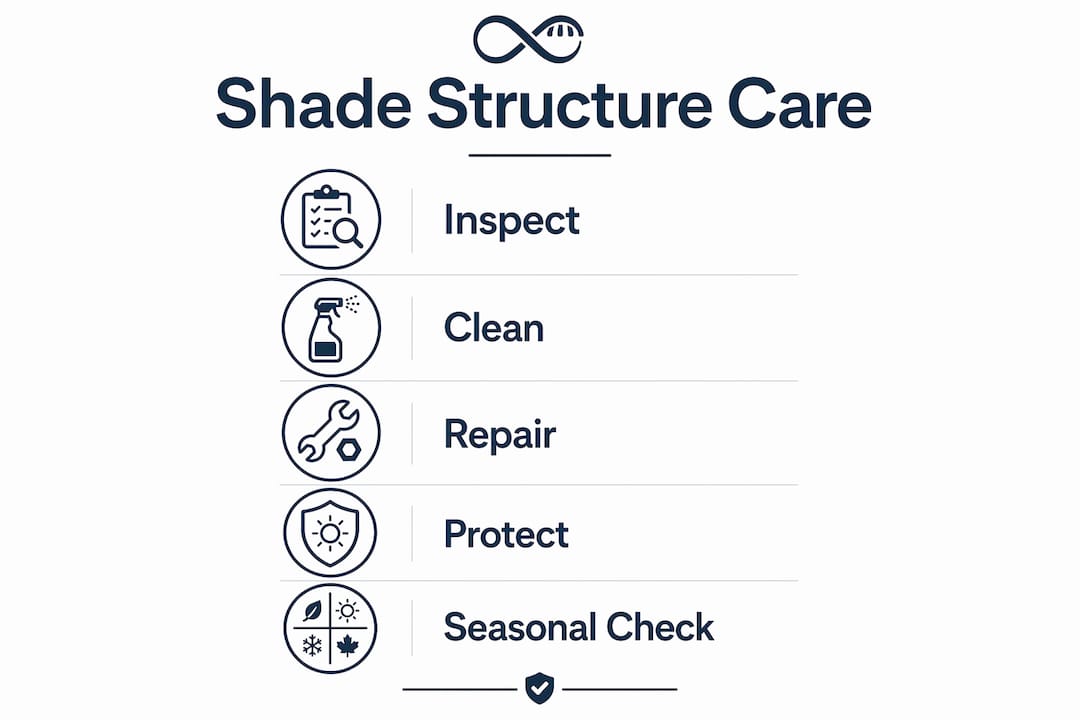
Maintenance task | Frequency | Method |
Fabric cleaning | Every 2 to 3 months | Soft brush and mild soap solution |
Frame inspection | Twice yearly | Check fixings, joints, and corrosion |
Retraction mechanism lubrication | Annually | Silicone spray on moving parts |
Seasonal storage (umbrellas) | Before winter | Clean, dry fully, store in a bag |
Shade sail re-tensioning | After each winter | Check and adjust turnbuckles |
Cord safety on roller shades is a genuine concern in households with young children or pets. Specify cordless or motorised operation wherever possible, or use cleats mounted out of reach to secure any loose cords.
How does shade design improve health and comfort outdoors?
Shade structures do more than block sunlight. Membrane shade structures reduce summer thermal exposure by 1.9 to 3.9 degrees Celsius and lower deep body temperature by up to 1.6 degrees Celsius, which measurably reduces heatstroke risk during peak summer hours. That is not a marginal improvement. For a restaurant with a south-facing terrace, it is the difference between a fully booked lunch service and empty tables.
“Thermal comfort depends on microclimate factors like radiation temperature and airflow. Shade effectiveness is not just about coverage but about how it modifies the surrounding environment.” — Membrane Structures as a Shelter Solution for Privately Owned Public Spaces
The UV protection provided by quality shade fabrics is a separate benefit from thermal comfort. A Coolaroo-grade HDPE fabric blocking 90% of UV radiation significantly reduces cumulative sun exposure for guests who spend two or more hours outdoors. For hospitality venues, this is a genuine duty-of-care consideration, not just a selling point.
Supporting features extend the usability of shaded spaces beyond summer. Infrared heaters mounted to pergola beams allow outdoor dining into October in most parts of Yorkshire and Lincolnshire. Mist spray systems attached to shade structures lower the perceived temperature by a further two to three degrees on very hot days. LED lighting integrated into pergola frames extends evening use without requiring separate electrical installation. These additions turn a seasonal shade structure into a year-round outdoor room.
Key takeaways
Creating shaded dining areas requires layering structures, materials, and vegetation to match sun exposure, airflow, and usage patterns across the day and season.
Point | Details |
Choose materials carefully | HDPE and acrylic fabrics outperform PVC for breathability and UV protection in UK conditions. |
Design for sun timing | Map sun paths at 10am, 1pm, and 4pm before positioning any fixed structure. |
Layer shade sources | Combine trees, pergolas, and retractable screens to cover shifting sun angles throughout the day. |
Prioritise thermal comfort | Membrane structures reduce ambient temperature by up to 3.9°C, directly lowering heatstroke risk. |
Extend usability with add-ons | Infrared heaters and LED lighting convert seasonal shade structures into year-round outdoor spaces. |
What I have learned from 15 years of shade installations
The single biggest mistake I see, both in residential gardens and commercial terraces, is treating shade as the last item on the project list. Clients spend months choosing paving, furniture, and planting, then ask us to fit an awning around whatever space is left. That approach produces compromises: awnings mounted too low, shade sails that miss the peak sun window, pergolas positioned for aesthetics rather than orientation.
The projects that work best start with shade as the primary design constraint. Once you know where the overhead structure sits and what it covers, everything else arranges itself around it. Furniture placement, planting zones, lighting positions. They all follow the shade logic rather than fighting it.
For restaurant operators specifically, zoning shade by seating area rather than covering the whole terrace uniformly is the approach that delivers the best return. You do not need to shade every table at every hour. You need to shade the right tables at the right times. A combination of a fixed pergola over the central dining zone and retractable awnings over the perimeter tables gives you that precision without the cost of a full enclosure.
I also think the industry undersells the winter case for shade structures. A well-specified pergola with a motorised louvred roof, side screens, and infrared heaters is not a summer product. It is an outdoor room that operates for ten months of the year in most of the UK. The return on investment looks very different when you calculate it on that basis rather than on a three-month summer season.
For homeowners in Yorkshire and Lincolnshire, the UK-specific benefits of quality shade structures are often underestimated precisely because our summers feel unpredictable. But the data on thermal comfort improvements is consistent, and the difference between a shaded and unshaded patio on a 25-degree day is not subtle.
— Andrew
Transform your outdoor dining space with Infinityawnings
If this guide has clarified what your outdoor dining space needs, Infinityawnings can take it from plan to installation. With over 15 years of experience across Yorkshire, Derbyshire, Nottinghamshire, and Lincolnshire, the team supplies and installs premium pergolas from brands including Weinor, Tarasola, and Morvelle, alongside motorised retractable awnings, verandas, and side screens. Every solution is customisable: fabric colour, frame finish, LED lighting, and integrated heating are all available as part of a single installation.
Whether you are a homeowner wanting to reclaim your garden patio or a restaurateur looking to extend your terrace season, Infinityawnings offers a free, no-obligation quote. Contact the team to discuss your space and get a tailored recommendation.
FAQ
What is the most effective shade structure for outdoor dining?
Pergolas with motorised louvred roofs offer the most flexible and durable solution for outdoor dining, allowing adjustment to sun angle and weather conditions throughout the day. Retractable awnings are the best option where a permanent structure is not suitable.
How much UV protection do outdoor shade fabrics provide?
Quality HDPE fabrics such as those used by Coolaroo block up to 90% of UV rays while remaining breathable. This level of protection significantly reduces cumulative UV exposure for guests dining outdoors over extended periods.
Can shade structures reduce the temperature under them?
Yes. Membrane shade structures reduce ambient thermal exposure by 1.9 to 3.9 degrees Celsius and lower deep body temperature by up to 1.6 degrees Celsius, which meaningfully reduces heat stress during summer peak hours.
What slope is needed for a shade sail to drain properly?
A slope of approximately 25% is the standard for effective water drainage from a shade sail, according to shade sail design guidance. Shallower angles cause pooling; steeper angles reduce headroom and comfort.
How do I extend outdoor dining into autumn and winter?
Infrared heaters mounted to pergola frames and motorised side screens allow outdoor dining spaces to remain comfortable well into October across most of the UK. LED lighting integrated into the structure extends evening use without separate electrical work.
Recommended
Comments