
Eco-friendly school shelter ideas: a procurement guide
- Andrew Crookes

- 10 minutes ago
- 9 min read
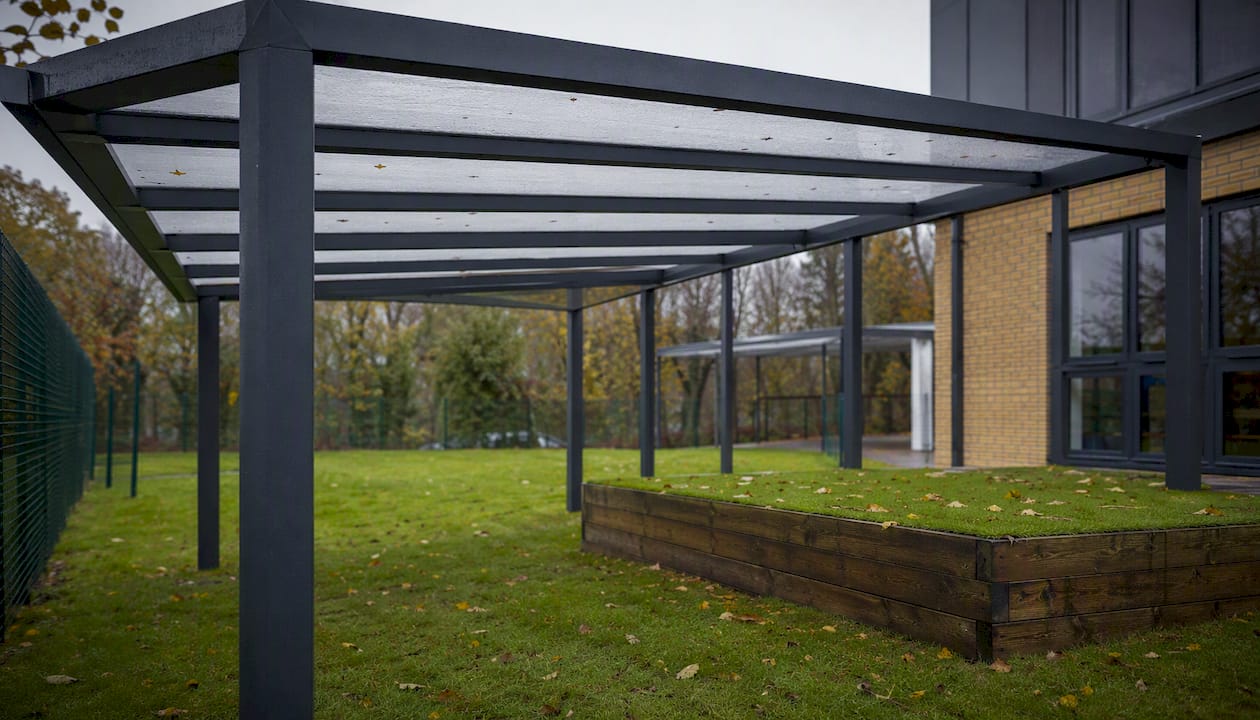
For schools looking to create durable, year-round outdoor learning spaces, the most reliable solution is a professionally supplied and installed eco-friendly pergola, veranda, or retractable awning built with sustainable materials. Not a tarpaulin canopy. Not a temporary gazebo. A bespoke, structurally sound shelter that a professional has surveyed, specified, and installed with school use in mind.
Why does professional supply and installation matter? Three reasons:
A site survey identifies drainage, wind exposure, access routes, and foundation requirements before a penny is committed.
A bespoke specification matches the structure to your school’s curriculum needs, pupil numbers, and site constraints rather than forcing a standard product to fit.
Manufacturer warranties and maintenance plans protect the investment and keep the structure safe and compliant for years.
The immediate next step: contact a supplier with school experience and request a free site survey. Everything else follows from that.
Key takeaways
Professionally installed eco-friendly school shelters deliver measurable improvements in outdoor learning frequency, pupil wellbeing, and year-round usability when specified with sustainable materials and backed by a maintenance plan.
Point | Details |
Start with a site survey | A professional survey identifies drainage, wind loading, and access issues before any commitment is made. |
Choose materials for whole-life performance | Recyclable aluminium typically outperforms timber on whole-life cost; FSC timber suits schools with active maintenance programmes. |
Insist on warranties and a maintenance plan | Both protect the investment, keep the structure safe, and preserve warranty cover over time. |
Use research to justify the spend | Natural Connections (125 schools, 40,000+ pupils) and LOtC systematic reviews provide peer-reviewed evidence for governors and funders. |
Infinityawnings for school projects | Infinityawnings offers free site surveys, bespoke specification, and sustainable material options across Yorkshire and surrounding counties. |
Table of Contents
How do professionally installed shelters improve outdoor learning and wellbeing?
What eco-friendly design and material options should schools consider?
How do you commission a school shelter? A step-by-step checklist
What planning, safety, and accessibility checks do schools need to make?
What does a school shelter cost, and where can you find funding?
What happens during installation, and what maintenance does a shelter need?
Why schools underestimate the procurement side of sustainable shelters
How Infinityawnings can help schools commission a sustainable shelter
How do professionally installed shelters improve outdoor learning and wellbeing?
The evidence is consistent. Systematic reviews link time spent outdoors and nature-based activities to higher physical activity levels and measurable mental-health benefits for children and young people, including reduced stress and improved resilience. The barrier most schools face is not motivation but weather and infrastructure.
A professionally installed shelter removes that barrier. It converts an underused playground corner into a reliable, distraction-free teaching space that works in February as well as June. Teachers who previously avoided outdoor lessons because of unpredictable conditions start using the space regularly once a covered, accessible area exists.
The Natural Connections Demonstration Project, which worked with 125 schools and more than 40,000 pupils, reported improved enjoyment, wellbeing, and engagement when outdoor learning was embedded in school practice. Separately, reviews and empirical studies indicate that repeat outdoor learning experiences over multiple weeks can improve academic performance and develop personal and social competencies such as problem-solving and communication.
Key benefits schools consistently report after installing permanent shelters:
Increased frequency of outdoor lessons across all year groups
Improved pupil engagement and behaviour during outdoor sessions
Reduced teacher anxiety about weather disruption
Year-round use of previously seasonal outdoor spaces
Contribution to whole-school wellbeing and sustainability goals
What eco-friendly design and material options should schools consider?
The practical shortlist for sustainable school shelters comes down to four main choices: recyclable aluminium frames, FSC-certified timber, high-performance recyclable fabrics, and integrated photovoltaic (PV) panels where the budget and roof orientation allow.
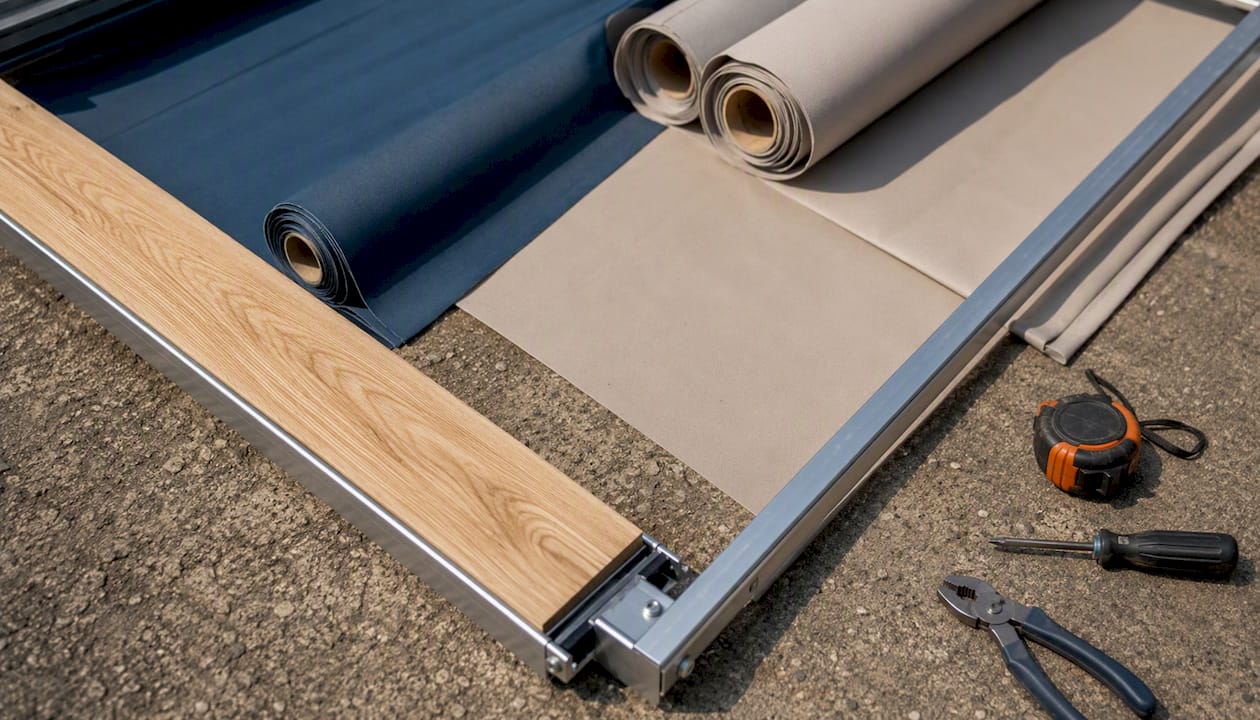
Recyclable aluminium is the workhorse of the sector. It has high embodied carbon at manufacture but is infinitely recyclable, requires almost no maintenance, and carries a service life of 30 years or more. For schools with tight maintenance budgets, that whole-life calculation often wins.
FSC-certified timber carries lower embodied carbon at the point of manufacture and connects naturally to a school’s sustainability narrative. The trade-off is maintenance: timber needs periodic treatment to resist rot and UV degradation, and a school that skips annual checks will find its eco credentials eroding along with the wood.
High-performance recyclable fabrics (used in retractable awnings and canopy roofs) now include options with UV-stabilised, PVC-free, or recycled-content compositions. Fabric choice affects solar shading coefficient, acoustic performance, and end-of-life recyclability.
Integrated PV panels on pergola or veranda roofs generate electricity while providing shade. The upfront cost is higher, but the energy offset and curriculum value (pupils can monitor live generation data) make it worth costing at specification stage.
Pro Tip: Don’t choose timber purely for its lower embodied carbon if your school lacks a maintenance programme. An aluminium structure that lasts 30 years with minimal upkeep has a better whole-life environmental profile than a timber one that needs replacing after 12.
A 2026 review of outdoor learning spaces stresses that flexible, well-designed outdoor spaces support both wellbeing and sustainability, and recommends design features including zoning, good lighting, and seating to maximise usability. Splitting the covered area into zones so that two classes can use the space simultaneously is a detail worth raising with your supplier at specification stage. For detailed guidance on school awning materials, durability, and safety, the Infinityawnings resource covers the key trade-offs clearly.
How do you commission a school shelter? A step-by-step checklist
The procurement sequence is straightforward when you follow it in order:
Site survey — a qualified surveyor visits, assesses drainage, wind loading, access, and foundation options.
Bespoke specification — the supplier produces a written spec covering dimensions, materials, fixings, fabric, and any extras (lighting, heating, sensors).
Written quote — itemised, with lead times, payment terms, and warranty details stated.
Contract — signed before any deposit is paid; should include a project programme and escalation process.
Installation — carried out by the supplier’s own team or a named, vetted subcontractor.
Commissioning and handover — structure signed off, staff trained, documentation handed over.
Questions every school must ask a prospective supplier:
Do you carry out a free, no-obligation site survey before quoting?
What manufacturer warranties do you offer, and what do they cover?
Do you provide a maintenance plan or annual service contract?
Can you supply FSC-certified timber or recyclable aluminium as standard?
Are your fabrics CE or UKCA marked, and do you hold fire-rating documentation?
Can you provide references from other schools or case studies?
Who carries out the installation, and are they trained by the manufacturer?
Red flags to walk away from: no site survey offered, warranties described only verbally, no maintenance plan available, inability to name the product brands being supplied.
For a fuller procurement walkthrough, the Infinityawnings step-by-step guide to choosing school awnings covers specification decisions in practical detail.
What planning, safety, and accessibility checks do schools need to make?
Start with a professional site survey that covers access routes, drainage, fall-hazard zones, and egress. That single step surfaces most of the issues that cause delays later.
On planning permission: government guidance is clear that the need for permission depends on permanence, size, and degree of attachment to land. A fixed, permanent shelter in a conservation area, or one that exceeds the thresholds for permitted development, will require a full planning application. Local planning officer reports show that timber canopies and pergolas are regularly approved where scale, siting, and design respect local character, but schools in listed buildings or conservation areas should check with their local authority before committing to a specification.
Safety checklist for school shelter installations:
Foundations and wind loading — confirm the structural engineer’s calculations cover the site’s wind exposure category.
Fire safety — specify fire-rated fabrics; see the Infinityawnings guide on fire-rated awnings for schools for compliance detail.
Clear circulation routes — minimum 1,500mm clear width for DDA compliance; confirm with your accessibility officer.
Drainage — guttering and downpipes must discharge to an appropriate drain, not onto a play surface.
Insurer notification — inform your buildings insurer before installation; some policies require prior notification for permanent structures.
Pro Tip: Ask your supplier to provide a structural engineer’s wind-loading certificate as part of the handover pack. Insurers and building control officers increasingly expect it, and having it on file saves time if questions arise later.
What does a school shelter cost, and where can you find funding?
Professionally supplied and installed school shelters vary considerably by size, material, and specification. As a working guide:
Entry-level retractable awning (covering a small teaching area, manual or electric): lower cost band, suitable for a single-class space.
Mid-range pergola or canopy (powder-coated aluminium, fixed roof, fabric or polycarbonate panels): mid cost band, covers a larger area and suits year-round use.
Premium veranda or PV-integrated pergola (bespoke, FSC timber or high-spec aluminium, integrated lighting and PV): higher cost band, whole-life cost often lower than mid-range due to energy offset and reduced replacement frequency.
Whole-life cost factors that justify the higher-quality sustainable choice:
Longer service life reduces replacement frequency and associated waste
Lower maintenance costs with aluminium versus untreated timber
Energy savings from PV integration offset running costs over time
A maintenance contract (typically annual) protects warranty cover and extends structural life
Funding routes worth exploring:
School capital budgets and devolved formula capital
PTA fundraising and community grants
Local authority climate adaptation or sustainability funds
Charitable trusts focused on education and outdoor learning
Environmental grants linked to biodiversity or carbon-reduction commitments
When writing a funding application, cite the Natural Connections project outcomes and the LOtC systematic review evidence directly. Governors and funders respond to peer-reviewed evidence, not supplier brochures. Integrating a shelter with a school garden or growing area strengthens the sustainability case further.
What happens during installation, and what maintenance does a shelter need?
A typical installation runs across four to six weeks from contract signing to handover, depending on lead times for bespoke components.
Site preparation — groundworks, drainage connections, and foundation excavation.
Foundation pour — concrete bases cured before any steelwork is erected (allow 48–72 hours minimum).
Frame delivery and erection — structural frame installed and checked for level and plumb.
Roof and fabric installation — panels, glazing, or fabric fitted and tensioned.
Electrical and ancillary works — lighting, sensors, or PV connections completed by a qualified electrician.
Commissioning and staff handover — supplier walks the site manager through operation, maintenance requirements, and warranty terms.
Annual maintenance schedule:
Spring inspection — check fixings, seals, and fabric tension; lubricate moving parts on retractable systems.
Fabric care — clean with manufacturer-approved solution; inspect for UV degradation or tears.
Structural check — inspect welds, brackets, and drainage channels; clear any debris from gutters.
Warranty review — confirm any warranty-linked service requirements have been met and documented.
A service contract with your installer is worth the annual fee. It keeps the warranty valid, catches minor issues before they become expensive, and gives you a named contact when something needs attention. The Infinityawnings guide on school awning maintenance sets out a proven step-by-step schedule.
What does the evidence say? A case example and key research
A primary school in the East Midlands installed a bespoke powder-coated aluminium pergola with retractable fabric panels across a previously unused courtyard. Within one term, the proportion of teachers using the space for lessons had risen from occasional to weekly, and the school reported improved pupil focus and reduced disruptive behaviour during outdoor sessions. The structure was specified with recyclable aluminium, fire-rated fabric, and integrated LED lighting, and was installed over four days with no disruption to the school day.
That outcome aligns with what the research consistently shows:
Key research sources for your business case:
LOtC Summary of Evidence (November 2022) — systematic review evidence on physical activity and mental health
Gov — programme outcomes across 125 schools
Institute for Outdoor Learning: benefits of outdoor learning — academic performance and personal skills evidence
Outdoor Learning in Northern Ireland’s Schools, 2026 — design and wellbeing recommendations
Why schools underestimate the procurement side of sustainable shelters
Schools spend considerable energy choosing the right material and almost none on qualifying the supplier. That is the wrong order.
The material choice matters, but it is downstream of a more fundamental question: does this supplier actually understand school environments? A company that has never navigated DDA requirements, fire-rating documentation, or a school’s term-time installation constraints will create problems that no amount of FSC timber can fix.
The suppliers worth commissioning are the ones who lead with a site survey, hand over a structural engineer’s certificate at completion, and offer a named contact for the maintenance contract. Those are not nice extras. They are the minimum standard for a structure that will be used by children.
Eco credentials are real and worth specifying. But they are a secondary filter, applied after you have confirmed the supplier can deliver a safe, warranted, professionally installed structure. Get that right first.
How Infinityawnings can help schools commission a sustainable shelter
Infinityawnings designs, supplies, and installs bespoke pergolas, verandas, and retractable awnings for schools across Yorkshire, Derbyshire, Nottinghamshire, and Lincolnshire, with sustainable specification options including recyclable aluminium frames and FSC-certified timber.
Every school project starts with a free site survey. From there, the team produces a bespoke written specification covering materials, dimensions, fabric choice, and any extras such as LED lighting or weather sensors. Products are supplied from established manufacturers including Weinor, Llaza, Selt, Tarasola, and Morvelle, all carrying manufacturer warranties. Maintenance plans and annual service contracts are available as standard.
To see the range of school-ready pergola options or to request a free site survey, contact Infinityawnings directly. A surveyor will visit, assess your site, and produce a no-obligation written quote.
Sources
Use these sources directly in any business case presented to governors, a trust board, or a funding body:
Recommended
Comments