
Explaining pergola louvre systems: a full guide

TL;DR:
Modern louvre pergolas utilize precisely engineered aluminium blades that rotate up to 140°, offering adjustable ventilation and rain protection. They feature integrated drainage channels, smart sensors, and certified weatherproofing, making them suitable for UK climates and smart home integration. Proper design, drainage sizing, and sensor tuning are essential for optimal performance and durability.
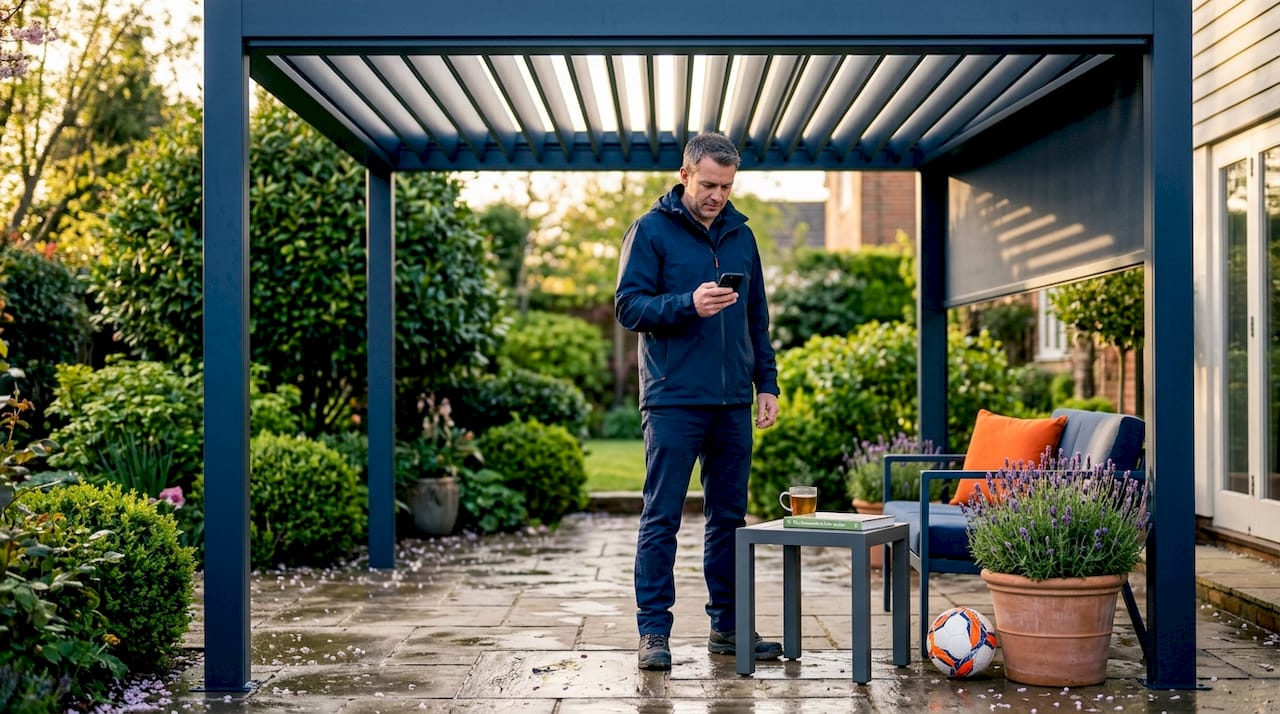
If you’ve been exploring pergola options and wondering why some seem far more versatile than others, the answer almost always comes down to the roof. Explaining pergola louvre systems properly means going beyond “adjustable slats.” These are precisely engineered structures that manage rain, control airflow, respond to sensors, and connect to your smart home. Whether you’re a homeowner wanting year-round outdoor living or a developer specifying outdoor structures for a project, understanding how louvre systems work will fundamentally change how you evaluate what’s on the market.
Table of Contents
Key takeaways
Point | Details |
Adjustable blades, serious engineering | Aluminium louvre blades rotate through up to 140° to shift between full ventilation and a watertight seal. |
Drainage is built in | Internal channels within the blades direct rainwater to concealed gutters inside the pergola posts. |
Sensors reduce wear and effort | Rain, wind, and sun sensors automate blade positioning while a post-rain hold timer protects the motor from excessive cycling. |
Performance must be tested | Recognised standards cover rain resistance, airflow, and wind loading — choosing a certified system protects your investment. |
Smart home integration is now standard | Modern louvre pergolas connect to Bluetooth, Matter, and voice control platforms for effortless daily use. |
How louvre pergola systems actually work
Most people picture a pergola as a fixed timber frame with open rafters. A louvre system turns that expectation completely on its head. Bioclimatic pergolas use a series of aluminium blades that can rotate through a full 140° arc, meaning you can go from a fully open position that allows maximum airflow to a completely closed position that sheds rain just as effectively as a solid roof.
The blade profiles are not simply flat panels. They are precision-extruded aluminium sections designed so that when fully closed, each blade interlocks with its neighbour, forming a continuous watertight seal across the entire roof span. That interlocking geometry is what separates a high-quality louvre system from a cheaper imitation. If the profiles are not machined to tight tolerances, even a small gap under load will let water through.
All blades are driven by a single motor connected to a concealed linkage system that runs across the pergola frame. This matters enormously. When one motor moves every blade simultaneously through the same mechanical linkage, every blade closes to exactly the same angle at exactly the same time. Systems that use individual blade actuators introduce the risk of differential movement, where one blade closes fractionally faster than its neighbour and breaks the seal.
Key mechanical features to look for when choosing a system:
Blade profile depth: Deeper profiles handle heavier rain loads without flexing
Motor IP rating: Motors should carry an IP67 rating for full protection against water and dust ingress in year-round British weather
Linkage housing: Concealed within the frame perimeter, protecting mechanisms from UV and corrosion
Blade coating: Powder-coated aluminium resists weathering far better than painted steel or timber
Pro Tip: Ask any supplier to demonstrate the fully closed position under a hose test before installation. A well-engineered system should show zero water ingress along the blade junctions, even under sustained water pressure.
Weatherproofing and drainage design
Closing the blades is only half the story. Once rain hits a closed louvre roof, that water has to go somewhere, and where it goes is determined entirely by how well the drainage system was designed.
Effective weatherproofing in a quality louvre system relies on internal channels moulded into each blade profile. Water landing on a closed blade surface flows along these channels towards collection points at the blade ends, where it enters concealed gutters running inside the pergola’s structural posts. From there, it travels down through the posts and exits at ground level via standard downpipes, all without a single visible gutter on the outside of the structure.
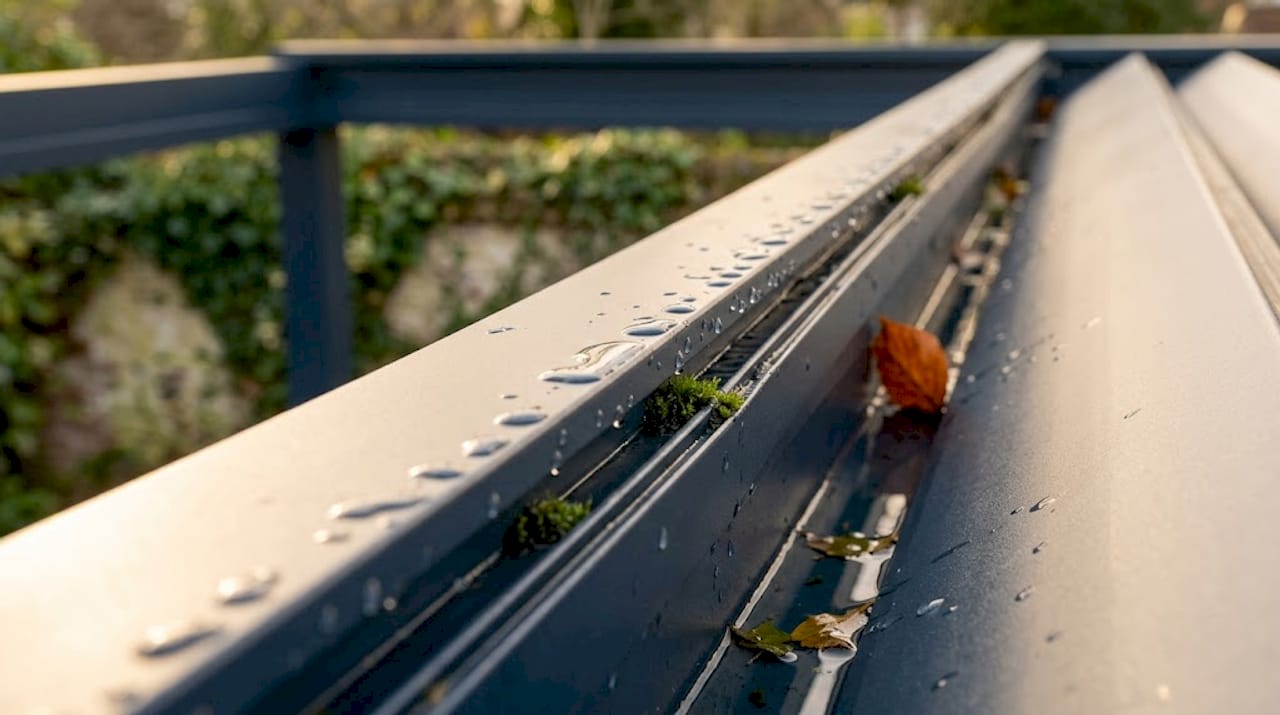
Getting the drainage sizing right matters far more than most buyers realise. BS EN 12056-3:2000 sets the standard for gutter and downpipe sizing in the UK using a design rainfall intensity of 75 mm per hour for most regions. If your pergola covers a large area and the internal gutters are undersized for that rainfall rate, water will back up, overflow into the frame, and eventually reach the structure below.
The table below gives a practical illustration of how roof area relates to drainage requirements under UK standard conditions:
Roof area (m²) | Minimum gutter profile (mm) | Minimum downpipe diameter (mm) | Typical risk if undersized |
Up to 10 | 75 | 63 | Low overflow risk |
10 to 25 | 100 | 75 | Moderate, monitor in heavy rain |
25 to 50 | 125 | 90 | High risk without adequate fall |
Over 50 | 150+ | 110+ | Structural water ingress risk |
Pro Tip: Drainage is a design-stage decision, not an afterthought. Confirm that your installer has calculated gutter capacity against the actual roof area and local rainfall data before the order is placed. Changing internal gutter sizing after installation is far more disruptive than specifying correctly at the outset.
Sensors and smart automation
The difference between a good louvre pergola and a genuinely practical one often comes down to how intelligently it responds to changing weather. Manual control via a remote or wall switch is fine on a still, clear day. It is considerably less convenient when a shower arrives mid-afternoon while you’re inside cooking.
Sensor-based automation allows the system to close the blades, adjust the lighting, and trigger any connected heating without you lifting a finger. Rain, wind, and sun sensors each play a distinct role, and understanding how they interact helps you get the most from the system.
A typical automated sequence when rain is detected runs as follows:
Rain sensor triggers: The detector registers moisture and sends a signal to the control unit
Staged closure begins: Blades begin rotating towards the closed position at a controlled speed, avoiding sudden mechanical stress
Fully closed position reached: The interlocking seal engages and the roof is weatherproof
Post-rain hold activates: The system waits for a configurable period (typically 10 to 20 minutes) after the rain sensor reads dry before reopening
System returns to pre-set position: Blades reopen to the stored preferred angle or await a manual override
That post-rain hold timer is worth understanding in detail. Intermittent rain, the kind that starts and stops repeatedly on a typical British afternoon, would cause a system without a hold timer to cycle open and closed dozens of times in an hour. That mechanical repetition accelerates wear on the motor and linkage far more than normal daily operation.
For wind response, wired sensors are strongly preferred over RF wireless alternatives. When wind speed exceeds the structural threshold, the system needs to respond within milliseconds. RF signals can suffer from interference or brief dropouts. A wired wind sensor eliminates that latency risk and protects the integrity of the structure during high-wind events, which in exposed Yorkshire or Lincolnshire gardens can arrive with very little warning.
Sensor automation also extends to sun tracking and lighting control. A sun sensor can angle the blades to track the optimal shading position through the day, and when light levels drop in the evening, the system can trigger LED lighting scenes automatically. You can also read more about how wind sensor technology protects outdoor structures more broadly.
Performance trade-offs and testing standards
Here is something most product brochures will not tell you directly: the engineering decisions that make a louvre system highly weatherproof are often in tension with those that maximise airflow. You cannot always have both at maximum simultaneously, and understanding that trade-off helps you specify a system that genuinely suits your climate and usage patterns.
AS 4740:2025 covers rain resistance, airflow discharge coefficients, and wind loading as separate performance classifications for louvre systems. A roof tested to the highest rain resistance rating achieves that score with very tight blade profiles and steep drainage angles. Those same geometry choices reduce the discharge coefficient, meaning less air moves through the blades when they are partially open. In a hot, sheltered courtyard, that compromise matters. In a windswept northern garden where rain resistance is the priority, it might be exactly what you want.
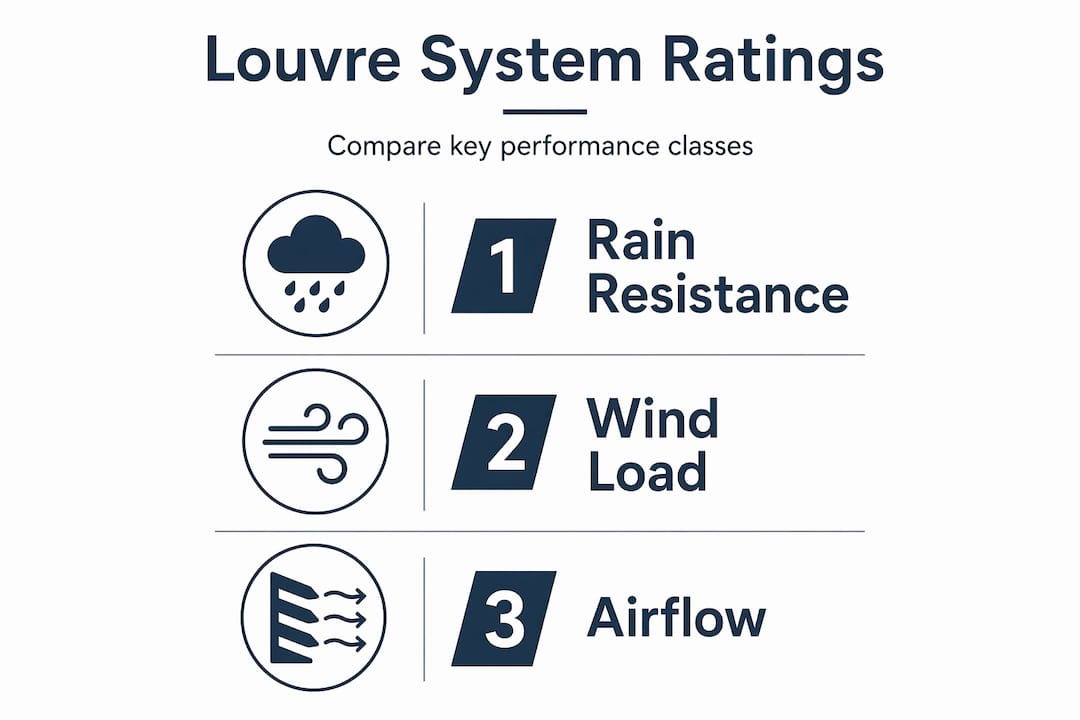
The table below summarises the key performance dimensions and what they mean in practice:
Performance dimension | What it measures | Implication for homeowners |
Rain resistance class | Volume of water shed without ingress | Higher class = tighter seal, potentially less airflow |
Airflow discharge coefficient | Volume of air passing through at given pressure | Higher value = better natural ventilation in summer |
Wind load rating | Structural load the frame withstands | Critical for exposed or elevated sites |
UV resistance (coating) | Colour and structural stability under sunlight | Matters most in south-facing installations |
Always ask a supplier for certified test data, not just marketing claims. A system with validated performance classifications gives you a basis for comparison. One without that documentation may perform well, or it may not. You have no way of knowing until it is already bolted to your house.
Benefits and practical considerations
Once you move past the mechanics, the real-world benefits of pergola louvres become compelling for both homeowners and property developers.
An all-season outdoor room is not an exaggeration when the system is properly specified. Open the blades fully on a warm summer evening and the space feels completely open to the sky. Close them during a November shower and the covered area underneath remains usable. That flexibility directly increases the number of days per year you actually use the space, which is ultimately what justifies the investment.
Key benefits and selection factors worth weighing:
Longevity: Powder-coated aluminium frames and blades require minimal maintenance compared to timber equivalents, with no annual treatment required
Property value: A professionally installed louvre pergola adds usable square footage to a property in a way that a simple canopy does not
Smart integration: Modern systems, including those with Bluetooth and Matter compatibility, connect to Apple Home, Google Home, and Amazon Alexa without additional hardware
Installation speed: Modular systems now include patent-pending louvre designs that reduce assembly time from over an hour to under 15 minutes per section
Customisation: RAL colour matching, integrated LED lighting, and motorised side screens can all be specified at the design stage
Before committing, assess your specific site. A garden in Sheffield with frequent west-facing wind exposure needs a different specification to a sheltered courtyard in Lincoln. Rainfall totals in your region, the load-bearing capacity of any wall the pergola attaches to, and the total roof area all feed directly into what drainage and structural specification is appropriate.
My honest view on pergola louvres
I’ve had the opportunity to observe a lot of louvre pergola installations across Yorkshire and the wider region, and the pattern of what separates a successful project from a frustrating one is remarkably consistent.
The single most common mistake I see is treating the drainage specification as an afterthought. Homeowners focus, understandably, on the aesthetics and the blade movement. Then the first heavy summer storm arrives and water backs up into the posts because the internal gutter profile was sized for a smaller roof than what was actually installed. That is not a manufacturing defect. It is a specification error that could have been avoided with a proper design review before ordering.
The second thing I would flag is sensor tuning. Out-of-the-box sensor sensitivity settings are often too aggressive for typical British intermittent rain. A system that closes at the first hint of drizzle and holds closed for 30 minutes every time will frustrate users quickly. I’d strongly recommend asking your installer to adjust the hold timer and rain sensitivity during commissioning, rather than leaving factory defaults in place.
What I genuinely find impressive about modern louvre systems is the quality of smart home integration now available at sensible price points. Five years ago, proper automation meant proprietary systems with expensive dedicated controllers. Today, Matter-compatible systems work with whatever smart home platform you already use. That shift has made the technology genuinely accessible rather than a premium add-on for the technically minded.
Choose a supplier who can provide certified performance data and who treats drainage sizing as a technical calculation rather than a sales conversation. That distinction tells you almost everything you need to know about the quality of what you’ll get.
— Andrew
Explore louvre pergolas with Infinityawnings
If this guide has given you a clearer picture of what a well-engineered louvre pergola can do, the next step is seeing what’s available for your specific space. Infinityawnings designs, supplies, and installs premium pergola systems across Yorkshire, Derbyshire, Nottinghamshire, and Lincolnshire, with more than 15 years of experience specifying the right structure for each site’s conditions. From fully motorised louvre roofs with integrated sensors to customised colour finishes and LED lighting, every installation is built around your requirements. Get in touch for a free quote or browse the full pergola range to see design options and detailed specifications that match what you’ve read here.
FAQ
What is a louvre roof on a pergola?
A louvre roof consists of a series of precision-extruded aluminium blades that rotate to control shade, ventilation, and rain protection. When fully closed, the interlocking blade profiles create a watertight seal and direct rainwater to internal drainage channels.
How do adjustable louvre systems handle rain?
The blades close to a fully sealed position and internal channels within each blade direct water to concealed gutters running through the pergola posts. Proper drainage sizing based on BS EN 12056-3:2000 standards is critical to prevent overflow.
Are pergola louvre systems suitable for the UK climate?
Yes, provided the system carries appropriate wind load ratings and drainage capacity for your specific region. Motors should be rated to IP67 for year-round protection against rain, frost, and coastal conditions.
Can louvre pergolas connect to smart home systems?
Modern louvre pergolas increasingly support Bluetooth and Matter protocols, enabling compatibility with Apple Home, Google Home, and Amazon Alexa for voice and app-based control without additional hardware.
What is the post-rain hold timer on a louvre system?
It is a configurable delay between the rain sensor reading dry and the blades reopening. Its purpose is to prevent the system from repeatedly cycling open and closed during intermittent rain, which would accelerate motor and actuator wear significantly.
Recommended
Comments