
Why consider pergolas for businesses: a practical guide

TL;DR:
Investing in a well-designed pergola enhances outdoor comfort, extends trading hours, and boosts revenue for businesses. Proper material choice, orientation, and professional installation are crucial for maximizing benefits and ensuring longevity. Pergolas serve as architectural assets that improve guest experience, property value, and brand identity while providing a significant return on investment.
Most business owners focus on their interiors when thinking about how to attract and retain customers. The outdoor space is often an afterthought. But when you understand why consider pergolas for businesses goes far beyond simple aesthetics, the calculation changes quickly. A well-designed pergola does not just look attractive. It creates genuinely usable outdoor space, extends your trading hours, reduces energy costs, and gives customers a reason to linger longer and spend more. This guide walks you through everything that matters before making the decision.
Table of Contents
Key takeaways
Point | Details |
Pergolas boost guest comfort | Slatted structures reduce solar radiation by 45–55%, keeping outdoor areas cooler and more inviting for guests. |
Material choice affects longevity | Aluminium outperforms wood for commercial use, offering durability and minimal maintenance over years of heavy use. |
Orientation determines performance | East–west rafter alignment maximises passive shade throughout the day without any moving parts or added cost. |
Revenue potential increases directly | Extra covered seating means more guests served per sitting, increasing turnover during peak trading periods. |
Professional installation is non-negotiable | Code-compliant attachment and thermal break installation prevent structural failure and costly remedial work later. |
Why consider pergolas for businesses: the core benefits
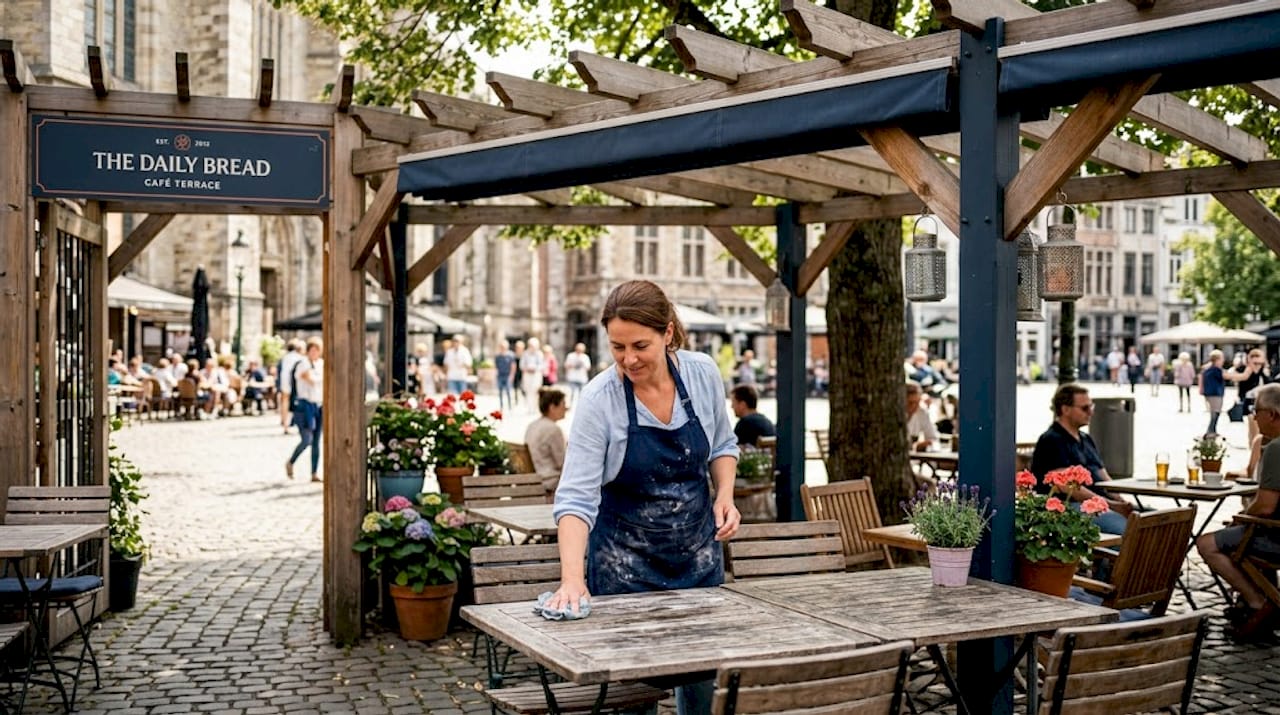
The simplest reason to invest in a pergola is comfort. Guests who are uncomfortable leave sooner. Guests who are shaded, cool, and at ease order another round, linger over dessert, and return next week. That connection between physical comfort and commercial return is the heart of the argument.
Well-designed slatted pergolas with 30–40% openness cut solar radiation by 45–55% while preserving airflow. Add climbing plants to the structure and you can reduce midday temperatures by a further 6–8°C. Compare that to planting trees, which take years to establish and offer no control over coverage. A pergola delivers immediate, measurable cooling from the day it goes up.
The benefits of pergolas for businesses extend beyond temperature alone. Consider what happens to your usable outdoor space:
Covered seating becomes viable in light rain, meaning fewer lost covers on uncertain days
Shade protection reduces glare, making al fresco dining comfortable even in direct sun
Pergolas for outdoor spaces create a defined zone that feels intentional, not improvised, which customers respond to positively
Dwell time increases when guests feel at ease in their surroundings, driving up average spend per visit
Pro Tip: If your outdoor area currently sits empty on hot or overcast days, a pergola is almost certainly the single fastest return on investment you can make to that space.
The impact of pergolas on customer experience is also psychological. Architectural shade structures signal that a business has invested in its guests. A bare concrete patio sends a different message than a thoughtfully covered outdoor room. That distinction matters in a competitive high street or hospitality market.

Materials and structure: what businesses need to know
Choosing the right material for a commercial pergola is not a style question. It is a practical and financial one. The three main options are aluminium, timber, and steel, and each carries different trade-offs.
Aluminium pergolas deliver long-term durability with minimal upkeep, making them the preferred choice for most commercial installations. Timber offers design flexibility and a warmer visual character, but it needs regular treatment to prevent decay and insect damage. In a commercial setting, that maintenance obligation adds cost and downtime. Steel is strong but heavy, and it corrodes without proper coating, which creates ongoing maintenance demands.
“For attached pergolas, engineers specify that the ledger must engage the building’s structural framing rather than only the exterior cladding. Fixing to cladding alone is a leading cause of pergola failure under load.” (Covered Patio Construction)
There are two structural details that businesses frequently overlook:
Ledger attachment: The ledger must transfer loads directly into the building’s frame. Attaching it to brick slips, render, or cladding alone creates a genuine collapse risk under wind or snow load.
Thermal breaks: Metal pergolas attached to buildings without thermal breaks conduct outdoor temperatures directly into the building frame, reducing energy efficiency and potentially causing condensation issues inside.
Permitting: Freestanding pergolas under roughly 200 square feet may fall below permit thresholds in many areas, but attached commercial structures almost always require planning approval and building code compliance.
Lifespan expectations: A correctly installed aluminium pergola in a commercial environment should last 20 to 30 years with basic maintenance. Timber, without treatment, can begin to deteriorate within five to seven years in the UK climate.
Getting these fundamentals right at the design stage costs far less than correcting them after installation.
Design and positioning for maximum impact
Where you place your pergola, and how you orient it, determines how well it actually works. Many businesses install a beautiful structure that underperforms because no one thought carefully about the sun’s path during the design process.
Identify your solar south. This is the direction of the sun at its highest point in the sky. In the UK, that is roughly south, but slightly west of true south in afternoon hours. Your pergola should be oriented to intercept direct sun during your busiest trading hours.
Align rafters east to west. East–west rafter orientation creates passive louvers that block high-angle sun throughout the day. No adjustments needed, no moving components. This single decision significantly improves shade coverage with no added cost.
Account for low-angle sun. Morning and late afternoon sun comes in at a low angle that standard slatted roofs cannot block. Incorporate vertical screening on the east and west faces, whether through fabric side panels, planting, or fixed louvres, to address this.
Match slat spacing to your climate. A 30–40% openness ratio optimises both shade and airflow. Tighter spacing blocks more sun but traps heat beneath. Wider spacing improves ventilation but reduces shade cover. Get the slat spacing right for your specific site orientation.
Consider the aesthetic alongside function. Pergola design for restaurants and hospitality venues should frame views, create privacy from neighbouring tables, and complement brand identity through colour and material choices.
Pro Tip: Walk your outdoor space at the times your guests are most likely to use it, note exactly where the sun falls, and use that observation to brief any installer. Most underperforming pergolas were designed from a plan, not from standing in the space.
Proper orientation and material selection are the two most commonly overlooked factors by business owners investing in outdoor shading. Getting both right from the start makes every other benefit significantly easier to achieve.
The commercial case: revenue and property value
The advantages of installing pergolas are not just about guest experience. They translate directly to financial return. Understanding the economic argument helps justify the investment to stakeholders and makes budgeting conversations more productive.
Pergolas expand capacity and usable seating, positively impacting business turnover and guest satisfaction. For a restaurant with 40 indoor covers, adding even 12 to 16 covered outdoor seats can increase peak-period revenue by a meaningful margin. That capacity is available during good weather and, with the right structure, in light rain too.
Benefit | Without pergola | With pergola |
Outdoor seating viability | Weather-dependent, limited | Extended season, rain-protected |
Energy costs | Higher solar heat gain inside | Shaded walls reduce cooling load |
Brand and kerb appeal | Standard exterior | Architectural feature, visible from street |
Guest dwell time | Shorter in discomfort | Longer with shade and comfort |
Attached pergolas shade windows and walls, reducing solar heat gain and lowering air conditioning costs inside the building. For a commercial premises running cooling systems during summer, that saving is real and recurring every year.
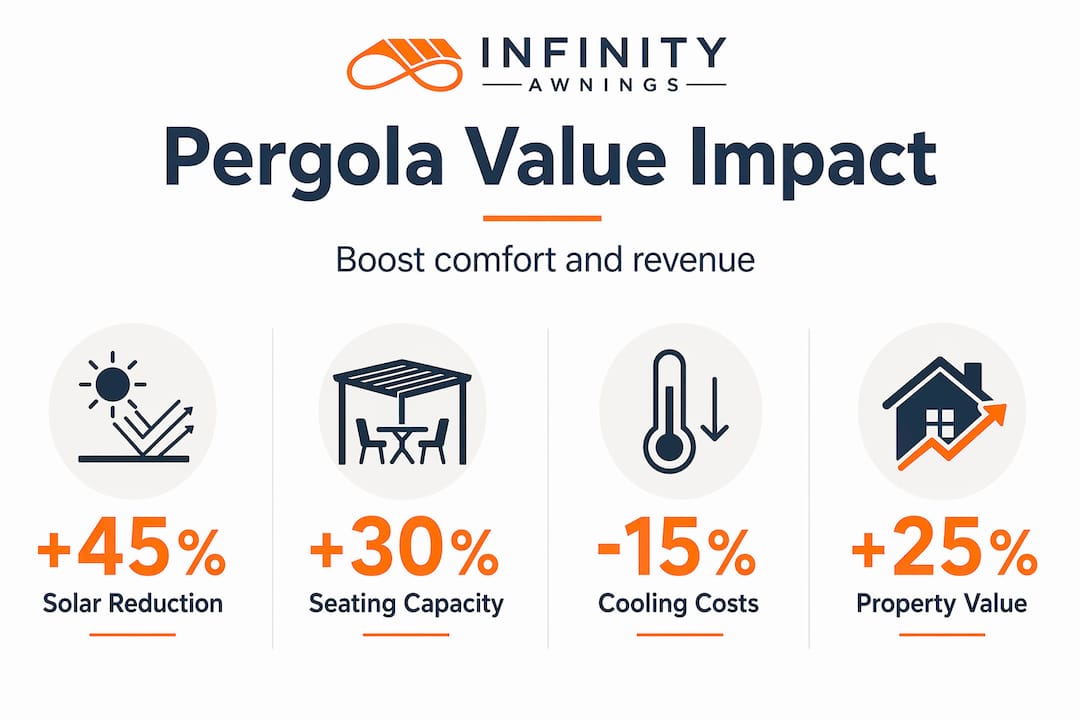
Pergolas serve as architectural features that enhance kerb appeal and encourage longer guest stays. That visibility from the street is also a marketing asset. A well-lit, covered outdoor terrace on a summer evening draws attention in a way that a plain exterior simply cannot. In that sense, pergolas function as a marketing tool for the business, creating a visual identity that extends beyond the front door.
Choosing the right installation partner
The structure is only as good as its installation. Commercial pergola projects involve planning compliance, structural engineering, and site-specific design that generic DIY approaches cannot address reliably.
Professional specialist teams bring precise coordination, skilled installation, and quality material sourcing. That leads to durable, compliant structures that do not require costly corrections six months after completion. Key advantages of working with an experienced installer include:
Accurate site surveys that capture sun angles, prevailing wind, and existing drainage
Design drawings suitable for planning applications, removing that burden from the business owner
Knowledge of commercial-grade fixings, thermal break requirements, and load transfer specifications
Access to premium pergola systems from established manufacturers, rather than off-the-shelf alternatives
Ongoing maintenance support and warranty coverage for commercial use conditions
The pergola installation process for a commercial site involves more coordination than a residential job. Deliveries, installation access, and minimising disruption to trading hours all need planning. An experienced commercial installer manages that process without you having to supervise every detail.
My honest take on commercial pergolas
I have seen businesses spend considerable budgets on outdoor furniture, lighting, and landscaping while leaving the space itself fundamentally unusable for half the year. The pergola almost always should have come first.
What surprises me most is how often business owners expect a pergola to be purely decorative. When someone asks how pergolas enhance business appeal, the conversation almost always gravitates toward appearance. But the real story is in hours. A business that can use its outdoor space reliably from March through October, rather than only on perfect days in July, has a structurally different proposition. That is not an aesthetic argument. It is a trading hours argument.
The other thing I have learned is that the businesses that get the most from their pergolas are the ones that treated the design process seriously. They thought about their customers, their service style, how the space needed to feel at 11am on a Saturday and at 7pm on a Tuesday evening. The ones who just asked for “a pergola for the terrace” often end up with something that works but does not quite sing.
My advice: explore pergola features before you decide on a specification, and approach the brief with as much care as you would give to a kitchen refurbishment. The outdoor space is part of your product. Treat it that way.
— Andrew
How Infinityawnings can help your business
If the case for a commercial pergola makes sense to you, the next step is speaking to a team that understands both the technical and commercial sides of the decision.
Infinityawnings has over 15 years of experience designing and installing pergolas, verandas, and shading solutions for businesses across Yorkshire, Derbyshire, Nottinghamshire, and Lincolnshire. From bars and restaurants to hotels and schools, the team works with commercial clients to design structures that fit the site, suit the brand, and perform reliably in the British climate. With products from manufacturers including Weinor, Tarasola, and Llaza, there is no shortage of options for specification, finish, and functionality. Explore the full range of commercial pergola options or find out how a bespoke veranda might complement your existing outdoor structure. Get in touch for a free consultation and site assessment.
FAQ
What are the main benefits of pergolas for businesses?
Pergolas extend usable outdoor space, improve guest comfort through shade and airflow, increase seating capacity, and reduce energy costs by shading external walls and windows. They also contribute to brand appeal and encourage longer customer stays.
Do commercial pergolas require planning permission?
Attached pergolas almost always require planning approval and building code compliance. Freestanding structures below certain size thresholds may be exempt, but this varies by location and the nature of the business premises. Always check with your local planning authority before proceeding.
Which material is best for a commercial pergola?
Aluminium is the preferred material for most commercial installations due to its durability, weather resistance, and low maintenance requirements. Timber is an option where aesthetics are a priority, but it requires regular treatment to maintain structural integrity in the UK climate.
How does pergola orientation affect performance?
Orienting rafters east to west creates natural passive shade throughout the day by blocking high-angle sunlight. This is the single most effective design decision for maximising shade coverage without relying on adjustable components or adding cost.
Can a pergola genuinely increase my business revenue?
Yes. By increasing covered seating capacity and extending the number of days your outdoor space is viable, a pergola directly raises the number of guests you can serve during peak periods. Combined with longer dwell times driven by improved comfort, the return on investment is well-evidenced for hospitality businesses.
Recommended
Comments