
The role of shading in student wellbeing for school leaders
- Andrew Crookes

- 11 minutes ago
- 11 min read
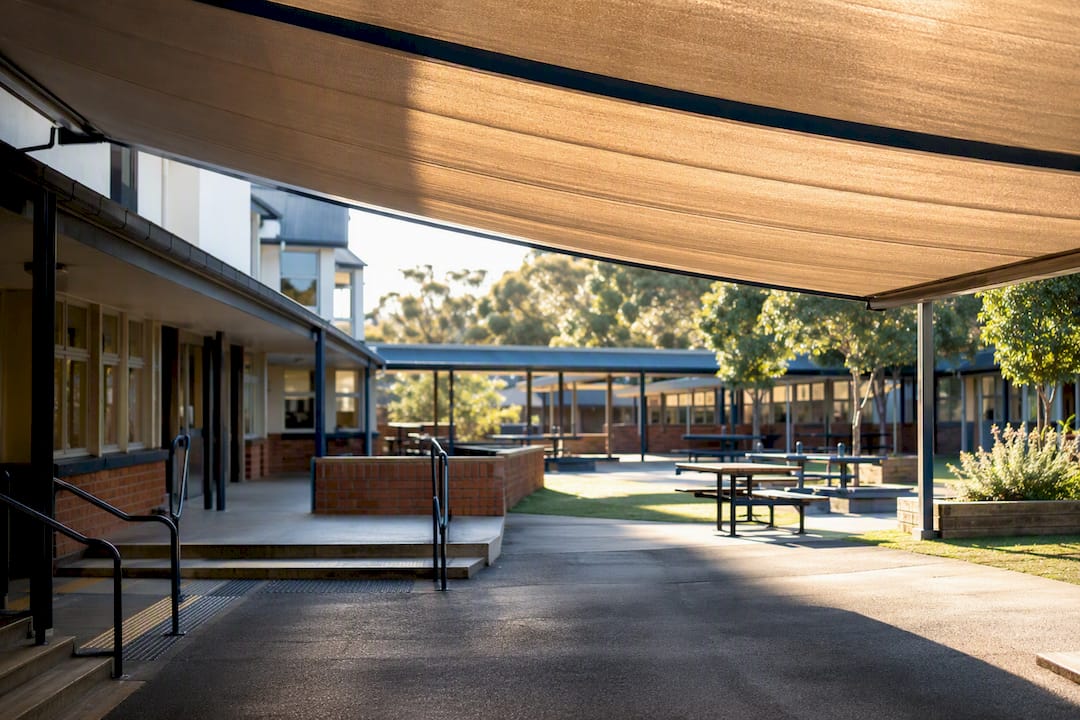
Shading in school grounds cuts heat stress and creates calmer, more sociable outdoor spaces, which in turn improves concentration, mood and inclusion. That claim is backed by a 2024 systematic review in the Journal of Educational Psychology and by physiologically equivalent temperature (PET) data showing shaded students report better thermal and social comfort than sun-exposed peers.
If you manage a school site, three actions matter more than any others right now:
Audit your grounds for shade coverage at peak break and lunch times.
Add targeted shaded seating in the spots students already gather.
Mix living shade (trees) with hard structures such as sails or awnings, since one alone rarely covers the school day.
Specialists like Infinity Awnings can survey a site and recommend which combination suits your layout and budget.
Table of Contents
What does the evidence say about the role of shading in student wellbeing?
The strongest evidence comes from a 2024 systematic review published in the Journal of Educational Psychology, which pooled findings on nature-based school interventions, including outdoor learning spaces, and found consistent improvements in positive affect and peer interaction. Students recover attention faster and report less stress when outdoor time is built into the normal school day rather than treated as an add-on.
A separate mixed-method study across schoolyards in Barcelona tested combined green, blue and grey interventions, tree planting, water features and shade structures, and found reduced perceived heat sensation alongside greater feelings of safety, relaxation and social inclusion. Conflict behaviour dropped after the changes, based on teacher interviews and student photovoice data.
Shaded outdoor spaces reduced mean recorded PET substantially compared with full sun, and students in shaded areas scored notably higher on concentration tests than those working in sun-exposed conditions.
That figure comes from a Bilkent University study using PET, predicted mean vote (PMV) and thermal sensation vote (TSV) metrics, the standard toolkit for measuring how a body actually experiences outdoor temperature rather than just the air reading on a thermometer. Researchers increasingly pair these measurements with ENVI-met microclimate modelling to predict cooling effects before a single structure goes up, which matters when you are justifying spend to a governing board.
How does shading benefit thermal comfort, focus and mood?
Shading works on three levels at once, and school leaders rarely see all three laid out together.
Thermal: lower PET and PMV scores translate directly into fewer overheated, irritable students by mid-afternoon.
Cognitive: the Bilkent research recorded higher concentration scores in shaded conditions compared to sun, a meaningful gap on a standard attention test.
Social and emotional: shaded seating gives students somewhere to decompress; the Canberra Times reported that students actively ask designers for quiet, calm, shaded places to sit, and that these spots particularly help students who are stressed or neurodivergent.
Health: less UV exposure lowers long-term skin cancer risk, and shaded buildings often need less mechanical cooling in summer months.
Combine those four effects and shading stops looking like a comfort extra. It starts looking like infrastructure that touches attendance, behaviour and classroom performance simultaneously.
Which shading strategies work best for school grounds?
No single solution covers every part of a site. Playgrounds, courtyards and covered walkways each demand different trade-offs between cost, permanence and cooling power.
Option | Best suited to | Strengths | Watch-outs |
Mature trees | Large playing fields, boundary areas | Strong PET reduction, low running cost, ecological value | Slow to establish, deciduous species lose leaves in winter |
Shade sails | Playgrounds, informal seating zones | Fast to install, flexible shapes, moderate cost | Fabric degrades faster in exposed sites, needs periodic re-tensioning |
Retractable awnings | Covered walkways, dining and social areas | Adjustable coverage, works year-round, weather sensors available | Higher upfront cost, requires professional installation |
Pergolas | Outdoor classrooms, staff and social courtyards | Permanent structure, supports climbing plants, strong visual anchor | Fixed footprint, less flexible once built |
Fixed overhangs | Building entrances, classroom extensions | Integrated with the building, low maintenance | Only shades the immediate perimeter |
Hybrid setups tend to perform best in practice. Pairing a deciduous tree with a fixed structure gives dense shade in summer while letting winter light through once the leaves drop, something a fabric-only solution can’t do on its own.
Pro Tip: Avoid clustering shade in one corner. Deep, enclosed shaded pockets can become blind spots for supervising staff, so keep sightlines open even when you’re prioritising quiet zones for neurodivergent students.
How should schools plan shading placement?
Getting the design right before procurement saves rework later. Work through these steps during a site audit:
Map shade by time of day. Track sun position across a full school day, not just at lunchtime, since orientation shifts dramatically between morning drop-off and afternoon pick-up.
Assess sky view factor and existing trees. Note which zones already have partial canopy and which are fully exposed.
Plan seating variety. Offer benches, individual seats and adjacent (not just face-to-face) arrangements, since design researchers note many neurodivergent students prefer sitting side by side rather than opposite others.
Check sightlines for supervision. Poorly placed shade can create hidden corners that invite the exact behaviour you’re trying to prevent, so balance quiet zones against visibility.
Confirm accessibility. Surfaces need to support wheelchairs and mobility aids, with seating at varied heights.
Decide on retractable versus fixed. Retractable awnings with electric operation and weather sensors suit spaces used differently across seasons; fixed pergolas suit permanent outdoor classrooms.
Pro Tip: Bring your maintenance team into the design meeting, not just after installation. A structure that’s hard to clean or inspect becomes a liability within two years, whatever the initial cooling performance looks like.
Official guidance from bodies such as the California Department of Education’s outdoor learning framework reinforces the same priorities: accessibility, durable surfacing and researching shade options before committing budget.
How should schools procure and maintain shading structures?
Procurement runs smoothest as a phased sequence: brief assessment, written specification, comparative quotes, a pilot installation on one zone, then wider roll-out once you’ve confirmed it works for your site.
Budget in two separate lines. Capital cost covers the structure itself; ongoing maintenance covers fabric cleaning, frame checks and, for living shade, tree management over years rather than months. Grants for climate-resilient school infrastructure sometimes cover part of the capital spend, so it’s worth checking eligibility before finalising a single-phase plan.
On the supply side, established manufacturers give you warranty backing that a generic fabricator can’t match. Infinity Awnings installs products from Weinor, Llaza, Selt, Tarasola and Morvelle, brands with established track records in commercial and educational settings, which matters when a structure needs to survive a full UK school year of weather.
Schedule fabric inspections at least twice yearly, before and after winter.
Check frame fixings and electrical components (LED lighting, sensors) annually.
Build tree pruning and health checks into your grounds maintenance contract.
Ask your installer about a service contract covering routine checks and rapid repairs.
Pro Tip: Ask any prospective installer how they handle warranty claims on fabric UV degradation specifically. Some suppliers cover frame defects but exclude fabric fading, and that gap catches schools out two or three summers in.
How can schools measure the impact of shading on wellbeing?
You don’t need a research grant to evaluate whether shading is working. Combine a short student and teacher survey with basic microclimate data and simple usage counts.
Measurement type | Method | What it tells you |
Subjective comfort | Pre/post student survey (thermal sensation, stress, willingness to use the space) | Whether perceived comfort and mood improved |
Objective microclimate | Handheld sensor readings or brief ENVI-met modelling | PET or mean radiant temperature change before and after installation |
Usage patterns | Staff logs of outdoor lesson frequency and duration | Whether teachers actually use the new space more |
Ask students simple, direct questions: how comfortable do you feel outside at lunchtime, do you have somewhere quiet to sit if you need one, do you feel safe in the shaded areas. For governors, present findings as a percentage shift in reported comfort alongside a sample PET reading before and after, rather than a dense academic write-up.
Does shading affect more than just temperature and comfort?
Yes, and this is the part school leaders most often underestimate. The Barcelona evaluation found that shading interventions supported more egalitarian play and measurably reduced conflict between students, not simply lower reported heat sensation. Shaded areas gave students, particularly those who found busy playgrounds stressful, somewhere to withdraw without leaving the social environment entirely.
That distinction matters for how you think about outdoor space. A sun-baked playground tends to concentrate activity into small patches of available shade, which increases crowding and, with it, friction. Spread shade across a site instead and you spread the students, naturally reducing pressure points where conflict tends to start.
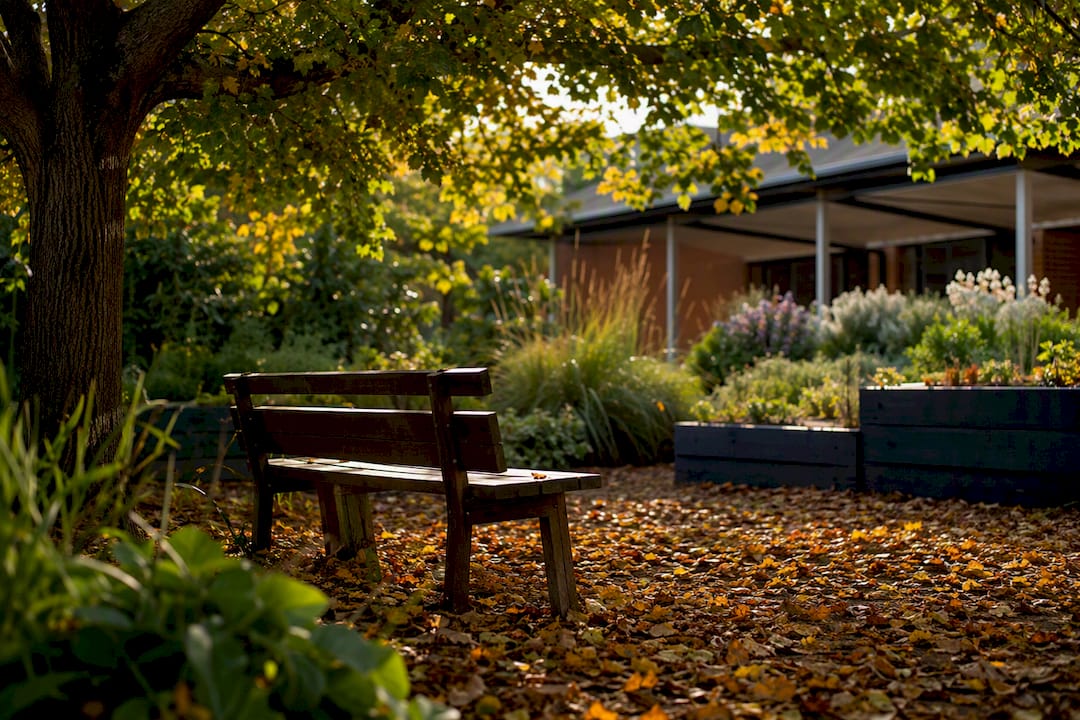
There’s a mental health dimension too. Students dealing with anxiety or sensory sensitivity often need a lower-stimulation option during breaks. A quiet shaded bench away from the main play area gives them that option without singling them out or requiring staff intervention. Design researchers working with Australian schools found this demand for calm shaded seating came directly from students themselves, not from adults guessing at what young people wanted.
The social effect compounds over the school year. Students who have a reliable, comfortable place to sit with friends or alone are more likely to spend break time outdoors rather than retreating indoors, which supports physical activity levels as a side effect of a decision made primarily for comfort and mental health.
What long-term maintenance issues come with different shading types?
Every shading type carries a different maintenance profile, and mismatching your choice to your maintenance capacity is one of the most common planning mistakes schools make.
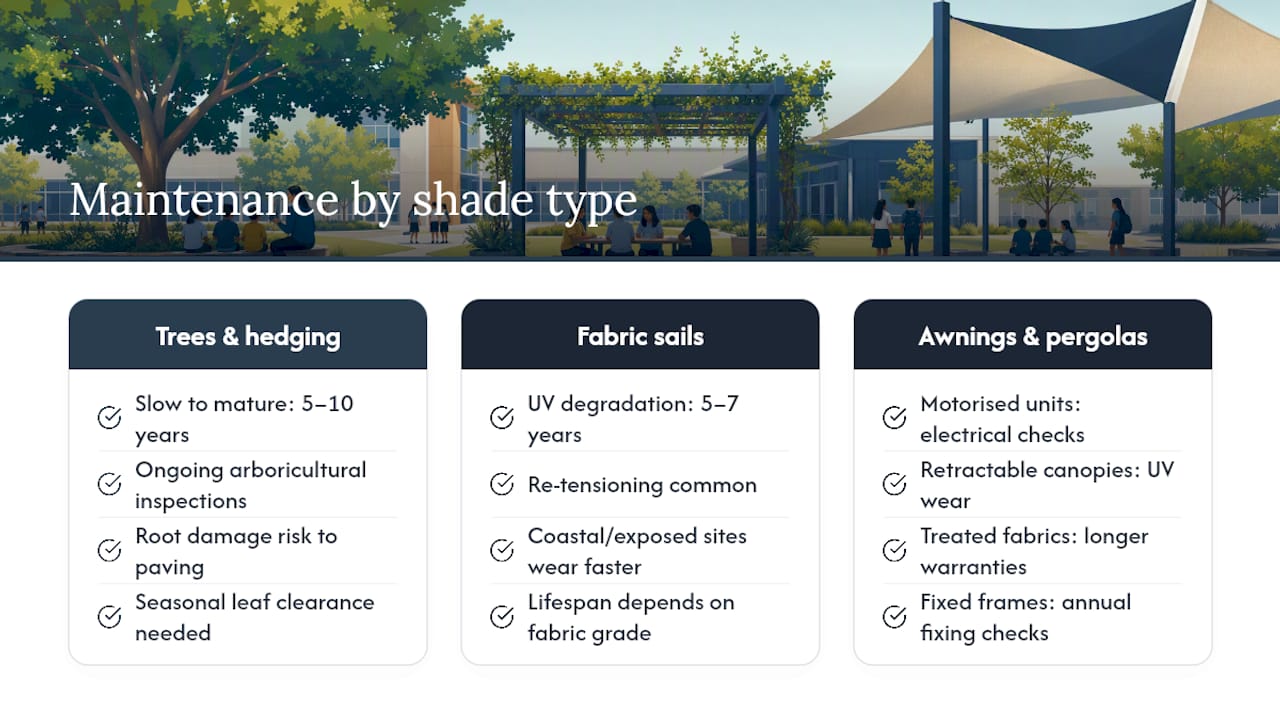
Living shade, trees and hedging, needs the longest view. A newly planted tree offers negligible shade for its first five to ten years, and mature trees require ongoing arboricultural inspection for root damage to paving, storm risk and seasonal leaf clearance. Deciduous species also mean your best shade coincides with summer term but disappears for the coldest months, which is usually the right trade-off but needs planning for.
Fabric shade sails degrade under UV exposure faster than most schools expect, typically needing replacement or re-tensioning within five to seven years depending on fabric grade and site exposure. Coastal or exposed rural sites see faster wear than sheltered urban courtyards.
Retractable awnings and pergolas carry different risks again. Motorised components need periodic electrical checks, and fabric canopies on retractable systems benefit from the same UV consideration as sails, though quality manufacturers such as those Infinity Awnings supplies typically offer treated fabrics with longer warranty periods. Fixed pergola timber or aluminium frames need less frequent attention but should still be checked annually for fixing integrity, especially in high-wind locations.
The practical lesson: budget maintenance costs by material type from day one, not as an afterthought once the invoice for the initial structure has been paid.
How does shading interact with daylighting and ventilation?
Shading decisions made in isolation from lighting and airflow planning tend to backfire. A transdisciplinary methodology study on educational buildings found that poorly designed shading increases reliance on artificial lighting and heating, cancelling out much of the intended energy benefit.
External shading devices, overhangs and louvres set at the correct angle for your latitude block high summer sun while still admitting lower-angle winter light, keeping classrooms bright without needing supplementary lighting. Fixed shading installed without that calculation can leave rooms dim year-round, pushing schools toward more artificial lighting rather than less.
Outdoor shading interacts with ventilation in a similar way. Shaded courtyards create cooler air pockets that, with the right layout, encourage natural airflow towards adjacent classrooms when windows are open, reducing the need for mechanical cooling on warm days. Dense, unplanned tree cover around building perimeters can have the opposite effect, trapping stagnant warm air against walls if there’s no clear ventilation path.
The practical takeaway for facilities teams: treat shading, daylighting and ventilation as one design conversation rather than three separate budget lines. A structure specified purely to solve summer glare, without checking its effect on winter daylight or nearby airflow, often needs costly retrofitting within a few years.
A publisher’s perspective on getting shading right
Fifteen years of supplying and installing outdoor structures across Yorkshire, Derbyshire, Nottinghamshire and Lincolnshire has taught Infinity Awnings one consistent lesson: schools that get shading right start with a proper site visit, not a catalogue order. Every playground has its own sun path, its own supervision constraints, its own budget cycle.
If you’re weighing up options for your school grounds, a site survey costs nothing and tells you far more than a brochure ever could. We’ll walk the space with you, flag where hard structures beat trees and vice versa, and talk through compliance and long-term service so nothing surprises you three years in. The pergolas and awnings page has more detail if you want to see what’s possible before booking a visit.
Key takeaways for planning shading in schools
Shading reduces heat stress and supports calmer, more inclusive outdoor spaces, and schools that treat it as core infrastructure see measurable gains in comfort, focus and social behaviour.
Point | Details |
Evidence is strong | The 2024 systematic review and Barcelona case study both link shading to improved affect, comfort and reduced conflict. |
Thermal comfort drives cognition | Bilkent research recorded higher concentration scores in shaded areas than in sun. |
Mix living and hard shade | Trees plus sails, awnings or pergolas cover seasonal gaps neither option handles alone. |
Design for supervision and inclusion | Keep sightlines open while offering quiet, adjacent seating for neurodivergent students. |
Infinity Awnings supports procurement | Supplies and installs Weinor, Llaza, Selt, Tarasola and Morvelle products with warranty backing suited to school budgets. |
Where Infinity Awnings fits into your shading plan
Infinity Awnings is the specialist route to a shading solution built for your actual site, not a generic catalogue product. Where the options covered above, trees, shade sails, fixed overhangs, sit at different points on cost and permanence, our work is designing, supplying and installing the structural pieces: retractable awnings, pergolas and verandas from trusted manufacturers including Weinor, Llaza, Selt, Tarasola and Morvelle.

That matters for schools because structural shading needs to survive UK weather, meet safety expectations for a site full of children, and come with a warranty someone will actually honour. We’ve spent 15 years fitting these systems across Yorkshire, Derbyshire, Nottinghamshire and Lincolnshire, for homes, hospitality venues and educational sites alike, so we know what holds up on an exposed playground and what doesn’t.
If your governing board needs a concrete proposal for a funding bid, browse the pergola options and request a free site survey. You’ll get a specification and quote before committing to anything.
Frequently asked questions about shading and student wellbeing
Does shading actually improve academic focus, or just comfort? Both. The Bilkent study found students in shaded outdoor spaces scored notably higher on concentration tests than those in sun-exposed conditions, suggesting the thermal benefit carries through to attention and performance.
What’s the cheapest way to add shading to a playground quickly? Shade sails offer the fastest, lowest-cost coverage for playgrounds and informal seating zones, though they need more frequent fabric replacement than permanent structures.
How do we choose between trees and built structures? Trees offer the strongest long-term cooling and lowest running costs but take years to mature; built structures like awnings and pergolas provide immediate, adjustable coverage. Most sites benefit from combining both rather than choosing one.
How do we measure whether new shading is actually working? Pair a simple pre/post student and teacher survey on comfort and stress with a basic microclimate reading, such as a handheld PET measurement, and track how often teachers actually use the shaded space for lessons.
Can shading help students who struggle with sensory overload or anxiety? Yes. Quiet, shaded seating away from busy play areas gives these students somewhere to decompress without leaving the social environment, a need researchers have documented directly through student feedback.
Sources
For the underlying evidence base, the Journal of Educational Psychology systematic review and the Barcelona schoolyard evaluation are the strongest starting points for governors weighing up a business case.
Recommended
Comments