
School awning maintenance: proven steps for longevity and safety

TL;DR:
Neglected school awnings degrade gradually due to weather, risking safety and increasing repair costs. Regular maintenance extends lifespan by up to 100% and prevents costly structural failures. Implementing systematic inspections, proper tools, and professional support ensures outdoor spaces remain safe and durable.
School awnings across Yorkshire take a battering from the elements every single year. Wind, rain, frost, and the occasional heavy snowfall can quietly degrade fabric, corrode fixings, and compromise the structural integrity of canopies that pupils rely on daily. When maintenance slips down the priority list, the consequences range from mould-ridden fabric to outright structural failure, both of which carry serious safety and financial implications. This article gives facility managers a clear, actionable maintenance process to protect their investment, extend awning life, and keep outdoor learning spaces safe.
Table of Contents
Key Takeaways
Point | Details |
Proper maintenance is essential | Consistent upkeep significantly extends the life and safety of school awnings. |
Aluminium canopies require less care | Aluminium school canopies are lower maintenance compared to retractable awnings. |
Safety standards matter | School awnings must meet EN 13561 wind resistance requirements for compliance and safety. |
Avoid common mistakes | Never retract awnings while wet and use professional tools for snow removal to prevent damage. |
Professional support adds value | Expert maintenance services help Yorkshire schools maximise performance and reduce long-term costs. |
Understanding the risks and benefits of proper awning maintenance
The most dangerous thing about neglected school awnings is how gradual the damage is. There is rarely one dramatic event. Instead, minor mould growth, small fabric tears, and loose fixings compound quietly over months until a routine inspection reveals a structure that is genuinely unsafe. For a Yorkshire school operating under tight budgets, replacing an entire canopy system prematurely is a serious financial setback that proper maintenance could have prevented entirely.
The risks are well-documented. Mould and mildew take hold in fabric that retains moisture, especially during Yorkshire’s damp autumn and winter months. UV degradation weakens canopy fabric from above while moisture damage attacks from below. Metal components corrode when debris accumulates in joints and channels. Any one of these issues can accelerate the deterioration of the others, creating a cycle that is much harder and costlier to break once it takes hold.
The benefits of regular upkeep, on the other hand, are substantial. Proper maintenance extends fabric life by 50 to 100%, and a well-maintained awning lasts two to three times longer overall compared to one that receives minimal attention. For schools, this means the capital investment in quality awnings can be stretched across many more years of reliable service.
“A proactive maintenance programme is not an additional cost for schools. It is a cost-avoidance strategy that protects capital expenditure and keeps outdoor spaces safe for pupils.”
Using an awning maintenance checklist tailored to educational settings helps ensure nothing is missed during routine inspections. Key risk areas to monitor regularly include:
Fabric condition: tears, fading, mould patches, or seam separation
Fixing points and brackets: corrosion, loose bolts, or signs of movement
Drainage channels and gutters: blockages caused by leaf litter and debris
Mechanical components on retractable systems: spring tension, motor function, and arm movement
Frame and support structure: any deformation, rust, or stress cracking
Now that the stakes are clear, it is important to know what you will need to implement a robust maintenance regime.
What you need: tools, materials, and safety requirements
Good intentions only go so far without the right equipment. Facility managers attempting school awning maintenance without proper tools risk causing more damage than they prevent, particularly when cleaning delicate fabric or accessing fixings at height.
The following table outlines the core tools and materials required for a complete school awning maintenance session:
Item | Purpose | Notes |
Soft-bristle brush | Fabric cleaning | Never use stiff wire brushes |
Mild, pH-neutral cleaner | Removing mould and grime | Avoid bleach on coloured fabric |
Hosepipe or low-pressure washer | Rinsing panels and fabric | High pressure can damage seams |
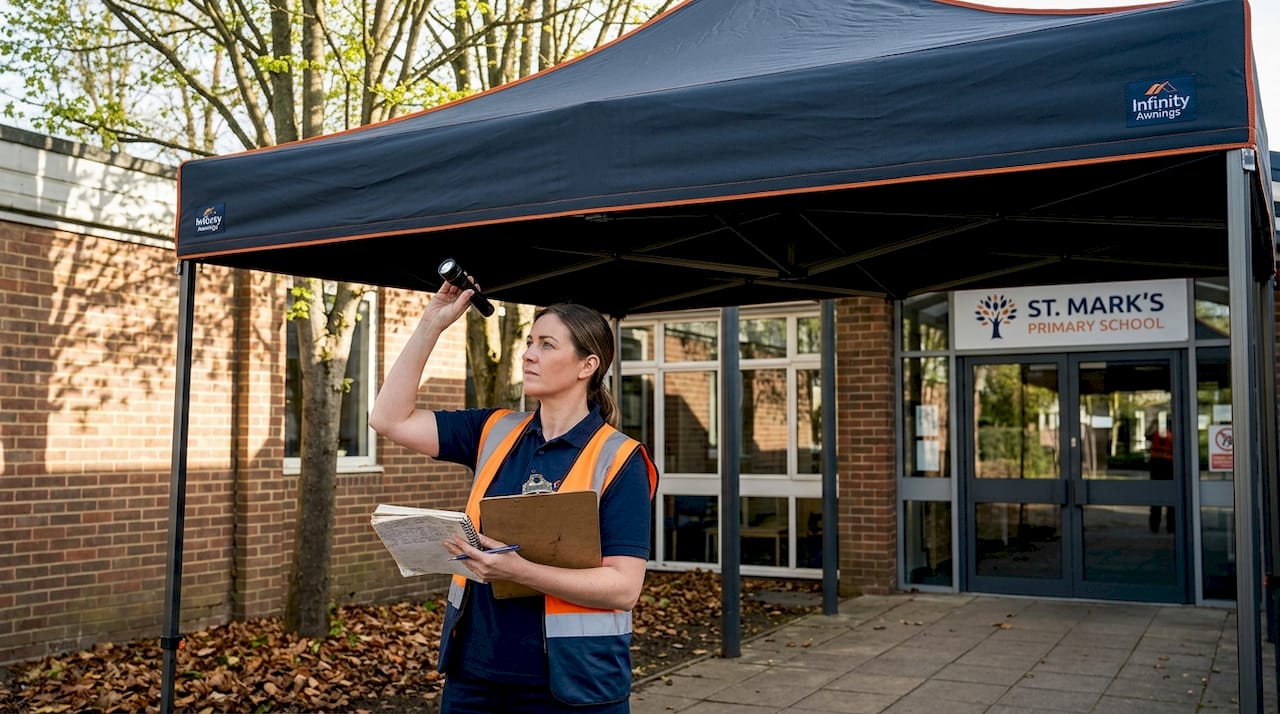
Torch or inspection light | Checking fixings and channels | Useful in shaded bracket areas |
Ladder or mobile platform | Safe access at height | Must be secured per working-at-height regulations |
Non-silicone lubricant | Moving joints and tracks | Silicone attracts dust and debris |
Gutter clearing tools | Removing leaf and debris build-up | Blocked drains accelerate corrosion |
For school awning materials such as powder-coated aluminium frames, mild detergent is sufficient for cleaning, and aluminium structures need gutters and drains cleared regularly, with visual checks after storms and occasional panel cleaning.
Safety compliance is non-negotiable. UK school awnings should meet EN 13561 wind resistance requirements, and facility managers need to understand what wind class their installed awnings carry before deciding how to operate them in adverse weather. PPE requirements for maintenance staff include non-slip footwear, safety glasses when using cleaning solutions, and a hard hat when working beneath structures at height.
Essential pre-task checks include:
Confirming the wind rating class of each awning structure on site
Ensuring all ladders and platforms are in serviceable condition
Checking weather forecasts before scheduling exterior maintenance
Pro Tip: Never retract a wet awning at the end of a maintenance session. Even if the fabric looks clean, moisture trapped inside a rolled or folded fabric creates the perfect conditions for mould growth within days. Always allow full drying time before closing a retractable awning.
With tools and safety requirements ready, the next step is to follow a systematic maintenance process.
Step-by-step school awning maintenance process
A structured approach prevents both omissions and accidental damage. The following process is designed for Yorkshire schools managing a mix of retractable and fixed canopy systems, accounting for the region’s variable climate.
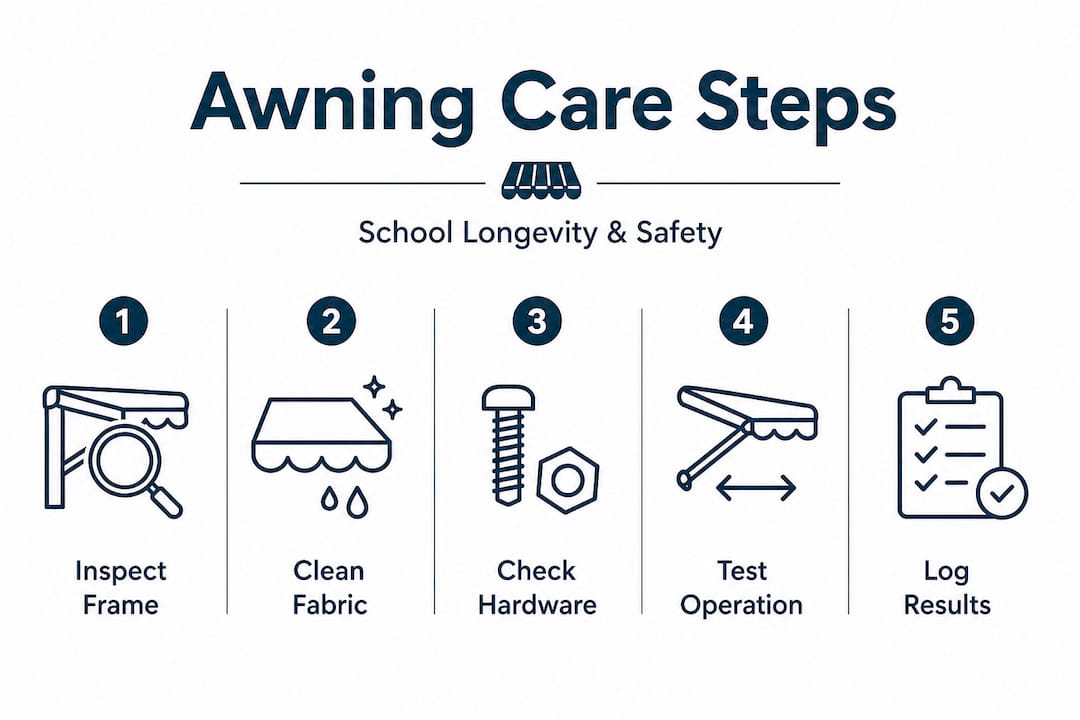
Clear gutters and drainage channels first. Leaf litter, moss, and debris from Yorkshire’s autumn season block drainage and cause standing water, which accelerates corrosion of aluminium frames and stains fabric.
Conduct a full visual inspection before touching anything. Look for fabric tears, seam splits, mould patches, loose brackets, and any signs of storm damage. Document findings with photographs to track deterioration over time.
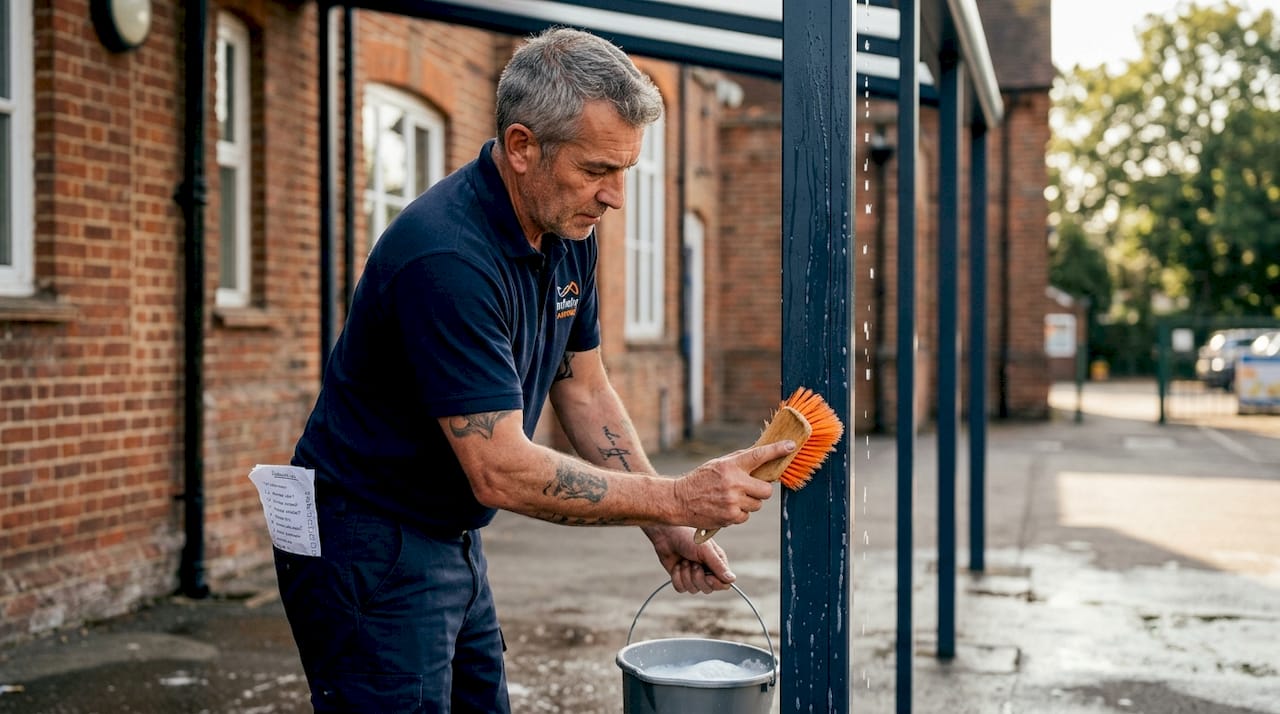
Clean all fabric panels using a soft brush and mild detergent. Work from the top downwards to avoid dragging grime across cleaned areas. Rinse thoroughly with a low-pressure hose.
Inspect and clean all fixings, joints, and connection points. Apply non-silicone lubricant sparingly to moving parts on retractable systems. Over-lubrication attracts dirt and can clog tracks.
Test all mechanical functions on retractable awnings. Extend and retract the awning fully to check for uneven movement, unusual noise, or resistance in the arms. Retractable awning maintenance requires this kind of mechanical verification at least twice yearly.
Check wind speed compliance. UK awnings comply with EN 13561 wind resistance classifications, typically Class 2 or Class 3, which dictate the maximum safe operating wind speed. Ensure operators on site know the specific class for each installation.
Allow all fabric to dry fully before retracting. This is the step most often skipped. It is also the most consequential.
Log the full maintenance session with dates, findings, and any actions taken, ready for review at the next scheduled check.
The maintenance demands of retractable versus fixed awnings differ meaningfully, as shown below:
Feature | Retractable awnings | Fixed canopies |
Mechanical care | Required: motors, springs, arm joints | Not applicable |
Fabric inspection frequency | Monthly in active season | Termly |
Storm retraction requirement | Yes, per wind class | No |
Cleaning complexity | Moderate: folding fabric, moving parts | Lower: static panels |
Overall maintenance demand | Higher frequency needed | Lower, but structural checks still required |
The awnings repair guide on our website covers specific repair procedures for the most common damage types, including torn fabric and arm alignment issues.
Pro Tip: Snow removal on canopies should always be carried out by professionals using appropriate tools. Improvised snow clearance with rakes or brooms risks tearing fabric and damaging the frame, especially in cold temperatures when materials become brittle.
After following the step-by-step process, facility managers should review maintenance effectiveness and watch for common pitfalls.
Common mistakes and troubleshooting tips
Even experienced facility managers can fall into predictable patterns that undermine their maintenance efforts. Understanding these errors in advance saves both time and money.
The most widespread mistakes include:
Skipping post-storm inspections. Yorkshire weather can be severe, and wind-driven rain or hail can cause damage that only becomes apparent during a close inspection. Missing these checks means small issues become large problems before the next scheduled service.
Retracting wet fabric. This bears repeating because it is so frequently overlooked. Never retract wet fabric, as the mould risk is significant and the resulting damage can render entire fabric panels unusable.
Over-lubricating moving parts. A common belief that more lubrication means better protection is wrong in this context. Excess lubricant on awning tracks and hinges attracts fine debris, which forms an abrasive paste that accelerates wear.
Using incorrect cleaning products. Bleach-based cleaners are particularly damaging to coloured or patterned awning fabrics, causing fading and weakening the weave. Always use products specifically approved for awning fabrics.
Ignoring drainage. Blocked gutters are the silent killer of fixed canopy structures. Water pooling in channels stresses fixings and causes galvanic corrosion where different metals meet.
When it comes to troubleshooting specific problems, the following approaches apply:
Mould on fabric: Treat with a specialist awning fabric cleaner designed for mould removal. Do not scrub aggressively. Allow the product to dwell, then rinse with low pressure. Persistent mould may indicate the fabric needs replacing.
Mechanical faults on retractable awnings: Uneven retraction often points to an arm alignment issue or uneven spring tension. This requires professional adjustment rather than DIY intervention.
Fabric degradation and UV fading: If large areas of fabric show significant fading or brittleness, replacement is more cost-effective than repeated patching. For guidance on installing durable school awnings, selecting UV-stable, solution-dyed fabrics at the outset dramatically reduces this risk.
“The schools that spend the most on emergency awning repairs are almost always the ones that skipped routine post-storm checks. A five-minute inspection after every significant weather event costs nothing and prevents thousands in reactive repairs.”
With hands-on maintenance advice covered, it is time to verify and maximise results through regular checks.
Verifying results and ongoing checks
Carrying out maintenance is only half the task. Verifying that it is working, and adjusting your schedule accordingly, is what separates a reactive approach from a genuinely protective one.
A structured verification routine includes the following steps:
Post-maintenance fabric assessment. After each cleaning session, check fabric tension, colour uniformity, and seam condition. Note any areas of concern in your maintenance log.
Mechanical function test after every servicing of retractable systems. Confirm that the full range of motion is smooth, the locking mechanism is secure, and the motor (where fitted) responds correctly.
Photographic comparison at each inspection. Comparing current photos against earlier records allows you to detect slow-moving degradation that would otherwise go unnoticed.
Post-storm structural review. For school canopies, visual checks after storms and snowfall are essential to catch any immediate safety concerns before pupils use the outdoor area again.
Scheduling recommendations for Yorkshire schools:
Visual inspection after every significant weather event (wind above 25 mph, heavy snow, or hailstorms)
Full cleaning and mechanical check at the start of spring term and at the beginning of autumn term
Structural fixing check at least once annually, ideally carried out by a qualified installer
For long-term tracking, maintain a simple log that records:
Date of each inspection and maintenance session
Condition ratings for fabric, fixings, and mechanical components
Any repairs carried out and the associated costs
Estimated remaining fabric life based on current condition
This data allows budget forecasting, justifies maintenance expenditure to budget holders, and provides evidence of due diligence in the event of any safety-related incident. Resources on maintaining awnings for lasting comfort and expert maintenance tips provide further detail on building effective long-term maintenance habits.
Having established recurring checks and validation methods, facility managers can now learn from broader expertise and rethink the standard approach.
Why neglected awning maintenance costs schools more than you think
There is a pattern we see repeatedly across educational sites, and it is worth naming directly. Most schools do not neglect awning maintenance because they lack resources. They neglect it because awnings are structurally invisible. Nobody walks past a clean canopy and considers whether its gutters were cleared last month or whether its motor was tested recently. The maintenance becomes visible only when something fails, and by then the cost is always higher than it needed to be.
The compounding nature of neglect is what makes it so costly. A blocked gutter costs almost nothing to clear. Left for a full academic year, that same blockage causes standing water, which corrodes fixings, which allows movement in the frame, which stresses the fabric, which eventually tears. What began as a ten-minute clearing job becomes a structural repair costing several thousand pounds.
The smarter approach is to treat awning maintenance the same way you would treat fire safety inspections. It is not optional, it is not discretionary, and it is not something that gets bumped when other priorities arrive. Build it into the annual facilities calendar with firm dates, assign it to named staff, and make post-storm checks a standing instruction rather than a judgement call.
Empowering site staff to carry out basic checks, while reserving mechanical and structural work for qualified professionals, creates a tiered system that is both cost-effective and genuinely protective. Minor issues found early by a caretaker doing a post-storm walk-around are exactly the kind of early-warning system that prevents expensive reactive work. Full guidance on awnings repair and maintenance helps staff understand the boundary between what they can manage themselves and when professional support is needed.
Professional solutions and ongoing support for schools
If you are looking to move beyond reactive maintenance and establish a reliable, long-term approach for your school’s outdoor structures, we can help.

At Infinity Awnings, we work with educational institutions across Yorkshire, Derbyshire, Nottinghamshire, and Lincolnshire to specify, supply, and install awning and canopy systems built for demanding environments. Our commercial-grade products, including robust school pergola options, are designed with low-maintenance longevity in mind from the outset. Whether you need guidance on selecting durable materials, planning a maintenance schedule, or accessing pergola installation support, our team brings over 15 years of industry experience to every project. Contact us for a free, no-obligation consultation tailored to your school’s specific requirements.
Frequently asked questions
How often should school awnings be cleaned?
School awnings should be cleaned at least twice annually, typically at the start of spring and autumn terms, with additional attention following major storms or snowfall.
What is the biggest mistake in school awning maintenance?
Retracting awnings while the fabric is still wet is the most damaging error, as it creates ideal conditions for mould growth. Never retract wet fabric, and always avoid over-lubrication of moving parts.
How does regular maintenance impact awning lifespan?
Proper maintenance extends fabric life by 50 to 100%, with a well-maintained awning lasting two to three times longer overall than one receiving minimal care.
Are aluminium canopies lower maintenance than retractable awnings?
Yes. Aluminium canopies require less attention than retractable systems, which need regular mechanical checks of motors, springs, and arm joints to remain safe and functional.
What safety standard should UK school awnings comply with?
UK school awnings should meet EN 13561 wind resistance requirements, typically Class 2 or Class 3, which specify the safe operational wind speed limits for each installation.
Recommended
Comments