
Budget £3,000–£30,000: UK school canopy costs, procurement and funding

Most UK schools pay between £3,000 and £10,000 for a small entrance or bike-shelter canopy, £5,000 to £30,000 for a standard classroom or dining canopy, and upwards of £30,000 for large, multi-module outdoor teaching structures. Groundworks, glazing choice, and add-ons like lighting or solar panels can push any of these bands higher, so a site survey remains the only way to price a specific project. Funding and leasing options can close the gap between wish list and budget, and those are covered later in this guide.
TL;DR:
Small canopies cost between £3,000 and £10,000 installed, while larger structures typically range from £30,000 to over £45,000 based on size and complexity.
Installed costs per square metre usually fall between £300 and £800, with the per-sqm rate decreasing as canopy size increases.
Ground conditions, material choices, span size, and add-ons like lighting or solar panels significantly influence the final price, requiring a site survey for accuracy.
Most projects are delivered within a few days for standard designs, but complex sites or bespoke structures can extend installation time and costs.
Schools can leverage funding sources such as Devolved Formula Capital, the Condition Improvement Fund, sport grants, or leasing options to finance canopy projects.
Table of Contents
How much does a school canopy cost in the UK?
Most suppliers price installed canopies on a per square metre basis, and the rate you pay falls as the canopy gets bigger. Supplier guides commonly quote installed costs of roughly £300 to £800 per sqm ex VAT, including foundations, with smaller structures sitting at the top of that range because fixed costs like delivery, scaffolding, and site setup get spread across less floor area.
Supply-only pricing runs lower, but most schools choose supply-and-install because it shifts liability for structural calculations and groundworks onto the contractor, which matters when a governing body needs a fixed figure for a budget line rather than an estimate that might move.
Three worked examples show how this plays out in practice:
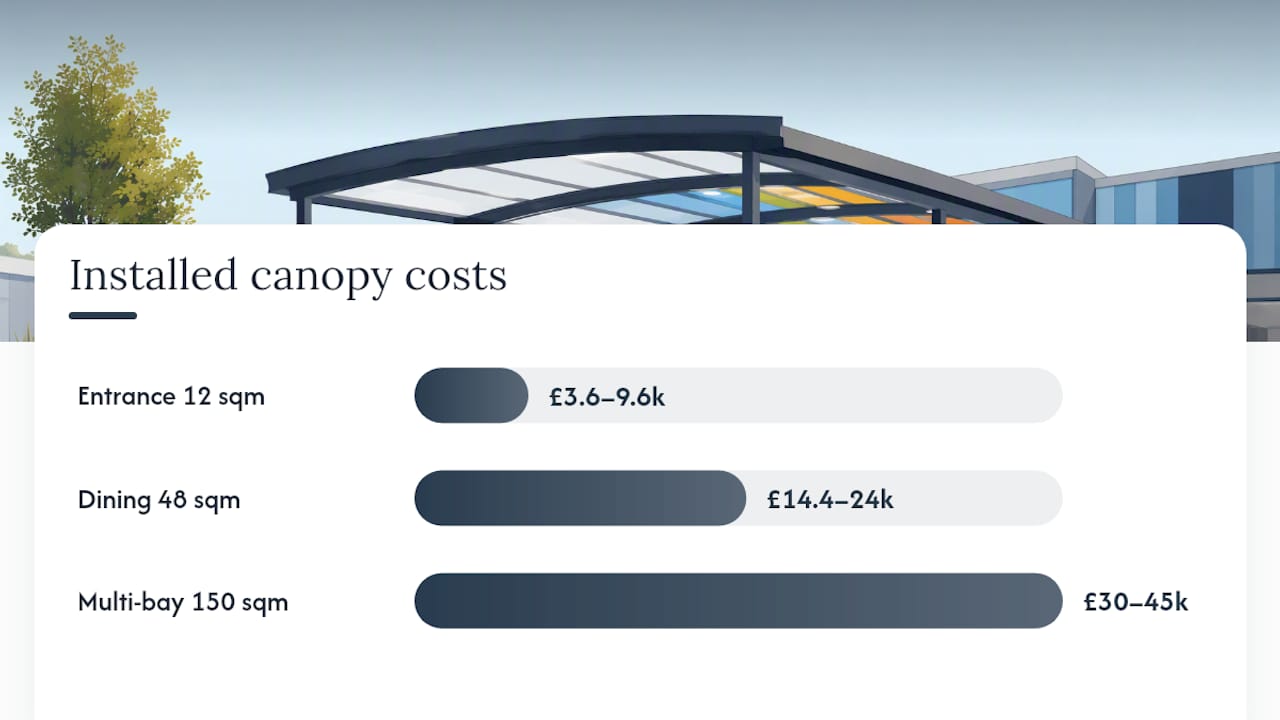
A 4m x 3m entrance canopy (12 sqm): roughly £3,600 to £9,600 installed, depending on frame material and roof glazing.
An 8m x 6m dining or classroom canopy (48 sqm): typically £14,400 to £24,000, with the lower end reflecting standard modules and polycarbonate roofing.
A 15m x 10m multi-bay teaching canopy (150 sqm): often £30,000 to £45,000 once foundations, drainage, and electrics are factored in, though the per-sqm rate drops noticeably at this scale.
Sample project totals published by suppliers put many small projects under £10,000 and average installations around £18,000, which lines up with the middle of these bands. Treat every figure here as a planning guide rather than a quotation. The final number depends on your ground conditions, access, and specification, which is exactly why a site visit comes before any fixed price.
What affects the cost of a school canopy?
Frame material sets the tone for the whole project. Aluminium dominates the schools market because it resists corrosion without heavy maintenance and needs lighter foundations than steel, which keeps groundworks costs down. Steel frames cost more upfront and need more substantial footings, but they suit very wide spans or sites with high wind exposure. Timber looks good against a listed building or in a nature-focused primary school, though it demands more frequent treatment.
Roof and glazing choice moves the price almost as much as the frame. Polycarbonate is the budget default; toughened glass and box-profile metal roofing cost more but last longer and handle rain noise better, which matters directly outside a classroom window.
Several other factors shift the final figure:
Span width and column spacing, since wider clear spans need heavier structural steel to avoid mid-span supports
Modular versus bespoke design, with standard module widths costing noticeably less than a made-to-measure span
Siteworks including foundations, drainage, and access for plant, particularly on sites with contaminated or uneven ground
Extras such as LED lighting, side screens, heating, or solar panels, each adding a discrete line to the quote
Site-specific structural calculations covering wind loading and ground conditions are not optional extras. Supplier guidance is consistent that skipping this step at quote stage tends to surface as an unwelcome cost increase once installation begins.
Pro Tip: Ask every supplier whether structural calculations are included in the quoted price or billed separately later. That single question exposes more hidden cost than any other in the procurement process.
How do you size and specify a school canopy?
Getting the specification right before you ask for quotes saves rework and keeps costs predictable. Three things matter most:
Choose standard modules where the site allows it. Manufacturers build most canopies from repeatable 3 to 8 metre bays, and staying within those standard sizes keeps unit costs down compared with a fully bespoke span.
Match clear width to actual use. A covered walkway needs perhaps 2 to 3 metres of clear width; a dining canopy for a class group needs 6 metres or more; a full outdoor classroom often needs 8 metres plus to fit furniture and movement space comfortably.
Flag planning triggers early. Canopies attached to a listed building, those exceeding certain height or footprint thresholds, or projects near a site boundary will almost certainly need planning permission and, in most cases, formal structural calculations regardless of size.
What happens on site and how long does installation take?
A typical project runs through survey, design sign-off, groundworks, and installation, in that order. Schools should have utility drawings, access arrangements, and any asbestos survey results ready before the contractor arrives, since gaps here are the most common cause of delay.
Site complications change both cost and timeline. Restricted vehicle access, hidden underground services, or contaminated ground can each add days and hundreds of pounds in extra groundworks. Standard canopy installs often complete within days once foundations are in, but bespoke designs or difficult sites extend that considerably.
Practical points worth building into your project plan:
Book installation for school holidays wherever possible to avoid disruption to lessons and playground use
Allow extra lead time for bespoke steel fabrication versus standard aluminium modules
Confirm who is responsible for making good the surrounding surface once groundworks finish
What funding is available for school canopies in the UK?
Devolved Formula Capital is usually the simplest route for maintained schools, since it is allocated automatically each year and many schools pool two or three years of DFC allocation to reach the sum a canopy project needs. School Condition Allocations work similarly for schools that receive them directly, while the Condition Improvement Fund is competitive and suits academies and sixth-form colleges without their own capital budget.
Department for Education guidance confirms these three routes, DFC, SCA, and CIF, sit alongside High Needs capital funding for SEND-related access projects. CIF bids succeed most often when tied to an urgent health, safety, or condition issue rather than a general improvement wish.
Beyond core DfE funding, 2026 funding guides highlight further options worth checking before you commit a budget:
Sport-focused grants such as Football Foundation funding, which can contribute significantly to larger canopy projects covering playing areas
Charitable trusts and local business sponsorship, particularly for primary schools with a clear community-use case
Finance leasing, which has become more workable for schools since 2024 because Secretary of State approval is no longer required for some finance leases, letting schools spread cost while using the space immediately
Most successful bids combine two or more of these routes and lean on a fixed-price quotation and photographic evidence of the existing problem, whether that is playground crowding, sun exposure, or wet-weather access. Charitable and sport funding almost always require match funding alongside a demonstrated curriculum or access benefit, so budget for that contribution from the outset rather than treating the grant as covering the full cost. Grant windows and priorities shift every year, so check current DfE guidance before you build a bid timeline around last year’s rules.
What warranty and maintenance costs should you expect?
Guarantee periods vary by material: aluminium frames commonly carry 10 to 25 year structural warranties, steel around 10 to 15 years, and timber shorter terms unless regularly treated. Aluminium and steel need little beyond an annual gutter clear and fixing check; timber needs periodic re-treatment that adds a recurring cost most budgets overlook.
Judging value on the upfront quote alone is a mistake. A slightly costlier aluminium frame with toughened glazing often beats a cheaper polycarbonate structure over a 20-year ownership period once repainting, panel replacement, and reduced downtime are counted.
Procurement tips from Infinity Awnings
Before signing off any quote, ask for a CAD drawing of the finished structure, a fixed price rather than an estimate, confirmation of structural calculations, a stated lead time, and the warranty terms in writing. The most common pitfall we see is a specification that looks complete but omits groundworks or drainage, leaving schools with an unwelcome variation order mid-project.
Infinity Awnings supports schools through this process with a free site survey, CAD drawings for governor or trust sign-off, and guidance on structuring a specification that funders will recognise as fixed-price and evidence-backed.
Real UK school canopy projects and their cost breakdowns
Cost breakdowns from real projects tell you more than any per-sqm rule of thumb, because they show where the money actually goes once a design leaves the drawing board.
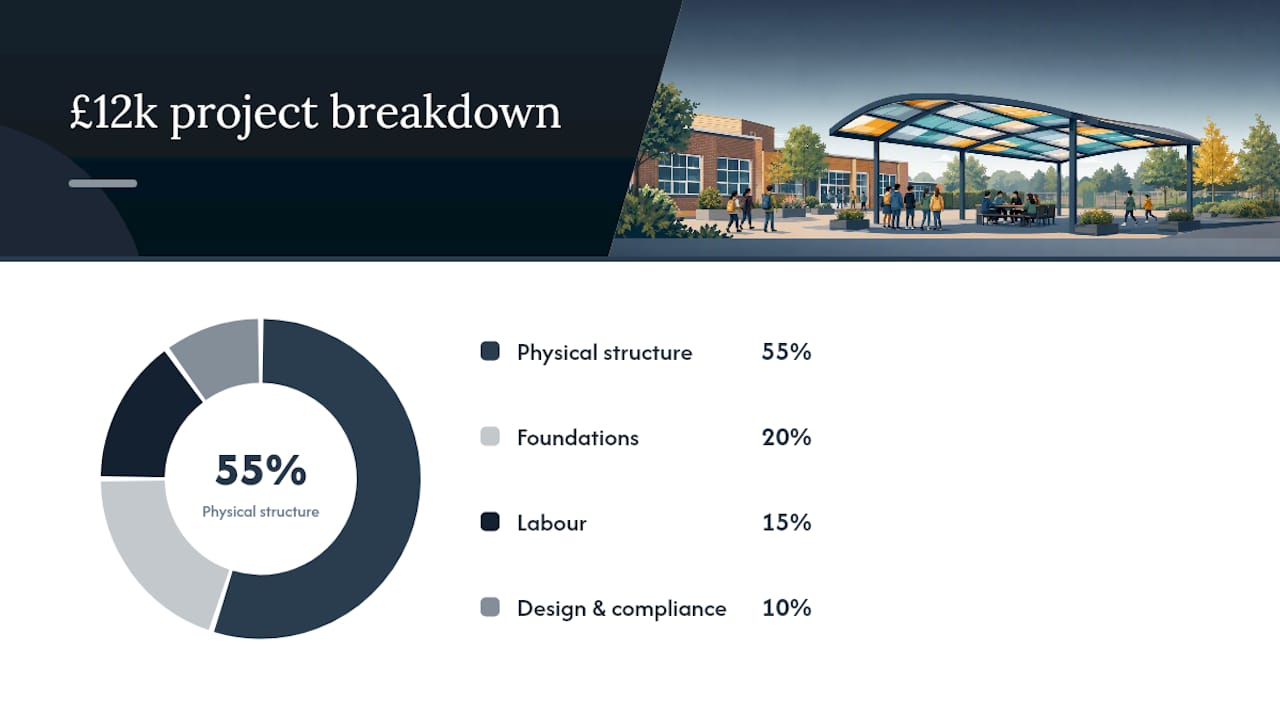
On a £12,000 project, that puts roughly £6,600 into the physical structure, £2,400 into foundations, £1,800 into labour, and £1,200 into design and compliance work.
Larger dining or outdoor classroom projects shift that balance. Foundation and drainage work grows as a share of the total once a canopy covers 100 square metres or more, because larger roof areas need more substantial rainwater management and often a longer run of guttering to an existing drainage point.
The pattern that emerges across most UK school projects is straightforward: smaller canopies are structure-cost-dominated, while larger ones become groundworks-dominated. Knowing which category your project falls into helps you predict where a contractor’s quote is likely to move if you change the specification.
Does energy efficiency affect the cost of a school canopy?
Sustainability choices add cost upfront but often reduce running costs and support wider net-zero commitments many trusts now report against. Solar-integrated roofing is the clearest example: fitting photovoltaic panels into a canopy roof adds a meaningful sum to the initial quote, but it can generate electricity for lighting, classroom equipment, or EV charging points elsewhere on site.
Material choice also plays into sustainability without adding cost. Aluminium frames are widely recycled and typically carry a lower embodied carbon footprint over their service life than equivalent steel structures, since less energy-intensive processing is needed at end of life.
Roof glazing choice affects thermal performance beneath the canopy used in outdoor learning. Polycarbonate roofing transmits more heat than double-skin or insulated panel alternatives, which matters if the space beneath is used as a genuine outdoor classroom for much of the school year rather than just a covered walkway. Schools aiming to use covered space year-round increasingly specify insulated or low-emissivity glazing despite the higher initial cost, because it extends the usable season for the space.
LED lighting integrated at build stage costs less than retrofitting later and draws a fraction of the power older fluorescent fittings use, which matters for any canopy intended for after-school clubs or winter pick-up times. None of these choices are compulsory, but each one changes the whole-life cost calculation in the school’s favour once you look past the first invoice.
Are school canopies better value than a building extension?
A canopy rarely costs more than a fraction of what a traditional extension would, and it delivers usable covered space in weeks rather than the months a full build demands. Schools weighing up capital options should get a supplier engaged early, before a budget is finalised, because an accurate site-specific quotation changes the maths more than any general guide can.
— Andrew
Get a free site survey for your school canopy
Infinity Awnings works directly with schools, nurseries, and colleges to turn a capital budget into a fixed-price, fully specified canopy project, rather than leaving governors guessing at a per-sqm estimate. We bring over 15 years’ experience supplying premium brands including Weinor, Llaza, Selt, Tarasola, and Morvelle, and every project starts with a free site survey rather than a desk-based quote.
That survey covers ground conditions, access, and drainage before we produce CAD drawings and a fixed-price quotation your finance team can take straight into a DFC, SCA, or CIF bid. We also talk through finance leasing where spreading the cost makes more sense than a single capital outlay. If your trust is scoping an outdoor solution for schools, nurseries, or colleges, get in touch to book a free site survey and a fixed-price quotation before your next budget round closes.
Official funding and cost guidance
Verify current funding windows against Department for Education capital funding guidance and cross-check per-sqm pricing against supplier cost breakdowns before finalising any budget submission.
Sources
FAQ
How much does a canopy cost in the UK?
Small canopies typically cost £3,000 to £10,000 installed, standard classroom or dining canopies run £5,000 to £30,000, and large multi-module structures can exceed £30,000, with per-sqm rates around £300 to £800 ex VAT depending on specification.
How much do school canopies typically cost per square metre?
Most UK suppliers quote installed costs of roughly £300 to £800 per square metre excluding VAT, with the rate falling as the total canopy area increases because fixed costs spread across more floor space.
How much does it cost to make a bespoke canopy versus a standard one?
Bespoke, made-to-measure spans cost more than standard modular sizes because they need custom structural calculations and often non-standard fabrication, while standard 3 to 8 metre modules keep unit costs predictable.
Does it cost more to build a school than to add a canopy?
Yes, substantially more. A canopy delivers covered outdoor space for a fraction of the cost and construction time of a full building extension, which is why many schools use canopies to solve space pressure without a capital building project.
What funding can UK schools use to pay for a canopy?
Maintained schools commonly use Devolved Formula Capital or School Condition Allocations, while academies often bid into the competitive Condition Improvement Fund, sometimes combined with sport grants or charitable funding.
Recommended
Comments