
Fabric pattern options: a complete guide for makers and home projects
- Andrew Crookes
- 6 hours ago
- 17 min read
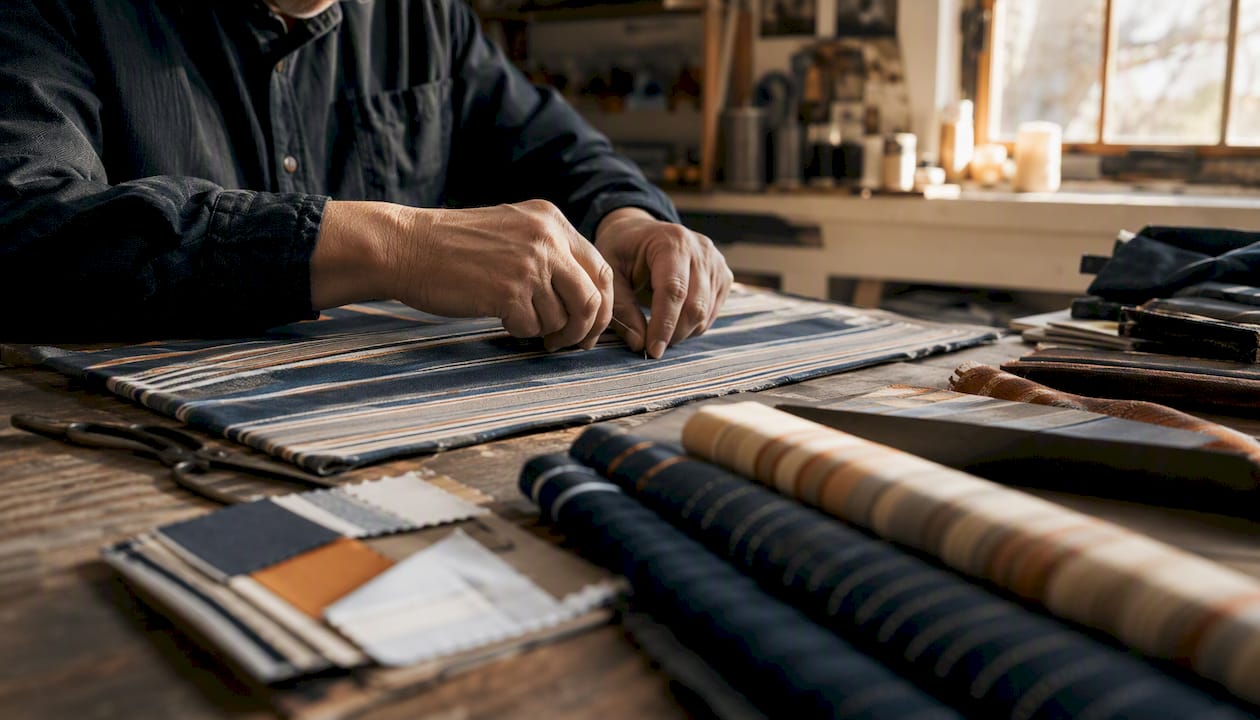
Fabric pattern options fall into four distinct categories: motif name (what the design looks like), visual family (geometric, organic, ornamental or small-scale), repeat/tile layout (how the motif tiles across the cloth), and construction method (whether the pattern is printed, woven or embroidered). Each axis matters independently. You can have a floral motif in a half-drop repeat on a Jacquard-woven ground, and every one of those details changes how much fabric you need, how it cuts, and how it wears.
The main pattern families and repeat types covered here:
Motif families: stripes, checks, gingham, tartan, polka dot, chevron, houndstooth, herringbone, ikat, paisley, floral/botanical, toile, damask, brocade, medallion, ogee, quatrefoil, trellis/lattice, harlequin, ditsy, animal print
Repeat/layout types: full-drop (block), half-drop, brick/half-brick, mirror, tossed/random, stripe and dot repeats
Construction-based patterns: Jacquard, brocade, damask, dobby, basketweave, crewel/embroidered
Whether you are specifying fabric for curtains, upholstery, clothing, or outdoor awnings, knowing these distinctions means you can describe exactly what you want to a supplier and order the right quantity the first time.
Key takeaways
Fabric pattern options cover four decisions: motif name, visual family, repeat/tile layout and construction method, and the repeat type is as important as the design itself when calculating how much to order.
Point | Details |
Name the motif precisely | Use the correct trade name (e.g., half-drop floral, straight-match ogee) so suppliers and workrooms can generate an accurate cut plan. |
Confirm repeat dimensions in cm | Always obtain the vertical and horizontal repeat in centimetres from the supplier before calculating yardage, not after. |
Allow for match type | Add one full vertical repeat per cut for a straight match; add one and a half repeats per cut for a half-drop match. |
Consider construction for durability | Woven patterns (Jacquard, damask) outlast printed ones in high-abrasion or outdoor use; solution-dyed woven stripes are the standard for awnings. |
Infinityawnings for outdoor fabric specification | Infinityawnings brings over 15 years of experience specifying patterned and plain fabrics for retractable awnings and shading structures across Yorkshire and surrounding counties. |
Table of Contents
What are fabric pattern options? A grouped glossary of motif names
How does pattern match type affect how much fabric you need?
A worked metric example: calculating fabric for a half-drop repeat
UK and European naming conventions: what differs from American usage
Patterned fabric for outdoor shading: Infinityawnings can help
What are fabric pattern options? A grouped glossary of motif names
The Sailrite fabric pattern glossary and The Spruce’s guide to common fabric patterns both organise motifs into broad visual families. The groupings below follow the same logic, with UK naming notes where they differ from American usage.
Geometric patterns
Geometric designs are built from repeating mathematical shapes: lines, angles, grids and polygons. They tend to read as structured and contemporary.
Stripe: parallel bands running vertically, horizontally or diagonally. Awning stripes (bold alternating bands) are the classic outdoor choice; ticking stripes are narrower and traditionally used for mattress covers and cushions.
Chevron: a continuous V-shaped zigzag. Bolder than herringbone and usually printed rather than woven. Works well on curtains and upholstery where the directional energy suits a focal wall.
Herringbone: a broken V-shape created by weaving, not printing. The offset columns give it a subtler, more textural quality than chevron. Common in suiting and upholstery cloth.
Houndstooth: interlocking broken checks, traditionally woven in two colours. The classic version is black and white; larger-scale versions are called “puppy tooth” in the UK trade.
Gingham: an even check woven from dyed and undyed threads, producing a two-colour grid. The check size ranges from 3 mm to 25 mm. Widely used for kitchen textiles, clothing and café-style soft furnishings.
Tartan/plaid: a multi-colour woven check with a defined sett (the sequence of coloured threads). In the UK, “tartan” refers specifically to a registered clan or district pattern; “plaid” is the more general American term for any large check.
Polka dot: evenly spaced filled circles on a contrasting ground. Dot size and spacing determine the mood: small tight dots read as classic; large spaced dots feel retro or playful.
Quatrefoil: a four-lobed shape derived from Gothic tracery. Popular in upholstery and wallcovering; often laser-cut or woven as a trellis overlay.
Trellis/lattice: a diagonal or square grid, sometimes with a floral motif at each intersection. A staple of traditional British soft furnishings and garden-room upholstery.
Harlequin: a diamond grid, typically in two alternating colours. Historically associated with theatrical costume; now used in bold upholstery and scatter cushions.
Ogee: a pointed arch shape derived from Islamic and Gothic architecture, often used as a repeat tile in damask and brocade grounds.
Organic and nature-inspired patterns
These designs draw from plants, animals and natural forms. They tend to soften a room and work particularly well on curtains and loose covers.
Floral: the broadest category, covering everything from tight rosebuds to large-scale painterly blooms. Scale is the critical variable: small florals (under 5 cm motif) suit clothing and cushions; large florals (over 15 cm) suit curtains and statement upholstery.
Botanical/leaf: stylised or realistic foliage without flowers. Fern, palm and eucalyptus prints have been popular in UK interiors since the mid-2010s.
Paisley: a teardrop-shaped motif with a curved tip, originating in Persia and popularised in the UK through the Paisley mills of Scotland. Used in clothing, scarves and decorative cushions.
Ikat: a resist-dyeing technique that blurs the edges of geometric or floral motifs. The characteristic “feathered” outline is a visual identifier. Used in upholstery and decorative textiles.
Animal print: an abstracted representation of animal skin (leopard, zebra, snake). Treated as a neutral in UK interior design; scale and colourway determine whether it reads as subtle or dramatic.
Toile de Jouy (toile): a monochrome scenic or figurative print on a plain ground, typically cream or white. French in origin but deeply embedded in British country-house style. Usually a half-drop repeat.
Ditsy: a small, scattered motif (flowers, stars, insects) with no obvious directional repeat. The motifs are typically under 2 cm. Suits clothing, children’s textiles and light curtains.
Ornamental and historical patterns
Damask: a reversible woven pattern where the motif and ground use the same yarn but in opposite weave structures (satin vs sateen), creating a lustrous contrast. Traditionally used for table linen, curtains and upholstery. The pattern is structural, not printed.
Brocade: a supplementary weft weave that raises a motif above the ground cloth, often in a contrasting colour or metallic thread. Heavier than damask and typically used for formal curtains and ceremonial upholstery.
Medallion: a large, centred circular or oval motif, often with radiating symmetry. Derived from Persian carpet design. Requires careful centring when cutting for upholstery.
Ogee repeat: the pointed arch tile used as an all-over repeat, often hosting a floral or botanical motif within each arch. Common in traditional British furnishing fabrics.
Small-scale and novelty motifs
Ditsy (see above): the defining characteristic is scale and scatter, not the motif itself.
Novelty/figurative print: a representational motif (animals, vehicles, food, text) used in children’s fabrics, fashion and novelty homeware. Rarely used in upholstery or awnings.
How do repeat types affect the look and feel of a fabric?
A pattern repeat is the smallest unit of a design that, when tiled, produces the full cloth. Every repeat has two dimensions: the vertical repeat (the height of one tile) and the horizontal repeat (the width). Understanding both is what separates a confident fabric order from an expensive mistake.
The Designer Basics slide deck on pattern repeats and the Made Good Designs repeat explainer both identify the same core structures. Printmag’s fabric patterns analysis confirms that most repeats are variations of three templates: block, brick and drop.
Full-drop (block) repeat: the motif tiles in a straight grid. Every row and column aligns. The result looks ordered and symmetrical, which suits geometric patterns. The downside is visible “tracking lines” where the eye follows the grid.
Half-drop repeat: each column of motifs is offset vertically by half the vertical repeat. The stagger breaks the grid and gives organic motifs (florals, toile) a more natural, flowing appearance. Toile de Jouy is the classic half-drop fabric. Half-drop requires more fabric than a block repeat because the offset creates additional wastage at each cut.
Brick/half-brick repeat: the offset runs horizontally rather than vertically. Each row shifts by half the horizontal repeat. The effect resembles a brick wall and suits geometric and abstract designs.
Mirror repeat: adjacent tiles are flipped horizontally, vertically or both. The mirrored join hides seams and creates a symmetrical, kaleidoscopic effect. Mirror repeats are the most reliable for disguising seam lines, which makes them a practical choice for wide upholstery panels.
Tossed/random repeat: motifs are scattered without a fixed grid. There is no obvious directional repeat, so the fabric has no “right way up.” Ditsy prints and some animal prints use this layout. It minimises wastage because cuts do not need to align.
Stripe repeat: the pattern tiles as a continuous vertical or horizontal band. Technically a zero-vertical-repeat design, so there is no match allowance needed for vertical seams, only for horizontal joins.
Dot repeat: evenly spaced circles in a grid or offset arrangement. Functionally similar to a block or half-drop repeat depending on the spacing.
Combination repeats layer two or more of the above structures. A trellis ground with a floral motif at each intersection, for example, combines a geometric block repeat with an organic element. These are common in traditional British furnishing fabrics and require the workroom to plan cuts around both the grid and the centred motif.
Pro Tip: If a full-drop repeat is producing distracting tracking lines on a large curtain drop, switch to a half-drop or tossed layout. The stagger breaks the eye’s tendency to follow the grid and makes the finished panel look more considered.
How does pattern match type affect how much fabric you need?
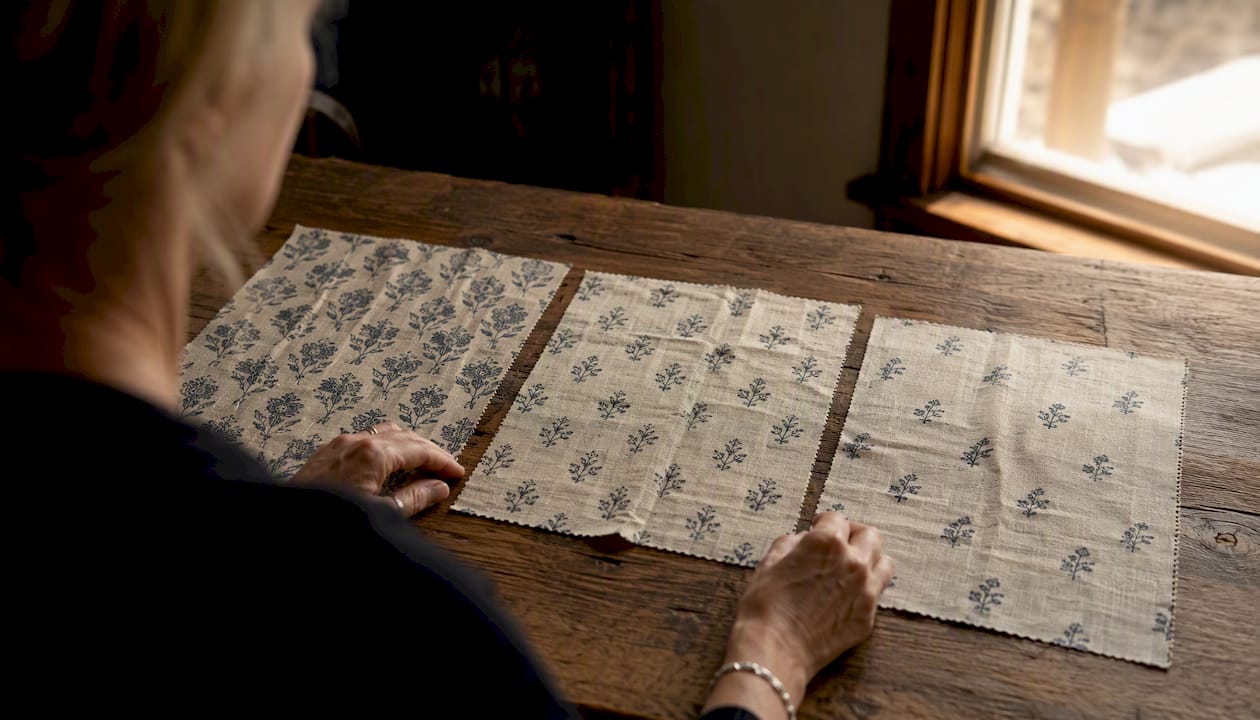
Pattern match type is the single biggest driver of fabric wastage, and ordering without confirming it is, as Kothea’s pattern matching guide puts it, one of the most costly mistakes in pattern work. The two standard match types are:
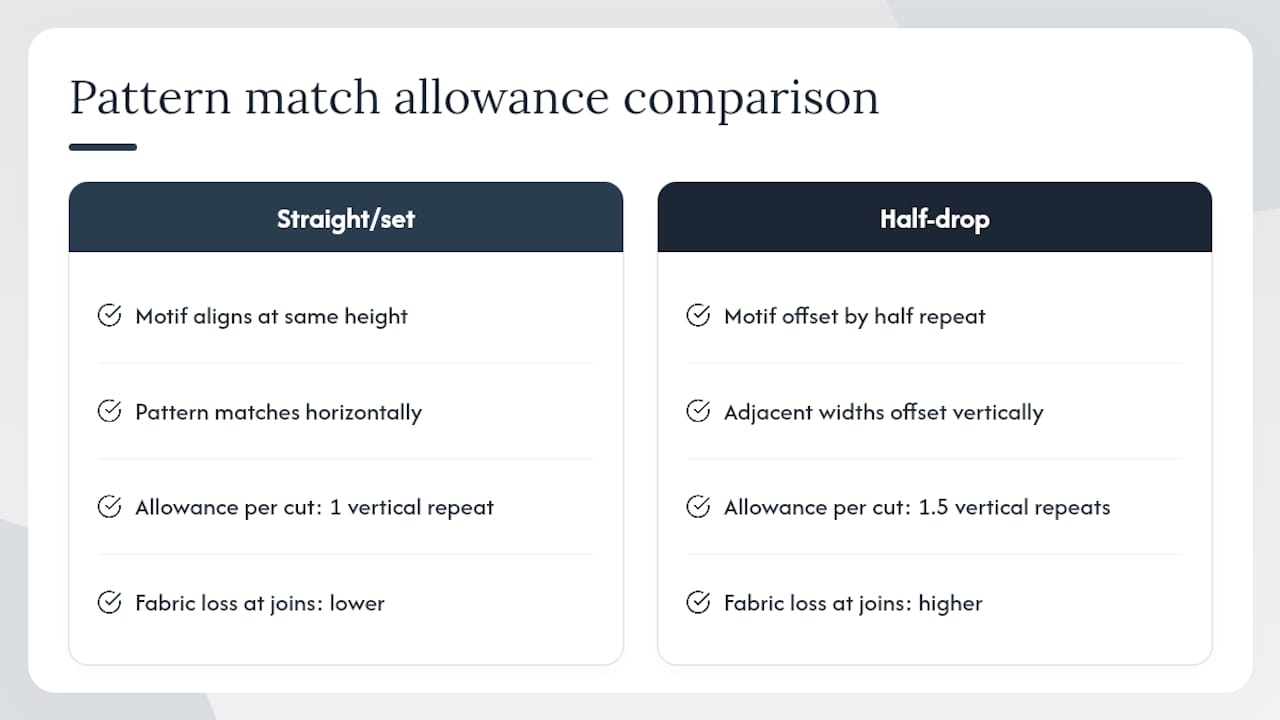
Straight/set match: the motif aligns at the same vertical height across every width. When you place two widths side by side, the pattern matches horizontally. The industry allowance is a full vertical repeat per cut length added to your base measurement.
Half-drop match: the motif in the adjacent width is offset by half the vertical repeat. The allowance is one and a half vertical repeats per cut length, because the offset means you lose more fabric at each join.
Calculating extra fabric: a step-by-step checklist
Measure the finished cut length you need (e.g., 240 cm for a curtain drop).
Confirm the vertical repeat size in centimetres from the bolt tag or supplier product page. Suppliers such as Zoffany publish both vertical and horizontal repeat measurements on every product page.
For a straight match, divide the cut length by the repeat size and round up to the next whole number, then multiply back by the repeat size. That is your adjusted cut length per panel.
For a half-drop match, add 50% of the vertical repeat to the cut length before performing the same rounding calculation.
Multiply the adjusted cut length by the number of panels or widths required.
Add 10 cm per panel as a general cutting tolerance.
Convert to metres and round up to the nearest 0.5 m before ordering.
Centring: for upholstery, confirm whether the motif needs to be centred on the seat or back panel. A centred medallion on a chair seat may require an additional half-repeat of fabric to position the motif correctly.
Match type | Extra allowance per cut | Visual effect | Typical uses |
Straight/set match | One full vertical repeat | Ordered, symmetrical | Geometric prints, stripes, checks |
Half-drop match | One and a half vertical repeats | Organic, flowing | Florals, toile, ikat, large-scale prints |
Tossed/random | None | Scattered, no direction | Ditsy, animal print, abstract |
Before ordering, run through this workflow:
Confirm the vertical repeat size in centimetres (ask the supplier if it is not on the product page).
Confirm the match type (straight or half-drop).
Ask the workroom for a cut plan showing how panels will be positioned on the bolt.
Confirm any centring requirements for upholstered pieces.
Stitchdesk’s pattern repeat calculation guide recommends zone-by-zone calculations for upholstery, treating each section of a piece (seat, back, arm, cushion) as a separate cut rather than estimating a single total. This approach avoids the compounding wastage that occurs when a large repeat is applied to multiple panels without planning.
Patterns produced by weave and construction, not print
Not every pattern comes from a dye or a print screen. Some of the most durable and prestigious fabric designs are structural, built into the cloth during weaving or embroidery. The Dress and Textile Specialists’ guide to identifying textile types and weaves explains that even the simplest tabby/plain weave can produce checks or stripes simply by alternating coloured warp and weft threads, with no printing required.
Jacquard: a loom-controlled weave that can produce any motif by individually controlling each warp thread. Jacquard fabrics include damask, brocade and tapestry. The pattern is woven in and cannot be rubbed off. Highly durable and suitable for upholstery and formal curtains.
Brocade: a supplementary weft Jacquard where extra threads are woven in to raise a motif above the ground. The raised surface catches light differently from the ground, creating depth. Not ideal for high-abrasion upholstery because the raised threads can snag.
Damask: a self-patterned Jacquard where the motif and ground use the same yarn in contrasting weave structures (typically satin and sateen). Reversible, with the motif appearing in reverse on the back. Used for table linen, curtains and traditional upholstery.
Dobby: a simpler loom attachment than Jacquard, capable of producing small geometric repeats (spots, small diamonds, simple stripes). Dobby weaves are common in shirting and lightweight furnishing fabrics.
Basketweave: pairs of warp and weft threads woven together in a plain weave, creating a visible square grid. The pattern is purely structural. Used in upholstery cloth and outdoor fabrics where the open weave aids breathability.
Crewel embroidery: a surface pattern stitched onto a plain woven ground using wool yarn. The raised stitching creates texture and depth. Traditional in British country-house interiors; not suitable for high-wear upholstery or outdoor use because the stitching is vulnerable to abrasion and moisture.
Appliqué: a motif cut from one fabric and stitched onto another. The pattern is additive rather than woven or printed. Used in decorative cushions and wall hangings.
For outdoor applications such as awnings, construction-based patterns in solution-dyed acrylic (where the colour is in the fibre, not on the surface) offer the best UV and fade resistance. Woven stripes in solution-dyed yarn are the standard choice for retractable awning fabrics across the UK market. You can read more about how fabric construction affects outdoor performance in Infinityawnings’s dedicated materials guide.
How to choose a fabric pattern for your specific project
Choosing a pattern is not just about what looks appealing on a swatch. Scale, repeat size, match type, fabric weight and end-use durability all interact, and the wrong combination creates problems that are expensive to fix after cutting.
Motif scale vs viewing distance: a large-scale medallion (30 cm across) reads beautifully on a full-length curtain viewed from across a room but looks overwhelming on a small armchair seen at close range. As a rule, the larger the piece and the greater the viewing distance, the larger the motif can be.
Repeat size and yardage budget: a 30 cm vertical repeat on a six-panel curtain order adds significantly more fabric than a 10 cm repeat. If budget is tight, choose a smaller repeat or a tossed layout.
Match type and cutting complexity: half-drop repeats require more skill and time from a workroom. If you are making up curtains yourself, a straight match is considerably easier to manage.
Fabric weight and drape: lightweight printed cotton suits gathered curtains and clothing; heavier woven Jacquard suits structured upholstery and formal curtains with pinch pleats.
Abrasion and care: upholstery fabrics should have a Martindale abrasion rating of at least 15,000 rubs for domestic use and 25,000 rubs for commercial use. Woven patterns generally outperform printed ones on this measure because the design is in the structure, not on the surface.
UV and fade resistance for outdoor textiles: printed designs on standard cotton or polyester will fade within one to two seasons outdoors. For awnings and outdoor cushions, specify solution-dyed acrylic or polyester with a UV-stable coating. Woven awning stripes in solution-dyed yarn are the most durable option. Infinityawnings’s guide to selecting awning fabric for lasting outdoor appeal covers this in detail.
Pattern choices by application:
Curtains: large-scale florals, toile (half-drop), damask, wide stripes. Centring the motif on each panel matters.
Upholstery: medium-scale geometric, medallion (centred), houndstooth, plain weave with texture. Avoid very large repeats on small pieces.
Clothing: ditsy, small floral, gingham, ikat, stripe. Tossed layouts minimise wastage on pattern pieces.
Outdoor awnings: woven awning stripe, solution-dyed geometric, basketweave. Avoid embroidered or appliquéd designs outdoors.
Hold the mock-up against the piece you are covering. A motif that looked perfect on a 10 cm swatch can look very different at 1:1 scale on a sofa back.*
How to identify a pattern and describe it to a supplier
Communicating accurately with a supplier or workroom saves time and prevents costly re-orders. Use this checklist when you are working from a swatch or a bolt.
Visual identification checklist:
Locate the most distinctive motif in the design.
Find the same motif in the adjacent width and check whether it sits at the same vertical height (straight match) or is offset by half the repeat height (half-drop).
Measure the vertical distance from the top of one motif to the top of the identical motif directly below it. That is the vertical repeat.
Measure the horizontal distance from the centre of one motif to the centre of the next identical motif across the width. That is the horizontal repeat.
Check whether adjacent tiles are flipped (mirror repeat) or identical (block/half-drop).
If the bolt tag does not state the match type, the Dress and Textile Specialists’ identification guide recommends the offset test: locate a distinctive motif and check whether the same motif in the next width aligns at the same height or drops by half the vertical repeat.
Information to give your supplier or workroom:
Pattern/motif name (e.g., “half-drop floral,” “straight-match ogee”)
Vertical repeat in centimetres
Horizontal repeat in centimetres
Match type (straight or half-drop)
Centring requirement (e.g., “medallion centred on seat panel”)
Any join or placement priority (e.g., “pattern to run continuously across a three-seater sofa”)
Both Wayfair UK’s fabric pattern guide and the Designer Basics repeat deck stress that vocabulary varies between suppliers, so always supply both the motif name and the repeat mechanics rather than relying on the name alone.
A worked metric example: calculating fabric for a half-drop repeat
This example uses a pair of lined curtains for a domestic window, a common scenario where repeat mismatch causes the most avoidable waste.
Inputs:
Calculation walkthrough:
Base cut length: 240 cm (finished drop) + 20 cm (hem and heading allowance) = 260 cm per panel.
Half-drop allowance: add 1.5 × 32 cm = 48 cm to the base cut length. Adjusted cut length = 260 + 48 = 308 cm.
Round up to the next full repeat: 308 ÷ 32 = 9.625, rounded up to 10 repeats. 10 × 32 = 320 cm per panel.
Total fabric required: 320 cm × 4 panels = 1,280 cm = 12.8 metres.
Rounding for order: round up to 13 metres.
For comparison, the same curtains in a plain fabric would need approximately 10.4 metres (260 cm × 4 panels ÷ 100). The 32 cm half-drop repeat adds roughly 2.6 metres to the order, which is consistent with the principle that large vertical repeats drive significant additional yardage across multiple panels.
Pro Tip: Always request the bolt’s exact repeat dimensions from the supplier before calculating, not after. A supplier product page may list a nominal repeat that differs slightly from the actual bolt. Ask for a cut plan in writing before the workroom makes the first cut, and keep a copy.
Where do common fabric patterns come from?
Pattern names carry history, and knowing the origin of a design often explains why it looks the way it does and where it works best.
Tartan originates in the Scottish Highlands, where each clan’s sett (the sequence of coloured threads) was a form of identification. The Tartan Register, maintained in Edinburgh, holds over 7,000 registered designs. In the UK trade, “tartan” is a specific term; using it for any large check is considered imprecise.
Paisley takes its name from the Scottish town of Paisley, Renfrewshire, where mills in the 19th century produced affordable versions of the Kashmiri shawl. The boteh motif itself is Persian in origin, appearing in Safavid textiles from the 16th century.
Toile de Jouy was first produced at the Oberkampf factory in Jouy-en-Josas, France, in 1760. The scenic copper-plate prints depicted pastoral and mythological scenes. The design reached Britain through trade and became associated with country-house interiors, where it remains a staple.
Houndstooth is a woven check with roots in the Scottish Borders and Northern England, where it appeared in shepherd’s plaids. The interlocking tooth shape is created by the weave sequence, not by printing.
Ikat is a resist-dyeing technique found independently across Central Asia, South-East Asia, West Africa and Latin America. The name comes from the Malay/Indonesian word mengikat (to tie or bind). In the UK market, ikat-style prints are common in upholstery and decorative textiles, though most are printed imitations of the woven original.
Damask takes its name from Damascus, the Syrian city through which the fabric reached Europe via the Silk Road in the medieval period. The self-patterned woven structure was later replicated in European mills, particularly in Flanders and later in Spitalfields, London.
Gingham has contested origins, with some historians tracing it to the Malay word genggang (striped) and others to Dutch imports in the 17th century. In the UK, gingham is strongly associated with kitchen and country-style interiors.
Chevron as a decorative motif appears in prehistoric art and in medieval heraldry, where it denoted a rafter or roof shape. Its use in fabric became widespread in the 20th century as a bold, graphic alternative to the stripe.
UK and European naming conventions: what differs from American usage
Fabric pattern vocabulary is not universal. Several terms mean different things on either side of the Atlantic, and some patterns have entirely different names in the UK trade.
Plaid vs tartan: in the United States, “plaid” describes any multi-colour woven check. In the UK, “plaid” historically referred to a length of tartan cloth worn as a garment, and the check pattern itself is called “tartan.” Using “plaid” for a tartan-style fabric is understood in the UK but considered informal in the trade.
Check vs gingham: in the US, “gingham” often refers to any simple two-colour check. In the UK, gingham specifically means an even check woven from dyed and undyed threads, producing a white-and-colour grid. A check woven from two dyed colours is simply called a “check” or “block check.”
Calico: in the UK, calico is an unbleached, undyed plain-weave cotton, used for toiles (test garments) and upholstery underlay. In the US, “calico” refers to a small printed floral cotton. The two uses are essentially opposite, which causes confusion when ordering from American suppliers.
Chintz: in the UK, chintz is a glazed printed cotton, typically with a large floral design. The glaze gives it a slight sheen and stiffness. In the US, the term is used more loosely for any floral cotton print, glazed or not.
Toile: in the UK interior design trade, “toile” almost always means toile de Jouy (the scenic monochrome print). In the fashion trade, “toile” means a test garment made in calico. Context determines which meaning applies.
Repeat measurement conventions: UK and European suppliers typically state repeat dimensions in centimetres. American suppliers often use inches. When ordering from a US source for a UK project, always convert and confirm: 1 inch = 2.54 cm.
Colour naming: UK suppliers tend to use descriptive colour names (duck egg, eau de nil, stone, slate) rather than the Pantone-referenced naming more common in American commercial fabric catalogues. When specifying a colourway to a UK workroom, use the supplier’s own colour name rather than a Pantone reference unless the workroom specifically requests one.
A note from Andrew on specifying patterned fabrics
Pattern selection looks straightforward until you are standing in front of a bolt with a tape measure and a cut list. The repeat type question is where most mistakes happen, and I have seen it go wrong on jobs that looked simple on paper.
The most common error is ordering to the finished measurement without adding any repeat allowance at all. On a plain fabric, that works. On a 30 cm half-drop repeat across six curtain panels, it can leave you 2 metres short with no matching fabric left on the bolt.
At Infinityawnings, specifying patterned fabrics for awnings and soft furnishings has been part of the work for over 15 years. The practical discipline is the same whether the fabric is going onto a retractable awning cassette or a pair of interlined curtains: confirm the repeat in centimetres, confirm the match type, get a cut plan in writing, and add your tolerance before you order. The guidance in this article reflects exactly what we apply on every project.
If you are specifying fabric for an outdoor shading project, the Infinityawnings awning fabric types guide covers the construction and performance side in detail alongside the pattern options available.
Patterned fabric for outdoor shading: Infinityawnings can help
Choosing the right patterned fabric for an awning or pergola canopy is a different challenge from choosing for curtains or upholstery. The fabric has to perform outdoors year-round, which means UV stability, water resistance and structural integrity matter as much as the visual design.
Infinityawnings supplies and installs retractable awnings, pergolas and verandas across Yorkshire, Derbyshire, Nottinghamshire and Lincolnshire, working with premium fabric brands whose patterned ranges are specified for outdoor durability. The fabric options available through Infinityawnings include woven awning stripes, geometric prints and plain solution-dyed acrylics, all with the repeat dimensions and technical data you need to make an informed choice before ordering.
If you are at the stage of selecting fabric for a shading project, a free quote gives you access to fabric samples, repeat specifications and a cut plan from an experienced installer. Request a free quote for your pergola or awning project and get the technical detail alongside the design options.
Sources
Recommended