
Why schools need outdoor shelters: a 2026 guide

TL;DR:
Outdoor shelters provide permanent or semi-permanent covered spaces that extend outdoor learning, support mental health, and promote inclusivity in schools. They help prevent indoor congestion, enable year-round outdoor activities, and meet government funding and regulatory standards. Proper design and strategic placement maximize their educational and operational benefits.
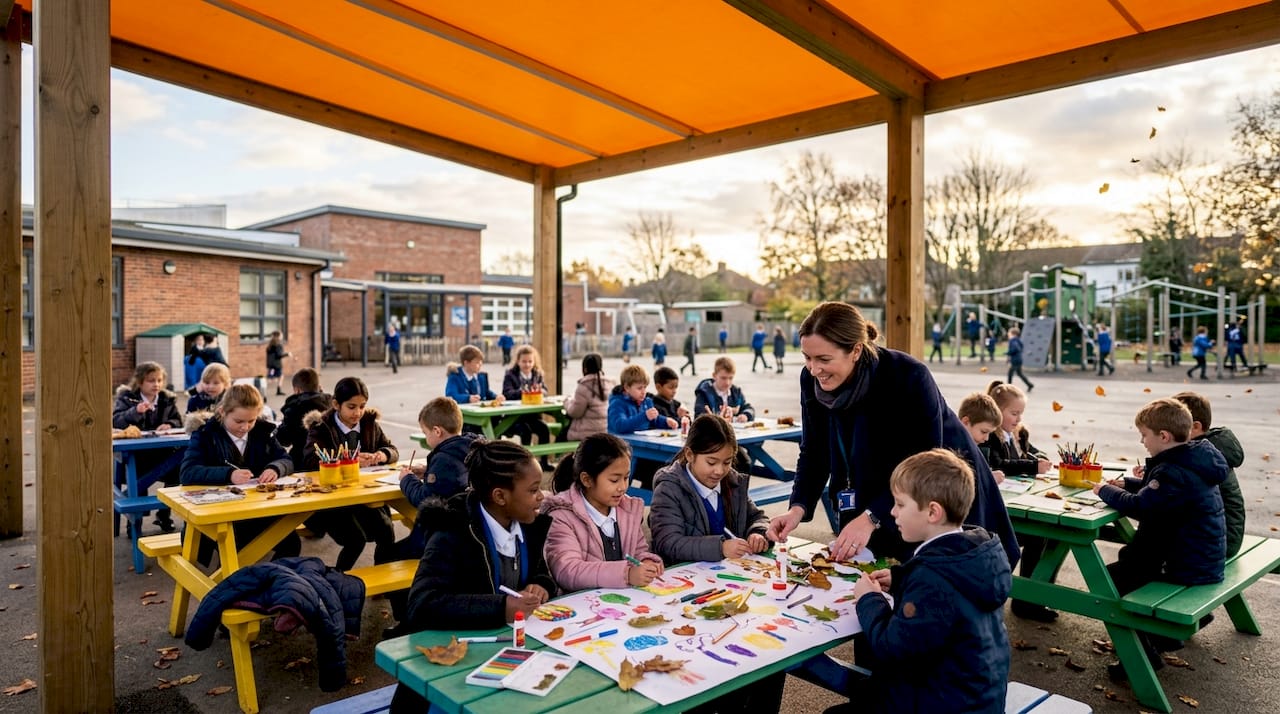
Outdoor shelters are defined as permanent or semi-permanent covered structures that give schools protected, flexible space for learning, play, and social activity in all weather conditions. Understanding why schools need outdoor shelters has become more pressing in 2026, as covered walkways and shelters increase outdoor learning time by 30% and support significantly better mental health trajectories in children up to age 8. The Department for Education and inclusive education estate standards now both reference outdoor covered spaces as high-impact adaptations. For school administrators, the case is no longer about comfort alone. It is about educational outcomes, safeguarding, and compliance.
How do outdoor shelters enhance student engagement and mental health?
The link between outdoor play and improved mental health is well established. Social outdoor play is directly linked to fewer internalising and externalising problems in young children, with longitudinal data from 4,151 children showing significance at p < .001. That figure means the relationship is not coincidental. Schools that invest in shelters give children the conditions to access those benefits consistently, regardless of rain, wind, or glare.
Without a covered space, outdoor time shrinks the moment weather turns. A shelter removes that barrier. Children who might otherwise spend break times in corridors or cramped halls can instead socialise, move, and decompress outside. The result is calmer re-entry to classrooms and better concentration during lessons.
“Outdoor play with peers increases mental health benefits more than indoor play. Outdoor shelter use supports this by enabling safe social interaction outdoors, reducing internalising and externalising problems in young children.”
The benefits extend beyond break times. Teachers report that outdoor shelter use supports safer supervision and creates calmer, better-included pupils by reducing glare, heat exposure, and distractions. A shaded, defined space gives children a clear boundary, which aids focus and reduces overstimulation.
Key mental health and engagement benefits schools report include:
Reduced anxiety during unstructured time outdoors
Better peer interaction and social skill development
Improved concentration when returning to indoor lessons
Lower rates of heat-related discomfort during summer months
More consistent access to outdoor learning across the academic year
Pro Tip: Schedule at least one curriculum lesson per week under your outdoor shelter from september onwards. Consistent use builds pupil confidence outdoors and signals to staff that the space is a genuine learning zone.
What role do outdoor shelters play in inclusivity and accessibility at schools?
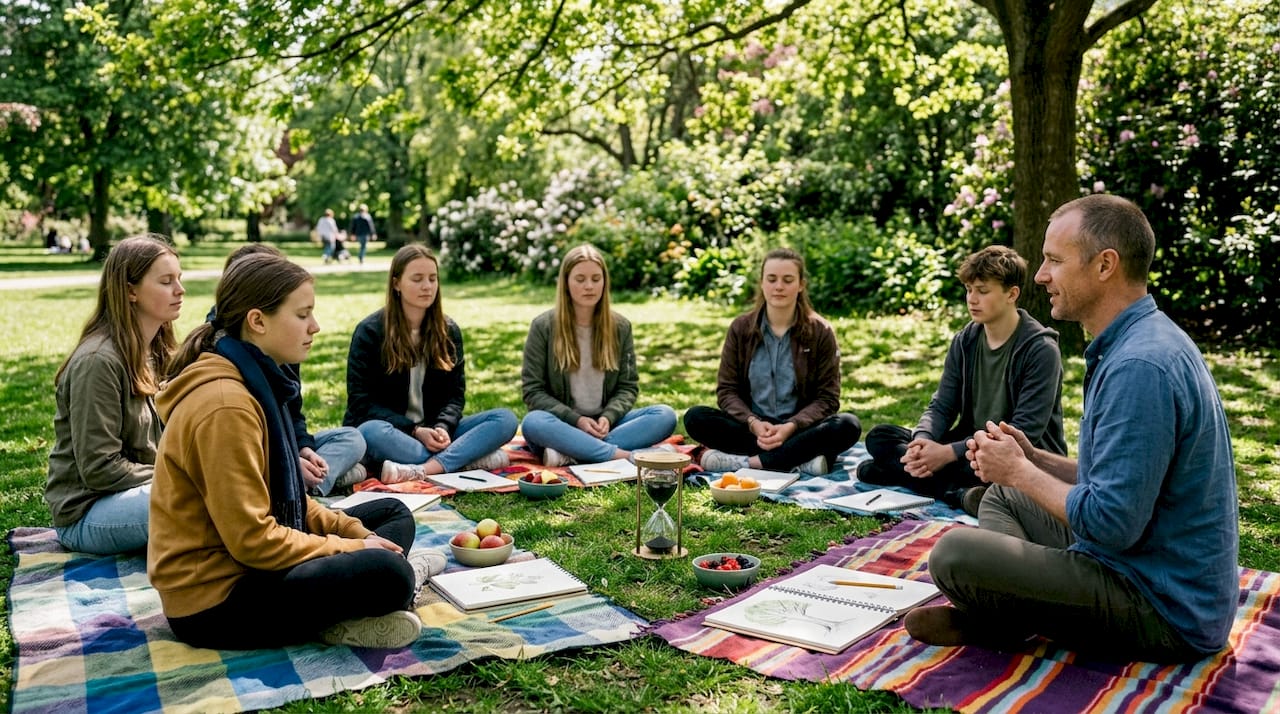
Outdoor shelters are a recognised adaptation under current government guidance. The 2026 inclusive education estates guidance explicitly recommends covered outdoor spaces as high-impact adaptations for children with sensory or medical needs. That guidance carries weight. Schools that ignore it risk failing pupils who depend on controlled environments to participate fully.
Children with light sensitivity, autism spectrum conditions, or conditions requiring temperature regulation cannot safely use uncovered outdoor spaces during bright or hot weather. A shelter addresses all three barriers at once. It filters direct sunlight, reduces ambient temperature, and creates a defined, predictable zone that reduces sensory overload.
Inclusivity benefits of covered outdoor spaces include:
Protection from UV exposure for children with photosensitivity
Reduced temperature fluctuation for pupils with medical conditions
A calmer, lower-stimulation zone for children with sensory processing differences
Improved supervision sight lines for staff supporting pupils with additional needs
Year-round access to outdoor space for all pupils, regardless of physical or sensory profile
Accessibility also means staff accessibility. A covered space with slip-resistant flooring and clear sightlines makes outdoor supervision safer and less physically demanding. Schools that invest in safe outdoor areas for pupils also reduce the supervision burden on teaching assistants and lunchtime staff.
Pro Tip: When specifying a shelter for inclusivity, ask your installer about fabric opacity ratings. A fabric with a high UV block percentage reduces glare significantly more than a standard canopy, making the space usable for light-sensitive pupils even on bright days.
What practical benefits do outdoor shelters offer to school facilities?
Outdoor shelters add functional square footage to a school without the cost or planning complexity of a new building. That is a significant operational advantage. Schools facing pressure on hall space, dining areas, and corridors can redirect foot traffic outdoors by creating covered zones that serve multiple purposes throughout the day.
The operational case for school playground shelters is straightforward:
Relieve indoor congestion. A covered outdoor dining area removes 30 to 50 pupils from the hall at any one sitting, reducing noise and queuing pressure.
Protect indoor flooring. Pupils who move between covered outdoor and indoor spaces track in less mud and water, reducing cleaning costs and slip hazards.
Enable year-round outdoor activities. PE warm-ups, assemblies, science experiments, and art projects all become viable outdoors when weather protection exists.
Create dedicated social zones. A covered seating area gives older pupils a defined space that reduces corridor loitering and associated behaviour issues.
Support outdoor dining. Schools with covered outdoor dining report calmer mealtimes and faster throughput compared to indoor-only arrangements.
Schools that treat shelters as planned educational zones rather than emergency weather cover extract far more value from the investment. A shelter positioned near a science garden, for example, becomes a base for year-round outdoor STEM work. One placed near the library entrance becomes a quiet reading area that extends borrowing and reading time.
Pro Tip: Map your school’s peak congestion points before specifying a shelter location. Placing a covered space near your busiest indoor bottleneck, such as a dining hall exit or a main corridor junction, delivers the fastest operational return.
Which funding and regulatory frameworks support outdoor shelter installation?
Schools do not need to fund outdoor shelters entirely from their own budgets. Since october 2023, the Department for Education has allocated £17 million across more than 1,800 educational settings through the National Education Nature Park programme. An additional £2 million was confirmed for 2026 to 2027. That funding covers contractor fees, equipment purchase, and installation, which means a shelter project can qualify in full.
Funding stream | Amount | Eligible uses |
National Education Nature Park (2023 to 2025) | £15 million | Shelter installation, biodiversity, gardening |
National Education Nature Park (2026 to 2027) | £2 million | Nature-based education improvements |
Inclusive education estates guidance | Not a grant; design standard | Covered outdoor adaptations for SEND pupils |
Schools can leverage government grants to fund biodiversity improvements alongside shelter installation, making a single application cover multiple site improvements. A school installing a shelter over a raised bed garden area, for instance, can present the project as both a nature-based education improvement and an inclusive adaptation, strengthening the application considerably.
The inclusive education estates guidance does not provide direct funding, but it does create a compliance rationale. Governors and senior leaders can use it to justify capital expenditure on covered outdoor spaces as a statutory-aligned investment rather than a discretionary one. That framing matters when presenting proposals to finance committees.
Schools exploring playground shading options should check current National Education Nature Park eligibility criteria before specifying a structure, as grant conditions may influence material choices and installation requirements.
How should schools design outdoor shelters for maximum educational impact?
Design determines whether a shelter becomes a genuinely used learning space or an underused structure at the edge of the playground. Effective shading design creates zoned spaces for specific uses rather than uniform overhead cover. A single large canopy with no internal differentiation tends to attract chaotic use. A shelter divided into a quiet corner, a group work area, and an open social zone generates purposeful activity.
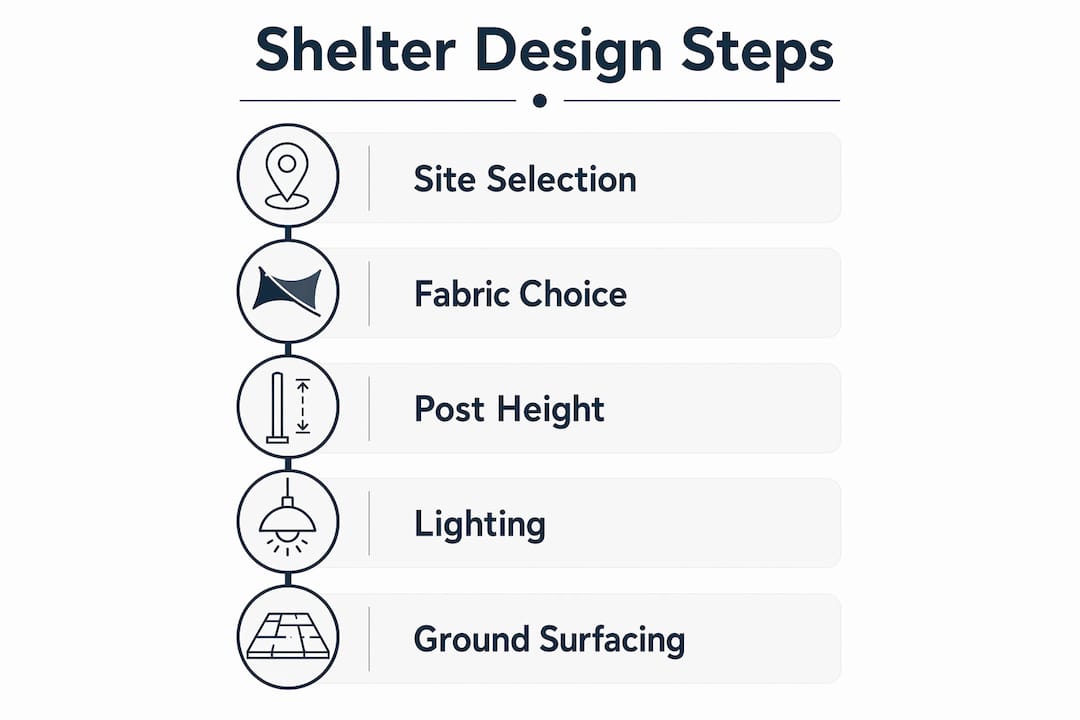
Design factors such as fabric choice, post height, angle, and ground surfacing all influence usability and comfort. High-grade commercial fabrics provide UV protection and reduce glare while still allowing natural light. Post height affects ventilation. A shelter that traps heat in summer defeats its own purpose. Ground surfacing must be slip-resistant and suitable for wheelchair access to meet inclusive design requirements.
Design factor | What to specify | Why it matters |
Fabric | High-grade UV-blocking commercial canopy | Reduces glare; protects from UV without blocking light |
Post height | Minimum 2.4 metres at eaves | Allows ventilation and prevents heat build-up |
Ground surface | Slip-resistant, level, wheelchair-accessible | Meets inclusive design standards and reduces injury risk |
Zoning | Defined areas for quiet, group, and social use | Drives purposeful use and reduces conflict |
Technology provision | Conduit for power and Wi-Fi cabling | Enables digital learning and outdoor presentations |
Learning through Landscapes stresses integrating school grounds into long-term education and wellbeing strategies, underpinned by shelter infrastructure. That means the design conversation should involve teachers, not just facilities managers. A class teacher who uses the space for storytelling needs different features than a science teacher running experiments. Consulting both produces a shelter that earns consistent use across the timetable.
Schools pairing shelter installation with school outdoor space ideas for 2026 will find that multi-zone layouts generate the strongest return on investment. Locker Space solutions for secure outdoor storage can also complement a covered zone by giving pupils somewhere to store equipment without returning indoors.
Key takeaways
Outdoor shelters are essential school infrastructure that extend usable learning space, support mental health, meet inclusive education standards, and qualify for government funding.
Point | Details |
Mental health impact | Covered outdoor play supports better mental health trajectories in children, with longitudinal significance at p < .001. |
Inclusivity compliance | The 2026 inclusive education estates guidance recommends covered outdoor spaces for pupils with sensory or medical needs. |
Operational value | Shelters relieve indoor congestion, protect flooring, and enable year-round outdoor activities without new buildings. |
Government funding | The National Education Nature Park programme has allocated £17 million since 2023, with £2 million confirmed for 2026 to 2027. |
Design principle | Zone shelters for specific uses rather than installing uniform cover to maximise purposeful daily use. |
From the field: why shelters are no longer optional
The shift I have observed over the past decade is clear. Schools used to treat outdoor shelters as contingency cover, something to keep pupils dry during a downpour. That framing is now outdated. The schools getting the most from their outdoor spaces treat shelters as permanent learning infrastructure, planned with the same intention as a classroom.
What surprises most administrators I speak with is how quickly a well-designed shelter changes staff behaviour. Once teachers see a covered, equipped space outside, they start using it. Lessons migrate outdoors. Reading groups appear under the canopy. Science experiments that were previously impossible in changeable weather become routine. The shelter does not just protect pupils from rain. It gives teachers permission to teach differently.
The funding picture in 2026 makes inaction harder to justify. With £17 million already distributed and another £2 million confirmed, schools that have not yet applied are leaving money on the table. The inclusive education estates guidance adds a compliance dimension that governors cannot easily ignore. Taken together, the financial, educational, and regulatory arguments all point in the same direction.
My practical advice: start with a site audit. Identify your three highest-traffic outdoor zones and your most congested indoor spaces. The overlap between those two maps is where your first shelter should go. Get teachers involved in the brief. And treat the structure as a room, not a roof.
— Andrew
Outdoor shelter solutions for schools from Infinityawnings
Schools across Yorkshire, Derbyshire, Nottinghamshire, and Lincolnshire have worked with Infinityawnings to create covered outdoor spaces that perform year-round.

Infinityawnings designs and installs premium pergolas and shade structures built for educational settings, using commercial-grade materials from brands including Weinor, Tarasola, and Morvelle. Every project is handled from initial design through to installation, with structures specified to meet inclusive design requirements and withstand UK weather conditions. Whether you need a covered dining zone, an outdoor classroom, or a multi-use social space, Infinityawnings provides a free quote and tailored advice to help you make the most of your school grounds. Contact the team to discuss your requirements.
FAQ
Why do schools need outdoor shelters?
Schools need outdoor shelters to extend usable learning time, support pupil mental health, and meet inclusive education standards. Covered outdoor spaces increase outdoor learning time by 30% and support better mental health trajectories in children.
Can schools get funding for outdoor shelter installation?
Yes. The Department for Education’s National Education Nature Park programme has allocated £17 million since 2023, with a further £2 million confirmed for 2026 to 2027. Funding covers contractor fees, equipment, and installation.
How do outdoor shelters support pupils with additional needs?
The 2026 inclusive education estates guidance recommends covered outdoor spaces as high-impact adaptations for children with sensory or medical needs, addressing light sensitivity, temperature fluctuation, and overstimulation.
What is the best location for a school outdoor shelter?
Place shelters near your highest-traffic outdoor zones or your most congested indoor spaces, such as dining hall exits or main corridor junctions, to deliver the greatest operational and educational benefit.
How should schools design outdoor shelters for learning?
Zone the shelter into defined areas for quiet work, group activity, and social use rather than installing uniform cover. Specify UV-blocking fabric, slip-resistant flooring, and conduit for power and Wi-Fi to maximise educational use.
Recommended
Comments