
Wind resistance in awnings: choosing and caring wisely

Updated: Sep 13
TL;DR:
Many UK awnings are damaged annually due to wind, but most owners neglect wind resistance in their choices. Proper wind resistance depends on the frame, fixings, size, fabric, and automation, which are often overlooked but crucial for exposed locations. Regular maintenance and understanding local microclimates significantly improve an awning’s ability to withstand unpredictable gusts and enhance its longevity.
Thousands of awnings across the UK are damaged every single year by wind, yet most owners never considered wind resistance when making their purchase. It is one of the most overlooked specifications in the entire outdoor shading market. Many people assume that any awning fixed to a wall is sturdy enough to handle whatever the British weather throws at it. That assumption is costly. Whether you own a home in the Yorkshire Dales, run a restaurant terrace in Nottingham, or manage a hotel with outdoor seating in Lincolnshire, understanding what wind resistance actually means for your awning could save you significant money and frustration.
Table of Contents
Key Takeaways
Point | Details |
Wind resistance varies widely | Not all awnings offer strong wind resistance, so always check the specific rating before purchase. |
Proper installation matters | Where and how your awning is fixed greatly affects its ability to withstand wind. |
Maintenance boosts durability | Regular cleaning, inspection, and prompt repairs help your awning perform well in windy weather. |
Consider local conditions | Properties in open or exposed areas need higher-rated wind resistance and possibly automation features. |
What does wind resistance mean in awnings?
Wind resistance is not a single number stamped on a box. It refers to the total capacity of an awning to withstand wind pressure without distorting, tearing, or detaching from its fixing points. Every component plays a role: the frame, the brackets, the fabric, and the mechanism that opens and closes the canopy.
Wind resistance is often measured in kilometres per hour, expressing the maximum sustained wind speed a product can tolerate under test conditions. Some manufacturers and standards bodies also use the Beaufort scale, a numbered system running from 0 (calm) to 12 (hurricane force), which gives a practical picture of real-world conditions. A well-rated awning might be certified to handle Beaufort 5 or 6, which equates to roughly 29 to 49 km/h. Others may only cope with Beaufort 3 before strain begins to build.
The factors that influence wind resistance include:
Frame rigidity: A robust aluminium or steel frame transfers wind load to the wall fixing rather than absorbing it through flex.
Fixing method and anchor points: The number, size, and spacing of wall fixings determine whether the awning stays put when wind builds.
Projection and width: A larger awning presents more surface area to the wind, increasing the load on every connection point.
Fabric type and tension: A loose, flapping fabric places enormous dynamic stress on the arms and cassette housing.
Automation and sensor systems: Electric awnings fitted with wind sensors for awnings can retract automatically before wind speeds reach damaging levels.
Yorkshire, Derbyshire, Nottinghamshire, and Lincolnshire are not exactly sheltered. The region sees frequent westerly and south-westerly winds, and elevated locations such as the Peak District fringes or the Lincolnshire Wolds can experience gusts well above average. Even urban properties in Sheffield, Leeds, or Derby can be caught out by wind tunnelling between buildings. Wind resistance is, as industry guidance confirms, a critical feature for awnings in exposed regions like ours.
Key fact: Gusts can exceed sustained wind speeds by 50% or more. An area described as experiencing 30 km/h winds might produce momentary gusts of 45 km/h. Your awning must be rated for gusts, not just averages.
Factors that affect wind resistance in awnings
Understanding what wind resistance is leads us to the most crucial question: what actually determines how well an awning stands up to the elements?
The size and projection of the awning matter enormously. A 6-metre wide awning with a 3.5-metre projection creates a large sail-like surface. Every extra metre of width or projection multiplies the load on the frame and fixings during a gust. Smaller awnings on sheltered elevations naturally face lower wind loads, but that does not mean they can be ignored.
Awning type | Typical wind resistance | Best suited for |
Open-arm retractable | Beaufort 3 to 4 | Sheltered gardens, enclosed courtyards |
Semi-cassette | Beaufort 4 to 5 | Moderate exposure, suburban properties |
Full cassette | Beaufort 5 to 6 | Exposed elevations, commercial terraces |
Pergola with roof system | Beaufort 6 to 7 | Open gardens, coastal or elevated sites |
Frame construction plays a significant role too. Aluminium frames are the industry standard for good reason: they combine low weight with high rigidity and resist corrosion over time. Steel frames can offer greater strength but add weight, which increases the load on wall fixings. Composite frames can be found in budget products, but they often lack the long-term rigidity needed in exposed conditions.
The type of fixing is equally critical. A soffit-mounted awning behaves differently to a wall-mounted one. Roof or rafter-mounted installations introduce different forces entirely. Any fixing must be appropriate for the substrate: solid brick, cavity wall, timber frame, and steel all require different fixings and different torque ratings.
Fabric selection is something many buyers underestimate. A woven acrylic fabric designed for outdoor use will hold its shape and drain water effectively, reducing the additional weight and flutter that weakens wind resistance over time. Knowing how to select awning fabric for your specific location and exposure is a step that pays dividends across the lifespan of the product.
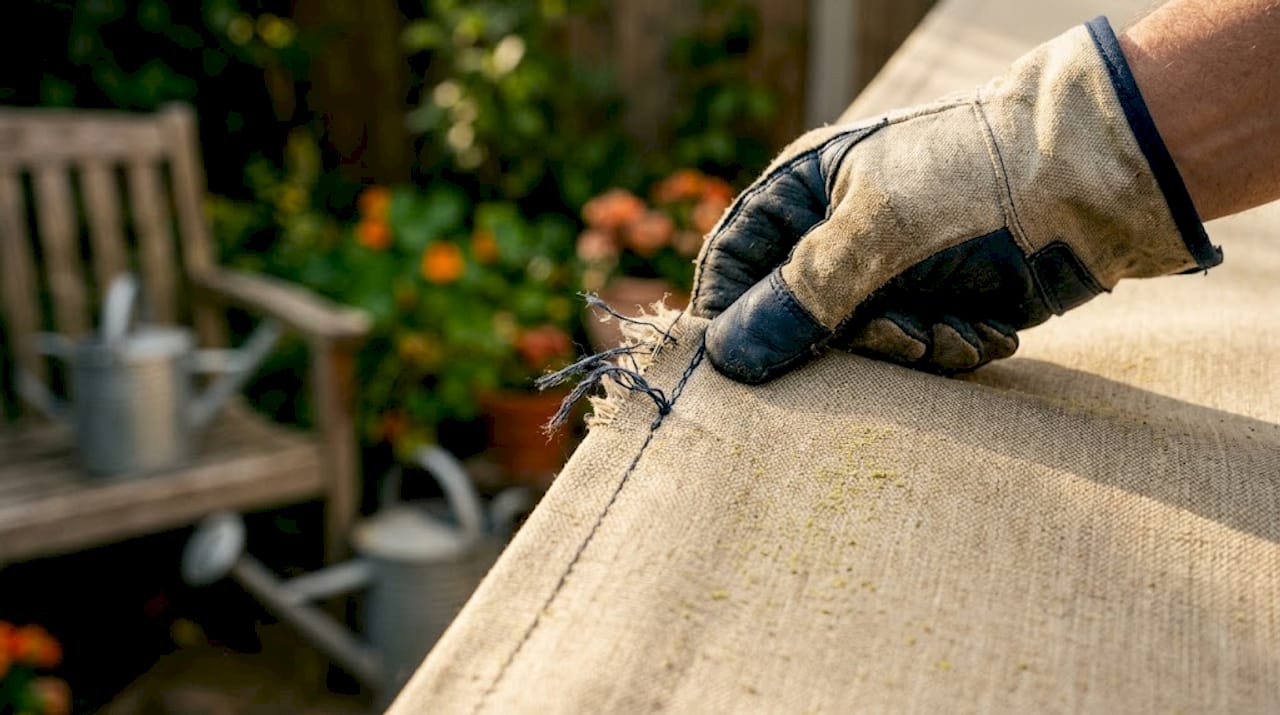
Regular maintenance matters more than most owners realise. Loose fixings, frayed fabric edges, and corroded pivot points all reduce the effective wind resistance of an awning that may have been perfectly specified when new. Proper maintenance increases wind resistance by keeping every component performing as designed. If an awning has suffered even minor wind damage in the past, awning repairs and maintenance should be addressed immediately, because small weaknesses compound rapidly under repeated wind stress.
It is also worth noting that wind damage insurance advice often highlights that insurers expect reasonable precautions to have been taken. An awning left extended in forecast gale conditions may not be covered by your policy.
How to choose wind-resistant awnings for UK properties
With these factors in mind, how can you confidently pick the right awning for your location?
Follow this structured approach before you commit to a purchase:
Assess your property’s wind exposure. Note which elevation you intend to use and whether it faces the prevailing westerly wind. Consider whether neighbouring buildings, fencing, or mature trees provide meaningful shelter or, conversely, funnel wind into a concentrated stream.
Research local wind conditions. Coastal Lincolnshire, the Pennine fringes of Yorkshire and Derbyshire, and open farmland across all four counties tend to experience higher sustained winds than valley bottoms or urban centres.
Choose the right awning type for your exposure. A full cassette awning houses the entire fabric and mechanism inside a protective box when retracted, reducing wear and offering better wind resistance when deployed. Open-arm designs are lighter and more affordable but suit sheltered positions only.
Check published wind resistance ratings. Ask your supplier for the rated Beaufort classification and the test conditions under which it was achieved. Not all ratings are comparable: a test in still air with minimal projection is very different from real-world conditions.
Factor in upgrades from the start. Wind sensors, motorised operation, and robust fixing kits are far easier and cheaper to specify during installation than to retrofit later.
When comparing awning types, the difference between cassette and semi-cassette designs is not just aesthetic. Different awning fabrics and mechanisms are genuinely better suited to exposed locations when correctly matched to your property. Before finalising any choice, it is worth reading through a full guide on how to choose outdoor awnings for patios and terraces.
Feature | Standard awning | Wind-resistant specification |
Frame material | Standard aluminium | Heavy-duty aluminium profile |
Fixings | Standard wall plugs | Structural anchors, engineer-specified |
Fabric | Standard polyester blend | Woven acrylic, reinforced edges |
Operation | Manual or basic motor | Motorised with integrated wind sensor |
Wind rating | Beaufort 3 | Beaufort 5 to 6 |
Pro Tip: Always consider how safety films help protect sliding glass doors nearby. Wind that damages your awning can also send debris toward glazed doors. A combined approach to wind protection across your outdoor space is always more effective than treating each element in isolation.
Caring for your awning: maximising wind resistance year-round
Once you have got the right wind-resistant awning in place, ongoing care is key to keeping it effective.
Follow this practical routine to maintain performance across every season:
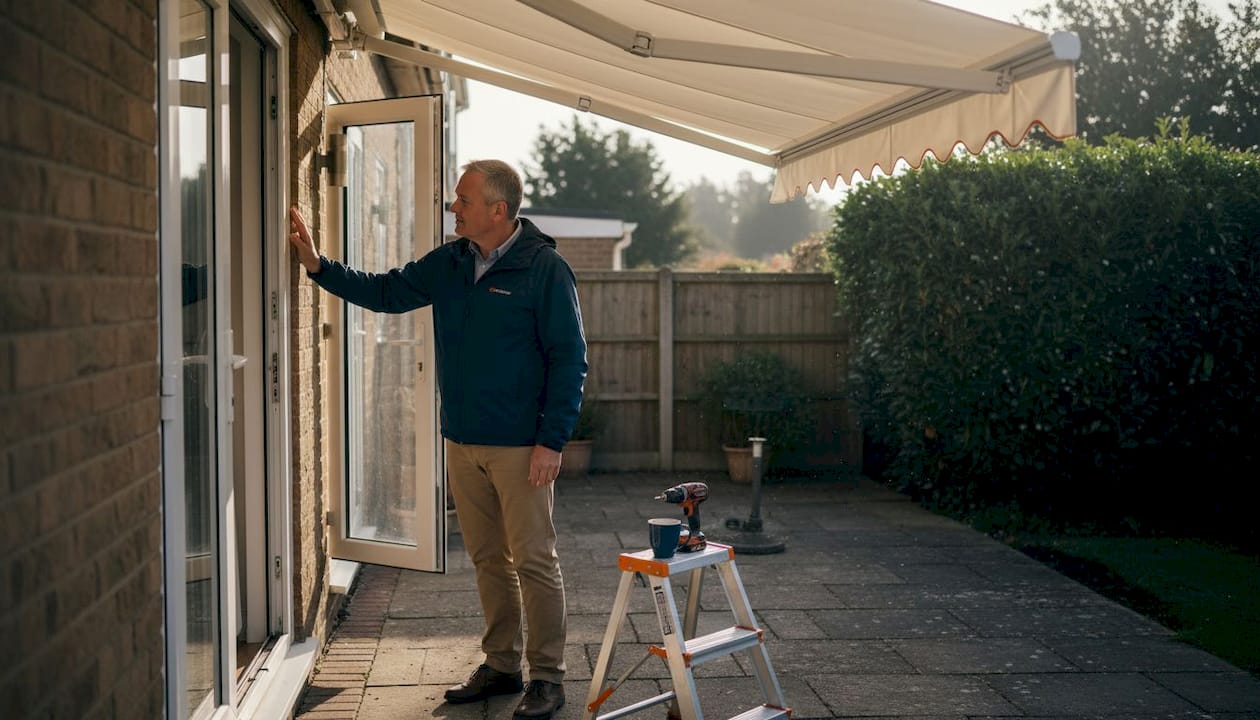
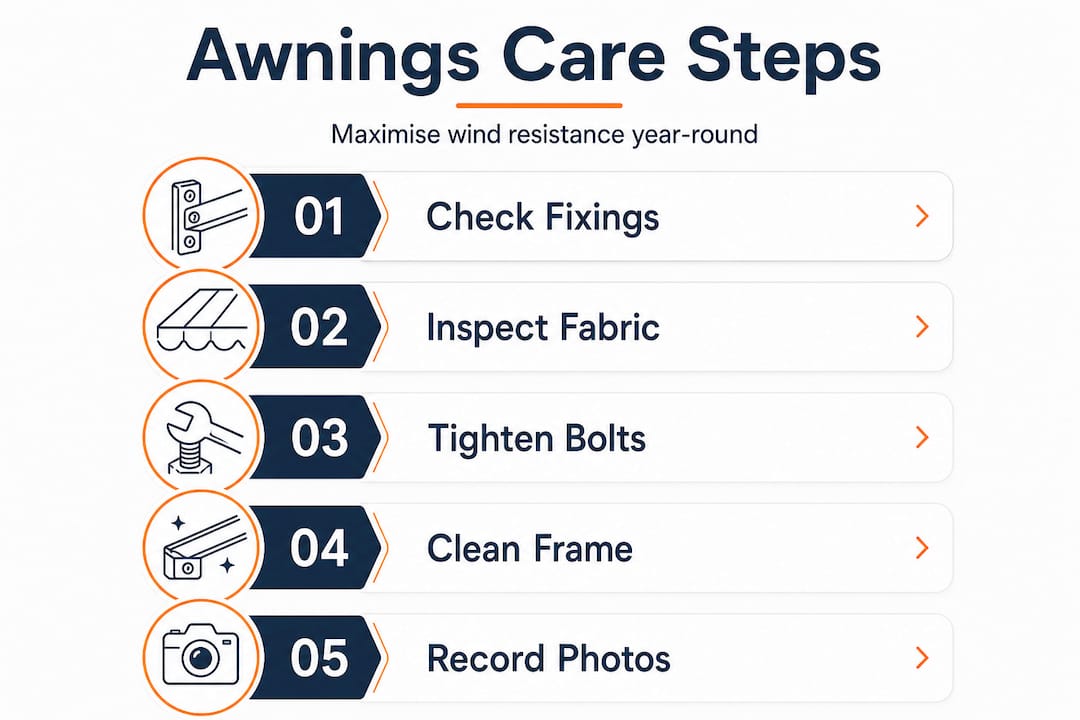
Inspect the frame and fixings at least twice a year. Spring and autumn are the natural points to check, before the summer season begins and before autumn gales arrive. Look for loose bolts, corrosion on metal parts, and any movement in the wall fixings under gentle pressure.
Clean the fabric regularly. Dirt, moss, and algae add weight, reduce water drainage, and accelerate fabric degradation. A gentle brush and a mild fabric cleaner are usually sufficient. Avoid pressure washing, which can damage the coating that gives the fabric its water resistance.
Retract the awning in high winds. This is the single most important rule, and it applies even to awnings with a high Beaufort rating. Wind resistance ratings describe limits, not targets. An awning extended in Beaufort 6 conditions will tolerate it but will be under significant stress. Repeated exposure at the rated limit shortens the working life of every component.
Test your wind sensor regularly. If your awning is motorised and fitted with a wind sensor, verify that it responds correctly at the start of each season. A sensor that fails to trigger costs far more than the inspection.
Address small damage immediately. A frayed fabric edge, a single loose fixing bolt, or a slightly bent arm is a minor repair today and a major failure tomorrow. Following a proper awning maintenance tips routine means catching problems before the next gust finds them.
“Proper maintenance extends wind resistance and product lifespan” and is the most cost-effective investment any awning owner can make.
For a structured approach, use a seasonal awnings maintenance checklist to ensure nothing is missed. If you own a retractable model, the guidance on how to maintain retractable awnings covers the specific mechanisms that need attention throughout the year.
Pro Tip: Take photographs of your awning fixings and frame joints at the start of each season. A visual record makes it far easier to spot subtle movement or corrosion at the next inspection, even if no single change is immediately obvious to the eye.
Our take on wind resistance: what most guides overlook
Having explored care strategies, let us step back and share some lessons learned first-hand across more than 15 years of installing and servicing awnings across Yorkshire, Derbyshire, Nottinghamshire, and Lincolnshire.
The official wind resistance rating on an awning is a useful starting point, but it rarely tells the whole story. Ratings are achieved under controlled test conditions that do not reflect the turbulent, unpredictable nature of real British wind. A gust that lasts three seconds and arrives at an angle the test rig never simulated is precisely what tends to catch awnings out.
What surprises many of our customers is that the most damaging events are rarely the forecasted storms. Storm warnings prompt people to retract their awnings. It is the unexpected squall on a warm August afternoon that causes the most damage. A sudden gust during a garden party, when the awning is extended and no one is watching the weather, is the scenario responsible for a large proportion of the call-outs we attend.
Microclimates are also widely underestimated. A property in a supposedly sheltered valley can experience ferocious downdrafts when wind spills over a ridge. A courtyard that looks protected on three sides can funnel and accelerate wind from a specific direction. We assess these conditions during every site survey because no amount of wind resistance rating compensates for a fundamentally exposed installation that was never anticipated in the product specification.
The uncomfortable truth is that consistent, simple checks and rapid repairs prevent the vast majority of wind-related failures. An awning that is inspected, cleaned, and retracted sensibly will outperform a higher-rated one that is ignored. Understanding the full benefits of outdoor awnings depends entirely on the awning remaining in good working order, which requires your active involvement as the owner.
Explore wind-resistant awnings with Infinity Awnings
Armed with the facts and local insight, here is how you can put wind resistance knowledge into action with support from trusted professionals.

At Infinity Awnings, we have been helping homeowners and businesses across Yorkshire, Derbyshire, Nottinghamshire, and Lincolnshire choose, install, and maintain awnings that genuinely stand up to local conditions. Our range includes full cassette retractable awnings, motorised systems with integrated wind sensors, and wind-resistant pergolas designed to handle exposed garden spaces with ease. Every product we recommend is matched to your specific property, orientation, and exposure level, not just picked from a catalogue. If you are ready to invest in outdoor shading that works through every season, the Infinity Awnings team is here to guide you from initial survey through to installation and beyond.
Frequently asked questions
How is wind resistance measured for awnings?
Wind resistance is typically measured as the maximum sustained wind speed in km/h that a product can withstand under test conditions. Many manufacturers also express this using the Beaufort scale, and wind sensors and resistance ratings together help determine whether a particular awning suits your location.
Can all awnings withstand high winds?
No, only awnings specifically designed and rated for wind resistance are suitable for exposed conditions. Proper selection is vital for any property where wind exposure is a realistic concern.
Does regular maintenance improve wind resistance?
Yes, regular inspection and prompt repairs keep fixings secure and fabrics in good condition. Maintenance extends wind resistance by ensuring every component performs as it was designed to, rather than degrading quietly over time.
Should I always retract my awning in windy weather?
Yes, retracting your awning during strong winds is the safest approach, even for models with high resistance ratings. Retracting protects awnings from cumulative stress that shortens working life even when no single event causes obvious damage.
Are wind sensors worth installing on awnings?
Yes, wind sensors are a genuinely valuable addition because they remove the need for manual judgement about when to retract. Wind sensors are a valuable safety upgrade that protects your awning automatically, even when you are not paying attention to the forecast.
Recommended
Comments